Learn why a small RF modulator connected to an antenna may seem to work at short range and why pros still prefer coax or IPTV.
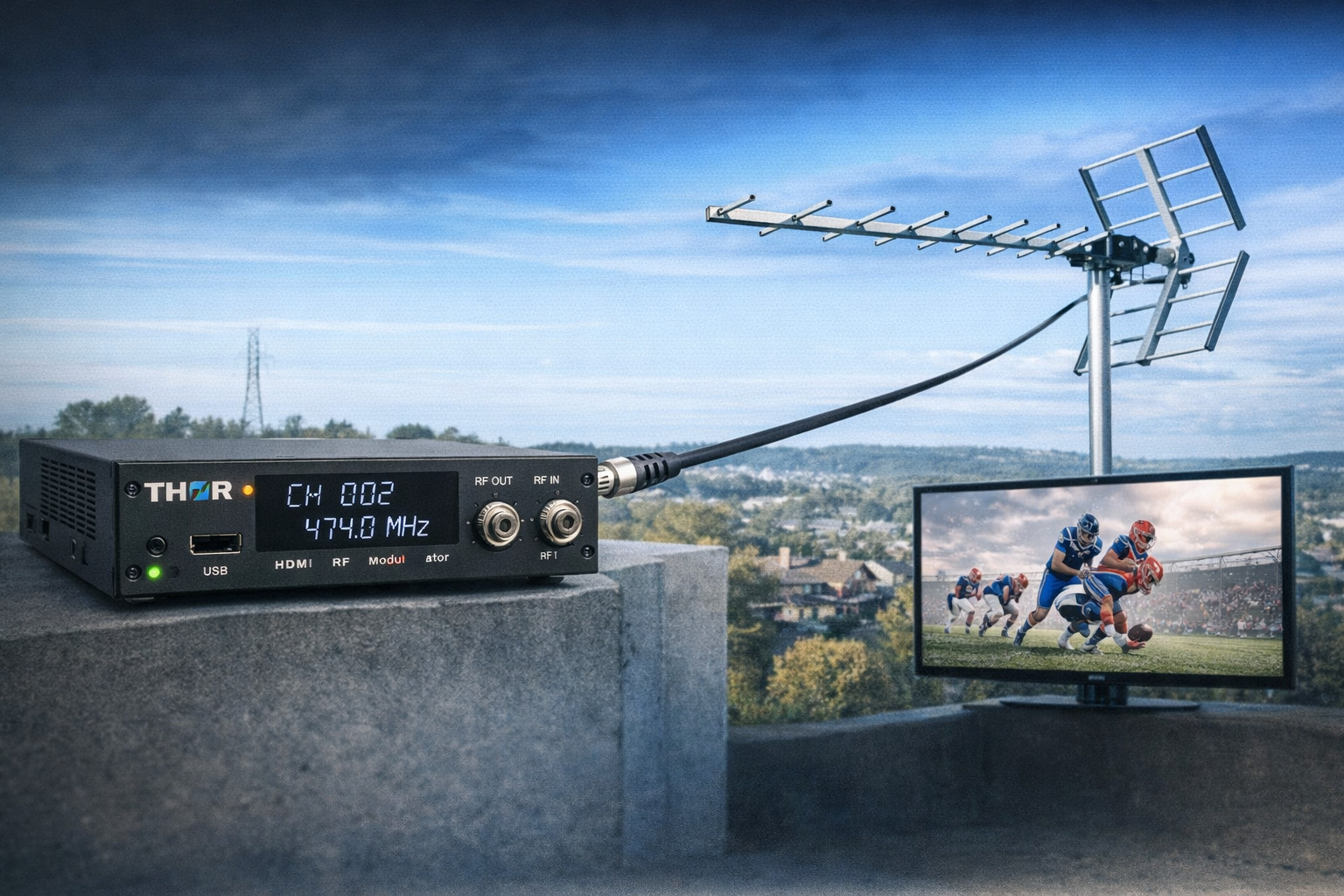
A Thor Broadcast technical curiosity article explaining why a small modulator + antenna may appear to work at short range, what actually controls signal reach, and why professional systems are usually designed around coax distribution or IPTV instead.
Table of Contents
A nearby TV may decode a tiny radiated signal because digital tuners are sensitive, digital reception has a sharp threshold, and local RF conditions may be quiet enough for the signal to be detected.
HDMI RF modulators are designed to create channelized RF outputs for coax systems, MATV/SMATV networks, commercial video distribution, hospitality systems, and digital signage.
In real-world installations, Thor modulators are most effective in controlled RF networks such as hotels, campuses, bars, hospitals, and private channel headends.
One of the most common curiosity questions in RF video distribution is this: if a compact HDMI RF modulator produces a real television channel, can that output be connected directly to an antenna? From a purely technical perspective, RF delivered to an antenna can radiate. The more useful engineering question, however, is why that setup may appear to work at short range, and why professional systems are usually designed differently.
Thor Broadcast offers several modulators that are perfect examples for understanding this topic: the Thor Petit HDMI RF Modulator, the Thunder Series, the HDCOAX Series, and the H-4ADHD-QAM-IPLL.
An RF modulator is a channel-creation device. It takes a source such as HDMI and converts it into a television channel format that a receiver can tune.
That is why products like Thor Petit, Thunder, and HDCOAX are so effective in controlled coax systems: they create stable, tunable channels for internal distribution.
Digital televisions are designed to decode weak signals. A nearby TV does not need much power at the tuner input to lock a channel, which is one reason very small radiated signals can sometimes be received locally.
| Signal level | Approximate meaning |
|---|---|
| +20 dBm | 100 mW RF power |
| 0 dBm | 1 mW RF power |
| -40 dBm | Very weak received signal |
| -80 dBm | Extremely small received signal |
RF power drops quickly with distance. A signal that works across a room may stop working at a much longer distance, even if nothing else in the system changed.
| Distance | Typical practical result |
|---|---|
| Same room | Highest chance of successful reception |
| Across a building | May work depending on walls, frequency, and reflections |
| Across open space | Highly dependent on antenna, height, and environment |
Digital television often looks perfect until the signal falls below the decoder threshold. That makes a tiny local signal seem stronger than it really is.
The channel locks and the image looks clean.
The channel freezes, pixelates, or disappears completely.
If the surrounding RF environment is relatively quiet on that channel, a small local signal may be easier to detect. If the channel is noisy or already occupied, reception becomes much more difficult.
Even simple antennas can radiate effectively enough for short-range reception. Small differences in antenna design can make a large difference in practical coverage.
People often ask, “How far will it go?” In reality, reach depends on the entire RF path, not just the modulator.
Two systems using the same modulator can behave very differently depending on losses, antenna type, antenna height, and surrounding conditions.
A higher antenna improves line-of-sight coverage and reduces blockage. Even modest increases in height can change practical reception significantly.
| Antenna height | Typical practical effect |
|---|---|
| 1–2 feet | Very localized signal region |
| 6–10 feet | Better indoor or short-range outdoor coverage |
| 20+ feet | Potentially much broader line-of-sight reach |
A classic TV antenna structure. Simple and efficient enough to be a useful educational reference.
Compact and convenient, though not always the most efficient depending on frequency and installation.
Directional and higher gain. Focuses energy in one direction, increasing reach in that path.
Broadband directional antenna commonly associated with TV reception and test setups.
Omnidirectional antennas spread energy broadly, while directional antennas concentrate energy into a narrower beam. That is one reason antenna choice matters so much.
Ideal for simple one-channel private TV applications from a single HDMI source.
Best for hospitality, sports bars, and larger coax-based private channel headends.
Strong choice for projects needing flexibility in channel count and modulation options.
Excellent for mixed RF and IPTV workflows in larger commercial and campus systems.
In most professional deployments, these products are used in closed coax systems, in-building RF networks, and IPTV-enabled architectures, where signal levels are predictable and scalable.
For curiosity, testing, and education, the best environment is usually a contained setup: a media source feeding a Thor modulator into coax, then into one or more televisions.
This kind of setup teaches channel scanning, RF distribution, signal loss, and modulation behavior much more cleanly than relying on open-air signal radiation.
A small modulator connected to an antenna may seem to work because several RF factors align at short range: receiver sensitivity, short distance, antenna efficiency, quiet channel conditions, and the digital cliff effect. That does not mean it behaves like a full professional broadcast station. It means the local RF conditions are good enough for a nearby receiver to decode the signal.
For real installations, Thor Broadcast modulators are best used where they truly excel: private RF channel generation, hospitality headends, in-building coax systems, and IPTV-capable distribution networks.


 EN
EN