Coax to HDMI requires an active tuner/decoder. Learn standards (ATSC/Clear QAM), RF margins, and Thor Broadcast RF-to-HDMI options.
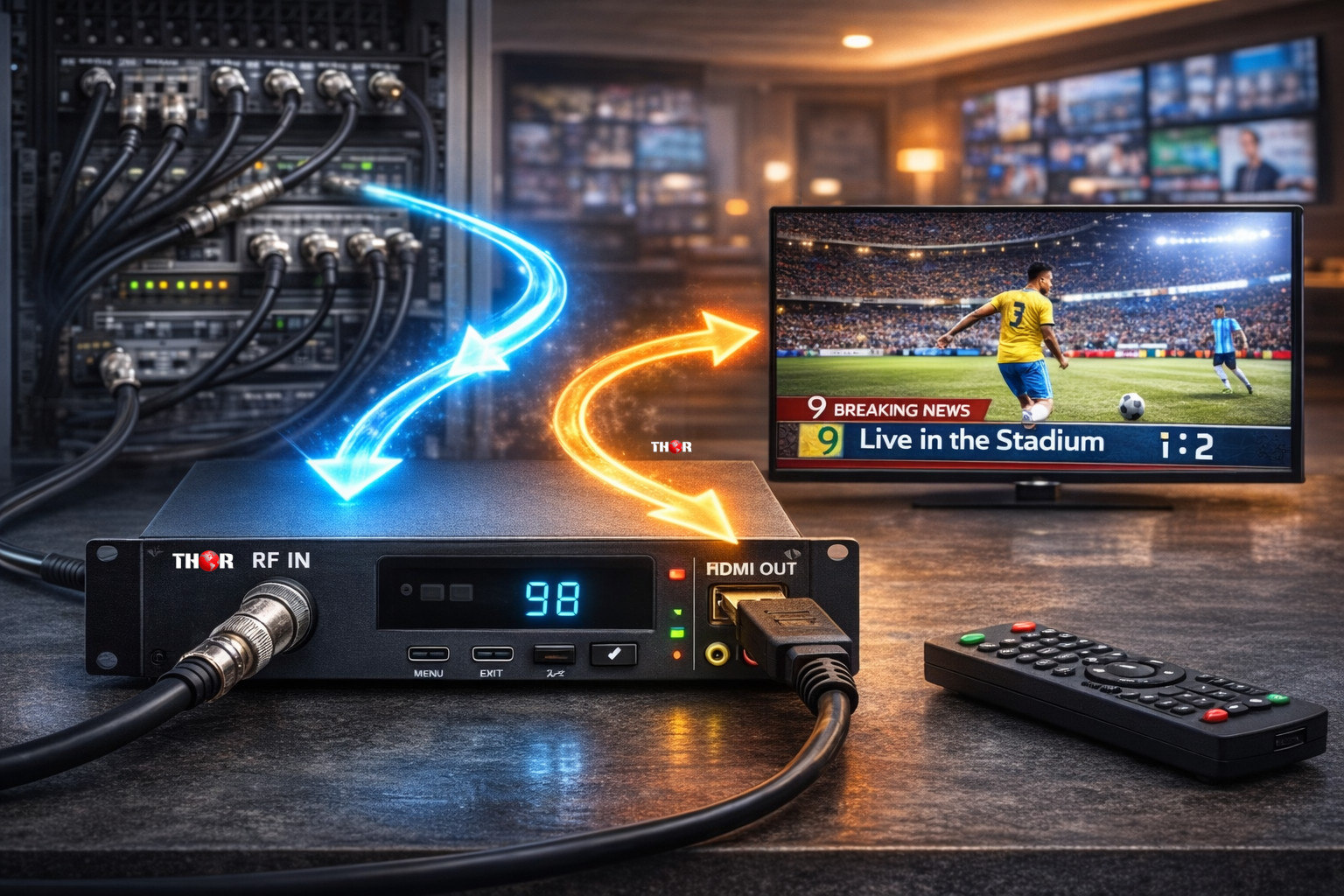
Table of Contents
“Coax input to HDMI output” is not a cable-adapter problem. It is a signal-conversion problem that requires active electronics to tune and demodulate an RF channel carried on a coaxial cable, then decode the recovered audio/video stream and output it as HDMI. A passive coax-to-HDMI adapter cannot work because coax carries radio-frequency (RF) energy (analog or digitally modulated carriers), while HDMI carries baseband digital video/audio with very different electrical signaling, timing, and protocol behavior. Without a tuner/demodulator and decoder, there is no way to extract usable pixels and audio samples from an RF carrier.
In professional AV distribution, this conversion is typically handled by a powered set-top box (STB) or dedicated RF-to-HDMI converter that supports the modulation standard present on the coax. Thor Broadcast offers a purpose-built solution for this task: the QAM CATV RF and ATSC RF to HDMI Decoder STB, designed to take a coax RF input and output HDMI (up to 1080p60) while also providing additional legacy outputs for compatibility and closed captions or separate audio outputs.
The correct converter depends on what type of signal is being transported over coax. Historically, coax carried analog TV channels (NTSC/PAL/SECAM) where each program occupied its own RF channel as an analog modulation. Many modern systems carry digital TV, where each RF channel carries a digitally modulated payload (often an MPEG transport stream) that contains one or more programs. The coax connector and cable may look identical in both cases, but the conversion requirements are completely different. However digital RF can also take up an entire RF step or frequency, in the case of North American ATSC and QAM signals, this is a 6mhhz frequency that utilizes the middle of the frequency step; this translates to channel 2 being a frequency step of 54-60mhz where the tunable frequency is 57mhz, and channel 3 would be 63mhz, which notates the 6mhz step.
If your coax feed originates from off-air broadcast reception, it is typically a standardized over-the-air digital system (for example ATSC in many North American deployments). If it originates from a cable system or an in-building headend, it may be QAM-based digital cable modulation (often called “Clear QAM” when unencrypted). In some facilities, coax may carry a mix: internal channels generated by a local modulator plus external off-air channels combined onto the same distribution plant.
The key technical takeaway is that “coax” is just the physical medium, commonly RG6 or RG11 are just cable mediums. What matters is the modulation standard on that coax and whether the content is encrypted. For coax-to-HDMI conversion inside a building (hotel, hospital, campus, enterprise), the most common requirement is decoding unencrypted channels from an internal QAM headend or from ATSC off-air reception.
A television tuner does multiple jobs that people often underestimate. It selects a frequency (tuning), locks to the modulation (carrier recovery and symbol timing), corrects errors (FEC), reconstructs the payload transport stream, parses service signaling, and finally decodes the compressed audio/video into baseband frames and samples. HDMI output is essentially the final step: presenting baseband digital video/audio in a standardized interface that most modern devices can conveniently connect to.
A passive adapter cannot perform tuning, carrier recovery, or error correction. It cannot parse MPEG-TS tables, select a program, decode H.264/MPEG-2 video, decode audio, or output synchronized HDMI. Even if you “wired” coax into HDMI pins (which is electrically wrong), you would still have no method to interpret the RF signal and generate valid HDMI timing. This is why any real coax-to-HDMI solution is a powered device with a tuner/demodulator/decoder chain inside.
In professional coax distribution, the most practical endpoint device is a tuner/decoder STB that accepts RF over coax and outputs HDMI to a monitor or TV that lacks an RF tuner. This is common because many modern commercial displays have HDMI inputs only, and even when a TV has a tuner, the facility may prefer a consistent interface and centralized control model at the display edge.
Thor Broadcast’s approach is embodied in the QAM CATV RF and ATSC RF to HDMI Decoder STB. Technically, it demodulates Clear QAM cable channels or ATSC off-air channels from the coax input, then decodes the selected program and outputs HDMI video/audio. This is the correct engineering pattern for “coax input to HDMI output”: a powered demodulator + decoder (and usually a remote control interface) at the endpoint.
Thor also documents the system-level use case-combining an HDMI-to-RF modulator at the headend with an RF-to-HDMI converter at the display edge-so that an HDMI source can be distributed over coax and then recovered as HDMI at displays that do not have tuners.
Selecting a coax-to-HDMI converter is primarily a question of which RF standards you must demodulate. ATSC (8-VSB) is typical for off-air reception in ATSC regions. Clear QAM is common for in-building “cable style” distribution where modulators generate QAM channels or where a cable provider delivers unencrypted channels. “Clear” is the important word: encrypted cable channels cannot be decoded without the appropriate conditional access and authorization ecosystem, and a generic decoder will not recover the content. So if you're paying for a service that requires a cable box that you pay a monthly fee for, using a clear QAM decoder will not work because the cable companies use encryption that necessitates their STB to decode, like a key to a lock.
Before deploying endpoint converter boxes, confirm that the channels on the coax are unencrypted and confirm their modulation type and frequency plan. In practical facility deployments, many integrators intentionally design the headend around Clear QAM or ATSC precisely because it allows direct tuning on consumer TVs and/or decoding via simple RF-to-HDMI converter STBs without subscription authorization complexity.
When you use a converter like Thor’s QAM/ATSC RF-to-HDMI STB, the most important field test is not just “does it lock,” but “does it scan, store, and reliably reacquire channels.” Channel persistence depends on stable service signaling, stable RF levels, and avoiding frequent changes in program IDs or virtual channel mappings in the headend.
Coax-to-HDMI conversion at the endpoint presumes there is something meaningful on the coax to decode. In many modern buildings, the coax signal is generated internally: an HDMI source (signage player, set-top box, camera feed, or internal channel) is converted into RF channels by an HDMI-to-RF encoder-modulator, then distributed throughout the building. This architecture is attractive because coax plants already exist in many facilities, and RF channels can feed many TVs without running new HDMI extenders to every room.
Thor Broadcast’s HDMI-to-RF modulators are designed for that headend role. A compact option for creating tunable channels from an HDMI source is the Petit HDMI RF Modulator, which is often used when you want to inject one HDMI program onto coax as one or more digital channels. For multi-program headends, chassis solutions such as 1-4 HDMI to QAM Modulators and IPTV Streaming Encoders are built around the idea that the same encoded programs can be distributed as RF channels and (often) as IPTV streams in parallel.
This headend context matters for coax-to-HDMI conversion because endpoint stability is heavily influenced by headend discipline. If the headend changes modulation parameters, service IDs, or transport characteristics frequently, endpoint STBs and TVs may require rescans or may behave inconsistently across the facility.
Many coax-to-HDMI problems are not caused by the converter box. They are caused by RF distribution issues. Digital RF reception requires adequate signal quality at the tuner input, often discussed in terms of MER and BER margins. Excessive attenuation from long cable runs, too many splits, poor connectors, and impedance mismatches can degrade RF quality enough that tuners intermittently lose lock. Over-amplification can also break systems by driving tuners or amplifiers into distortion, creating intermodulation products that corrupt multiple channels simultaneously.
If you plan to deploy many RF-to-HDMI converters across a building, treat the coax plant like a transmission system. Define output levels at the headend, calculate losses through splitters and taps to the worst outlet, and verify at representative endpoints. In a controlled in-building system, splitting and combining are routine operations, and Thor offers distribution accessories such as Coax Multiplexers / Splitters / Combiners to support structured coax distribution.
When troubleshooting, a useful diagnostic is to move the converter box closer to the headend (or to a known-good outlet). If reception becomes stable, you likely have a distribution-loss, connector, or reflection issue downstream. If reception remains unstable everywhere, then you may have a headend or RF output configuration problem, or the channel may not be truly Clear QAM/ATSC as assumed.
A converter box is not just a decoder; it is also the user interface for choosing a program. That means you must plan how channels will be selected, how the remote control will be managed, and how the system behaves after power cycles. In hospitality and institutional deployments, it is common to lock down channel access, standardize the channel lineup, and minimize the need for staff to perform rescans. The headend should be configured so that channels appear predictably and remain stable over time.
Thor’s RF-to-HDMI converter STB class is designed for practical deployment: it scans channels, stores them, and outputs HDMI for modern displays. Thor also describes use cases where many TVs or monitors do not have RF tuners, making the RF-to-HDMI converter a direct substitute for a built-in tuner. In those scenarios, the converter becomes the “tuner front end” for the display, while the coax network remains the distribution backbone.
From an engineering standpoint, the most important operational property is deterministic recovery. You should test what happens when the STB loses power, what happens when the coax feed is temporarily disconnected, and whether the box reliably returns to a known channel on reboot if that is required for signage or default programming. These are deployment questions, not lab questions, and they determine real-world support load.
Coax-to-HDMI conversion does not “increase quality.” The quality is largely determined upstream by how the channel is encoded at the headend or by the broadcast/cable source itself. The converter’s job is to faithfully recover and decode the program. However, conversion quality can be harmed by poor RF conditions (leading to errors) and by endpoint decoding limitations if the codec profile is unusual. This is why stable headend encoding choices and solid RF margins matter as much as the converter model.
Latency is also a system property. If the coax channel is generated by an HDMI-to-RF encoder-modulator, there is encoding delay in the headend plus decoding delay in the STB and display. For many enterprise channels and signage applications this is acceptable. If you are distributing live events where delay is noticeable, you should measure end-to-end delay with a clock/timestamp test signal and tune headend settings where possible. The coax-to-HDMI converter itself is not “the” latency; it is one part of the chain.
The most common architecture for “coax input to HDMI output” in modern facilities looks like this: at the headend, one or more HDMI sources are converted into digital RF channels with an HDMI-to-RF modulator; those RF channels are distributed over coax using standard splitting/combining practices; at the display edge, any screen that lacks an RF tuner uses an RF-to-HDMI decoder STB to tune the coax channel and output HDMI.
In Thor Broadcast terms, a compact headend could use the Petit HDMI RF Modulator to create the RF channels, with the coax plant built using accessories such as Coax Multiplexers / Splitters / Combiners, and endpoint conversion handled by the QAM/ATSC RF to HDMI Decoder STB. For multi-program deployments, the headend can be scaled with integrated chassis options such as 1-4 HDMI to QAM Modulators and IPTV Streaming Encoders, while keeping the endpoint conversion model consistent.
The engineering advantage of this approach is that it reuses existing coax infrastructure while still supporting modern HDMI-only displays. The operational advantage is that channel delivery behaves like a TV system: one headend, many endpoints, predictable tuning, and centralized control over what content appears on which channel.
Converting coax input to HDMI output requires a powered device that can tune, demodulate, and decode the RF signal on the coax. Passive adapters will not work because RF carriers must be actively recovered and converted into baseband video/audio before HDMI can be generated. In facility environments where displays lack RF tuners, a dedicated RF-to-HDMI set-top box is the practical solution class, and long-term stability depends on aligning RF standards (ATSC vs Clear QAM), maintaining disciplined headend signaling, and engineering the coax distribution plant for adequate RF margins at every outlet.
Thor Broadcast supports this end-to-end architecture with RF-to-HDMI decoding via the QAM/ATSC RF to HDMI Decoder STB, headend channel generation with HDMI-to-RF modulators such as the Petit HDMI RF Modulator, and coax distribution building blocks like coax splitters/combiners. If you treat the project as a complete RF system-rather than as a cable conversion-you get a scalable, serviceable, HDMI-ready coax TV network.
FCC: DTV interference rejection thresholds (PDF)
FCC: Digital Television engineering resources
University of Maryland: QAM fundamentals (PDF)
NTIA: DTV/ATSC transmission-related report (PDF)

 EN
EN