Discover how GPS over fiber and L-band over fiber technology enable long-distance, low-loss signal distribution for satellite, broadcast, and mission-critical applications.
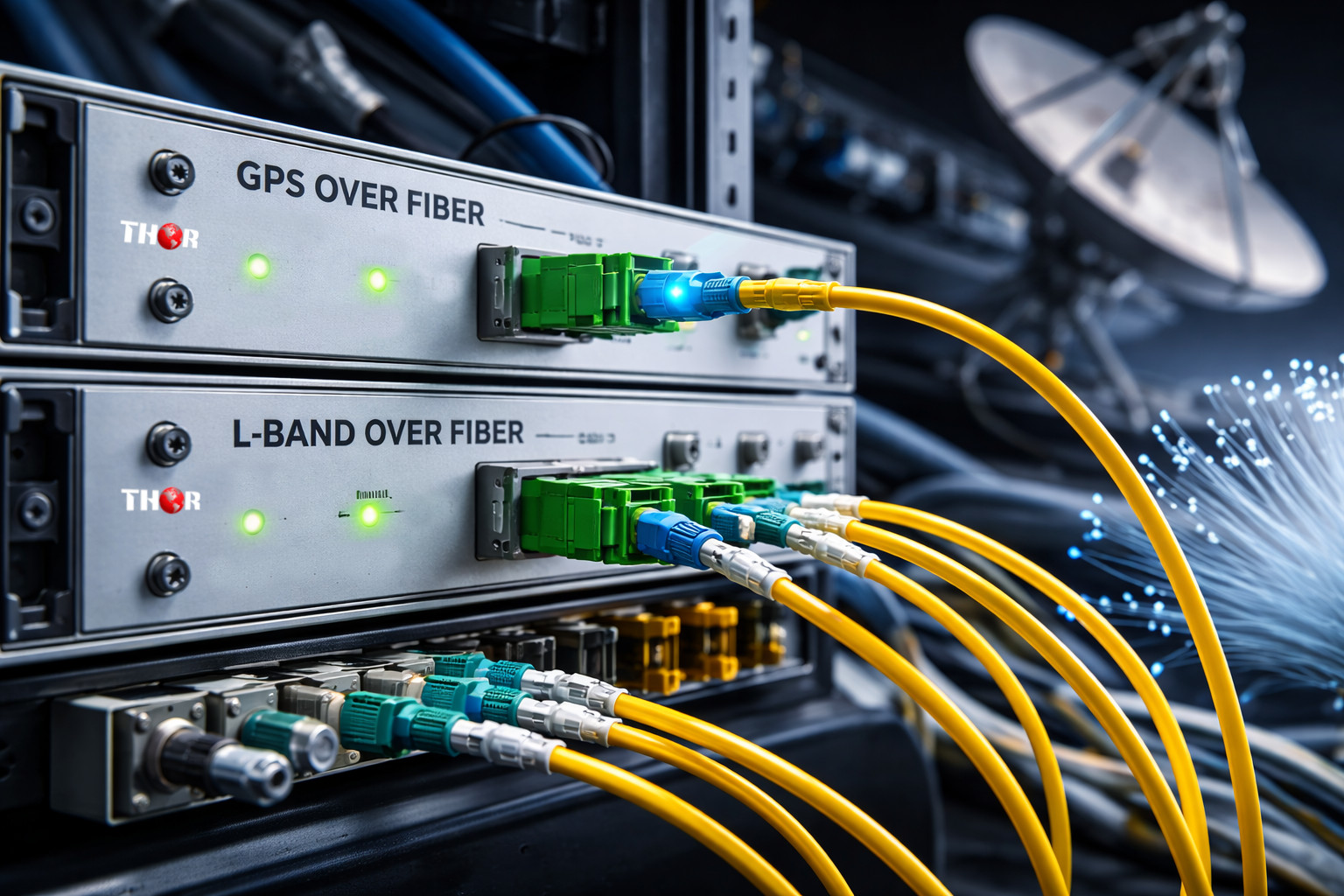
Table of Contents
In professional broadcast, satellite communication and government environments, signal integrity is everything. When distributing GPS timing signals or L-band satellite signals over long distances, traditional coaxial cabling creates major challenges such as signal loss, interference, and limited range.
That’s where GPS over fiber and L-band over fiber technology become essential.
At Thor Broadcast, we design professional RF over fiber solutions that ensure stable, low-loss transmission for mission-critical systems worldwide.
Learn more about our broadcast and RF solutions:
Thor Broadcast
GPS over fiber converts GPS radio frequency signals into optical signals and transmits them over single-mode fiber optic cable instead of traditional coax.
GPS signals are extremely sensitive and operate at low power levels. When transmitted over long coaxial runs, they can experience:
Significant signal attenuation
Electromagnetic interference
Timing inaccuracies
Limited cable distance
Single-mode fiber optic transmission eliminates these problems.
Long-distance transmission (kilometers instead of meters)
Zero electromagnetic interference
Improved timing accuracy
Lightweight and flexible single-mode fiber
Reliable synchronization across facilities
GPS over fiber is commonly used in:
Broadcast stations
Data centers
Military installations
Telecom networks
Financial trading systems (where precise timing is critical)
Thor Broadcast solutions are engineered to preserve signal integrity while extending GPS signals across large infrastructures.
L-band over fiber converts L-band RF signals (typically 950 MHz – 2150 MHz) into optical signals for fiber transmission.
L-band is commonly used in:
Satellite TV distribution
VSAT systems
Satellite earth stations
Teleport facilities
Cable headend systems
When transmitting L-band signals over coaxial cable, distance limitations and signal degradation become major challenges.
Fiber optic transmission eliminates signal loss issues while maintaining high signal quality.
Coax cables typically support limited runs before amplification is required. Fiber supports much longer distances without signal degradation.
Fiber optic cables do not suffer from RF attenuation like coax.
Fiber is immune to electromagnetic interference (EMI), making it ideal for high-RF environments.
Fiber cabling is thinner and easier to manage than heavy coaxial cables.
Fiber systems are easier to expand and integrate into large satellite distribution systems.
While both use fiber optic transmission, they serve different signal types:
GPS Over Fiber |
L-Band Over Fiber |
Used for GPS timing signals |
Used for satellite RF signals |
Focused on synchronization |
Focused on satellite distribution |
Critical for precise timing |
Critical for broadcast and teleport systems |
Many advanced facilities deploy both technologies within the same infrastructure.
Maintain accurate GPS timing while distributing satellite feeds internally.
Transport L-band signals from antennas to equipment rooms over long distances.
Secure, interference-free RF distribution for mission-critical systems.
Precise time synchronization using GPS over fiber.
Reliable GPS timing for high-frequency trading operations.
Choosing the right RF over fiber provider is crucial. Thor Broadcast offers:
Professional-grade RF engineering
High-reliability hardware
Broadcast and telecom-grade components
Global deployment experience
Technical consultation and system design support
Our solutions are designed for 24/7 operation in demanding environments.
If you’re planning a satellite, GPS, or RF infrastructure upgrade, our team can help you design the right fiber-based architecture.
Contact us today: Contact Thor Broadcast
GPS over fiber can transmit signals several kilometers without degradation, depending on system design.
No. Fiber preserves signal integrity and reduces loss compared to long coax runs.
For long distances and interference-prone environments, fiber is significantly more reliable.
Yes. It reduces signal degradation, helping maintain accurate synchronization.
L-band typically ranges from 950 MHz to 2150 MHz in satellite applications.
Fiber systems require proper design, but they simplify large-scale infrastructure long-term.
As satellite systems and precision timing networks continue to expand, GPS over fiber and L-band over fiber solutions provide the reliability, scalability, and performance modern facilities demand.
Fiber-based RF transmission eliminates signal loss, increases distance capability, and improves overall system efficiency - making it the preferred choice for professional broadcast and satellite environments.
To discuss your project requirements or get expert guidance: Contact our team


 EN
EN