Distribute 24-60 TV channels over coax by centralizing set-top boxes and using HDMI to RF modulators.
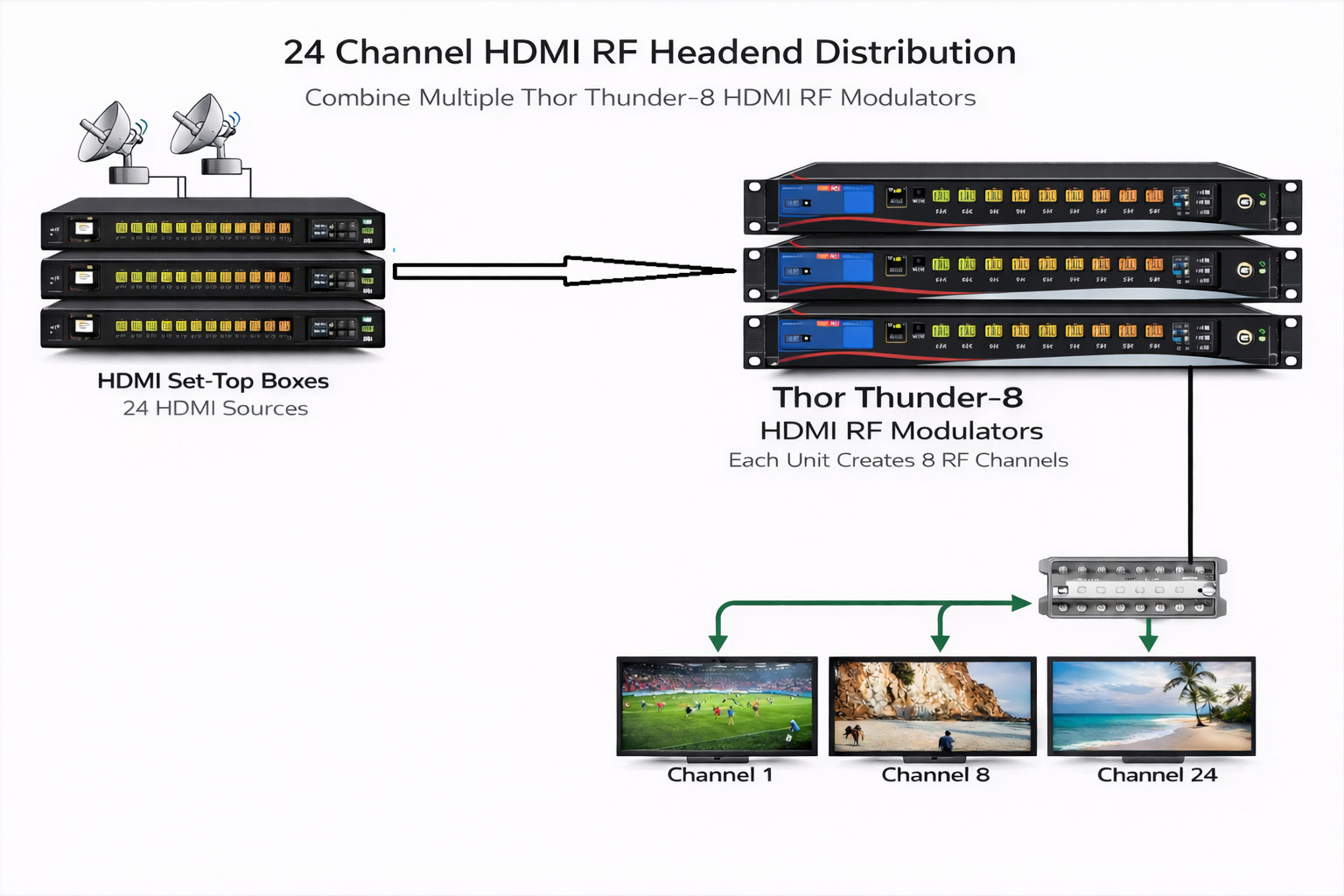
Table of Contents
Many hotels, healthcare facilities, campuses, and residential complexes need a reliable way to distribute dozens of video channels across an existing coax cable network. In many legacy systems, every room has its own set-top box connected directly to a television, which increases maintenance time, hardware costs, and service complexity.
A more efficient and scalable solution is to centralize all set-top boxes in an equipment rack and convert the HDMI outputs into digital RF cable TV channels using professional HDMI RF modulators.
This application example shows how Thor Broadcast Thunder Series HDMI RF Modulators can be used to deliver 24 to 60 HD channels over an existing coax infrastructure using a simple, scalable RF headend architecture.
Many integrators compare RF modulation vs IPTV when planning a multi-channel video distribution system. While IPTV is useful in some environments, RF modulation is often the better choice when a facility already has coax cabling and needs reliable, low-latency broadcast distribution.
RF distribution is often the best option when:
A systems integrator contacted Thor Broadcast looking for a cost-effective way to distribute television channels in two types of facilities.
In both cases, the goal was to remove set-top boxes from individual rooms and place them in a centralized IT or equipment closet. From there, the HDMI outputs from the set-top boxes could be modulated into RF channels and distributed throughout the building over the existing coax network.
The most cost-effective architecture uses multiple 8-channel HDMI to RF modulators, such as the Thunder-8 HDMI RF Modulator.
Each unit accepts 8 HDMI inputs and converts each input into its own independent RF cable TV channel. Multiple units can then be combined together to create a larger RF headend system.
For a facility requiring 24 channels, the system can be built using 3 Thunder-8 modulators.
Total delivered channels: 24
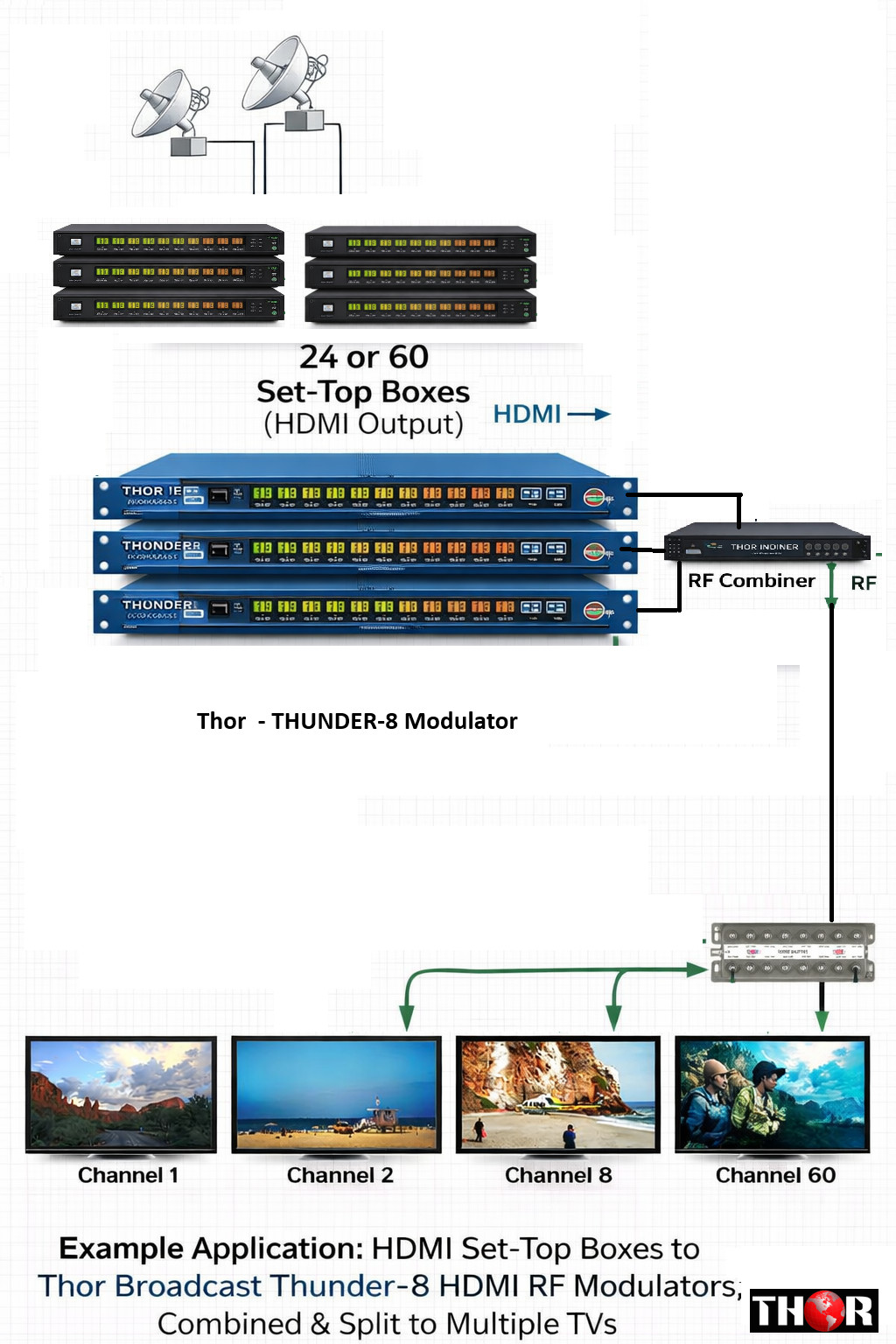
For a larger facility requiring around 60 channels, the system can be expanded using 8 Thunder-8 modulators.
Eight 8-channel modulators provide a total of 64 RF channels, which supports the required 60 channels while leaving room for future expansion.
Instead of placing a set-top box behind every TV, all set-top boxes are installed in one equipment rack. This is the preferred architecture in many commercial video distribution systems because it simplifies service, improves physical security, and makes channel management easier.
The HDMI outputs from the centralized set-top boxes connect to the RF modulators. The modulated RF channels are then combined and distributed to televisions over the building’s existing coax wiring.
This type of HDMI to RF modulation system is commonly used in:
A matching application diagram for this article could show the following signal flow:
Recommended caption: Example RF headend architecture using Thor Broadcast HDMI RF modulators to distribute 24 to 60 television channels over an existing coax cable network.
An HDMI RF modulator converts an HDMI video source into a digital RF cable TV channel that can be distributed over coaxial cable.
A properly designed RF distribution network can deliver the same RF channel to many televisions throughout a building or campus.
RF is often the better choice when a facility already has coax cable installed and requires reliable, low-latency video distribution to many displays.
Yes. Thor Broadcast can pre-configure RF channel assignments before shipment to help simplify installation and prevent channel overlap.
Yes. Additional channels can be added by installing more modulators and expanding the RF combining system.
Explore more HDMI RF Modulators and professional RF headend solutions from Thor Broadcast.


 EN
EN