Thor Broadcast Logo
Iniciar sesión
Carro (0)
  • en EN
  • Productos
    • Moduladores CATV
      • Moduladores HDMI a RF
      • Convertidores HD-SDI
      • Moduladores edge de IP a CATV
    • Codificadores DVB
      • Codificadores de video IPTV
      • Codificadores HDMI RTSP RTMP RTSP
      • Transcodificadores, convertidores MPEG, gateways IP/ASI
    • Decodificadores (IRD y STB)
      • Entrada RF - salida de video/audio
      • Decodificadores de transmisión IP
      • Decodificadores STB RF CATV e IPTV OTT
    • Moduladores satelitales
      • Moduladores satelitales DVB-S/S2
    • Transporte por fibra óptica
      • Extensores SDI por fibra óptica, extensores de audio digital
      • SDI SD/HD/3G con CWDM
      • CATV RF para televisión por cable 45-900 MHz
      • RF satelital banda L 45-3000 MHz
      • Datos y Ethernet por fibra
    • Conmutadores HDMI y SDI, extensores LAN y transporte inalámbrico de video
      • Conmutadores de video HD y convertidores de formato de señal para profesionales AV
      • Equipos inalámbricos de video y datos HD/SD
      • Extensores de video y audio por red Ethernet LAN/IP
    • Inventario con descuento
      • Equipos de radiodifusión satelital y CATV en venta
      • Equipos de radiodifusión usados en laboratorio en venta
      • Equipos de generación anterior
    • Monitores SDI
    • Almacén
  • About
  • Cartera De Clientes
  • Apoyo
      • Support Center Apoyo
      • User Manuals Manuales
        de Usuario
      • Request an RMA Solicitar una
        RMA
  • ⬇Download
    • Manuals
    • Datasheets
    • Quick Guides
  • Case Studies
    • THOR Gym
    • THOR Stadium
    • THOR Hotel
    • THOR University
  • Videos
  • Contacto
  • Conviértete en un revendedor

How to Distribute 8 HDMI Sources to 48 TVs Over Coax

Learn how to distribute eight HDMI sources to 48 TVs over coax using the Thor Broadcast Thunder-8 HDMI-to-RF modulator, an RF amplifier and a splitter network, with practical guidance on signal levels, cable losses and TV tuner compatibility.
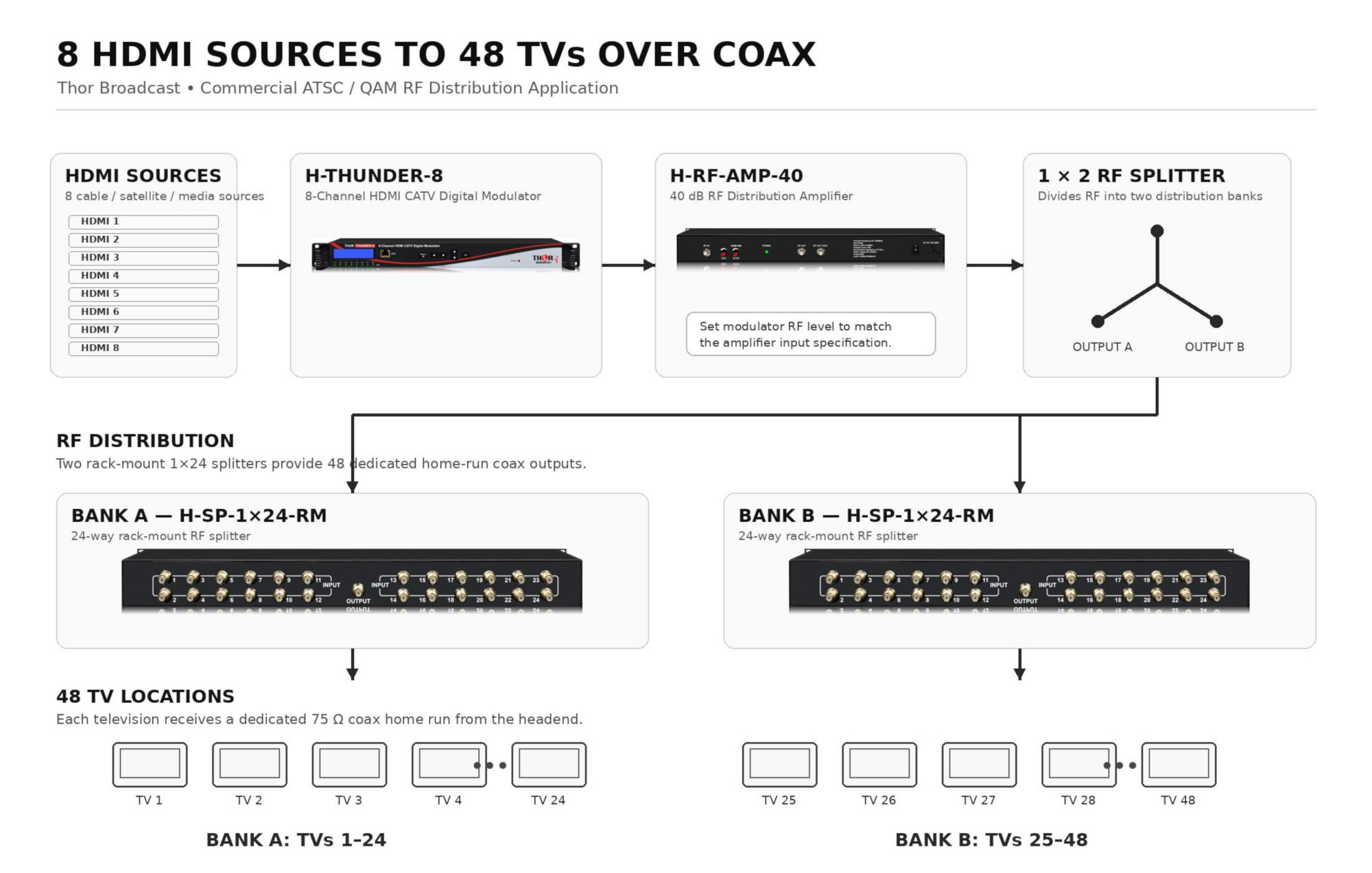
Thor 48TV Application Drawing V2

A commercial television distribution system does not require an HDMI cable, IP decoder or set-top box at every television. By using an HDMI to RF modulator, multiple HDMI video sources can be converted into digital ATSC or QAM television channels and distributed throughout a building using standard 75-ohm coaxial cable.

This application example explains how the Thor Broadcast HDMI RF modulation platform can distribute eight HDMI sources to approximately 48 televisions in a two-story commercial facility.

Table of Contents

  • HDMI to RF Distribution System Requirements
  • Recommended 48-TV HDMI Over Coax System
  • Thunder-8 8-Channel HDMI to RF Modulator
  • How to Split an RF Signal to 48 TVs
  • Do You Need an RF Amplifier for 48 TVs?
  • Important: Do Not Overdrive the RF Amplifier
  • Home-Run Coax vs. RF Taps and Cascaded Splitters
  • Using Cable or Satellite Boxes as HDMI Sources
  • How Do TVs Receive the HDMI Sources?
  • HDMI Over Coax Without a Decoder at Every TV
  • Where Are HDMI to RF Distribution Systems Used?
  • Typical Equipment for a 48-TV RF Distribution System
  • Frequently Asked Questions About HDMI to RF Distribution
  • How can I distribute HDMI to multiple TVs over coax?
  • How can I distribute 8 HDMI sources to 48 TVs?
  • Do I need a receiver at every TV?
  • Can HDMI be distributed 300 feet over coax?
  • Do I need an RF amplifier when distributing to 48 TVs?
  • Can I use existing coax cable?
  • Can cable TV boxes be connected to an HDMI RF modulator?
  • What is the difference between HDMI over coax and HDMI over IP?
  • Need Help Designing a Commercial TV Distribution System?

HDMI to RF Distribution System Requirements

The example installation requires:

  • 8 HDMI video sources
  • 48 television locations
  • Two-floor commercial facility
  • Individual home-run coaxial cables
  • Coax runs up to approximately 300 feet
  • Full-HD digital video distribution
  • Centralized headend equipment
  • No dedicated decoder required at each compatible TV

Possible HDMI sources include cable receivers, satellite receivers, digital signage players, media players, computers and other compatible HDMI devices.

Recommended 48-TV HDMI Over Coax System

For this installation, the recommended RF distribution topology is:

8 HDMI Sources → Thunder-8 HDMI RF Modulator → RF Distribution Amplifier → 1×2 RF Splitter → Two 1×24 RF Splitters → 48 Coax Runs → 48 TVs

This architecture creates a centralized television headend while allowing all 48 TVs to receive the same group of digital television channels.

Thunder-8 8-Channel HDMI to RF Modulator

The Thor Broadcast H-THUNDER-8 HDMI RF Modulator accepts up to eight HDMI video sources and converts them into digital television channels for distribution over coaxial cable.

Instead of installing separate HDMI receivers behind dozens of televisions, the modulated RF channels are delivered directly to compatible TV tuners.

This makes an HDMI-to-RF system particularly useful for commercial installations where the same group of video sources needs to be available on many displays.

How to Split an RF Signal to 48 TVs

In this application, every television has an individual home-run coaxial cable returning to the main equipment room.

Because the largest distribution splitter required for this design provides 24 outputs, the RF signal can first be divided using a 1×2 splitter. Each output then feeds a separate 1×24 rack-mount splitter.

1 RF Input → 1×2 Splitter → 2 × 1×24 Splitters → 48 RF Outputs

Each of the 48 outputs connects to an individual television through its dedicated coaxial cable.

Do You Need an RF Amplifier for 48 TVs?

Large passive RF distribution networks introduce signal loss. Every splitter, connector and length of coaxial cable reduces the RF level.

For a system feeding approximately 48 televisions, particularly where cable runs approach 300 feet, an RF distribution amplifier can provide additional RF margin to compensate for splitter and cable losses.

The RF link budget should include:

  • Modulator RF output level
  • Amplifier input and output levels
  • 1×2 splitter insertion loss
  • 1×24 splitter insertion loss
  • Coaxial cable attenuation
  • Connector losses
  • Required RF level at each television

Important: Do Not Overdrive the RF Amplifier

When an RF amplifier is installed after the HDMI modulator, the modulator output must be adjusted to remain within the amplifier's specified RF input range.

For example, if the selected amplifier accepts approximately 0 to +10 dBmV, the modulator output should be attenuated appropriately before entering the amplifier.

Excessive RF input can overload an amplifier and degrade modulation quality, MER and overall digital television reception.

Home-Run Coax vs. RF Taps and Cascaded Splitters

A home-run topology is ideal when every television already has its own coaxial cable returning to the headend.

For larger buildings, hotels, schools, apartment complexes and multi-floor facilities, RF taps or cascaded splitters can sometimes reduce the total amount of coaxial cable required.

The best RF distribution architecture depends on the number of televisions, cable lengths, building layout, available RF level and required signal level at each TV.

Using Cable or Satellite Boxes as HDMI Sources

Cable and satellite set-top boxes can be used as HDMI sources for the Thunder HDMI RF modulator.

For maximum stability, configure each source for a fixed HDMI output resolution, such as 1080p or 1080i, instead of using Auto Resolution.

A fixed resolution helps prevent unnecessary HDMI format changes and HDMI renegotiation between the source and encoder.

How Do TVs Receive the HDMI Sources?

After the HDMI signals have been converted into ATSC or QAM channels, the televisions receive the programming through their standard coaxial RF inputs.

During installation, compatible televisions perform a normal digital channel scan. The channels generated by the RF modulator then appear as regular television channels.

For example, eight HDMI sources can be assigned to eight digital television channels. Users can then select the desired source using the television's normal channel controls.

HDMI Over Coax Without a Decoder at Every TV

One of the major advantages of RF modulation is that a separate decoder is generally not required behind every compatible television.

The television's integrated ATSC or QAM tuner receives the RF channels directly.

For installations containing dozens or hundreds of TVs, this can simplify installation, wiring, power requirements, equipment management and maintenance.

Where Are HDMI to RF Distribution Systems Used?

HDMI-to-coax television distribution is commonly used in:

  • Hotels and resorts
  • Corporate offices
  • Financial institutions
  • Schools and universities
  • Hospitals and healthcare facilities
  • Fitness centers and gyms
  • Sports facilities
  • Government facilities
  • Apartment and condominium buildings
  • Digital signage systems
  • MATV systems
  • CATV headends
  • Commercial television distribution systems

Typical Equipment for a 48-TV RF Distribution System

A typical system can include:

  • 1 × H-THUNDER-8 – 8-Channel HDMI to ATSC/QAM RF Modulator
  • 1 × RF Distribution Amplifier – used to compensate for distribution losses
  • 1 × 1×2 RF Splitter
  • 2 × 1×24 Rack-Mount RF Splitters
  • Up to 48 individual 75-ohm coaxial cable runs

Final equipment selection and RF levels should be based on actual cable lengths, coax type, operating frequencies and passive distribution losses.

Frequently Asked Questions About HDMI to RF Distribution

How can I distribute HDMI to multiple TVs over coax?

Use an HDMI-to-RF modulator to convert HDMI sources into ATSC or QAM television channels. The resulting RF channels can then be distributed through standard 75-ohm coax using amplifiers, splitters or taps.

How can I distribute 8 HDMI sources to 48 TVs?

An 8-channel HDMI RF modulator can feed an appropriately designed RF distribution network. One configuration uses an RF amplifier followed by a 1×2 splitter and two 1×24 splitters, providing 48 individual coaxial outputs.

Do I need a receiver at every TV?

Normally, a separate receiver is not required when the televisions contain compatible ATSC or QAM tuners. Each television receives the generated RF channels through its standard coaxial input.

Can HDMI be distributed 300 feet over coax?

Yes. Once HDMI has been encoded and converted to RF, the television signal can travel substantial distances over suitable coaxial cable. Maximum distance depends on cable attenuation, operating frequency, splitter losses and available RF signal level.

Do I need an RF amplifier when distributing to 48 TVs?

It depends on the RF link budget. With large splitters and long coaxial runs, an amplifier is often used to compensate for distribution losses. The amplifier should be selected and adjusted according to the required RF level at each television.

Can I use existing coax cable?

In many installations, existing 75-ohm coaxial cable can be reused, provided the cable, splitters, connectors and other passive components support the required RF frequency range and are in suitable condition.

Can cable TV boxes be connected to an HDMI RF modulator?

Yes. Compatible cable and satellite receivers can provide HDMI signals to the modulator. Setting each receiver to a fixed HDMI resolution such as 1080p or 1080i is recommended for stable operation.

What is the difference between HDMI over coax and HDMI over IP?

HDMI over coax using RF modulation creates standard digital television channels that compatible TVs can tune directly. HDMI over IP transports video over an Ethernet network and commonly requires compatible receiving or decoding equipment at each display.

Need Help Designing a Commercial TV Distribution System?

Thor Broadcast can assist with designing HDMI-to-RF and coaxial television distribution systems ranging from a few displays to large commercial installations with dozens or hundreds of televisions.

For system design assistance, provide:

  • Number of HDMI sources
  • Number of televisions
  • ATSC or QAM requirement
  • Longest approximate coaxial cable run
  • Coaxial cable type
  • Existing or new coax infrastructure
  • Home-run, splitter or tap distribution topology
  • Number of floors or distribution areas

Contact Thor Broadcast for HDMI to RF system design assistance and a quotation.

Justin White
Justin White
Broadcast Engineer
Broadcast engineer specializing in turnkey CATV and fiber-transport solutions. Experienced in designing and deploying complete encoding/decoding workflows to move virtually any signal over IP, fiber, and RF. Focused on ultra-low-latency headend architectures and custom mux/demux builds, supporting demanding environments across telecom, sports, education, hospitality, studios, live events, and mission-critical institutions worldwide.
View author page
Contact us

Thor Broadcast Sales

Email: [email protected]
Phone: 1(800)521-THOR (8467) Ext 1
FAX: 1(800)521-6384

Customer Service/ Support

Phone: 1-800 521-THOR(8467) Ext 2
Email: [email protected]

Case Studies

- Converting Clear QAM HDTV Channels to Analog RF NTSC for Multi-Site Distribution
- Stadium IPTV - Replay System
- Hotel HDMI-to-QAM TV Distribution
- University IPTV Lecture Systems

  • Moduladores CATV:
    • Moduladores HDMI a RF
    • Convertidores HD-SDI
    • Moduladores edge de IP a CATV
  • Codificadores DVB:
    • Codificadores de video IPTV
    • Codificadores HDMI RTSP RTMP RTSP
    • Transcodificadores, convertidores MPEG, gateways IP/ASI
  • Decodificadores (IRD y STB):
    • Entrada RF - salida de video/audio
    • Decodificadores de transmisión IP
    • Decodificadores STB RF CATV e IPTV OTT
  • Moduladores satelitales:
    • Moduladores satelitales DVB-S/S2
  • Transporte por fibra óptica:
    • Extensores SDI por fibra óptica, extensores de audio digital
    • SDI SD/HD/3G con CWDM
    • CATV RF para televisión por cable 45-900 MHz
    • RF satelital banda L 45-3000 MHz
    • Datos y Ethernet por fibra
    • Audio y video analógico
    • Amplificadores de fibra - EDFA
    • DVB - ASI
    • Latiguillos de fibra, cables, atenuadores
    • Divisores y acopladores ópticos, multiplexores CWDM
    • Medidores ópticos, equipos de prueba, accesorios
    • Video y audio analógico de banda base, datos RS485/422/232, cierre de contacto
  • Conmutadores HDMI y SDI, extensores LAN y transporte inalámbrico de video:
    • Conmutadores de video HD y convertidores de formato de señal para profesionales AV
    • Equipos inalámbricos de video y datos HD/SD
    • Extensores de video y audio por red Ethernet LAN/IP
  • Cámaras HD 4K, SDI - HDMI - streaming IP - PTZ - radiodifusión y seguridad:
    • Cámaras PTZ para streaming Cámaras de radiodifusión con SDI, HDMI, CVBS y USB
  • Inventario con descuento:
    • Equipos de radiodifusión satelital y CATV en venta
    • Equipos de radiodifusión usados en laboratorio en venta
    • Equipos de generación anterior
  • Monitores SDI:
  • Almacén:
Thor Broadcast Logo
Email: [email protected]
Phone: 1(800) 521-8467 Ext 1
FAX: 1(800)521-6384
Information:
  • About us
  • Client Portfolio
  • Become a Reseller
  • Contact
  • Articles
  • Return Policy
  • Shipping Policy
  • International Order Policy
Popular:
  • RF Modulator
  • HDMI over COAX
  • HDMI over IP
  • COAX to HDMI
  • HDMI to SDI

Thor Broadcast
Torrance Business Park
2421 W 205th St
Torrance
CA 90501

© 2026 Thor Broadcast
Suscríbete a nuestro boletín

Regístrese aquí para recibir las últimas noticias, actualizaciones y ofertas especiales directamente en su bandeja de entrada.

Puedes darte de baja en cualquier momento
newsletter image