Case study of how Virginia International Raceway modernized TV distribution by converting HDMI and QAM feeds into IPTV multicast and rebuilding CATV over IP.
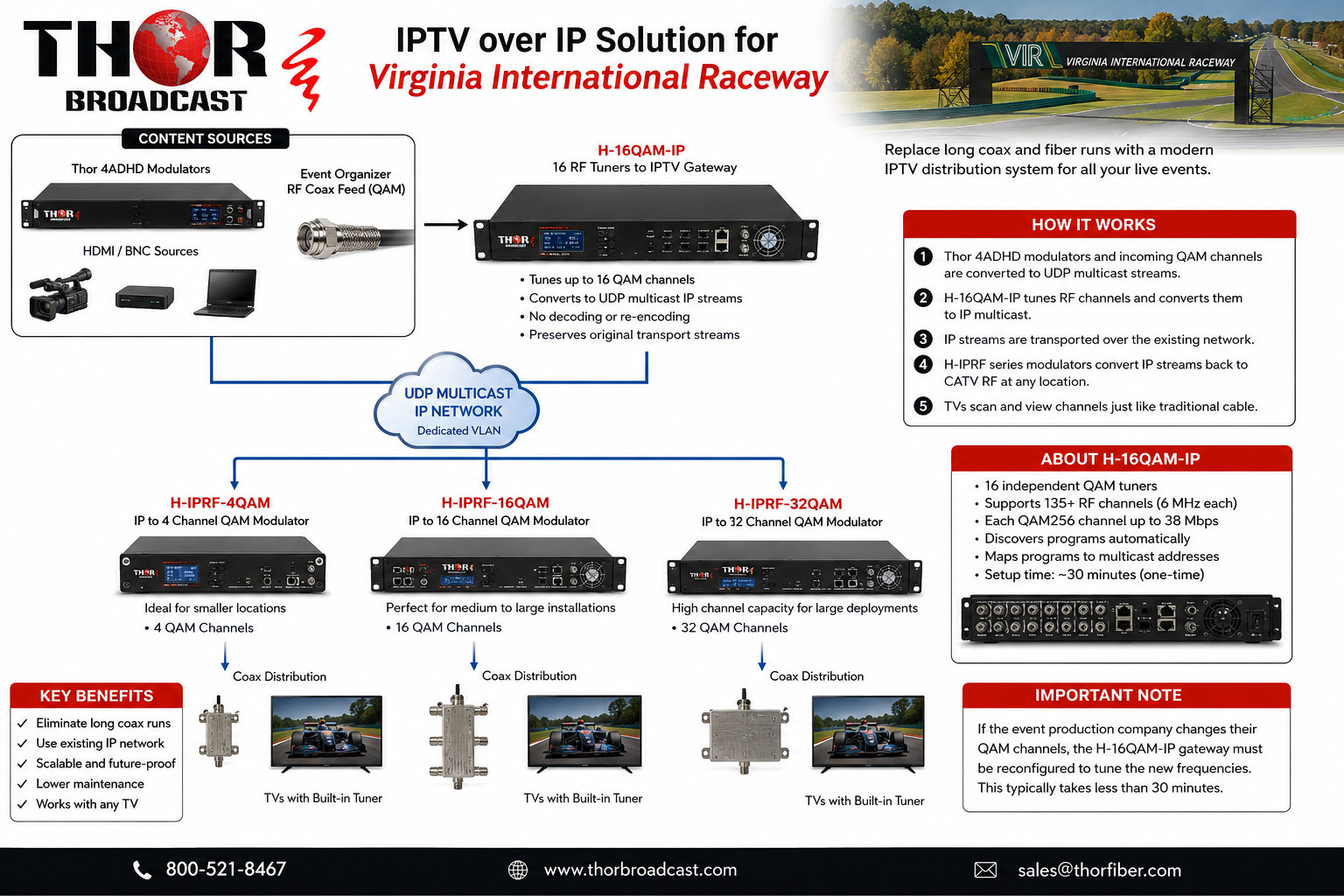
Virginia International Raceway modernized television distribution by replacing long coax runs with IPTV multicast and QAM over IP using existing Thor Broadcast infrastructure and Ethernet networking.
View H-16QAM-IP GatewayTable of Contents
Virginia International Raceway (VIR), one of America's premier motorsports facilities, operates a large property with multiple buildings, hospitality areas, and remote viewing locations requiring access to live television channels during major racing events.
For years, VIR distributed television channels using a traditional RF over Fiber (FTTH) architecture. Live channels were combined into a CATV RF lineup, converted to optical fiber, distributed across the property, and converted back to RF at remote locations.
While this architecture worked well, several challenges emerged:
A remote viewing area known as Tent Hill required nearly one-third mile of coaxial cable distribution, creating a difficult and maintenance-heavy signal path.
Multiple splitters and amplifiers increased maintenance requirements and created potential reliability concerns across the property.
One facility experienced fiber infrastructure problems, but still had access to the site's Ethernet network, creating an opportunity for IP-based television delivery.
Large annual racing events required distribution of approximately 20 live television programs received from third-party broadcast production crews.
The facility already utilized Thor 4 Channel HDMI to QAM Modulators, which were generating CATV channels from HDMI sources while simultaneously producing IPTV multicast streams.
Product:
Thor 4 Channel HDMI to QAM Modulators
After configuring a dedicated VLAN for television distribution, VIR successfully verified multicast streaming using VLC Media Player.
This confirmed that the existing content was already available as IPTV, reducing the need for major infrastructure replacement.
The proposed architecture converts the entire television ecosystem into UDP multicast streams that can be transported over standard Ethernet networks.
This design allows VIR to move away from long RF coaxial runs while keeping the familiar CATV viewing experience at remote locations.
The existing Thor HDMI modulators continue generating multicast streams. No changes are required.
All internally generated channels remain available on the network, making them ready for IP transport to any building or event area with network connectivity.
Some racing event organizers deliver approximately 20 television programs through a single RF coax feed. To make these channels available throughout the network, Thor recommended the H-16QAM-IP RF Tuner to IPTV Gateway.
H-16QAM-IP RF Tuner to IPTV Gateway
This platform contains sixteen independent QAM tuners capable of receiving CATV channels and converting them directly into UDP multicast streams.
The process is extremely efficient because no decoding or transcoding occurs. The original MPEG transport stream remains intact, which means no loss of quality and virtually no added latency.
One of the most common questions received from system integrators involves the relationship between RF channels and television programs.
A single RF carrier may contain:
The exact number depends entirely on the encoder bitrates used by the content provider.
The H-16QAM-IP gateway does not care how many programs are contained inside the carrier. It simply extracts the transport stream and places it onto the IP network.
Once all content exists as IPTV multicast streams, it can be redistributed anywhere on the property using Ethernet.
Thor recommended the following IPTV-to-RF platforms depending on the size of each remote location:
Ideal for smaller remote locations that only require a limited number of CATV channels.
Designed for larger installations requiring multiple RF channels and broader program distribution.
Supports larger channel lineups and enterprise CATV deployments across major facilities and campuses.
Remote locations can receive television service through existing network infrastructure instead of long outdoor coaxial runs.
Fewer amplifiers, splitters, and outdoor coax connections help reduce service complexity and ongoing maintenance issues.
Any building connected to the network can receive television channels, making future growth much easier.
The H-IPRF series recreates standard CATV channels that can be viewed directly on televisions using their internal tuners.
Temporary hospitality areas and remote viewing zones can be serviced using existing network drops or wireless Ethernet bridges, making the platform more flexible during major racing events.
If a production company changes their incoming QAM frequencies from one event to another, the H-16QAM-IP gateway must be reconfigured to tune the new RF channels.
This process typically takes less than 30 minutes and only needs to be performed when the incoming RF channel plan changes.
Once configured, the system operates automatically.
This architecture allows motorsports facilities, stadiums, universities, casinos, hotels, military installations, and large campuses to modernize legacy CATV systems while leveraging existing IP network infrastructure.


 EN
EN