Learn how RF modulators, HDMI modulators, and HDMI RF modulators work for professional AV systems. Complete guide by Thor Broadcast.
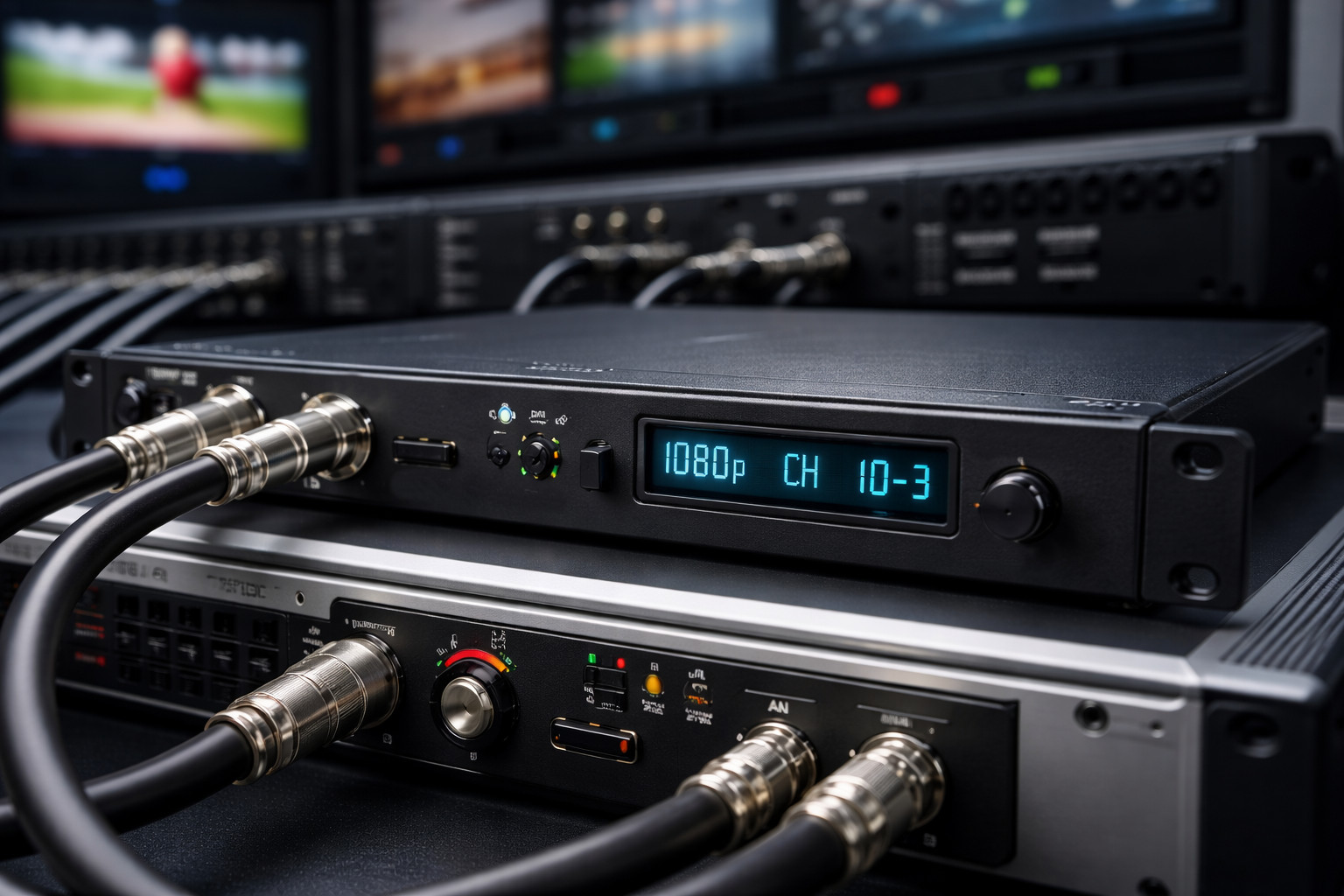
In today’s professional broadcasting and audiovisual environments, efficient signal distribution is essential for delivering high-quality content. Whether you are managing a hotel television system, corporate digital signage, educational broadcasting, or a large-scale commercial installation, an RF modulator, HDMI modulator, or HDMI RF modulator plays a critical role in your infrastructure.
These devices allow HDMI and video sources to be converted into RF signals that can be distributed over existing coaxial cable networks. At Thor Broadcast, we specialize in professional-grade modulation solutions that deliver stable, scalable, and reliable performance for modern AV systems.
To explore professional broadcast solutions, visit: https://thorbroadcast.com/
Table of Contents
An RF modulator is a device that converts audio and video signals into radio frequency (RF) signals. These RF signals can then be distributed through coaxial cables and displayed on televisions tuned to specific channels.
Historically, RF modulators were used to connect VCRs, gaming consoles, and cameras to older televisions. Today, they remain essential in professional environments where centralized signal distribution is required - especially when coaxial infrastructure is already installed and proven reliable.
In practice, RF modulators let you distribute content as standard TV channels. That makes integration simple: televisions (or commercial displays with tuners) can tune content using familiar channel numbers without requiring an HDMI cable to every screen.
An HDMI modulator takes a digital HDMI signal from a source device (media player, set-top box, signage player, PC, camera, etc.) and converts it into an RF signal for distribution over coax.
This matters in real-world installations because HDMI is great for short runs, but scaling HDMI to many displays often increases cost and complexity (long HDMI runs, extenders, splitters, EDID/HDCP challenges). An HDMI modulator changes that equation by turning one HDMI source into a channel that can be delivered across an existing coax network.
Most modern HDMI modulators support high-definition video, digital audio, and stable long-duration operation - which is why they are widely used in hospitality, education, healthcare, and corporate facilities.
An HDMI RF modulator combines HDMI processing and RF modulation into one integrated device. It converts HDMI input into digital RF formats such as ATSC or QAM, enabling HDMI content to appear as a standard TV channel.
This approach is especially powerful for large installations because it can eliminate extra endpoint equipment. Instead of placing receivers at each display, you can distribute one RF channel through coax and let each TV tune it directly using its built-in tuner (depending on the TV and the selected standard).
For system integrators, HDMI RF modulators help simplify deployment, centralize management, reduce points of failure, and keep maintenance predictable.
Professional RF and HDMI modulators offer a set of advantages that make them a preferred solution for long-term AV system planning.
By using existing coaxial wiring, modulators reduce (or eliminate) the need for expensive rewiring projects and disruptive construction.
Need to add more displays? Coax-based RF distribution makes expansion easier. New screens can often be connected with minimal changes to the headend.
Content sources and channel mapping can be controlled from one location, which is ideal for hotels, campuses, and multi-building environments.
Modern modulators support HD and, in some cases, 4K workflows. The right model helps preserve clarity and stability across long cable runs.
RF over coax is known for stable transmission over distance. With quality headend gear, you can deliver consistent service across many endpoints.
RF distribution integrates well with both commercial and consumer televisions (as long as tuners and standards match your deployment region and format).
Combined, these benefits make modulators a practical foundation for professional AV and broadcast distribution.
While the exact workflow varies by model and standard, most modulation systems follow the same core steps:
Signal intake - HDMI (or video) is received from the source device.
Encoding - The signal is digitally encoded for RF transport.
Compression - Audio and video may be compressed depending on the output format and configuration.
RF channel mapping - The encoded stream is assigned to a channel/frequency plan.
RF output - The signal is output over coax as a tunable channel.
Display tuning - TVs tune to the assigned channel to show the content.
Conceptually, this turns your HDMI source into something that behaves like a broadcast channel inside your facility.
HDMI RF modulators are widely deployed because they simplify multi-display distribution and reduce the need for complex cabling.
Hotels use modulators to distribute entertainment channels, welcome messaging, property promotions, local information, and internal hotel content to guest rooms.
Multiple HDMI sources can be converted into channels and displayed across many screens, helping staff manage content centrally and consistently.
Ideal for internal broadcasts, training sessions, executive messaging, and facility-wide announcement channels.
Schools and universities distribute lectures, emergency notices, event programming, and campus announcements across buildings.
Hospitals and clinics use modulators for patient entertainment, wayfinding, informational content, and internal communications.
Used for digital signage content, promotions, seasonal messaging, and advertising feeds across large floorplans.
Across these environments, the value is consistent: centralized control, simple expansion, and reliable distribution.
Selecting the right modulator depends on your signal format needs, the number of displays, and operational expectations (24/7 uptime, remote management, channel density, etc.). Use the checklist below to make a confident decision.
Check compatibility with ATSC, QAM, DVB, or other formats. Matching standards is critical for tuner compatibility on the receiving TVs.
Ensure support for 1080p or 4K if needed. Also consider frame rate support and audio handling.
Some modulators support multiple channels simultaneously. Verify how channels are configured and managed.
Advanced models support remote monitoring and control, which can reduce service time and improve uptime.
Choose equipment designed for continuous operation, especially for hospitality and 24/7 signage deployments.
For large systems, professional documentation and responsive support are important for smooth deployment and maintenance.
Thor Broadcast modulators are designed to meet these professional standards.
Thor Broadcast provides enterprise-level RF and HDMI modulation solutions trusted by system integrators and broadcasters worldwide.
Our products are known for:
High-performance signal processing
Durable industrial-grade construction
Flexible configuration options
Long-term reliability
Professional technical support
Learn more at: https://thorbroadcast.com/
An RF modulator converts audio and video signals into RF channels for distribution over coaxial networks, allowing TVs to tune content like standard broadcast channels.
An RF modulator can refer broadly to devices that create RF channels from A/V signals, while an HDMI modulator specifically converts an HDMI source into RF for coax distribution.
Yes, most professional models support full HD (1080p), and some systems support 4K depending on device capabilities and configuration.
Yes. One modulator can distribute content to dozens or even hundreds of televisions, depending on the coax network design, signal levels, and channel planning.
No. RF modulation works independently of internet connectivity.
Yes, smart TVs can receive RF channels using built-in tuners, as long as the RF standard matches (ATSC/QAM/DVB) and the TV supports the deployed format.
Yes, they can integrate with broadcast sources when configured properly.
This depends on the model. Some support multiple channels simultaneously.
For large systems, professional installation is recommended for best results.
They require minimal maintenance but should be updated and inspected periodically.
Yes, they transmit synchronized audio and video signals.
Yes, they are designed specifically for professional and commercial environments.
An RF modulator, HDMI modulator, or HDMI RF modulator is an essential component in modern AV and broadcast systems. These devices make it possible to distribute high-quality HDMI content through existing coaxial networks in a reliable and cost-effective way.
Whether you are building a hotel TV system, managing corporate displays, or operating a broadcast facility, professional modulators provide the performance and flexibility you need.
For industry-leading RF and HDMI modulation solutions, visit: https://thorbroadcast.com/


 EN
EN