RF vs IPTV for gym displays: improve reliability, reduce cable box costs, and choose the best TV distribution method.
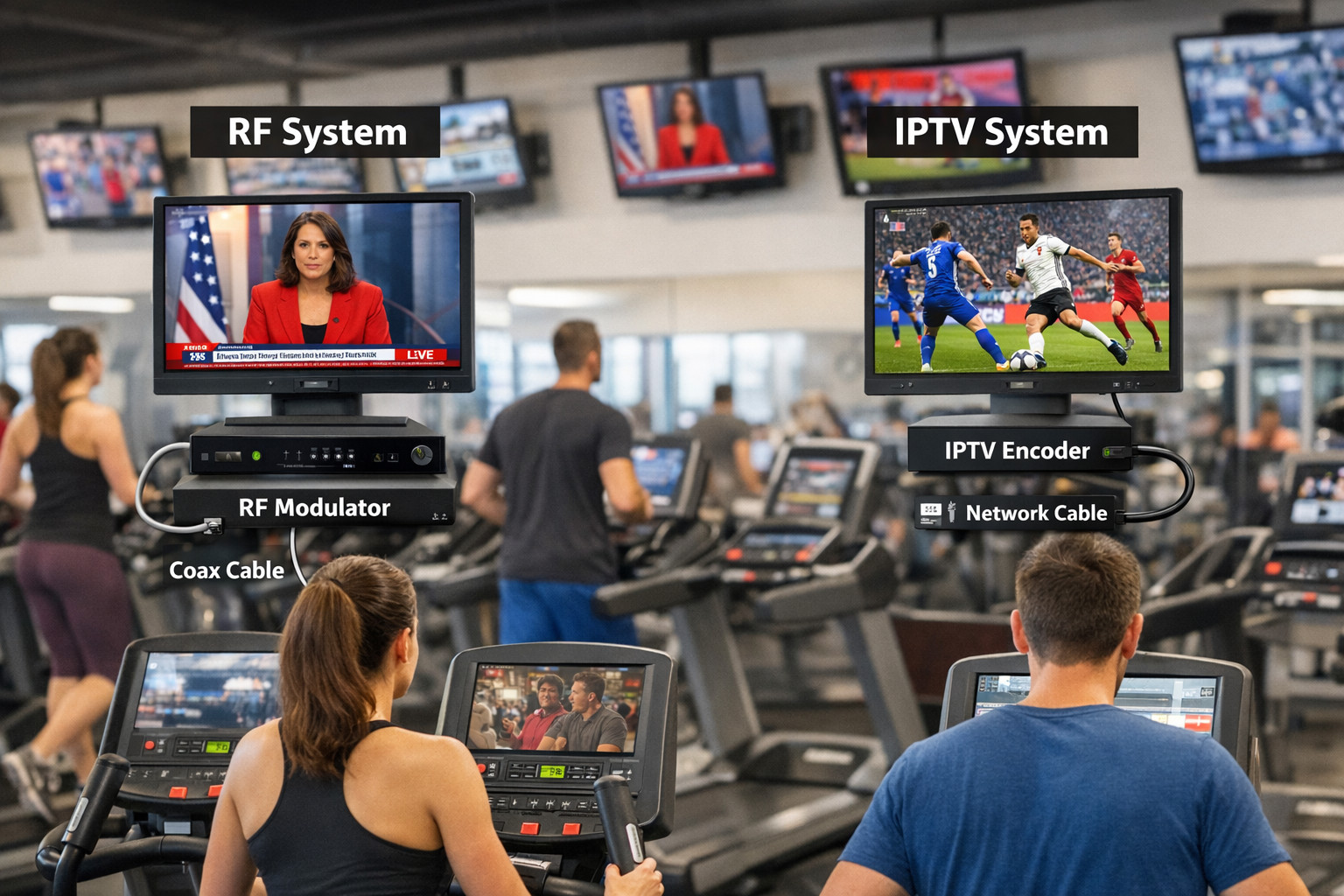
Table of Contents
Fitness centers, health clubs, and training facilities often distribute live television channels to cardio machines, treadmills, ellipticals, and wall-mounted displays. In many installations, the original system was built around cable-provider set-top boxes feeding RF modulators, creating in-house television channels that each machine can tune.
Over time, however, operators often face recurring problems such as locked-up cable boxes, wrong channel selection, monthly rental fees, and customer complaints when screens go offline. At the same time, many newer gym machines now support IPTV input, which raises an important question:
This article explains the differences, the advantages of each method, and the most practical way to improve reliability in a gym environment.
A common design uses multiple cable or satellite receiver boxes as source devices. Each box is tuned to a fixed live channel and connected by HDMI to an RF modulator. The modulators then create in-house RF channels distributed over coaxial cable to all cardio machines and displays.
In many cases, this system works well for years, but the weak point is usually not the RF modulator. The most common failures come from the external set-top boxes, which may:
This is especially frustrating in gyms, where even a small interruption quickly results in member complaints.
In some installations, the cable company charges a monthly fee for each receiver box. If a gym uses 10 boxes, those recurring costs can easily approach $1,000 per month after taxes and fees.
That leads many operators to explore alternatives such as:
Even though IPTV is now supported by many modern gym machines, traditional RF distribution still remains one of the most reliable and easiest methods for live channel delivery inside a facility.
With an RF system, each HDMI source becomes its own in-house TV channel. The distribution is simple, stable, and easy to troubleshoot. Once the coax network is in place, the system does not require Ethernet switch configuration, multicast management, VLAN planning, or more advanced IT involvement.
For facilities already wired with coax, RF is often the most practical long-term solution.
IPTV can be a strong option when the gym machines or displays already support multicast or set-top-box-based IPTV control, and when the facility wants to use its Ethernet network instead of coax cabling.
With IPTV, each source is encoded into a separate IP stream, typically as a UDP multicast program. The machines then select the desired stream from the network instead of tuning an RF channel.
However, it is important to understand that IPTV does not automatically eliminate the need for content source devices. You still need a source for each live channel, such as:
In other words, switching from RF to IPTV usually changes the delivery method, not the content acquisition method.
One of the biggest misunderstandings in these projects is the assumption that the IPTV encoder or RF modulator can somehow change channels on the source device. In reality, most modulators and encoders are passive video processing devices. They simply take whatever video is present at the HDMI input and convert it into RF or IPTV output.
This means:
So if a gym currently uses 10 set-top boxes to create 10 channels for RF distribution, an IPTV version of that same system would usually still require 10 live source outputs for 10 streams.
If over-the-air ATSC reception is weak or limited in your area, there are usually three main source options:
Free off-air ATSC can help in some markets, but in locations with poor reception or limited broadcast availability, it is usually not enough to meet the expectation of 40 to 100 channels in a commercial gym setting.
One of the most important reliability improvements has nothing to do with the RF modulator itself. It comes from correctly configuring the source set-top boxes.
Many cable and satellite boxes are left in Auto Resolution mode. In that mode, the box may switch between 1080i, 1080p, 720p, or other formats depending on the content, commercial breaks, menus, or source changes.
When the HDMI output format changes dynamically, the modulator must re-lock and re-encode the signal. That can create brief interruptions or apparent instability.
This simple step often makes the overall system far more stable and prevents unnecessary re-encoding events.
For many gyms, the smartest approach is not to immediately replace the RF modulators, especially if those modulators have already proven reliable in the field.
Instead, the better strategy is often:
IPTV can be an excellent solution in some projects, but if the real problem is provider boxes locking up or recurring service fees, simply changing the delivery format from RF to IP may not solve the root issue.
Thor Broadcast offers multiple solutions for in-house television and IPTV distribution, including compact RF modulators and hybrid RF + IPTV platforms.
For gym equipment displays, both RF and IPTV can work well. The right choice depends on the existing cabling, machine capabilities, available content sources, and how much network complexity the facility wants to manage.
In many real-world projects, the RF modulators are not the problem. The actual weak points are often the provider set-top boxes, unstable video settings, or the cost of the content source itself.
Before replacing a working RF architecture, it is worth asking:
If you already have a reliable coax network in place, improving the source side may be the fastest and most economical way to make the system more bulletproof.
Thor Broadcast can help you evaluate the best approach for RF, IPTV, or hybrid channel distribution for fitness centers, health clubs, hospitality facilities, and commercial AV projects.
Contact Thor Broadcast for application guidance, system design support, and product recommendations.


 EN
EN