Learn when to use QAM, ATSC, DVB-T, ISDB-T, or IPTV to deliver private TV channels across hotels, resorts, and campuses.
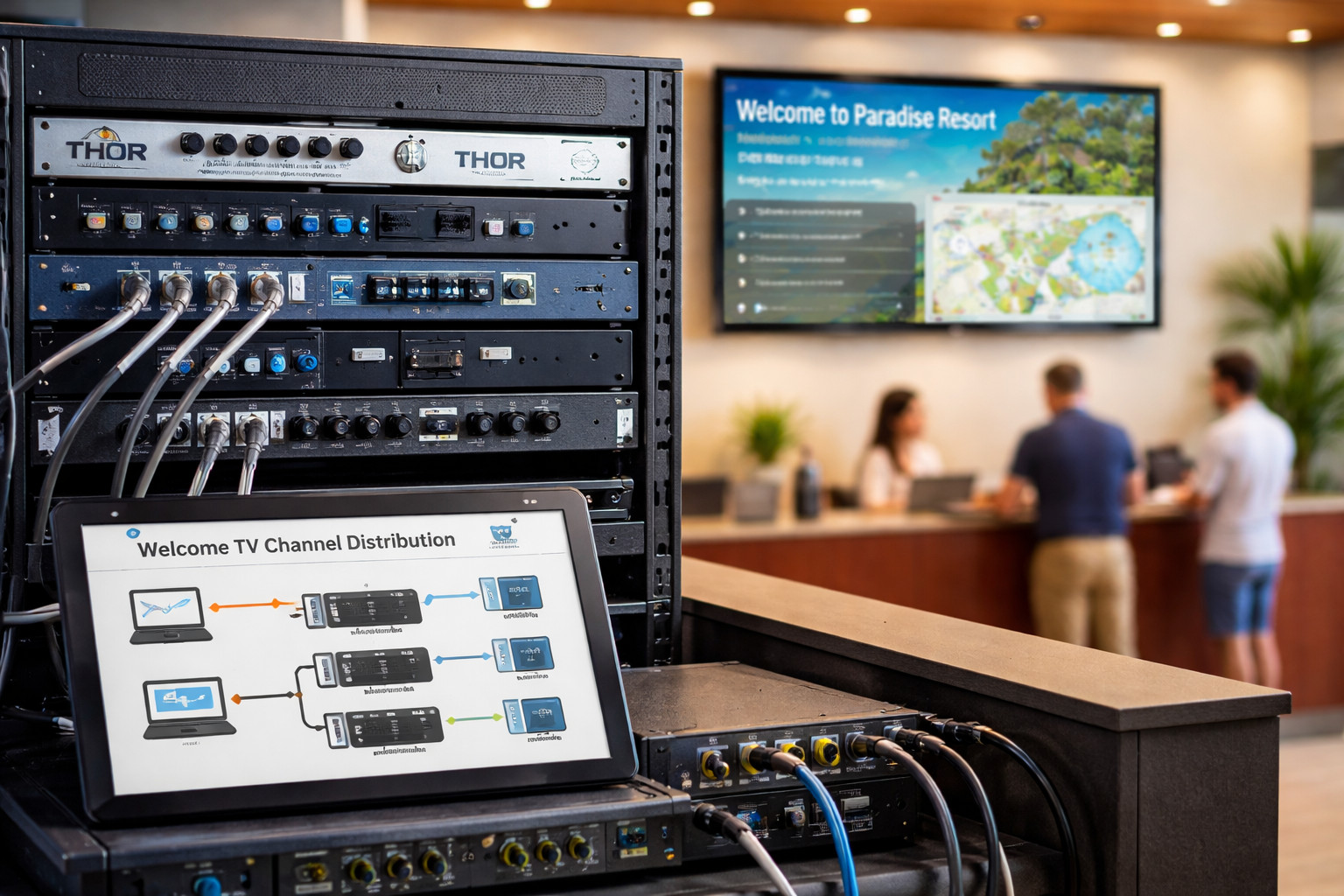
A property owner wants guests to turn their TV to a local channel and see welcome information, event schedules, activities, maps, announcements, emergency messages, menus, or advertising.
Create a branded information channel for check-in info, dining hours, activities, weddings, spa offers, and local events.
Display park maps, Wi-Fi instructions, site rules, gate codes, movie nights, office hours, and weather alerts.
Deliver internal TV channels for meeting schedules, sports, announcements, digital signage, or live camera feeds.
In many cases the content source is very simple: a laptop, media player, cable box, camera, signage PC, or streaming receiver. The real question is how to send that content to many TVs across a property in a way that is practical, reliable, and as compliant as possible.
In the United States, the television broadcast bands are licensed spectrum. That means a person generally cannot legally operate a private over-the-air ATSC, DVB-T, or other TV broadcast transmitter on normal TV channels just because the signal stays on private property.
| Question | Practical Answer |
|---|---|
| Can I legally create my own ATSC station on my land without a license? | Generally no, not as a normal over-the-air TV station in U.S. broadcast spectrum. |
| Is there a “property line” exemption? | No. U.S. regulation is based on licensed use of spectrum and interference protection, not land ownership. |
| Does changing the modulation from ATSC to DVB-T make it legal? | No. The issue is the use of broadcast spectrum, not the digital format itself. |
| What is usually acceptable and common? | Closed coax RF systems, in-building distribution, MATV/SMATV systems, IPTV networks, and contained signal distribution inside the property. |
In the real world, many people test a tiny modulator with a small antenna and find that it “works.” That does not automatically make it compliant. A very weak signal may go unnoticed if it does not cause interference, but that is different from it being formally authorized.
One of the biggest points of confusion is that people mix up the video source format, the transport format, and the RF modulation standard. These are different layers.
This is the final “TV channel format” the televisions or set-top boxes actually tune to.
| Standard | Primary Use | Where It Is Common | What It Does | Best Use Case |
|---|---|---|---|---|
| ATSC | Over-the-air digital television | United States, Canada, some other regions | Creates 8VSB RF broadcast-style channels TVs can tune directly with the antenna input | U.S. off-air compatible channels, in-building demo systems, contained RF environments, or licensed OTA applications |
| QAM / J.83B / DVB-C | Cable TV distribution | Hotels, hospitals, cruise ships, campuses, cable-style networks | Creates digital cable channels carried over coax networks | Best overall choice for private in-property coax distribution |
| DVB-T | Over-the-air terrestrial digital television | Europe, many international markets | Creates COFDM terrestrial RF channels for regions where DVB-T tuners are standard | International properties using DVB-T televisions |
| ISDB-T | Terrestrial digital TV | Japan, parts of Latin America and other markets | Creates terrestrial digital channels for ISDB-T receivers | Regional deployments where ISDB-T is the native TV standard |
| IPTV | IP network delivery | Modern campuses, hotels, smart-TV environments | Sends video as multicast/unicast streams over Ethernet instead of as RF over coax | New builds, large campuses, hybrid RF/IP systems |
ATSC makes a signal that behaves like a U.S. digital over-the-air TV channel. Any television with an ATSC tuner can scan and receive it through the antenna input.
Good for: U.S.-style off-air channel compatibility.
Not ideal for: large private cable distribution when QAM is available.
QAM makes a digital cable channel for a coax infrastructure. This is often the cleanest, easiest, and most scalable way to deliver many internal channels to many TVs on one property.
Good for: hotels, resorts, hospitals, MDUs, and campus coax plants.
Best fit: private in-house channel distribution.
DVB-T is the terrestrial RF standard widely used outside the United States. If the property is in Europe or another DVB-T market, it may be the right RF choice because guest televisions already support it.
IPTV skips RF modulation entirely and sends the program over the Ethernet network. This is ideal when the site already has structured cabling, network switches, VLANs, and smart TVs or IPTV set-top boxes.
If the goal is “put one or more custom channels on many TVs around the property,” the best answer is usually not a broadcast transmitter. It is a contained distribution system.
This is the easiest application. A laptop or media player feeds one HDMI source into a 1-channel modulator, and the RF output is injected into the site’s coax distribution.
| Source | Processing | Output | TV Side |
|---|---|---|---|
| Laptop / media player | Encode + modulate | QAM or ATSC RF on coax | Guests tune the internal channel |
If the property wants multiple channels - for example welcome info, live lobby camera, restaurant promos, satellite boxes, local streaming receivers, and event channels - then a multi-channel headend is the right approach.
Where coax does not exist or the site already depends on a structured network, IPTV can be cleaner. The encoder creates multicast streams, and smart TVs or STBs decode them at the edge.
In markets where DVB-T or ISDB-T is the native TV standard, the same content can be encoded into the correct local terrestrial format. The engineering logic is the same - the output standard simply matches the region’s receivers.
This is the cleanest answer for most private properties. The channel is delivered over coax to televisions already connected to the site’s internal RF network.
A hybrid design is ideal when some TVs still rely on RF tuning while other endpoints use IPTV decoders or smart-TV apps.
Below are the Thor Broadcast product families that best match these scenarios.
Ideal for a single local channel from one HDMI source. Great for simple property info channels, demo environments, or small installations.
Best fit: one source, one internal channel, low-cost compact deployment.
A strong choice when the project needs four sources and professional outputs such as RF plus IP. Useful for hospitality, campuses, and integrated digital signage distribution.
Best fit: multi-channel headends, RF + IPTV workflows, expandable commercial systems.
A practical commercial modulator for delivering multiple HD channels over coax. Excellent for hotels, bars, restaurants, schools, and private channel distribution systems.
Best fit: reliable private coax TV headends with several program sources.
Best when a property wants a more complete headend with many sources and room to grow. Ideal for channel lineups, welcome channels, local promo channels, and internal content networks.
Best fit: hotels, hospitals, large MDUs, large campgrounds, campuses, and enterprise distribution.
Thor HDCOAX units are a flexible family for HDMI-to-RF conversion with scalable channel counts. Very useful when you need global RF compatibility options and commercial-grade distribution.
Best fit: commercial private-channel systems with different size requirements.
For larger campuses, hospitality chains, and integrated systems, Thor Broadcast can combine modulators, RF combiners, IP encoders, distribution amplifiers, and set-top solutions into a full architecture.
Best fit: engineered projects needing channel planning and mixed RF/IP delivery.
| If the site has... | Usually choose... | Why |
|---|---|---|
| Existing coax to many TVs | QAM modulator | Fastest, most scalable, least disruptive upgrade path |
| Mostly smart TVs / network infrastructure | IPTV | Better fit for network-based distribution and expansion |
| Need compatibility with U.S. TV antenna tuners in a contained environment | ATSC | Native tuner compatibility |
| International site using European TVs | DVB-T or DVB-C | Matches local receiver standards |
Technically, a modulator can produce RF and an antenna can radiate RF. The better question is whether that is the correct and compliant design for the application. For commercial properties in the U.S., a contained coax or IPTV system is usually preferred.
Yes. It is a strong choice when the project needs one HDMI source converted into one TV channel for a simple deployment.
Move to a multi-channel platform such as the Thunder series or H-4ADHD-QAM-IPLL. This makes it easier to build a real headend architecture rather than piecing together multiple single-channel devices.
Then the regional modulation standard becomes very important. In many international markets, DVB-T, DVB-C, or ISDB-T may be the correct native output.
If the site already has coax and you want a private internal TV network, QAM is usually the best engineering choice. If you specifically need the TV to tune the channel through its antenna tuner in an ATSC-compatible environment, ATSC may be useful, but the overall distribution design should still be evaluated carefully.
Whether you need a single welcome channel, a 4-channel digital signage headend, or a full RF + IPTV distribution system, Thor Broadcast can help design the correct architecture for your resort, hotel, campground, campus, or commercial facility.
Start with these product families:
Thor Petit | Thunder Series | HDCOAX Series | H-4ADHD-QAM-IPLL


 EN
EN