Thor Broadcast Logo
Log in
Cart (0)
  • es ES
  • Products
    • CATV Modulators
      • HDMI RF Modulators
      • HD-SDI converters
      • IP to CATV Edge Modulators
    • DVB Encoders
      • IPTV Video Encoders
      • Hdmi RTSP RTMP RTSP Encoders
      • Transcoders, MPEG Converters, IP ASI Gateways
    • Decoders (IRD's & STB's)
      • RF input - Video /Audio Ouput
      • IP Broadcast Decoders
      • RF CATV and IPTV OTT STB's
    • Satellite Modulators
      • DVB-S/S2 Satellite Modulators
    • Fiber Optic Transport
      • SDI Fiber Optic Extenders, Digital Audio Extenders
      • SDI SD/HD/3G with CWDM
      • Cable TV CATV RF 45-900Mhz
      • L-Band Satellite RF 45-3000Mhz
      • Data & Ethernet over fiber
    • HDMI SDI Switchers, LAN Extenders, and Wireless Video Transport
      • HD Video Switchers and Signal Format Converters for AV Pros
      • Wireless HD SD Video Data Equipment
      • Video Audio Extenders Over Ethernet LAN IP Network
    • DIscounted Inventory
      • Satellite and CATV Broadcast Equipment for Sale
      • Lab Used Broadcast Equipment on sale
      • Past Generation Equipment
    • SDI Monitors
    • Warehouse
  • About
  • Client Portfolio
  • Support
      • Support Center Support Center
      • User Manuals User
        Manuals
      • Request an RMA Request an
        RMA
  • ⬇Download
    • Manuals
    • Datasheets
    • Quick Guides
  • Case Studies
    • THOR Gym
    • THOR Stadium
    • THOR Hotel
    • THOR University
  • Videos
  • Contact
  • Become a Reseller

How to Build a Private TV Information Channel for a Resort, Campground, Hotel, Campus, or Clubhouse

Learn when to use QAM, ATSC, DVB-T, ISDB-T, or IPTV to deliver private TV channels across hotels, resorts, and campuses.
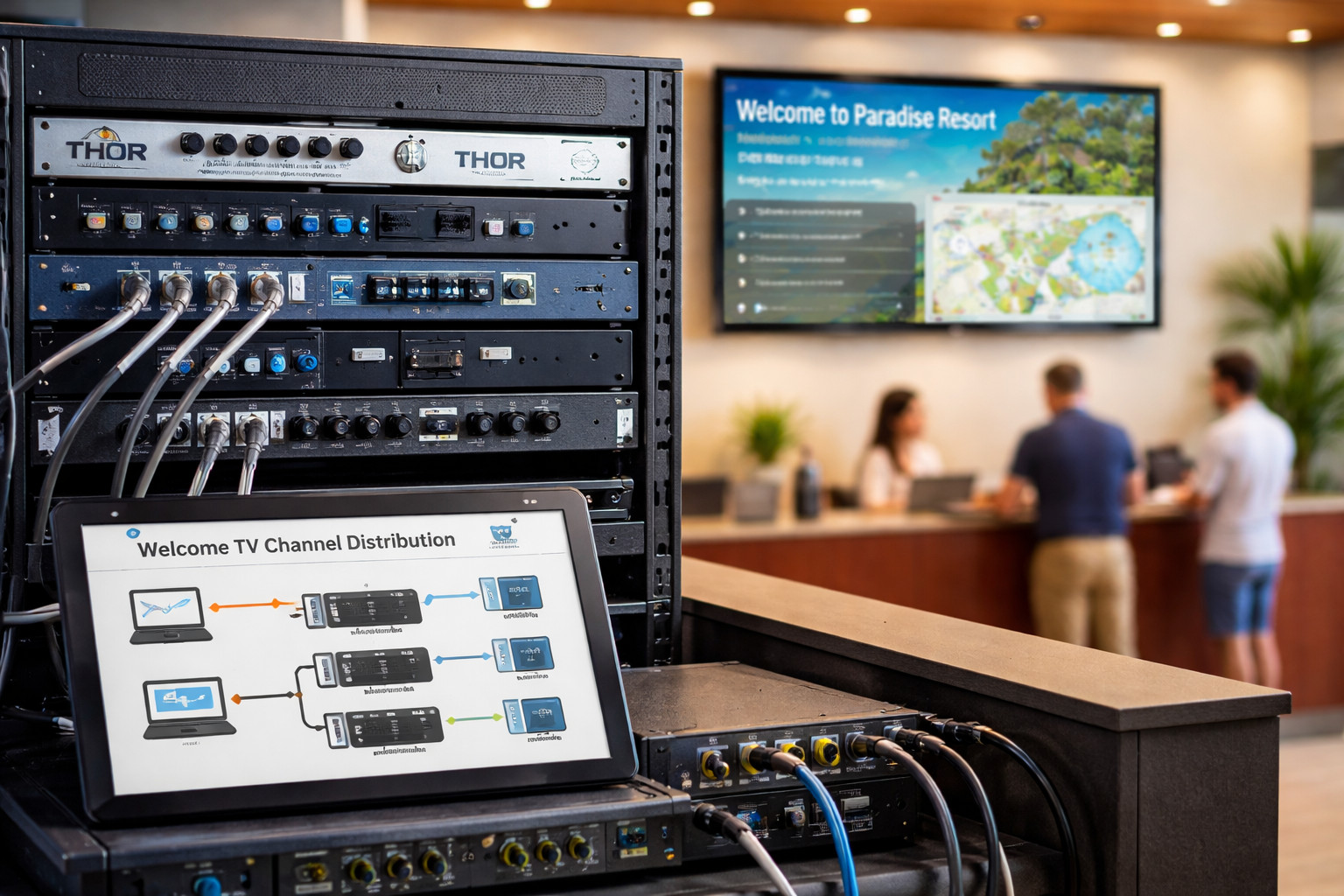
How to Build a Private TV Information Channel for a Resort, Campground, Hotel, Campus, or Clubhouse
This guide explains the real-world ways to distribute your own video channel across a property using ATSC, QAM, DVB-T, ISDB-T, and IPTV - what each modulation standard does, where each one makes sense, what the U.S. rules actually mean in practice, and which Thor Broadcast products are the best fit.

Table of Contents

  • The Use Case
  • U.S. Regulatory Reality
  • What Each Modulation Standard Does
  • Best Engineering Solution
  • System Architectures
  • Application Drawings
  • Recommended Thor Products
  • Design Tips
  • FAQ

The Typical Scenario

A property owner wants guests to turn their TV to a local channel and see welcome information, event schedules, activities, maps, announcements, emergency messages, menus, or advertising.

Resorts & Hotels

Create a branded information channel for check-in info, dining hours, activities, weddings, spa offers, and local events.

Campgrounds & RV Parks

Display park maps, Wi-Fi instructions, site rules, gate codes, movie nights, office hours, and weather alerts.

Campuses & Clubs

Deliver internal TV channels for meeting schedules, sports, announcements, digital signage, or live camera feeds.

In many cases the content source is very simple: a laptop, media player, cable box, camera, signage PC, or streaming receiver. The real question is how to send that content to many TVs across a property in a way that is practical, reliable, and as compliant as possible.

What Is Legal in the United States?

Important: This article is educational and engineering-focused. It is not legal advice. For any true over-the-air TV transmission on U.S. television spectrum, confirm the final design with qualified FCC counsel or a broadcast engineer.

The short version

In the United States, the television broadcast bands are licensed spectrum. That means a person generally cannot legally operate a private over-the-air ATSC, DVB-T, or other TV broadcast transmitter on normal TV channels just because the signal stays on private property.

Question Practical Answer
Can I legally create my own ATSC station on my land without a license? Generally no, not as a normal over-the-air TV station in U.S. broadcast spectrum.
Is there a “property line” exemption? No. U.S. regulation is based on licensed use of spectrum and interference protection, not land ownership.
Does changing the modulation from ATSC to DVB-T make it legal? No. The issue is the use of broadcast spectrum, not the digital format itself.
What is usually acceptable and common? Closed coax RF systems, in-building distribution, MATV/SMATV systems, IPTV networks, and contained signal distribution inside the property.

Why people still ask about “small antenna broadcasting”

In the real world, many people test a tiny modulator with a small antenna and find that it “works.” That does not automatically make it compliant. A very weak signal may go unnoticed if it does not cause interference, but that is different from it being formally authorized.

Best practice: For resorts, hotels, RV parks, campuses, and clubhouses, the most professional and lowest-risk approach is to use a closed coax distribution network or IPTV system, not a free-radiating over-the-air mini TV station.

Understanding the Modulation Standards

One of the biggest points of confusion is that people mix up the video source format, the transport format, and the RF modulation standard. These are different layers.

Layer 1: Source

  • HDMI from a laptop, set-top box, signage player, camera, or PC
  • Component video / CVBS in some legacy systems
  • IP stream from a network encoder or IPTV server

Layer 2: Compression / Transport

  • MPEG-2 or H.264 video encoding
  • Audio such as MPEG audio or Dolby AC-3
  • MPTS / SPTS transport stream
  • IP transport such as UDP, RTP, multicast, or RTSP in some systems

Layer 3: RF Modulation

This is the final “TV channel format” the televisions or set-top boxes actually tune to.

Standard Primary Use Where It Is Common What It Does Best Use Case
ATSC Over-the-air digital television United States, Canada, some other regions Creates 8VSB RF broadcast-style channels TVs can tune directly with the antenna input U.S. off-air compatible channels, in-building demo systems, contained RF environments, or licensed OTA applications
QAM / J.83B / DVB-C Cable TV distribution Hotels, hospitals, cruise ships, campuses, cable-style networks Creates digital cable channels carried over coax networks Best overall choice for private in-property coax distribution
DVB-T Over-the-air terrestrial digital television Europe, many international markets Creates COFDM terrestrial RF channels for regions where DVB-T tuners are standard International properties using DVB-T televisions
ISDB-T Terrestrial digital TV Japan, parts of Latin America and other markets Creates terrestrial digital channels for ISDB-T receivers Regional deployments where ISDB-T is the native TV standard
IPTV IP network delivery Modern campuses, hotels, smart-TV environments Sends video as multicast/unicast streams over Ethernet instead of as RF over coax New builds, large campuses, hybrid RF/IP systems

What ATSC does

ATSC makes a signal that behaves like a U.S. digital over-the-air TV channel. Any television with an ATSC tuner can scan and receive it through the antenna input.

Good for: U.S.-style off-air channel compatibility.

Not ideal for: large private cable distribution when QAM is available.

What QAM does

QAM makes a digital cable channel for a coax infrastructure. This is often the cleanest, easiest, and most scalable way to deliver many internal channels to many TVs on one property.

Good for: hotels, resorts, hospitals, MDUs, and campus coax plants.

Best fit: private in-house channel distribution.

What DVB-T does

DVB-T is the terrestrial RF standard widely used outside the United States. If the property is in Europe or another DVB-T market, it may be the right RF choice because guest televisions already support it.

What IPTV does

IPTV skips RF modulation entirely and sends the program over the Ethernet network. This is ideal when the site already has structured cabling, network switches, VLANs, and smart TVs or IPTV set-top boxes.

The Best Engineering Solution for Most Properties

If the goal is “put one or more custom channels on many TVs around the property,” the best answer is usually not a broadcast transmitter. It is a contained distribution system.

Preferred order of solutions

  1. Closed coax QAM system - best for existing TV coax infrastructure
  2. ATSC in a contained in-building RF environment - useful when TV tuner compatibility matters
  3. IPTV over Ethernet - best for newer network-centric properties
  4. Hybrid RF + IPTV - best for phased upgrades and mixed TV environments
Recommended for most U.S. resorts, hotels, campgrounds, and campuses: Use a Thor modulator to convert HDMI sources into QAM channels over coax or IPTV streams over Ethernet. This gives guests a familiar channel-tuning experience without relying on free-radiating antenna transmission.

Common System Architectures

1) Single welcome channel on existing coax

This is the easiest application. A laptop or media player feeds one HDMI source into a 1-channel modulator, and the RF output is injected into the site’s coax distribution.

Source Processing Output TV Side
Laptop / media player Encode + modulate QAM or ATSC RF on coax Guests tune the internal channel

2) Multi-channel property TV headend

If the property wants multiple channels - for example welcome info, live lobby camera, restaurant promos, satellite boxes, local streaming receivers, and event channels - then a multi-channel headend is the right approach.

  • Multiple HDMI inputs
  • Multiple digital TV channels generated in one rack
  • Output distributed over coax, IPTV, or both

3) IPTV-only campus model

Where coax does not exist or the site already depends on a structured network, IPTV can be cleaner. The encoder creates multicast streams, and smart TVs or STBs decode them at the edge.

4) International terrestrial channel creation

In markets where DVB-T or ISDB-T is the native TV standard, the same content can be encoded into the correct local terrestrial format. The engineering logic is the same - the output standard simply matches the region’s receivers.

Application Drawings

Drawing A - Best Practice: Private Coax Distribution Channel

Laptop / Media Player HDMI source Thor Modulator Petit / HDCOAX / Thunder / H-4ADHD-QAM-IPLL RF Combiner / Distribution Amp Property Coax Network • Hotel rooms • Campground office / clubhouse • Restaurant / bar TVs • Guest rooms / cottages / common areas

This is the cleanest answer for most private properties. The channel is delivered over coax to televisions already connected to the site’s internal RF network.

Drawing B - Hybrid RF + IPTV Architecture

Multiple HDMI Sources PCs, cameras, signage, STBs Thor Multi-Channel Modulator RF + IPTV capable system Thunder / H-4ADHD-QAM-IPLL Coax Plant QAM / ATSC internal channels Ethernet Switch Multicast IPTV distribution Legacy TVs RF tuner input rooms / bars / common areas Smart TVs / STBs IPTV endpoints new buildings / campuses

A hybrid design is ideal when some TVs still rely on RF tuning while other endpoints use IPTV decoders or smart-TV apps.

Drawing C - Small Localized ATSC-Style Channel Concept

HDMI Source Laptop / signage player ATSC Modulator Thor Petit or multi-channel ATSC set to local contained use case Optional Attenuation / RF Control Contained RF Zone clubhouse / lobby / demo area small localized antenna system site-specific engineering required
This third concept is shown because customers ask about it often. In the U.S., a true over-the-air TV transmission on broadcast channels raises regulatory questions. For most commercial properties, a coax or IPTV system is the better answer.

Recommended Thor Broadcast Products for These Applications

Below are the Thor Broadcast product families that best match these scenarios.

1 Channel
Compact
Entry Level

Thor Petit HDMI RF Modulator

Ideal for a single local channel from one HDMI source. Great for simple property info channels, demo environments, or small installations.

Best fit: one source, one internal channel, low-cost compact deployment.

View Thor Petit

4 Channel
QAM / ATSC / DVB-T / ISDB-T
Rack System

H-4ADHD-QAM-IPLL

A strong choice when the project needs four sources and professional outputs such as RF plus IP. Useful for hospitality, campuses, and integrated digital signage distribution.

Best fit: multi-channel headends, RF + IPTV workflows, expandable commercial systems.

View H-4ADHD-QAM-IPLL

4 Channel
Thunder Series
Hospitality

Thunder-4

A practical commercial modulator for delivering multiple HD channels over coax. Excellent for hotels, bars, restaurants, schools, and private channel distribution systems.

Best fit: reliable private coax TV headends with several program sources.

View Thunder-4

8 Channel
Expandable
Large Sites

Thunder Series Multi-Channel Platform

Best when a property wants a more complete headend with many sources and room to grow. Ideal for channel lineups, welcome channels, local promo channels, and internal content networks.

Best fit: hotels, hospitals, large MDUs, large campgrounds, campuses, and enterprise distribution.

View HDMI RF Modulator Family

1 / 2 / 4 / 6 / 8 Input
Closed Captioning
Multi-standard

HDCOAX Series

Thor HDCOAX units are a flexible family for HDMI-to-RF conversion with scalable channel counts. Very useful when you need global RF compatibility options and commercial-grade distribution.

Best fit: commercial private-channel systems with different size requirements.

View HDCOAX Series

ATSC
QAM
IPTV

Custom Headend Solutions

For larger campuses, hospitality chains, and integrated systems, Thor Broadcast can combine modulators, RF combiners, IP encoders, distribution amplifiers, and set-top solutions into a full architecture.

Best fit: engineered projects needing channel planning and mixed RF/IP delivery.

Explore Thor Broadcast

Engineering & Design Tips

Choose the right distribution method first

If the site has... Usually choose... Why
Existing coax to many TVs QAM modulator Fastest, most scalable, least disruptive upgrade path
Mostly smart TVs / network infrastructure IPTV Better fit for network-based distribution and expansion
Need compatibility with U.S. TV antenna tuners in a contained environment ATSC Native tuner compatibility
International site using European TVs DVB-T or DVB-C Matches local receiver standards

Think about content workflow

  • Will the source be a static slideshow, live channel, looping signage video, or a schedule feed?
  • Will staff update the content manually or from a CMS?
  • Does the site need one channel or ten?
  • Will you later add emergency alerts, lobby cameras, or advertising channels?

RF planning still matters even inside the property

  • Maintain clean signal levels across the coax plant
  • Use correct combining and splitting strategy
  • Avoid channel conflicts with any existing services
  • Control ingress, leakage, and poor terminations
  • Use good quality distribution amplifiers where needed

IPTV planning matters too

  • Use managed switches for multicast deployments
  • Confirm IGMP support where multicast is used
  • Segment traffic if the same LAN carries guest internet
  • Test endpoint compatibility early

Frequently Asked Questions

Can I just connect a small antenna directly to a modulator?

Technically, a modulator can produce RF and an antenna can radiate RF. The better question is whether that is the correct and compliant design for the application. For commercial properties in the U.S., a contained coax or IPTV system is usually preferred.

Does the Thor Petit work as a welcome channel generator?

Yes. It is a strong choice when the project needs one HDMI source converted into one TV channel for a simple deployment.

What if I need four channels instead of one?

Move to a multi-channel platform such as the Thunder series or H-4ADHD-QAM-IPLL. This makes it easier to build a real headend architecture rather than piecing together multiple single-channel devices.

What if the site is outside the U.S.?

Then the regional modulation standard becomes very important. In many international markets, DVB-T, DVB-C, or ISDB-T may be the correct native output.

Is QAM or ATSC better for a U.S. private property?

If the site already has coax and you want a private internal TV network, QAM is usually the best engineering choice. If you specifically need the TV to tune the channel through its antenna tuner in an ATSC-compatible environment, ATSC may be useful, but the overall distribution design should still be evaluated carefully.

Need a Thor solution for your property?

Whether you need a single welcome channel, a 4-channel digital signage headend, or a full RF + IPTV distribution system, Thor Broadcast can help design the correct architecture for your resort, hotel, campground, campus, or commercial facility.

Start with these product families:
Thor Petit | Thunder Series | HDCOAX Series | H-4ADHD-QAM-IPLL

Disclaimer: Product suitability depends on the site’s existing wiring, televisions, regional tuner standards, network design, and local regulatory environment. For U.S. broadcast-spectrum questions, always confirm the final plan with qualified counsel or a broadcast engineer before deploying an over-the-air transmission system.

Justin White
Justin White
Broadcast Engineer
Broadcast engineer specializing in turnkey CATV and fiber-transport solutions. Experienced in designing and deploying complete encoding/decoding workflows to move virtually any signal over IP, fiber, and RF. Focused on ultra-low-latency headend architectures and custom mux/demux builds, supporting demanding environments across telecom, sports, education, hospitality, studios, live events, and mission-critical institutions worldwide.
View author page
Contact us

Thor Broadcast Sales

Email: [email protected]
Phone: 1(800)521-THOR (8467) Ext 1
FAX: 1(800)521-6384

Customer Service/ Support

Phone: 1-800 521-THOR(8467) Ext 2
Email: [email protected]

Case Studies

- Converting Clear QAM HDTV Channels to Analog RF NTSC for Multi-Site Distribution
- Stadium IPTV - Replay System
- Hotel HDMI-to-QAM TV Distribution
- University IPTV Lecture Systems

  • CATV Modulators:
    • HDMI RF Modulators
    • HD-SDI converters
    • IP to CATV Edge Modulators
  • DVB Encoders:
    • IPTV Video Encoders
    • Hdmi RTSP RTMP RTSP Encoders
    • Transcoders, MPEG Converters, IP ASI Gateways
  • Decoders (IRD's & STB's):
    • RF input - Video /Audio Ouput
    • IP Broadcast Decoders
    • RF CATV and IPTV OTT STB's
  • Satellite Modulators:
    • DVB-S/S2 Satellite Modulators
  • Fiber Optic Transport:
    • SDI Fiber Optic Extenders, Digital Audio Extenders
    • SDI SD/HD/3G with CWDM
    • Cable TV CATV RF 45-900Mhz
    • L-Band Satellite RF 45-3000Mhz
    • Data & Ethernet over fiber
    • Analog Audio Video
    • Fiber Amplifiers - EDFA
    • DVB - ASI
    • Fiber Jumpers, Cables, Attenuators,
    • Optic Splitters Couplers CWDM Muxes
    • Optical Meters, Test Equipment, Accesories
    • Analog Baseband Video Audio, RS485/422/232 Data, Contact Closure
  • HDMI SDI Switchers, LAN Extenders, and Wireless Video Transport:
    • HD Video Switchers and Signal Format Converters for AV Pros
    • Wireless HD SD Video Data Equipment
    • Video Audio Extenders Over Ethernet LAN IP Network
  • HD 4K Cameras, SDI - HDMI - IP Streaming - PTZ - Broadcast and Security:
    • PTZ Streaming Cameras Broadcast cameras with SDI ,HDMI CVBS USB
  • DIscounted Inventory:
    • Satellite and CATV Broadcast Equipment for Sale
    • Lab Used Broadcast Equipment on sale
    • Past Generation Equipment
  • SDI Monitors:
  • Warehouse:
Thor Broadcast Logo
Email: [email protected]
Phone: 1(800) 521-8467 Ext 1
FAX: 1(800)521-6384
Information:
  • About us
  • Client Portfolio
  • Become a Reseller
  • Contact
  • Articles
  • Return Policy
  • Shipping Policy
  • International Order Policy
Popular:
  • RF Modulator
  • HDMI over COAX
  • HDMI over IP
  • COAX to HDMI
  • HDMI to SDI

Thor Broadcast
Torrance Business Park
2421 W 205th St
Torrance
CA 90501

© 2026 Thor Broadcast
Subscribe to our newsletter

Sign up here to get the latest news, updates and special offers delivered directly to your inbox.

You can unsubscribe at any time
newsletter image