HDMI to RF explained: how an HDMI RF modulator creates tunable coax channels, what standards matter, and how to engineer stable MER/BER.
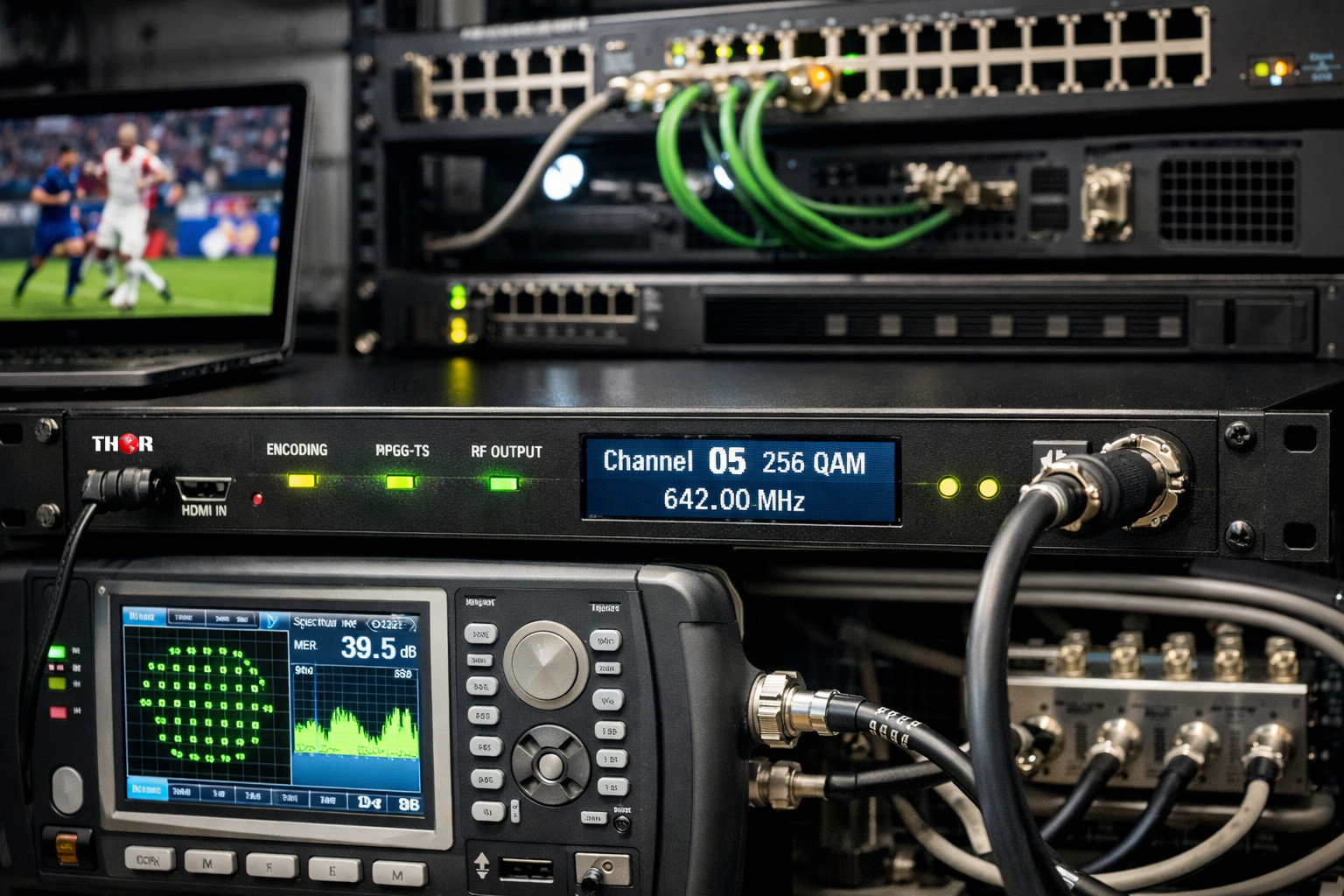
Table of Contents
An RF modulator with HDMI is a headend device that takes an HDMI source and turns it into one or more tunable RF channels that can be distributed over coax to many televisions. In professional deployments this is almost never “just modulation.” The device typically performs four coupled functions: it acquires a baseband HDMI signal, compresses it into a broadcast codec, packetizes it into an MPEG transport stream, and then modulates that stream onto an RF carrier that matches the tuning standard of the endpoint TVs (for example QAM for cable ecosystems, ATSC 8-VSB in ATSC environments, or DVB-T in terrestrial DVB regions).
That is why the correct technical term for most HDMI RF products is encoder-modulator. The encoding stage determines quality, latency, and channel-change behavior; the transport stage determines how reliably consumer televisions can interpret the service; and the RF stage determines whether the signal survives real coax distribution impairments and remains decodable everywhere in the building. Thor Broadcast builds HDMI RF modulators across compact single-program devices and higher-density rack systems, all aimed at turning HDMI into stable in-building TV channels over coax. A good starting point for the product family context is Thor’s HDMI RF Modulators category page.
HDMI is baseband video/audio. It carries pixel timing, audio samples, and control signaling (including link negotiation) over TMDS. A TV tuner, in contrast, expects a modulated RF carrier that contains a digital multiplex. To bridge that gap, the modulator must first lock to the HDMI source’s timing and audio format. In real installations the “lock” problem is often more operational than electrical: HDMI sources can renegotiate format after reboots, firmware updates, or changes in perceived sink capabilities. For stable headend behavior, you want an HDMI RF modulator designed for managed environments and, where possible, you keep HDMI cabling short and physically protected.
After input acquisition, the modulator encodes video and audio into a compressed bitstream. In coax TV distribution, this step is critical because it sets the bitrate you must carry on RF and the decoder compatibility of the endpoint TVs. Next, the modulator packetizes the compressed streams into an MPEG Transport Stream (MPEG-TS) and generates program/service signaling (tables and identifiers) so televisions can scan and present the channel consistently. Finally, the modulator maps the transport stream into symbols and places them onto the selected RF modulation standard, producing an RF output that can be combined with other channels and distributed through splitters, taps, and amplifiers.
In a single-channel use case-one HDMI source that needs to appear as a channel across a facility-compact integrated units are common. Thor’s Petit HDMI RF Modulator is an example of an all-in-one HDMI-to-coax digital RF modulator designed for this “one source to many TVs” pattern.
RF modulation is not interchangeable across tuner ecosystems. A television can only lock and decode what its tuner supports, so the modulation family must be selected by inventorying the receiving devices first. In a cable-style ecosystem, QAM is commonly used because it carries high net throughput per channel bandwidth and is widely supported by tuners that scan “cable” channels. In ATSC environments, 8-VSB is typical because TVs and set-top boxes natively scan ATSC channels and follow ATSC service conventions. In DVB regions, DVB-T is frequently used where televisions are built around terrestrial DVB tuning and OFDM-based reception behavior.
Standard choice also impacts RF robustness requirements. Higher spectral efficiency (for example higher-order QAM) generally demands cleaner RF conditions and higher MER/SNR margins through the coax plant. OFDM-based standards provide different resilience characteristics against certain propagation and echo behaviors, but coax distribution still demands clean levels, proper termination, and careful amplifier gain planning. The engineering point is that “HDMI RF modulator” is not a single product class; it is a family that must match both the endpoint tuner standard and the RF conditions of the building.
Thor Broadcast offers multiple HDMI-to-RF families aligned with these requirements. For multi-input headends where you want QAM output plus IP/ASI transport outputs for monitoring and IPTV integration, Thor’s 1-4 HDMI to QAM Modulators and IPTV Streaming Encoders is representative of an integrated “encode + multiplex + modulate” chassis approach. For ATSC-centric fleets, Thor’s 1-4 HDMI to ATSC Modulators and IPTV Streaming Encoders targets ATSC 8-VSB output with similar headend integration.
In HDMI-to-coax systems, encoding is frequently the difference between “channels exist” and “channels are watchable and stable.” Bitrate determines picture quality and the amount of capacity consumed within an RF channel’s transport budget. GOP structure determines channel-change behavior and error recovery; long GOPs improve compression efficiency but can increase the time it takes a TV to present a stable picture after tuning. Rate control (often aiming for constant-rate transport behavior) matters because RF multiplexing typically benefits from predictable payload rates; this helps maintain stable modulation occupancy and can reduce unexpected behavior in consumer tuners.
Compatibility is not only video. Audio is a classic field failure point: a TV may lock RF and show the channel name yet output silence if the audio codec is not supported or if signaling is inconsistent. The safest engineering practice is to decide on a codec/audio profile based on what your actual TV fleet decodes reliably, then validate on multiple representative models for scan behavior, audio presence, lip-sync stability, and long-duration playback. When you standardize encoding settings across all channels, you reduce the likelihood of “odd” tuner behavior that only appears on a subset of TVs.
Thor’s multi-channel HDMI modulator platforms are commonly selected specifically to make this standardization feasible. For example, Thor’s 1-8 HDMI Digital RF Modulator CC (Closed Captioning) represents a higher-density approach where multiple HDMI programs can be encoded and mapped to RF outputs under a unified management plane, which is operationally easier than tuning many unrelated single-channel boxes to behave consistently.
Once a program is encoded, it must be carried in a transport that televisions understand. MPEG-TS is ubiquitous in broadcast and headend ecosystems because it supports multiplexing and synchronization, and it carries the signaling that tells a receiver which audio and video packets belong to a given program. In a coax system, you must treat service signaling as part of the product, not an optional add-on. When signaling is unstable or inconsistent, TVs can display symptoms that look like RF problems: channels that disappear after rescans, intermittent audio, black screens during channel changes, or “duplicate” channel entries.
A disciplined headend maintains stable service identifiers, program numbers, and naming conventions across reboots and lineup changes. This stability reduces the need to rescan TVs and reduces customer support overhead in hospitality, healthcare, campus, and enterprise environments. Integrated Thor chassis systems are built for these managed headend workflows where you set transport parameters once, document them, and then expand or modify channels under change control rather than ad hoc adjustments.
An HDMI RF modulator can generate a clean carrier at the rack and still fail at the outlets if the coax plant is not engineered. Digital RF reception depends on adequate MER and low BER at the tuner. Splitters introduce insertion loss; long coax runs introduce frequency-dependent attenuation; connectors and poorly terminated branches introduce reflections; and amplifiers can either rescue margin or destroy it if they are driven into distortion or incorrectly balanced. In other words, the RF plant is not “just wiring”; it is a transmission line system with a measurable budget.
Proper design starts with a channel plan (frequencies and standards), then assigns RF output levels and calculates losses to the worst outlet, including all passives and actives. You then verify at representative outlets, especially at the farthest endpoints and across different splitter branches. A system that only works when the TV is near the headend is not a finished system. Commissioning should include verifying that the carrier lineup remains stable under normal building conditions and that the plant is protected against common issues such as loose F-connectors and unintended unterminated branches.
Thor provides RF distribution components that are commonly used to combine and split modulated channels in facility coax plants. For example, Thor’s Coax Multiplexers / Splitters / Combiners are typical building blocks for assembling a stable distribution topology after the modulator stage.
In coax TV distribution, latency is a combined property of the encoder pipeline, the transport/multiplex structure, and the TV’s own decode and presentation path. HDMI RF modulation is often used for signage and in-building channels where seconds of delay may be acceptable, but many environments are sensitive to delay, especially sports bars, live venues, and auditoriums where viewers can see a live event and a delayed screen simultaneously. The correct approach is to measure glass-to-glass delay using a visible clock or timecode test signal and then tune parameters (where the platform allows) to trade off compression efficiency for reduced buffering.
Channel-change time is similarly multi-factor. TVs must tune, lock, demodulate, parse service tables, and then wait for a decodable I-frame to present video. Shorter GOPs and stable signaling generally improve perceived responsiveness. When comparing modulators, the most meaningful test is not a theoretical specification but real tuning behavior on your actual TVs, because endpoint variability can be greater than headend variability in practice.
For one program, a compact unit is often ideal: minimal rack space, minimal configuration, and a clear “one source equals one channel” mental model. Thor’s Petit HDMI RF Modulator aligns with this scenario when you want to inject a single HDMI feed onto coax.
As soon as channel count grows, manageability becomes the dominant cost driver. A collection of independent single-channel devices increases cabling complexity and makes it difficult to keep encoding and RF levels consistent across the lineup. Rack-density approaches reduce those failure points by organizing power, cooling, and physical mounting, while integrated multi-input headends add a unified control plane for encoding, multiplexing, and RF mapping.
Thor supports these scaling steps. If you want to mount multiple compact modulators in a structured way, Thor’s HDMI RF Modulator Chassis System (1-12 units) provides a chassis-style expansion path. If you want integrated multi-input headend behavior with RF plus IP outputs, platforms such as 1-4 HDMI to QAM Modulators and IPTV Streaming Encoders are representative of the “one chassis manages multiple programs” design that improves operational discipline at scale.
Even when coax is the primary distribution medium, IP outputs are valuable. They enable monitoring, recording, secondary IPTV delivery, and simplified inter-rack transport. Many modern headends therefore treat HDMI-to-RF not as an isolated conversion but as a dual-output service: the same encoded programs can be distributed on coax as RF channels while also being available as MPEG-TS over IP for troubleshooting or additional endpoints.
This hybrid approach also simplifies expansion. If later you add an IPTV system or need remote monitoring, an HDMI encoder-modulator with integrated IP output lets you reuse the same encoding pipeline rather than creating parallel encoder infrastructure. Thor’s combined modulator/encoder lines, including the previously referenced 1-4 HDMI to QAM Modulators and IPTV Streaming Encoders, are aligned with this practical “RF today, IP also available” operational model.
HDMI RF modulators are specialized headend devices, so you typically procure them from broadcast/AV integrators, specialty resellers, or directly from manufacturer channels rather than from general big-box retail. The key technical procurement requirement is not the purchase channel but the validation plan: you want a predictable system, so you test the exact HDMI sources you will use, the exact modulation standard your TVs require, and a representative coax distribution path before you scale the rollout.
Validation should focus on real failure modes: how the modulator behaves after a power cycle, whether it reacquires HDMI cleanly after the source reboots, how stable the channel remains over long playback periods, and whether TVs consistently scan and retain the service without repeated rescans. If your facility includes displays without RF tuners, you may also need an RF-to-HDMI conversion endpoint in selected locations. Thor documents this use case with its universal RF-to-HDMI converter concept described in HDMI Modulator with RF-to-HDMI Converter, which is relevant when you must bridge coax channels to HDMI-only monitors.
An RF modulator with HDMI is the fastest path from an HDMI source to a tunable channel on coax, but the success criteria are broader than “it produces RF.” You must match the modulation standard to the TV tuner ecosystem, choose encoding parameters that receivers decode reliably, maintain stable MPEG-TS service signaling, and engineer the coax distribution network so MER/BER margins remain healthy at every outlet. When you treat HDMI RF modulation as a full headend system-input stability, transport correctness, and RF plant design-you get a facility-wide TV service that behaves like a miniature cable system rather than a fragile converter chain.
Thor Broadcast’s lineup supports the core building blocks of that system approach, from compact channel injection with the Petit HDMI RF Modulator, to higher-density multi-program platforms like the 1-8 HDMI Digital RF Modulator CC, to scalable rack organization via the HDMI RF Modulator Chassis System, and integrated headend chassis options like 1-4 HDMI to QAM Modulators and IPTV Streaming Encoders. Select based on tuner ecosystem, channel count, and management requirements, then validate end-to-end in your real building topology before full deployment.
FCC: DTV interference rejection thresholds (PDF)
FCC: FCC Office of Engineering and Technology
MIT: TMDS encoding notes, Part 1
MIT: TMDS encoding notes, Part 2
University of Maryland (edu): QAM fundamentals (PDF)
NTIA: DTV/ATSC RF transmission report (PDF)


 EN
EN