Learn which HDMI-to-coax converter is best: single-channel HDMI RF modulators, multi-channel headends, 4K QAM options, and coax planning tips.
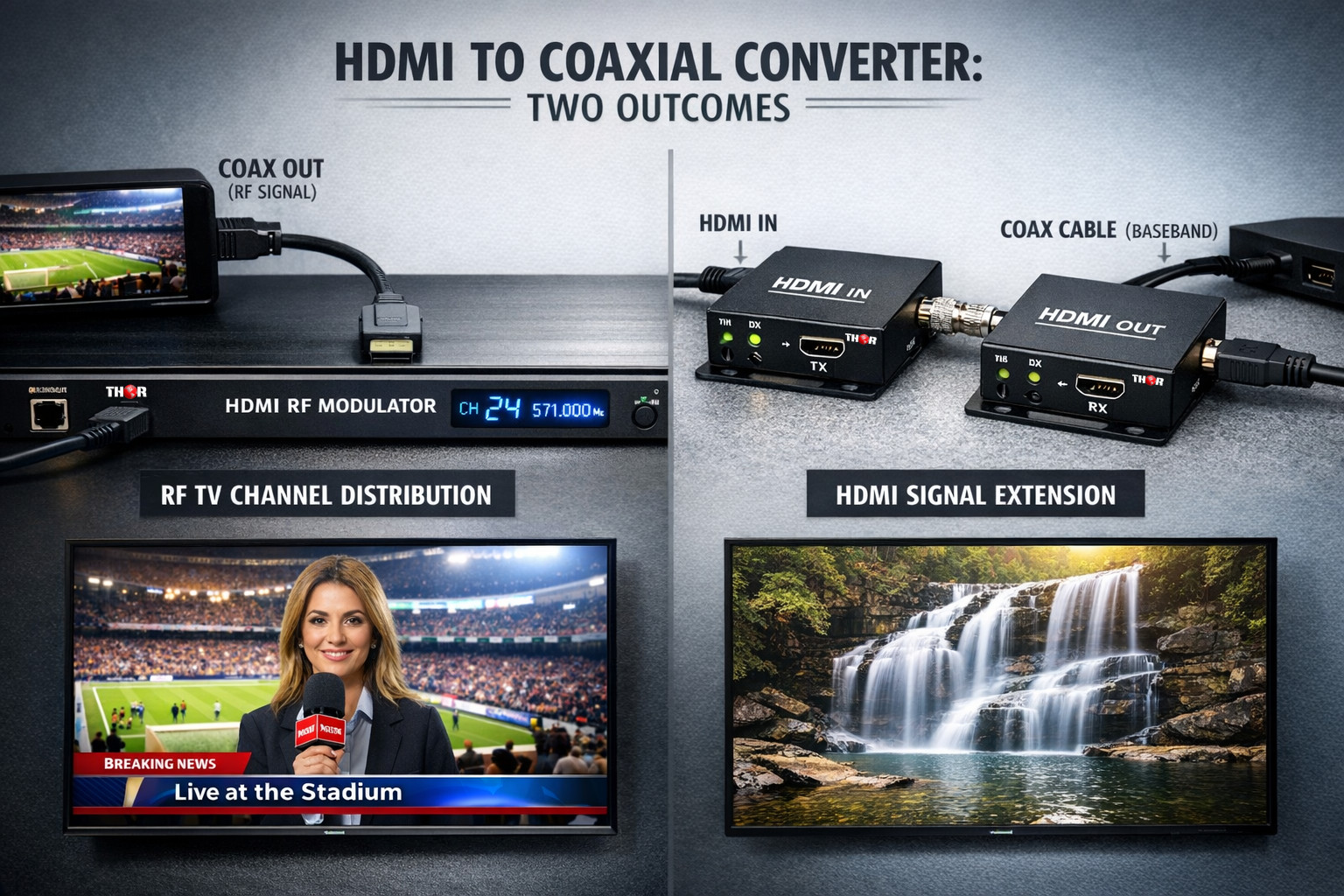
Table of Contents
In professional AV and broadcast distribution, the phrase “HDMI to coaxial converter” is used in two very different ways. Some people mean a device that takes HDMI and creates a tunable RF TV channel that can be injected onto a building’s coax plant so any television can receive it like a normal channel. Others mean a point-to-point “HDMI extender” that happens to use a coax cable as a transport medium for baseband video. Those two outcomes are not interchangeable: an RF-channel approach is a one-to-many distribution architecture built around tuners, modulation standards, and channel plans, while a baseband extender is typically a one-to-one link designed to mirror HDMI at the far end.
Thor Broadcast’s strongest “HDMI to coaxial” solutions are in the RF-channel category: HDMI-to-RF encoder-modulators that create QAM/ATSC/DVB-T/ISDB-T carriers for facility-wide coax distribution. This is also the most scalable and “TV-native” way to use existing coax infrastructure because televisions already understand how to tune RF channels. When you see references to “HDMI to coax converters” on the Thor Broadcast site, they are generally describing this RF modulation approach rather than a passive cable conversion.
If your goal is to feed many TVs over existing coax-hotels, campuses, hospitals, stadium suites, MDUs, retail, and enterprise signage-then the best HDMI-to-coax solution is a digital RF modulator that turns your HDMI program into a channel that every tuner can lock. This architecture thrives on coax because coax was made for RF distribution: it tolerates long runs, splitters, taps, and structured topologies far better than raw HDMI.
In that scenario, the “best” device is not a single model; it is the one that matches your tuner ecosystem (QAM/ATSC/DVB-T), your channel count, your service management needs, and your operational requirements such as remote configuration, predictable recovery after power cycles, and stable channel mapping. Thor Broadcast provides multiple tiers of HDMI RF modulation to cover everything from one channel to multi-program headends. A convenient entry point to compare the Thor families is the product category page: Thor Broadcast HDMI RF Modulators.
A true HDMI-to-coax RF converter is not simply “modulation.” It is usually an encoder-modulator that performs four chained operations that must all be correct for trouble-free reception. First it acquires the HDMI input format and audio mode. Second it compresses the video/audio into a broadcast-friendly format. Third it packetizes that compressed essence into an MPEG Transport Stream with the service signaling that televisions use to identify channels and programs. Fourth it modulates that transport onto an RF carrier in a chosen standard and outputs the carrier at a defined RF level for injection into the coax plant.
This is why passive adapters cannot convert HDMI to coax TV distribution. Coax carries RF energy that must be actively generated as a properly modulated carrier; HDMI carries baseband digital video/audio that must be encoded and repackaged before it can become a channel. Once you accept that the device is really a small headend, it becomes clear why “best” depends on system design: capacity planning, channel plan discipline, RF margin engineering, and management workflows are as important as the HDMI input itself.
When you need one HDMI source to appear as one facility channel-such as a lobby channel, a camera feed, a signage program, or a single set-top box output-the best solution is usually a compact, dedicated HDMI RF modulator that is easy to install, easy to reconfigure, and stable under day-to-day power events. In this class, you want a unit that is designed to be a “set it and forget it” headend element: the output channel should remain consistent, and configuration should be accessible without physically moving the unit every time you need a change.
Thor Broadcast’s compact single-program approach is represented by products like the Petit HDMI RF Modulator. Conceptually, this is the most direct implementation of “HDMI to coaxial converter”: one HDMI input becomes a tunable RF channel on coax. For many integrators, this is the “best” choice when the channel count is low because it minimizes rack complexity and reduces operational surface area while still delivering a real TV-channel outcome.
In the same single-channel family, there are scenarios where operational convenience matters as much as video delivery. A practical example is controlling an HDMI source that is physically located at the headend while users are in remote rooms. Thor provides a variant that is positioned around that workflow, such as the HDMI Modulator with return remote control IR, which is designed for installations where remote control signaling is part of the overall system behavior rather than an afterthought.
As soon as you move beyond a single program, a collection of unrelated one-off converters tends to become difficult to manage. The problem is not only rack space. It is consistency: you want the same encoding behavior, the same channel mapping discipline, predictable reboot recovery, and a unified way to adjust settings across many services. At this point, the “best” HDMI-to-coax converter is typically a multi-channel platform that behaves like a small headend rather than like a set of independent widgets.
Thor Broadcast offers multi-input encoder-modulator platforms that are built around this “headend first” approach. For example, if your ecosystem is cable-style QAM distribution, a chassis such as 1-4 HDMI to QAM Modulators and IPTV Streaming Encoders represents a common professional pattern: multiple HDMI inputs become multiple RF services while the platform is managed centrally. This helps maintain a stable channel lineup because you can treat configuration as an engineered artifact rather than as something that varies from unit to unit.
Where you need ATSC-compatible channels for TVs that expect over-the-air style tuning, Thor’s parallel family 1-4 HDMI to ATSC Modulators and IPTV Streaming Encoders is aligned with that tuner environment. For DVB-T ecosystems, the corresponding approach is 1-4 HDMI to DVB-T Digital Modulators and IPTV Streaming Encoders. The technical point is that “best” is defined by endpoint compatibility: the headend must output the RF standard and service structure that your television fleet can lock and decode reliably.
If your headend needs to scale further and you want a single platform family that can cover different channel counts while retaining consistent operational behavior, Thor’s
UHD distribution over coax is a system-level decision because it pushes harder on both compression and RF capacity. Even if the RF plant is clean, UHD programs demand more bitrate (or more advanced compression) to achieve acceptable quality, and that directly affects how many services you can fit per RF channel and how robust your margins remain through splitting and amplification. If UHD is a real requirement-not just a future aspiration-then the “best” HDMI-to-coax converter is the one designed to handle UHD encoding and headend duties explicitly.
Thor Broadcast offers an integrated UHD headend device in the encoder-modulator category, such as the Real Time Integrated Ultra HD 4K Encoder and QAM Modulator. In UHD scenarios, your selection criteria should include not only “does it output RF,” but also how you will structure multiplex capacity, how you will preserve stable service metadata, and how you will validate real receiver behavior on the intended UHD displays and set-top devices.
In an in-building coax system, your HDMI-to-coax converter is only as good as the RF environment you deliver to the outlets. Digital TV reception depends on maintaining sufficient modulation quality at the tuner, often discussed in terms of MER and BER. You can have a perfectly configured modulator and still see macroblocking, audio dropouts, or intermittent channel loss if the coax distribution has too many splits, poor connectors, impedance mismatches, or amplifiers that are overdriven into distortion.
This is why the “best converter” in the field is often the one that fits your plant margins and operational discipline. Higher density headends are attractive, but they also place more carriers into the plant, increasing the need for clean combining, correct levels, and careful frequency planning. A stable channel plan, correct RF output levels, good termination practices, and verification at the farthest outlets are what turn a headend device into a reliable TV service.
Thor supports these deployments with coax distribution components that are frequently part of the same engineering conversation as the modulator itself. For example, combining and splitting RF channels in a structured coax tree often uses purpose-built hardware such as Coax Multiplexers / Splitters / Combiners. Even the best encoder-modulator cannot compensate for a poorly engineered splitter topology, so the correct procurement mindset is “headend plus distribution,” not “converter box only.”
Most complaints in hospitality and enterprise TV systems are not about compression efficiency; they are about usability. Channels that jump around after rescans, duplicate entries that confuse guests, services that appear on some TVs but not others, and audio that disappears unpredictably are usually symptoms of unstable service signaling or undisciplined lineup changes. TVs cache service information; when program identifiers, tables, or mappings change frequently, the system becomes operationally expensive because it requires touch labor at the endpoints.
The best HDMI-to-coax converters are therefore the ones that support stable headend operation over time. In practice, multi-channel platforms that are managed centrally make it easier to maintain consistent naming, program numbering, and transport parameters. They also make it easier to apply change control: you can plan changes, apply them consistently, and validate behavior on representative TVs rather than discovering problems after hundreds of rooms have already scanned the lineup.
Physical deployment matters more than most spec sheets admit. HDMI is typically a short-run interface, and coax distribution plants often live in crowded closets where cable strain and accidental disconnections are common. When you are building a headend from multiple compact modulators, the best solution is often one that turns many small units into a coherent rack system with predictable power, mounting, and cabling behavior.
Thor addresses this deployment reality with a rack-oriented option such as the HDMI RF Modulator Chassis System 1-12 Units. In facilities where you expect growth over time, a chassis strategy can be “best” because it lowers the long-run cost of expansions and reduces the number of ad hoc mounting and power decisions that turn headends into fragile assemblies.
One reason people search for “HDMI to coaxial converter” is that they are trying to reuse an existing coax plant while deploying modern displays that only have HDMI inputs. In that case, the headend may convert HDMI into RF channels for coax distribution, but the display edge still needs a way to recover HDMI. The correct approach is a powered RF-to-HDMI tuner/decoder box, not a passive adapter, because the device must demodulate and decode the RF channel before it can output HDMI.
Thor Broadcast provides a dedicated RF-to-HDMI decoding device for this role: QAM CATV RF and ATSC RF to HDMI Decoder STB. While this is not an HDMI-to-coax converter, it is often the missing half of a complete architecture that starts with HDMI at the headend and ends with HDMI at the display, using coax as the distribution backbone in between.
The best HDMI-to-coaxial converters available today are the ones that produce the outcome you actually need. If you want a facility-wide TV channel over coax, the strongest and most scalable approach is HDMI-to-RF modulation using a Thor Broadcast encoder-modulator, selected by tuner standard (QAM/ATSC/DVB-T), channel count, and management requirements. If you need one channel, compact solutions like the Petit HDMI RF Modulator are often the most efficient. If you need centralized management and higher density, multi-channel platforms such as 1-4 HDMI to QAM and the 1-8 HDMI Digital RF Modulator CC become “best” because they reduce operational friction over time. If UHD is your requirement, the Real Time Integrated Ultra HD 4K Encoder and QAM Modulator is the appropriate class of solution. And regardless of which headend you choose, the coax distribution plan and metadata stability are what determine whether the system feels professionally engineered or perpetually fragile.
FCC: Digital Television engineering resources
FCC: DTV interference rejection thresholds (PDF)
University of Maryland: QAM fundamentals (PDF)
NTIA: DTV/ATSC transmission-related report (PDF)

 EN
EN