Explore why a small RF modulator may work with a simple antenna, including receiver sensitivity, antenna height, and digital TV behavior.
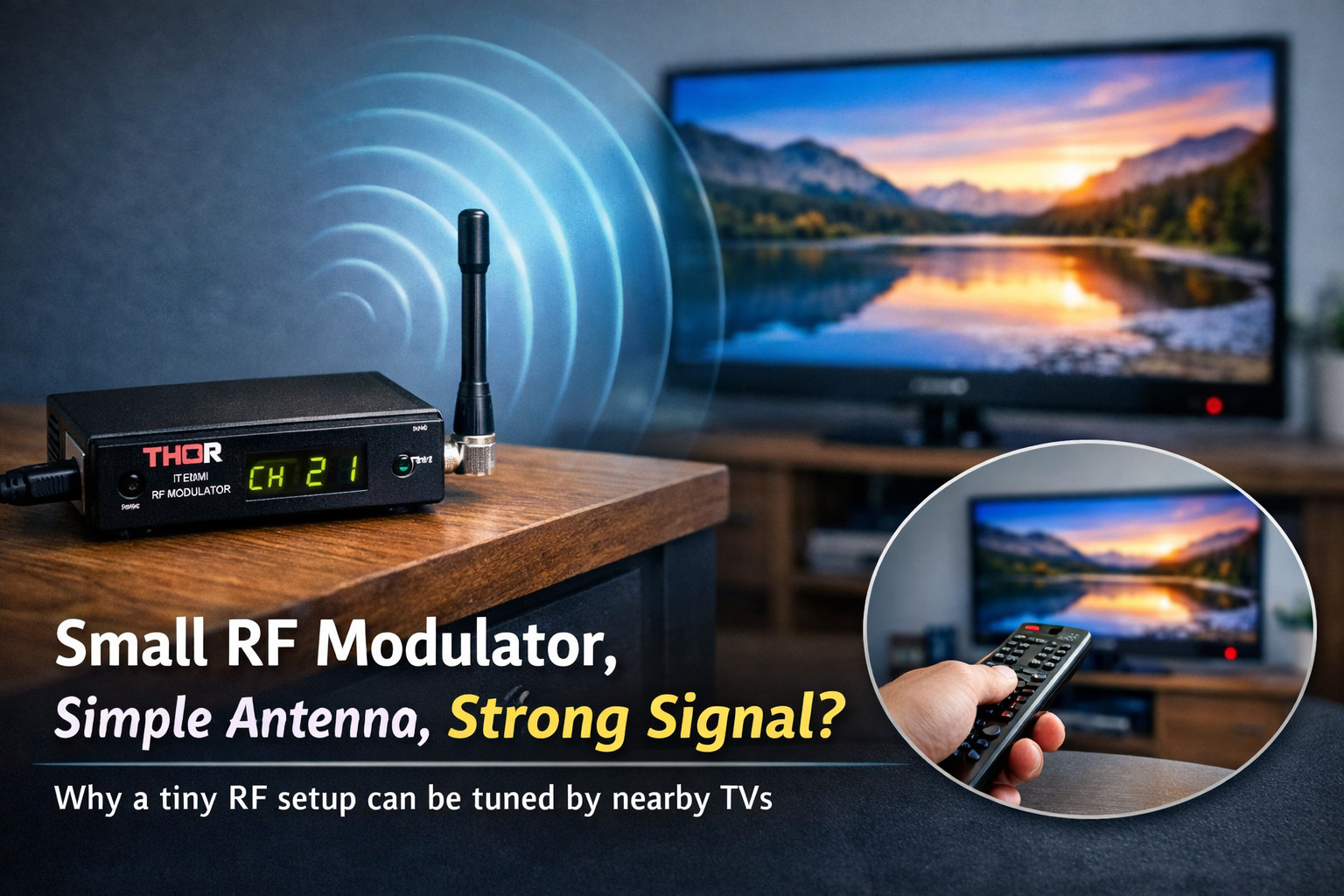
Table of Contents
Sometimes engineers or hobbyists notice something interesting. If a small RF modulator is connected to a simple antenna, a nearby television may be able to tune the signal. In some cases the signal might travel across a room, through a building, or even across a small property.
This naturally leads to the question:
Why does this appear to work?
The answer involves several RF engineering concepts including signal strength, receiver sensitivity, antenna efficiency, and the behavior of digital modulation.
A compact device often used for private RF channel generation is the Thor Petit HDMI RF Modulator.
This type of device converts HDMI video into a digital RF television channel that can be tuned by televisions.
Example product:
Thor Petit HDMI RF Modulator
Devices like this are primarily designed for cable distribution systems, but they can generate a full digital TV channel format.
Modern digital television receivers are extremely sensitive.
Typical ATSC receivers can decode signals around:
-83 dBm to -85 dBm
That is a very small signal level.
| Signal Power | Approximate Meaning |
|---|---|
| +20 dBm | 100 mW |
| 0 dBm | 1 mW |
| -40 dBm | very weak signal |
| -80 dBm | extremely tiny signal |
Because televisions are designed to receive distant broadcast stations, their tuners can detect surprisingly weak nearby signals.
RF signals weaken rapidly as distance increases.
This follows the inverse-square law of propagation.
| Distance | Approximate Signal Strength |
|---|---|
| 1 meter | 100% |
| 10 meters | ~1% |
| 100 meters | ~0.01% |
Because of this effect, a signal that works perfectly across a room may become undetectable only a short distance away.
Typical very small RF setups may only cover:
Digital TV behaves differently than analog television.
| Signal Quality | Result |
|---|---|
| Above decoding threshold | Perfect picture |
| Below threshold | No picture at all |
Because of this cliff effect, a signal that is barely strong enough can still produce a perfect picture.
This sometimes creates the illusion that the transmitter is stronger than it actually is.
Antenna height has a major impact on RF propagation.
Raising an antenna improves line-of-sight coverage and reduces obstacles.
| Antenna Height | Typical Effect |
|---|---|
| 1–2 feet | very short range |
| 6–10 feet | moderate local coverage |
| 20+ feet | much larger coverage area |
Even small increases in height can significantly extend signal reach.
Different antenna designs affect how efficiently RF energy is radiated.
| Antenna Type | Characteristics |
|---|---|
| Dipole | simple balanced antenna, common for TV |
| Whip antenna | small and convenient, moderate efficiency |
| Yagi antenna | directional, higher gain |
| Log periodic | broadband directional antenna |
Directional antennas such as Yagi designs can concentrate energy in a particular direction, increasing range in that direction.
Another factor that can make tiny signals work locally is the RF environment.
In some locations there may be little competing signal on a specific frequency.
When the channel is quiet, even a small signal can be detected by nearby receivers.
Professional video distribution systems almost always use contained RF networks.
Examples include:
These systems distribute channels through coax cables rather than broadcasting through antennas.
This provides:
The reason a small modulator connected to an antenna may appear to work is not because it behaves like a full broadcast transmitter.
Instead it is the combination of:
Understanding these factors provides insight into how RF systems behave at very small scales.
However, professional systems typically rely on controlled RF distribution through coax or IPTV networks rather than free-space radiation.


 EN
EN