Thor Broadcast Logo
Log in
Cart (0)
  • es ES
  • Products
    • CATV Modulators
      • HDMI RF Modulators
      • HD-SDI converters
      • IP to CATV Edge Modulators
    • DVB Encoders
      • IPTV Video Encoders
      • Hdmi RTSP RTMP RTSP Encoders
      • Transcoders, MPEG Converters, IP ASI Gateways
    • Decoders (IRD's & STB's)
      • RF input - Video /Audio Ouput
      • IP Broadcast Decoders
      • RF CATV and IPTV OTT STB's
    • Satellite Modulators
      • DVB-S/S2 Satellite Modulators
    • Fiber Optic Transport
      • SDI Fiber Optic Extenders, Digital Audio Extenders
      • SDI SD/HD/3G with CWDM
      • Cable TV CATV RF 45-900Mhz
      • L-Band Satellite RF 45-3000Mhz
      • Data & Ethernet over fiber
    • HDMI SDI Switchers, LAN Extenders, and Wireless Video Transport
      • HD Video Switchers and Signal Format Converters for AV Pros
      • Wireless HD SD Video Data Equipment
      • Video Audio Extenders Over Ethernet LAN IP Network
    • DIscounted Inventory
      • Satellite and CATV Broadcast Equipment for Sale
      • Lab Used Broadcast Equipment on sale
      • Past Generation Equipment
    • SDI Monitors
    • Warehouse
  • About
  • Client Portfolio
  • Support
      • Support Center Support Center
      • User Manuals User
        Manuals
      • Request an RMA Request an
        RMA
  • ⬇Download
    • Manuals
    • Datasheets
    • Quick Guides
  • Case Studies
    • THOR Gym
    • THOR Stadium
    • THOR Hotel
    • THOR University
  • Videos
  • Contact
  • Become a Reseller

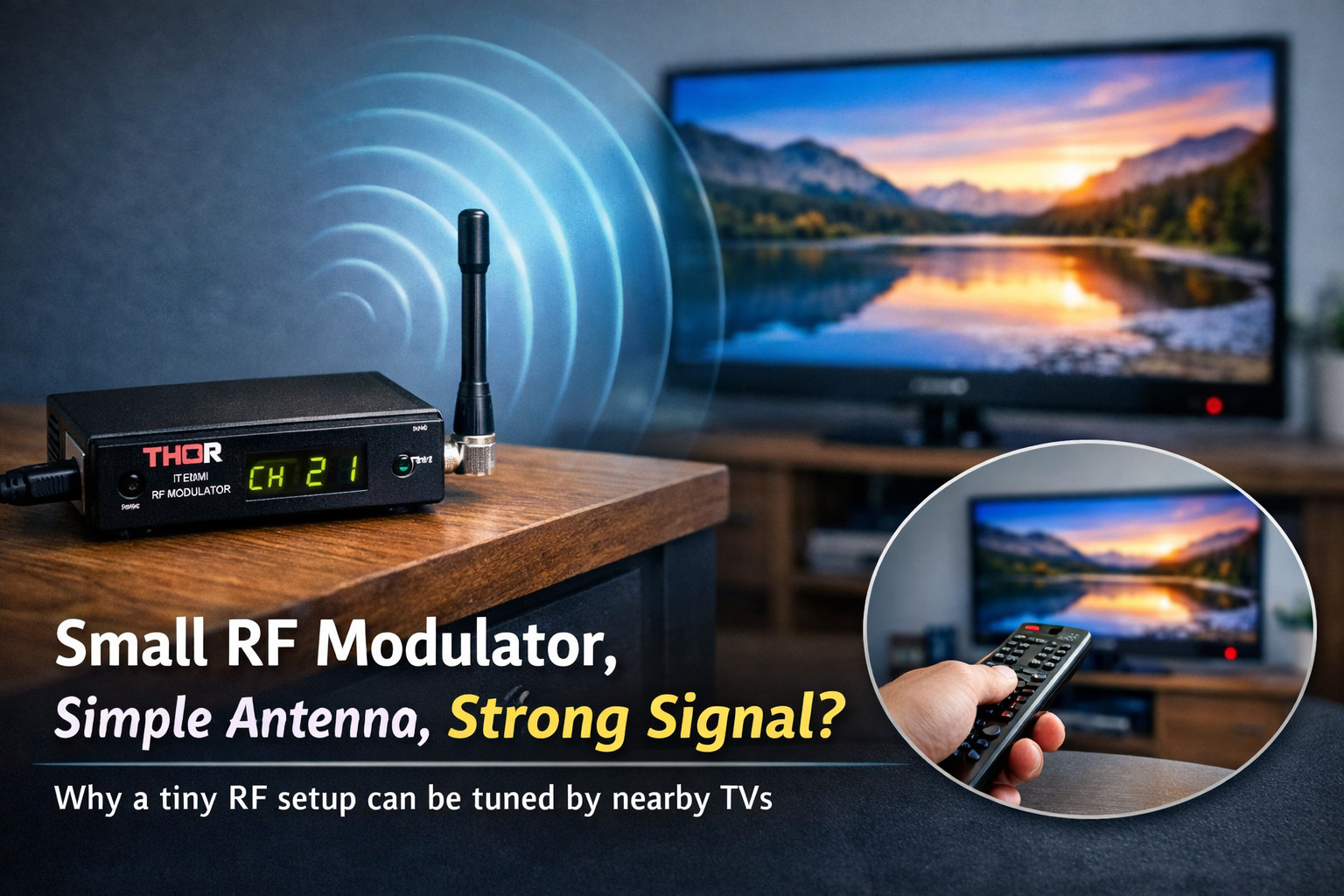
Why a "Small Modulator + Antenna" May Seem to Work

Explore why a small RF modulator may work with a simple antenna, including receiver sensitivity, antenna height, and digital TV behavior.
Why a "Small Modulator + Antenna" May Seem to Work

Table of Contents

  • A Technical Curiosity Article for RF Hobbyists and Engineers
  • Example Modulator Used in Experiments
  • 1. Receiver Sensitivity
  • 2. RF Power vs Distance
  • 3. The Digital Cliff Effect
  • 4. Antenna Height
  • 5. Antenna Types
  • 6. Quiet RF Environment
  • 7. Why Professional Systems Use Coax Instead
  • Conclusion

A Technical Curiosity Article for RF Hobbyists and Engineers

Sometimes engineers or hobbyists notice something interesting. If a small RF modulator is connected to a simple antenna, a nearby television may be able to tune the signal. In some cases the signal might travel across a room, through a building, or even across a small property.

This naturally leads to the question:

Why does this appear to work?

The answer involves several RF engineering concepts including signal strength, receiver sensitivity, antenna efficiency, and the behavior of digital modulation.

Important disclaimer: Television broadcast spectrum is regulated in most countries. Operating any intentional RF transmitter may require licensing depending on the region. This article is written purely for technical curiosity and educational discussion. Always check local regulations before transmitting RF signals.

Example Modulator Used in Experiments

A compact device often used for private RF channel generation is the Thor Petit HDMI RF Modulator.

This type of device converts HDMI video into a digital RF television channel that can be tuned by televisions.

Example product:
Thor Petit HDMI RF Modulator

Devices like this are primarily designed for cable distribution systems, but they can generate a full digital TV channel format.

1. Receiver Sensitivity

Modern digital television receivers are extremely sensitive.

Typical ATSC receivers can decode signals around:

-83 dBm to -85 dBm

That is a very small signal level.

Signal Power Approximate Meaning
+20 dBm 100 mW
0 dBm 1 mW
-40 dBm very weak signal
-80 dBm extremely tiny signal

Because televisions are designed to receive distant broadcast stations, their tuners can detect surprisingly weak nearby signals.

2. RF Power vs Distance

RF signals weaken rapidly as distance increases.

This follows the inverse-square law of propagation.

Distance Approximate Signal Strength
1 meter 100%
10 meters ~1%
100 meters ~0.01%

Because of this effect, a signal that works perfectly across a room may become undetectable only a short distance away.

Typical very small RF setups may only cover:

  • 10–30 feet indoors
  • 50–200 feet outdoors
  • possibly a few hundred feet depending on antenna and environment

3. The Digital “Cliff Effect”

Digital TV behaves differently than analog television.

Signal Quality Result
Above decoding threshold Perfect picture
Below threshold No picture at all

Because of this cliff effect, a signal that is barely strong enough can still produce a perfect picture.

This sometimes creates the illusion that the transmitter is stronger than it actually is.

4. Antenna Height

Antenna height has a major impact on RF propagation.

Raising an antenna improves line-of-sight coverage and reduces obstacles.

Antenna Height Typical Effect
1–2 feet very short range
6–10 feet moderate local coverage
20+ feet much larger coverage area

Even small increases in height can significantly extend signal reach.

5. Antenna Types

Different antenna designs affect how efficiently RF energy is radiated.

Antenna Type Characteristics
Dipole simple balanced antenna, common for TV
Whip antenna small and convenient, moderate efficiency
Yagi antenna directional, higher gain
Log periodic broadband directional antenna

Directional antennas such as Yagi designs can concentrate energy in a particular direction, increasing range in that direction.

6. Quiet RF Environment

Another factor that can make tiny signals work locally is the RF environment.

In some locations there may be little competing signal on a specific frequency.

When the channel is quiet, even a small signal can be detected by nearby receivers.

7. Why Professional Systems Use Coax Instead

Professional video distribution systems almost always use contained RF networks.

Examples include:

  • hotel TV systems
  • hospital television networks
  • stadium displays
  • campus MATV systems

These systems distribute channels through coax cables rather than broadcasting through antennas.

This provides:

  • stable signal levels
  • predictable coverage
  • minimal interference risk
  • scalability

Conclusion

The reason a small modulator connected to an antenna may appear to work is not because it behaves like a full broadcast transmitter.

Instead it is the combination of:

  • very sensitive receivers
  • short transmission distances
  • efficient antennas
  • quiet RF environments
  • digital modulation characteristics

Understanding these factors provides insight into how RF systems behave at very small scales.

However, professional systems typically rely on controlled RF distribution through coax or IPTV networks rather than free-space radiation.


Reminder: Always check local telecommunications regulations before operating any RF transmitter.
Justin White
Justin White
Broadcast Engineer
Broadcast engineer specializing in turnkey CATV and fiber-transport solutions. Experienced in designing and deploying complete encoding/decoding workflows to move virtually any signal over IP, fiber, and RF. Focused on ultra-low-latency headend architectures and custom mux/demux builds, supporting demanding environments across telecom, sports, education, hospitality, studios, live events, and mission-critical institutions worldwide.
View author page
Contact us

Thor Broadcast Sales

Email: [email protected]
Phone: 1(800)521-THOR (8467) Ext 1
FAX: 1(800)521-6384

Customer Service/ Support

Phone: 1-800 521-THOR(8467) Ext 2
Email: [email protected]

Case Studies

- Converting Clear QAM HDTV Channels to Analog RF NTSC for Multi-Site Distribution
- Stadium IPTV - Replay System
- Hotel HDMI-to-QAM TV Distribution
- University IPTV Lecture Systems

  • CATV Modulators:
    • HDMI RF Modulators
    • HD-SDI converters
    • IP to CATV Edge Modulators
  • DVB Encoders:
    • IPTV Video Encoders
    • Hdmi RTSP RTMP RTSP Encoders
    • Transcoders, MPEG Converters, IP ASI Gateways
  • Decoders (IRD's & STB's):
    • RF input - Video /Audio Ouput
    • IP Broadcast Decoders
    • RF CATV and IPTV OTT STB's
  • Satellite Modulators:
    • DVB-S/S2 Satellite Modulators
  • Fiber Optic Transport:
    • SDI Fiber Optic Extenders, Digital Audio Extenders
    • SDI SD/HD/3G with CWDM
    • Cable TV CATV RF 45-900Mhz
    • L-Band Satellite RF 45-3000Mhz
    • Data & Ethernet over fiber
    • Analog Audio Video
    • Fiber Amplifiers - EDFA
    • DVB - ASI
    • Fiber Jumpers, Cables, Attenuators,
    • Optic Splitters Couplers CWDM Muxes
    • Optical Meters, Test Equipment, Accesories
    • Analog Baseband Video Audio, RS485/422/232 Data, Contact Closure
  • HDMI SDI Switchers, LAN Extenders, and Wireless Video Transport:
    • HD Video Switchers and Signal Format Converters for AV Pros
    • Wireless HD SD Video Data Equipment
    • Video Audio Extenders Over Ethernet LAN IP Network
  • HD 4K Cameras, SDI - HDMI - IP Streaming - PTZ - Broadcast and Security:
    • PTZ Streaming Cameras Broadcast cameras with SDI ,HDMI CVBS USB
  • DIscounted Inventory:
    • Satellite and CATV Broadcast Equipment for Sale
    • Lab Used Broadcast Equipment on sale
    • Past Generation Equipment
  • SDI Monitors:
  • Warehouse:
Thor Broadcast Logo
Email: [email protected]
Phone: 1(800) 521-8467 Ext 1
FAX: 1(800)521-6384
Information:
  • About us
  • Client Portfolio
  • Become a Reseller
  • Contact
  • Articles
  • Return Policy
  • Shipping Policy
  • International Order Policy
Popular:
  • RF Modulator
  • HDMI over COAX
  • HDMI over IP
  • COAX to HDMI
  • HDMI to SDI

Thor Broadcast
Torrance Business Park
2421 W 205th St
Torrance
CA 90501

© 2026 Thor Broadcast
Subscribe to our newsletter

Sign up here to get the latest news, updates and special offers delivered directly to your inbox.

You can unsubscribe at any time
newsletter image