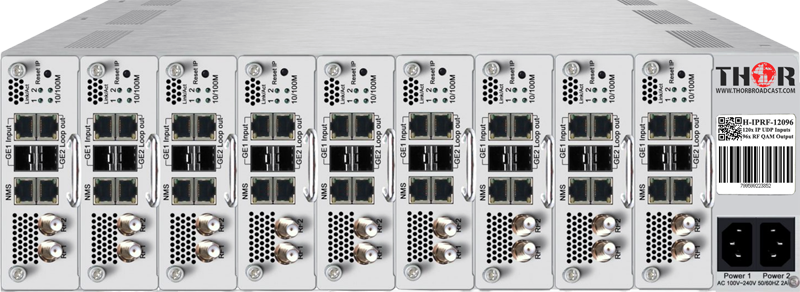
Edge QAM Modulador de la IPTV columna vertebral para Borrar QAM RF
Número de parte# H-IPRF-3024
Entrada: 30x IP (UDP) : Salidas: 24x QAM-256
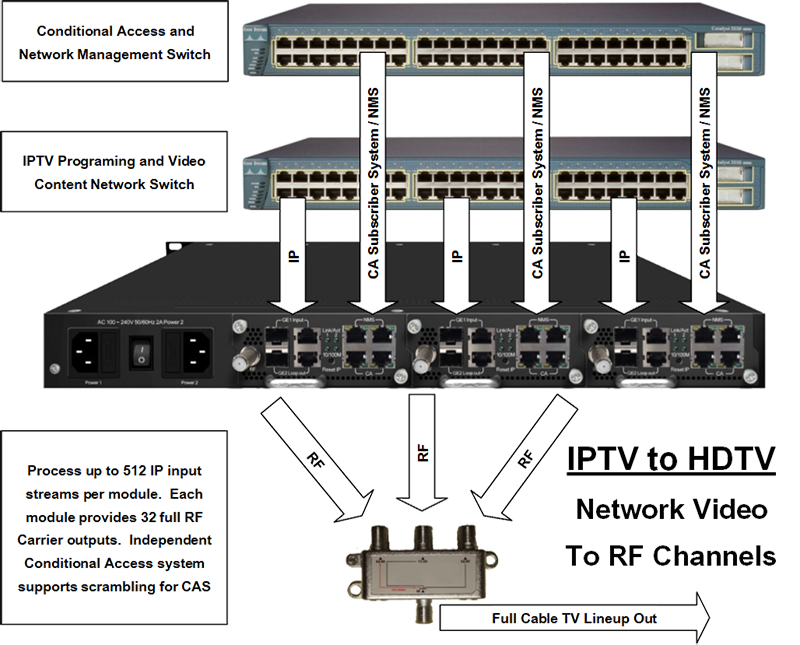
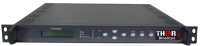
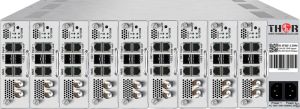
Thor número de pieza H-IPRF sistemas de alta densidad de la tarjeta de modulador basado en el chasis. Tarjeta de bahías de apoyo T108 modulador de tarjetas con dos sistemas independientes, uno por cada tarjeta, cada uno con 4x adyacentes QAM-256 salidas y 5 UDP direcciones IP y los puertos. Cada entrada de la propiedad intelectual puede apoyar MPTS entradas de hasta 108 Mbps, con el total de la entrada por el puerto Gigabit Ethernet tener un máximo de agregado de programa de secuencia de entrada de hasta 870 Mbps. Esta capacidad permite que el 3024 chasis modular de hasta 96 programas HD por chasis, o hasta 400 SD programas cuando están correctamente configurados en QAM-256. El panel frontal dispone de interruptores de llave para ambas unidades de suministro de energía, así como un interruptor para el sistema de alarma. Cuando está activada, la unidad emitirá un sonido de tono de alarma cuando una alarma de evento, tales como una perdida de entrada de vídeo es detectado. La placa base en el chasis incluye una alta capacidad de TS multiplexor que es capaz de enrutar los programas de una tarjeta de entrada a otro. Esto permite que cualquier entrada en cualquier carta para ser reasignados dinámicamente en cualquier disposición, para cualquier configuración de salida. Esto proporciona una completa matriz de enrutamiento de todos los programas para el cherry picking personalizado alineaciones para el RF de salida. Thor H-IPRF sistemas son los más altos de la densidad digital moduladores de canales disponibles. Esta plataforma es ideal para viajeros de negocios MATV y las industrias de la hospitalidad.
|
*Todas las Especificaciones Sujetas a Cambio Sin previo Aviso |
|||
|
De entrada |
2x Gigabit Etherent RJ-45 o SFP de la Interfaz |
||
|
Protocolo De Secuencia |
UDP-TS Multidifusión o Unidifusión IGMP V2/V3 |
||
|
Código De Tarifa |
108 Mbps / canal 840 Mbps / tarjeta de |
||
|
Los Canales De Entrada |
Hasta 10 Direcciones IP / Puertos |
||
|
Canales De Salida |
Hasta 8 Direcciones IP / Puertos |
||
|
Max Pid |
Proceso de hasta 256 único PIDs |
||
|
Las Funciones De Multiplexación |
PID Reasignación de PCR ajuste Fino PSI / SI la Generación de |
||
|
RF Salidas |
8x QAM |
||
|
RF Normas |
QAM, DVB-C |
||
|
Símbolo De Las Tasas De |
5.0 - 7.0 Msps |
||
|
Interfaz de RF |
2x Tipo-F (4 portaaviones por terminal) |
||
|
Frecuencia del RF |
45 - 870 MHz |
||
| RF Ajuste | -14 dBm - 6 dBm | ||
|
Entrada De Alimentación |
100-240 v Conmutación Automática de ~ 20 W |
||
|
Dimensiones |
630 x 440 x 44 mm |
||
|
Peso |
9.5 kg |
||
|
Temperatura De Funcionamiento |
0 - 45 C |
||
Typical bitrate is 4–8 Mbps per HD channel depending on quality requirements. UDP multicast is preferred for large-scale distribution due to efficiency and scalability. Multicast addresses typically use the 239.x.x.x private range. A single QAM channel can carry multiple programs depending on bitrate. One QAM channel supports approximately 38 Mbps of usable bandwidth. MPTS is commonly used for RF QAM systems, while SPTS is typical for IPTV streams. A hybrid encoder like Thunder-2 can generate both RF and IPTV outputs simultaneously. A pure IPTV encoder (like Spartan-2) is used when RF distribution is not required. An IP-to-QAM gateway such as H-IPRF-4QAM converts multicast IP streams directly into RF channels. Direct IP-to-QAM gateways are more efficient, while STB + modulator is a lower-cost alternative. Hybrid systems allow gradual migration from RF to IPTV without replacing infrastructure. The network must support multicast routing, IGMP snooping, and sufficient bandwidth. IGMPv2 is commonly sufficient, but IGMPv3 allows more advanced filtering. Yes, VLANs are recommended to isolate IPTV traffic and improve performance. QoS should prioritize multicast video traffic to prevent packet loss and jitter. Latency is typically very low (sub-second) in multicast IPTV systems. Redundancy can be implemented using backup encoders and network paths. Yes, multicast allows unlimited endpoints to subscribe to the same stream. The number of streams depends on network capacity and switch/router performance. Decoders include IP set-top boxes, professional IRDs, or software players. Most smart TVs do not natively support multicast, so STBs are typically required. Streams can be recorded using NVR systems or software-based TS recorders. Tools like TS analyzers and network sniffers can monitor stream quality and integrity. RF and IP systems are synchronized by using the same encoded source streams. Virtual channel issues are caused by differences in PSIP tables and frequency mapping. Frequency planning should avoid overlap and ensure proper RF level balancing. Typical RF output levels are around +35 dBmV, adjusted based on distribution losses. Yes, multicast architecture allows easy scaling across multiple facilities. Centralized encoding is simpler to manage, while distributed encoding adds redundancy and flexibility.
The hospital is expected to use multicast streaming for distributing content across multiple facilities. Initially, they are planning for one channel, but this will likely expand to 3–4 channels. The content will be internally produced and non-copyrighted. The content may be displayed on patient TV channels, staff-only TVs, or a combination of both. The current system is QAM-based using COM3000, with a likely transition to IPTV in the future. Yes, a coaxial RF distribution network is already in place across all facilities. Yes, IP infrastructure is available behind the TVs due to recent upgrades. Facilities are likely connected via dedicated fiber links, but this needs confirmation. The network is expected to support multicast and VLANs, but this should be verified. Yes, there is a clear intention to migrate toward IPTV over time. Some facilities may still require RF output, so both IP and QAM solutions should be supported. The system will likely use a centralized encoder generating multicast streams. Yes, content can be injected into the existing QAM system if needed. There have been previous issues with virtual channel mapping due to differences in channel tables. The deployment scale could range from a few sites to potentially all facilities. Budget is not finalized, but ballpark pricing ranges from ~$1,500 per encoder to ~$3,000 for IP-to-QAM gateways.
HDMI, DVI o VGA a través de IP
Transporte de HDMI, DVI o VGA de video sobre Redes IP con HDCP para HDMI.
4x CVBS Codificador / Modulador / Servidor IPTV
4 Ch CVBS SD Modulador del Codificador con ASI Multiplexor y el RF / IP / Salida ASI de