| Availability: | Check availability | Condition: | new |
|
| Shipping: | starting at $0.00 | Warranty: | 2Yrs |
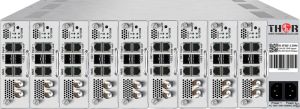
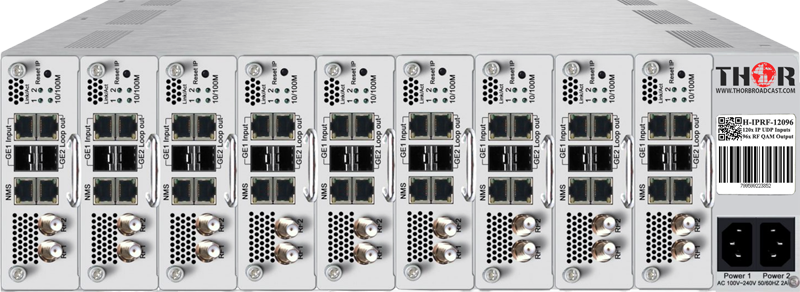
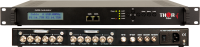
Edge QAM Modulator for IPTV Backbone to Clear QAM RF
Part Number: H-IPRF-3024
Input: 30x IP (UDP) : Outputs: 24x QAM-256
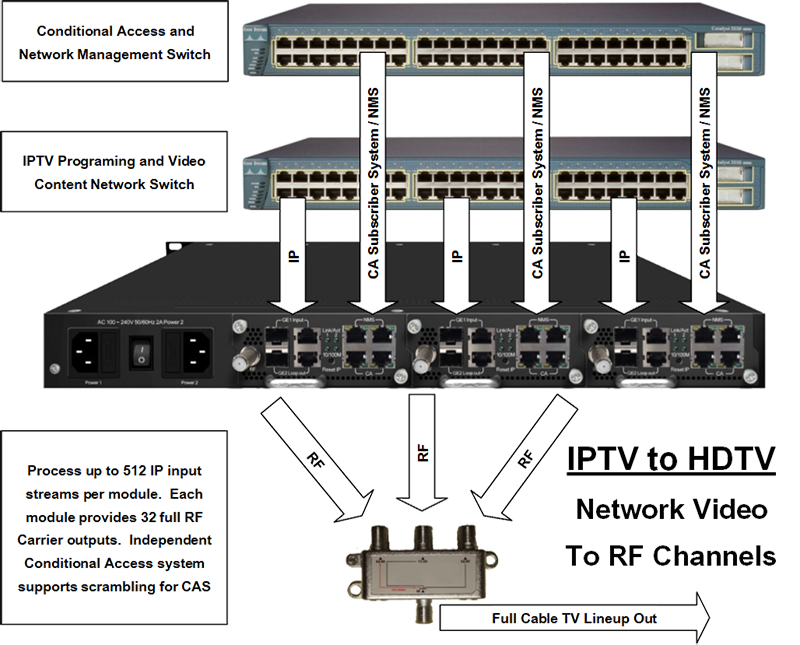
Thor part number H-IPRF systems are high-density, card-based modulator chassis. Card bays support T108 modulator cards with two independent systems per card, each with 4x adjacent QAM-256 outputs and 5 UDP IP addresses and ports. Each IP input can support MPTS inputs up to 108 Mbps, with the total input per Gigabit Ethernet port having a maximum aggregate program stream input of up to 870 Mbps. This capacity allows the 3024 chassis to modulate up to 96 HD programs per chassis, or up to 400 SD programs when properly configured on QAM-256. The front panel has keyed switches for both power supply units, as well as a toggle for the alarm system. When armed, the unit will emit an audible alarm tone when an alarm event, such as a lost video input, is detected. The mainboard in the chassis includes a high-capacity TS multiplexer that is able to route programs from one input card to another. This allows any input on any card to be dynamically remapped in any arrangement to any output configuration. This provides full matrix routing of all programs for cherry-picking custom lineups for the RF outputs. Thor H-IPRF systems are the highest-density digital channel modulators available. This platform is ideal for the corporate MATV and hospitality industries.
|
*All Specifications Subject to Change Without Notice |
|||
|
Input |
2x Gigabit Ethernet RJ-45 or SFP Interface |
||
|
Stream Protocol |
UDP-TS Multicast or Unicast IGMP V2/V3 |
||
|
Code Rate |
108 Mbps / channel 840 Mbps / card |
||
|
Input Channels |
Up to 10 IP Addresses / Ports |
||
|
Output Channels |
Up to 8 IP Addresses / Ports |
||
|
Max PIDs |
Process up to 256 unique PIDs |
||
|
Multiplexing Functions |
PID Remapping PCR Fine Tuning PSI / SI Generation |
||
|
RF Outputs |
8x QAM |
||
|
RF Standards |
QAM, DVB-C |
||
|
Symbol Rates |
5.0 - 7.0 Msps |
||
|
RF Interface |
2x Type-F (4 Carriers per terminal) |
||
|
RF Frequency |
45 - 870 MHz |
||
| RF Adjustment | -14 dBm - 6 dBm | ||
|
Power Input |
100-240 VAC auto switching ~ 20 W |
||
|
Dimensions |
630 x 440 x 44 mm |
||
|
Weight |
9.5 kg |
||
|
Operating Temperature |
0 - 45 C |
||
Typical bitrate is 4-8 Mbps per HD channel depending on quality requirements. UDP multicast is preferred for large-scale distribution due to efficiency and scalability. Multicast addresses typically use the 239.x.x.x private range. A single QAM channel can carry multiple programs depending on bitrate. One QAM channel supports approximately 38 Mbps of usable bandwidth. MPTS is commonly used for RF QAM systems, while SPTS is typical for IPTV streams. A hybrid encoder like Thunder-2 can generate both RF and IPTV outputs simultaneously. A pure IPTV encoder (like Spartan-2) is used when RF distribution is not required. An IP-to-QAM gateway such as H-IPRF-4QAM converts multicast IP streams directly into RF channels. Direct IP-to-QAM gateways are more efficient, while STB + modulator is a lower-cost alternative. Hybrid systems allow gradual migration from RF to IPTV without replacing infrastructure. The network must support multicast routing, IGMP snooping, and sufficient bandwidth. IGMPv2 is commonly sufficient, but IGMPv3 allows more advanced filtering. Yes, VLANs are recommended to isolate IPTV traffic and improve performance. QoS should prioritize multicast video traffic to prevent packet loss and jitter. Latency is typically very low (sub-second) in multicast IPTV systems. Redundancy can be implemented using backup encoders and network paths. Yes, multicast allows unlimited endpoints to subscribe to the same stream. The number of streams depends on network capacity and switch/router performance. Decoders include IP set-top boxes, professional IRDs, or software players. Most smart TVs do not natively support multicast, so STBs are typically required. Streams can be recorded using NVR systems or software-based TS recorders. Tools like TS analyzers and network sniffers can monitor stream quality and integrity. RF and IP systems are synchronized by using the same encoded source streams. Virtual channel issues are caused by differences in PSIP tables and frequency mapping. Frequency planning should avoid overlap and ensure proper RF level balancing. Typical RF output levels are around +35 dBmV, adjusted based on distribution losses. Yes, multicast architecture allows easy scaling across multiple facilities. Centralized encoding is simpler to manage, while distributed encoding adds redundancy and flexibility.
The hospital is expected to use multicast streaming for distributing content across multiple facilities. Initially, they are planning for one channel, but this will likely expand to 3-4 channels. The content will be internally produced and non-copyrighted. The content may be displayed on patient TV channels, staff-only TVs, or a combination of both. The current system is QAM-based using COM3000, with a likely transition to IPTV in the future. Yes, a coaxial RF distribution network is already in place across all facilities. Yes, IP infrastructure is available behind the TVs due to recent upgrades. Facilities are likely connected via dedicated fiber links, but this needs confirmation. The network is expected to support multicast and VLANs, but this should be verified. Yes, there is a clear intention to migrate toward IPTV over time. Some facilities may still require RF output, so both IP and QAM solutions should be supported. The system will likely use a centralized encoder generating multicast streams. Yes, content can be injected into the existing QAM system if needed. There have been previous issues with virtual channel mapping due to differences in channel tables. The deployment scale could range from a few sites to potentially all facilities. Budget is not finalized, but ballpark pricing ranges from ~$1,500 per encoder to ~$3,000 for IP-to-QAM gateways.
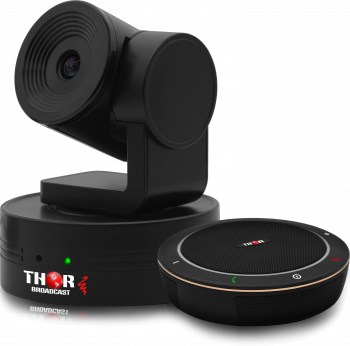 MaximusStarTalk Video Conference 10x Camera with Omnidirectional USB Microphone
The MaximusStarTalk is a video conferencing suite with audio and video for collaborative applications. The camera has a built-in 10x Zoom 1080P wide-angle lens. The kit includes an omnidirectional USB microphone, which picks up voices at a distance of 3 meters in every direction. Ideal for small professional conference rooms or video applications within 30 square meters. It is compatible with various conference call systems and applications like Skype for Business, Cisco, Zoom, WebEx APKs, or video conferencing software, and is the best choice for software video conferencing solutions.
 4x CVBS Encoder / Modulator / IPTV Server
4 Ch CVBS SD Encoder Modulator with ASI Multiplexer and RF / IP / ASI Output

 ES
ES