The broadcasting industry upgrades itself now and then to support 4K and 8K video data requirements through new technologies. Some of those waves of new technologies include 12G SDI over fiber.
Table of Contents
As it stands, high-resolution video content demands are ever on the increase. The broadcasting industry upgrades itself now and then to support 4K and 8K video data requirements through new technologies. Some of those waves of new technologies include 12G SDI over fiber-some of the key technologies in delivering uncompressed video signals with unparalleled quality.
It is a capability that provides quality content with little latency and preserves the integrity of video signals for broadcasters.
Running at 12 Gbps, 12G SDI has the headroom for uncompressed video, audio, and ancillary data over a single coaxial or fiber optic cable. Immediately, this simplifies things for the broadcaster: he is able to send high-definition signals without a multitude of cables or complicated configurations.
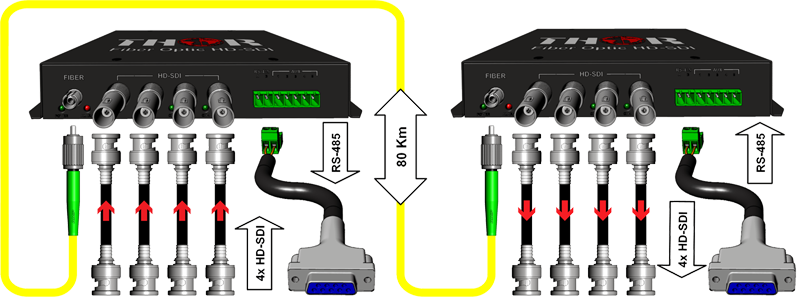
While HD-SDI over fiber and 3G SDI over fiber served the industry well, burgeoning demands for higher resolutions better positioned the industry for an upgrade to use 12G SDI over fiber. Some of the benefits that come along with the use of fiber optics together with 12G SDI:
It can transmit data across a much larger area than regular copper cables without any deterioration in its signal. That's very useful for live broadcasts because cameras can be placed farther away from the production facility.
This is one of the greatest advantages in fiber optic cables. These do not experience electromagnetic interference, which is experienced in copper cables. This, in fact, ensures that a video signal stays clear and consistent even in an area with heavy electronic equipment.
Compared to copper, the fiber optics are highly compatible with higher data rates. Hence, this is ideal for 12G SDI in terms of bandwidth. High bandwidth essentially means the system can transit uncompressed video signals; hence maintaining broadcast quality.
Several components are integrated into 12G SDI over fiber with the assurance of high-quality video transmission:
This in turn means that the key device for converting electrical 12G SDI into an optical signal for transmission over the optical cables is the SDI fiber extender. The possibility of extending much farther without diminishing video quality is thus created. Hence, especial use for the SDI fiber extender can be found in applications that involve very long cable runs-for example, inside a sports stadium or a large production studio.
The primary job of any SDI multiplexer is to use bandwidth efficiently. This can allow a number of signals of SDI combined into a single fiber optic cable, further enabling the broadcasters to send multiple video feeds all at once. This is significantly advantageous in complex broadcasting setups where the management of a number of cameras or multiple feeds needs to be done effectively.
Like the SDI Mux, this SDI fiber multiplexer is also a very effective solution when one has to deal with multiple 12G SDI signals. More importantly, aggregating them onto a single strand of fiber for transmission ensures that broadcasters can easily operate and set up their systems.

Another strong advantage of 12G SDI over fiber in delivering uncompressed video signals: It can deliver full-quality 4K and 8K material with no loss in detail to provide crystal-clear quality for your audience. This becomes extremely important in very critical live broadcasts where the quality of the picture is just as important as the broadcast itself.
Consequently, moving to 12G SDI over fiber will be one avenue through which broadcasters will be able to future-proof their infrastructure in the industry's march toward higher and higher resolutions. With 4K and 8K contents on the increase, investing in 12G SDI is prudent business; such steps ensure that broadcasters meet future demands without necessarily needing major upgrades.
This alone might be a huge problem with live broadcasts. 12G over fiber reduces latency, enabling real-time transmission of signals. In live sports or other time-sensitive productions, every fraction of a second lost in the transmission of signals counts toward viewer experience.
Although the initial installation cost of fiber optics can be much higher compared to the traditional copper systems, in the long run, it is very cost-effective. This is due to the fact that these cables are usually lighter and have less maintenance. It cuts down a lot of costs from operations. Moreover, the fact that one cable can carry lots of signals reduces the installation and material costs.

The application of 12G SDI over the fiber includes one of the largest sports broadcasting areas. This technology is used more in events because this is a highly pressurized area for real-time and high-quality video transmission. Therefore, with the use of technology, one is able to connect a number of cameras with several feeds at various angles from the event site back to the production facility for complete viewer coverage.
Television Production
12G over fiber SDI is becoming a go-to technology within the production process of many television studios. A number of 4K and 8K feeds that emanate from different cameras are required to be managed. This, however, has to be done without compromising quality. It simplifies the routing of video signals within the studio; efficient workflow promotes allowing complex productions.
Moving with the progress of broadcast technology to remote production-where control is done from a location different from that which the event is happening-12G over fiber became indispensable. This, in fact, really enables broadcasters to send very high-quality video signals from faraway places back to the central control room for professional-grade production of events from very far distances.
While the industry is moving at an increased pace towards IP-based workflows, integration with the existing systems becomes crucially important. It can also carry SDI signals as well as data traffic on the fiber optics. It allows seamless communication between the devices. That could mean a lot when innovating technologies in broadcasting and opened future possibilities.
While the face of broadcasting is changing fast, 12G over fiber technology stands at the head in this revolution. Since more content will be produced in both 4K and 8K, there is an increasing demand for real and high-quality transmission. This technology meets their current demands and positions broadcasters into the future with changing trends in video resolution and quality.
Soon, 12G SDI over fiber technology is going to play a very important role in broadcasting, as it allows uncompressed 4K and 8K video signal transmission at a quality that has never been seen before. The advantages include long-distance transmission with no interference, support for several signals, and hence one of the best choices for professional environments.
Understand and implement 12G SDI over fiber to enable the broadcasters to continue embracing high-resolution content. From live sports and television production to remote broadcasting and integration with IP, 12G over fiber is considered one of the most reliable and efficient solutions that will shape the next generation of video transmission.
Read More:


 ES
ES