Hybrid RF and IPTV modulators helped a major racetrack modernize video distribution for garages, pit lanes, control rooms, and hospitality areas.
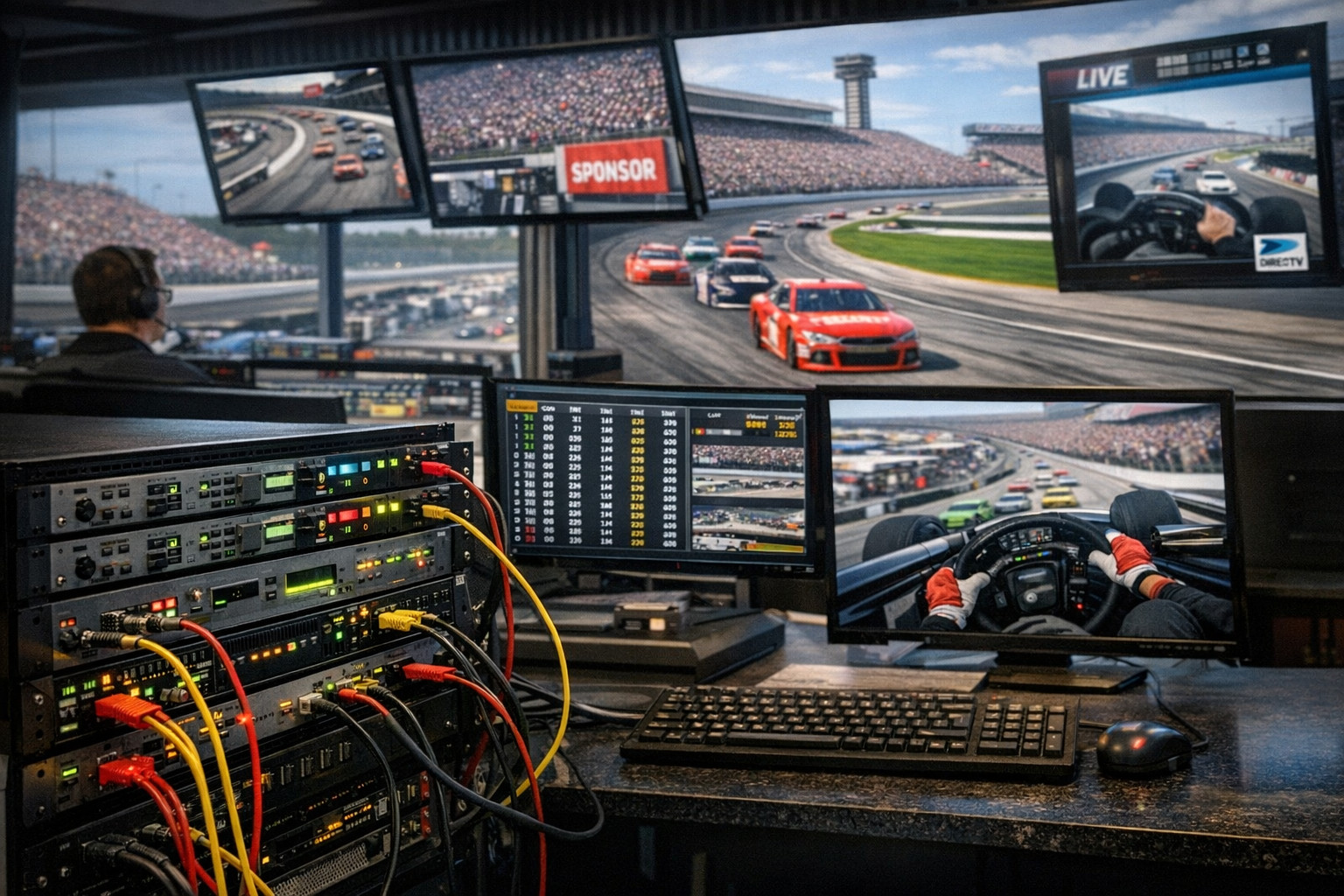
Table of Contents
Large motorsport venues such as racetracks operate complex video distribution systems that must deliver multiple video feeds simultaneously to garages, pit lanes, control rooms, hospitality areas, and broadcast partners.
A recent project involved a major racetrack facility that needed to modernize its aging RF modulation system while maintaining compatibility with an existing Cisco StadiumVision IPTV platform.
The facility receives video from multiple sources including:
Traveling broadcast production trucks
Timing and scoring systems
Race commentary feeds
DirectTV receivers
Graphics and sponsor feeds
Because race events such as NASCAR require absolute reliability, the system had to support both RF television distribution and IPTV streaming simultaneously, while also allowing flexibility for future expansion.
The racetrack selected Thor Broadcast Hybrid HDMI/SDI RF + IPTV Modulators as the core upgrade solution.
The racetrack’s legacy system had evolved organically over more than a decade.
Key challenges included:
Several modulators had begun failing, causing channel outages during events.
These legacy devices were responsible for converting HDMI or SDI video feeds into RF channels distributed throughout the facility.
The facility receives video feeds in multiple formats:
HDMI from DirectTV receivers and internal graphics systems
SDI feeds from mobile production trucks and broadcast equipment
Resolution typically 1080i over 3G-SDI
However, the venue expects that future events may require support for:
1080p workflows
12G-SDI broadcast signals
This required a future-proof system architecture.
The racetrack distributes video through two systems simultaneously:
RF Distribution
Traditional coax network feeding televisions across garages and pit areas
IPTV Distribution
Cisco StadiumVision platform distributing video to digital signage and internal networks
Maintaining both systems meant that every video source needed to be available as:
RF television channel
IPTV multicast stream
International race organizations frequently bring their own video infrastructure.
These teams often insert additional RF channels into the racetrack combiner system for specialized team broadcasts.
This requires:
Flexible RF channel allocation
Ability to quickly disable or reassign channels
High-frequency channel management
The original system contained approximately:
| Source Type | Channels |
|---|---|
| HDMI Sources | 16 |
| SDI Sources | 7 |
| DirectTV Receivers | Multiple |
| Graphics Channels | Several |
| Production Truck Feeds | Multiple |
Most feeds were converted using single-channel modulators, resulting in a rack full of equipment with limited redundancy.
To modernize the infrastructure while maintaining flexibility, the racetrack deployed Thor Broadcast Hybrid RF/IPTV modulators.
These devices convert video inputs into both:
QAM RF channels
IP multicast streams
at the same time.
4-Channel HDMI/SDI RF + IPTV Modulator
Key capabilities:
4 HDMI or SDI inputs
Simultaneous RF and IPTV output
QAM modulation for cable TV distribution
Multicast UDP streaming for IPTV systems
Rack-mount design for broadcast environments
This allowed the facility to replace multiple aging modulators with a smaller number of high-density units.
The engineering team evaluated multiple approaches.
Using standalone RF modulators plus an IPTV encoder.
Pros
Lower cost per device
Cons
Doubled equipment count
More failure points
Complex signal splitting
Another option was converting RF channels back into IP using a QAM-to-IP gateway.
Pros
Centralized IP conversion
Cons
Single point of failure
Requires working RF modulator first
Pros
RF and IPTV created simultaneously
Fewer devices
Reduced signal splitting
Simplified configuration
Independent redundancy across multiple units
This architecture prevents a single system failure from disabling the entire network.
During the upgrade process, engineers also improved RF efficiency.
Instead of mapping one program per RF channel, the system can multiplex multiple streams.
Example:
One QAM256 RF channel ≈ 38 Mbps bandwidth
Two HD streams (~19 Mbps each) can share a single RF channel
This allows the facility to:
Reduce RF spectrum usage
Free up channels for visiting broadcast teams
Maintain video quality
The racetrack plans additional upgrades including:
Because the facility spans several miles, long coax runs create signal loss challenges.
Using RF over fiber technology allows:
Transmission of RF signals over kilometers
Elimination of coax attenuation
Simplified distribution architecture
Thor Broadcast RF over fiber systems can extend RF distribution across large campuses such as stadiums or racetracks.
The facility is evaluating alternatives to Cisco StadiumVision.
By using modulators that output standard UDP multicast streams, the system remains compatible with virtually any IPTV middleware platform.
After deploying the hybrid modulators, the racetrack gained several improvements.
New modulators replaced failing legacy units.
The modular architecture allows additional channels to be added easily.
Multiple smaller modulators prevent total system failure.
Each source now generates RF + IPTV simultaneously.
The system easily accommodates visiting production teams and additional RF channels.
This architecture is commonly used in:
Sports stadiums
Racetracks
Casinos
Cruise ships
University campuses
Hotels and resorts
Military bases
Anywhere that requires simultaneous RF television and IPTV distribution.
Relevant technologies involved in this deployment include:
QAM Modulation
IPTV Multicast Streaming
HDMI and SDI Broadcast Interfaces
RF Over Fiber Distribution
Broadcast Video Routing
Modern sports venues require flexible video distribution systems capable of supporting both traditional RF television networks and modern IPTV platforms.
By upgrading to Thor Broadcast hybrid RF/IPTV modulators, the racetrack achieved:
Improved reliability
Simplified architecture
Future-ready infrastructure
Support for major racing events such as NASCAR
The deployment demonstrates how hybrid modulation technology can bridge the gap between legacy cable systems and modern IP video networks.


 ES
ES