Learn how to convert 100 DVB-S2 satellite TV channels to IPTV multicast and distribute them over fiber using Thor Broadcast gateways, converters and STBs.
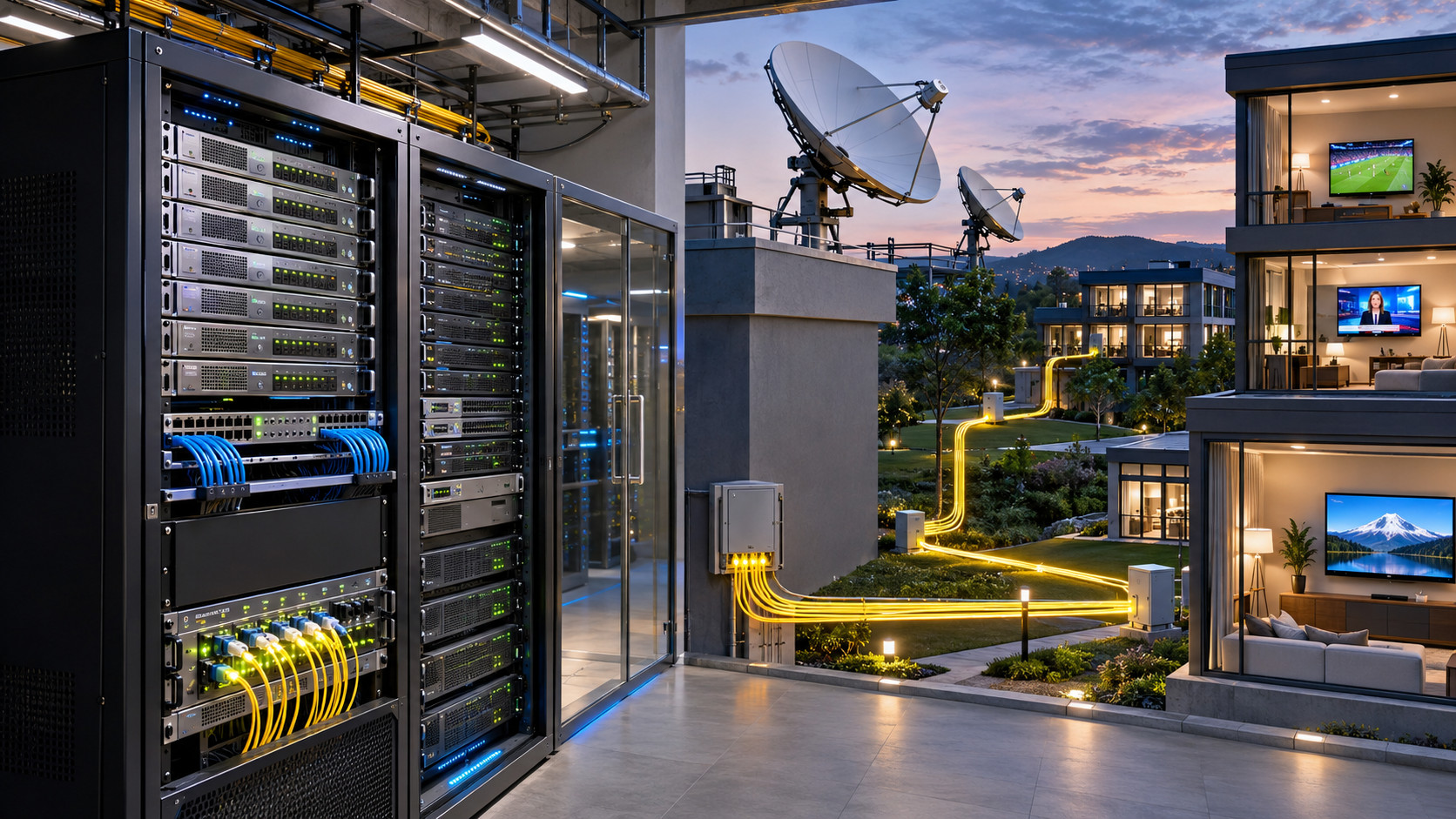
Complete DVB-S/S2 to IPTV Multicast Headend and Fiber Optic TV Distribution Solution by Thor Broadcast
Table of Contents
How can you receive 100 satellite TV channels and distribute them to 100 televisions across multiple buildings using fiber optic cable?
Thor Broadcast offers a professional DVB-S/S2 to IPTV over fiber solution that converts free-to-air (FTA) satellite television channels into IPTV multicast streams and distributes them through standard Gigabit Ethernet networks and fiber optic connections.
The system uses the Thor Broadcast H-16DVBS-IP satellite to IPTV gateway, Gigabit Ethernet switches, F-GET Ethernet over fiber media converters, and H-STB-IP IPTV set-top boxes.
This architecture is suitable for hotels, resorts, hospitals, universities, residential compounds, corporate campuses, commercial facilities, and other large-scale television distribution projects.
Instead of installing a separate satellite receiver at every television, all satellite signals are received and converted at a central IPTV headend. Individual televisions then receive their selected channels over the Ethernet network.
Satellite DVB-S2 → IPTV Multicast → Gigabit Ethernet → Fiber Optic Distribution → IPTV Set-Top Box → TV
text
       SATELLITE DISH / LNB
                 |
                 | DVB-S/S2 Satellite RF
                 v
       SATELLITE MULTISWITCH
                 |
                 | Coaxial L-Band Feeds
                 v
      +------------------------+
      | THOR H-16DVBS-IP       |
      | SATELLITE IPTV GATEWAY |
      | 16 DVB-S/S2 Tuners     |
      | (2-3 Units Estimated)  |
      +------------------------+
                 |
                 | UDP/RTP IPTV Multicast
                 v
      +------------------------+
      | GIGABIT ETHERNET       |
      | MANAGED IP SWITCH      |
      | IGMP Snooping Enabled  |
      +------------------------+
                 |
                 | RJ45 Ethernet
                 v
      +------------------------+
      | THOR ETHERNET TO FIBER |
      | F-GET-TR-SFP-A         |
      |       OR               |
      | F-GET-4ET-A            |
      +------------------------+
                 |
                 | SINGLE-MODE FIBER
                 |
                 v
      +------------------------+
      | THOR FIBER TO ETHERNET |
      | F-GET-TR-SFP-B         |
      |       OR               |
      | F-GET-4ET-B            |
      +------------------------+
                 |
                 | RJ45 Ethernet
                 v
      +------------------------+
      | REMOTE IP SWITCH       |
      | (If Required)          |
      +------------------------+
                 |
          Ethernet Network
                 |
          +------+------+
          |      |      |
          v      v      v
        IPTV   IPTV   IPTV
        STB    STB    STB
          |      |      |
        HDMI   HDMI   HDMI
          |      |      |
          v      v      v
         TV 1   TV 2   TV 3

       Repeat for up to 100 TVs
The remote Ethernet switch may be omitted when using an F-GET-4ET-A/B converter directly with a small group of IPTV set-top boxes.
Product Link: Thor Broadcast H-16DVBS-IP – DVB-S/S2 to IPTV Gateway
The H-16DVBS-IP is a professional satellite receiver and IPTV gateway equipped with 16 independent DVB-S/S2 satellite tuners.
Each tuner receives a satellite transport stream from a selected transponder. Unlike a conventional satellite receiver that typically displays one TV program at a time, the H-16DVBS-IP can extract multiple television programs from each received transponder.
For example, one DVB-S2 satellite transponder may carry 4, 8, 10, or more TV programs, depending on compression, available bandwidth, and the satellite operator's configuration.
The gateway converts the selected TV programs into IP transport streams that can be distributed over a local Ethernet network.
For a 100-channel satellite IPTV headend, approximately 2–3 H-16DVBS-IP gateways may be appropriate, depending on the satellite channel lineup and transport stream bandwidth.
For example, if each satellite transponder carries an average of eight television programs, approximately 13 transponders would contain 100 programs.
However, the actual number of gateways depends on several factors, including:
Important: The 16-tuner specification refers to 16 satellite transponder tuning inputs, not a limit of 16 television programs. A single gateway can output substantially more than 16 IPTV programs, provided that the tuner and system bandwidth requirements are satisfied.
For a final equipment recommendation, Thor Broadcast can evaluate the satellite transponder list and determine the optimal gateway configuration.
In many applications, no separate IP multiplexer is required.
The H-16DVBS-IP provides transport stream processing and multiplexing functions that allow selected satellite programs to be extracted and delivered as IPTV streams.
For straightforward satellite-to-IPTV multicast distribution, the gateway can serve as the central headend device.
A separate multiplexer, transcoder, or additional processing equipment may be needed for more complex applications involving bitrate reduction, codec conversion, or combining sources from multiple systems.
After satellite channels are converted into IPTV streams, the gateway's DATA Ethernet output connects to a managed Gigabit Ethernet switch.
The Ethernet switch distributes the IPTV channels to the remote network locations through fiber optic media converters.
IPTV multicast is particularly efficient for large-scale television distribution.
With multicast, the gateway sends each television program as an IP stream. Multiple IPTV set-top boxes can subscribe to the same multicast address and receive the channel without requiring a separate transmission from the gateway for every viewer.
For example, if 50 televisions are watching the same TV channel, the gateway does not need to generate 50 separate video streams.
The network distributes the multicast traffic to the required destinations.
For reliable IPTV multicast distribution, the network should include:
IGMP snooping helps prevent multicast video traffic from unnecessarily reaching every Ethernet port.
This is especially important in systems with 100 or more televisions, where many different channels may be viewed simultaneously.
Thor Broadcast offers two practical Ethernet-over-fiber solutions for transmitting IPTV multicast traffic between buildings, floors, network closets, and remote television locations.
Product Link: F-GET-TR-SFP – 10/100/1000 Mbps Ethernet over Fiber with SFP
The Thor F-GET-TR-SFP is a Gigabit Ethernet media converter designed to extend standard Ethernet connections over fiber optic cable.
It converts Ethernet signals from an RJ45 copper interface to an optical SFP interface and restores the Ethernet signal at the receiving end.
The standard single-fiber configuration uses matching A and B units, with 1310 nm and 1550 nm optical wavelengths, respectively.
Features:
Typical Application:
Central IPTV Switch → F-GET-TR-SFP-A → Single-Mode Fiber → F-GET-TR-SFP-B → Remote Ethernet Switch → IPTV STBs
This configuration is recommended when many televisions are connected to a remote Ethernet switch.
Product Link: F-GET-4ET-A/B – 4-Port Gigabit Ethernet over Single-Mode Fiber
The F-GET-4ET-A/B is a compact fiber optic Ethernet transceiver system that provides four RJ45 Gigabit Ethernet ports at each end of a single-fiber link.
This product is especially useful when multiple IPTV set-top boxes are installed close together.
Instead of installing an individual Ethernet media converter for each television, one F-GET-4ET-A/B fiber link can provide Ethernet connectivity to several devices at the remote location.
Features:
Typical Application:
Central Ethernet Switch → F-GET-4ET-A → Single-Mode Fiber → F-GET-4ET-B → Up to Four IPTV Set-Top Boxes → Four TVs
This is an excellent solution for small groups of televisions located in the same building area or equipment room.
Note: The four Ethernet ports share the available Gigabit fiber-link bandwidth. They do not provide four independent 1 Gbps optical links.
| Application | Recommended Product |
|---|---|
| Connect two Ethernet switches over fiber | F-GET-TR-SFP |
| Extend one Gigabit Ethernet link to another building | F-GET-TR-SFP |
| Connect several nearby IPTV devices without a separate remote switch | F-GET-4ET-A/B |
| Deliver IPTV to remote network closets | F-GET-TR-SFP |
| Connect up to four IPTV STBs at one remote fiber endpoint | F-GET-4ET-A/B |
Both options transport the IPTV streams as standard Ethernet/IP traffic. They do not convert IPTV back into RF.
Product Link: Thor Broadcast H-STB-IP – Compact IPTV Set-Top Box
At each television location, the Thor Broadcast H-STB-IP receives IPTV streams over Ethernet and converts the selected stream into an HDMI video output.
Each set-top box connects to the local Ethernet network through an RJ45 port and to the television through HDMI.
The user selects an available IPTV channel, and the set-top box receives and decodes the corresponding multicast stream.
The published H-STB-IP specification lists video decoding up to 720p/1080i, with output display support up to 1080p. Source resolution, audio compatibility, and channel configuration should be verified before deployment.
For a 100-television installation, approximately 100 H-STB-IP set-top boxes would normally be required, assuming one set-top box per TV.
Each television can select and display its own IPTV channel independently of the other televisions on the network.
The following equipment provides a starting point for designing a complete satellite TV to IPTV over fiber distribution network.
| Equipment | Model / Description | Estimated Quantity |
|---|---|---|
| DVB-S/S2 to IPTV Gateway | H-16DVBS-IP | 2–3 units, subject to final design |
| Ethernet over Fiber Converter | F-GET-TR-SFP | One matched A/B pair per applicable fiber link |
| 4-Port Ethernet over Fiber Converter | F-GET-4ET-A/B | Alternative to single-port converters, depending on topology |
| IPTV Set-Top Box | H-STB-IP | Approximately 100 |
| Main Ethernet Switch | Managed Gigabit switch with IGMP snooping | 1 or more |
| Remote Ethernet Switches | Managed Ethernet switches where needed | Based on locations |
| Satellite Dish and LNB | DVB-S/S2 satellite reception system | Based on satellites received |
| Satellite Multiswitch / Distribution | L-band distribution for the required transponders | Based on RF topology |
| Fiber Optic Cable | Single-mode fiber with compatible connectors | Based on cable routes |
| Ethernet Cabling | Cat5e/Cat6 RJ45 cables | Based on endpoint locations |
| HDMI Cables | STB-to-TV connections | Approximately 100 |
| Power Supplies / Rack Accessories | Equipment power and mounting | As required |
The above quantities are preliminary. Fiber converter quantities depend on the number of remote buildings or distribution points, rather than the total number of televisions.
A critical consideration in any large IPTV installation is the combined bitrate of the satellite channels.
For example, consider 100 IPTV channels with the following average encoded bitrates:
| Average Bitrate per TV Channel | Total for 100 Channels |
|---|---|
| 3 Mbps | 300 Mbps |
| 4 Mbps | 400 Mbps |
| 5 Mbps | 500 Mbps |
| 8 Mbps | 800 Mbps |
| 10 Mbps | 1,000 Mbps |
These figures represent approximate video stream totals before Ethernet/IP overhead and network headroom.
Actual bandwidth depends on the satellite channel encoding format, transport streams, and which multicast groups must cross each network link.
A Gigabit Ethernet connection may be sufficient for many 100-channel IPTV systems, particularly when channels use efficient compression and multicast traffic is properly managed.
However, high-bitrate HD channel packages can approach or exceed Gigabit Ethernet capacity.
For systems with high aggregate bitrates, multiple gateway outputs, segmented distribution, or higher-capacity network switching may be required.
Engineering recommendation: Calculate the total transport stream bitrate and the expected multicast traffic on every critical network uplink before selecting the final fiber distribution architecture.
The satellite dish and DVB-S2 reception equipment can be located in one central headend room instead of installing individual satellite receivers throughout the facility.
Multiple televisions can view the same program without requiring an independent encoder or unicast stream for every display.
Fiber optic links enable Ethernet IPTV distribution between buildings or across large facilities while providing electrical isolation and immunity to electromagnetic interference.
Each compatible IPTV set-top box can select its own channel from the available IPTV streams.
Additional gateways, Ethernet switches, fiber links, and IPTV decoders can be added as the system expands, subject to network capacity.
This solution distributes satellite TV as IPTV multicast over Ethernet and fiber. It does not require the satellite programs to be converted to DVB-C QAM RF signals.
The Thor Broadcast satellite-to-IPTV-over-fiber solution is suitable for:
The same general system architecture can be adapted for smaller installations or larger projects with hundreds of television endpoints.
Use a DVB-S/S2 to IPTV gateway such as the Thor Broadcast H-16DVBS-IP. The gateway receives satellite transport streams through its RF tuner inputs, extracts selected television programs, and outputs UDP/RTP IPTV streams over Ethernet.
Yes. Each DVB-S2 transponder may contain multiple television programs. The gateway can extract multiple programs from each transponder. The actual number of programs depends on the satellite multiplex and available system bandwidth.
A preliminary system design may use two or three H-16DVBS-IP gateways. The final quantity depends on the number of satellite transponders, the channel lineup, the required bitrate, and redundancy requirements.
Yes. IPTV multicast can be transported over fiber optic cable using Gigabit Ethernet fiber media converters or Ethernet switches with compatible optical interfaces. Thor Broadcast offers the F-GET-TR-SFP and F-GET-4ET-A/B for this application.
Yes. The four-port F-GET-4ET-B can connect multiple Ethernet devices, including compatible IPTV set-top boxes, directly through its RJ45 ports. A remote Ethernet switch is optional when the available ports and network requirements are sufficient.
Yes. With IPTV multicast, multiple set-top boxes can subscribe to the same video stream. Multicast-capable network switches distribute the traffic to the receiving devices.
No. DVB-C QAM modulation is not required if the complete distribution system uses IPTV streams over Ethernet and fiber. A QAM modulator would be used for an alternative coaxial RF television distribution architecture.
The H-16DVBS-IP configuration described here is intended for free-to-air DVB-S/S2 satellite channels. Encrypted satellite services require an appropriate authorized decryption solution and may require different equipment.
The H-16DVBS-IP primarily receives and processes satellite transport streams. It should not be treated as a video transcoder. If the incoming satellite channels use a format that the IPTV set-top box cannot decode, an appropriate transcoder or compatible decoder is required.
The published H-STB-IP specification lists MPEG-2 and MPEG-4/H.264 decoding. H.265/HEVC is not listed. For HEVC satellite channels, a compatible IPTV decoder or a transcoding stage should be selected.
This design is intended primarily for private local-area IPTV multicast distribution. Public Internet delivery generally requires additional streaming infrastructure, such as a video server or OTT platform.
A centralized DVB-S2 to IPTV headend is an effective way to distribute large numbers of satellite TV channels across hotels, campuses, hospitals, resorts, and commercial buildings.
Using the H-16DVBS-IP 16-tuner satellite IPTV gateway, F-GET Ethernet over fiber converters, and H-STB-IP set-top boxes, system integrators can build a scalable television distribution network without installing individual satellite receivers at every display.
For a typical project involving approximately 100 free-to-air satellite channels and 100 televisions, Thor Broadcast can recommend an appropriate combination of satellite gateways, network distribution equipment, and IPTV decoders.
Satellite IPTV Headend:
H-16DVBS-IP – DVB-S/S2 to IPTV Gateway
Single-Port Fiber Distribution:
F-GET-TR-SFP – Gigabit Ethernet over Fiber
Multi-Port Fiber Distribution:
F-GET-4ET-A/B – Four-Port Ethernet over Single Fiber
IPTV Decoding:
H-STB-IP – IPTV to HDMI Set-Top Box
Thor Broadcast provides professional broadcast equipment for satellite reception, RF-to-IP conversion, multicast IPTV distribution, Ethernet over fiber, and IPTV decoding.
Our engineering team can assist with equipment selection, gateway capacity calculations, IPTV bandwidth planning, fiber optic network design, and complete system configurations.
Visit thorbroadcast.com to explore our solutions or contact our team with your channel lineup, satellite transponder information, and network topology.
Thor Broadcast – Professional Satellite IPTV Headend and Fiber Optic TV Distribution Solutions.


 ES