Learn why RF modulation often beats IPTV for gym TV systems, and how fixed-resolution outputs improve reliability.
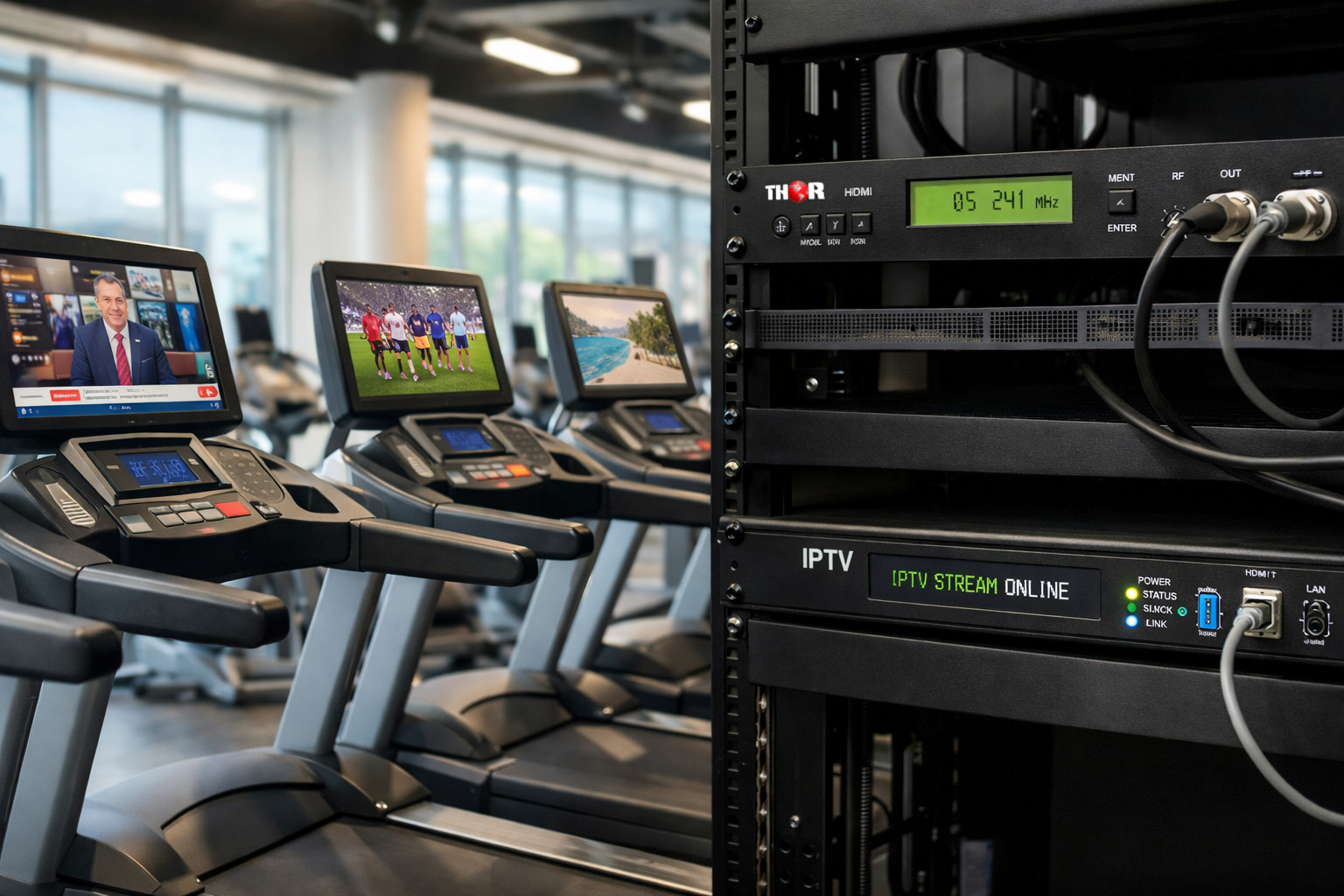
Table of Contents
Modern fitness centers frequently install entertainment systems on cardio equipment such as treadmills and bicycles. These systems allow members to watch television while exercising, improving the overall user experience. However, maintaining reliable video distribution across dozens of machines can present both technical and financial challenges.
A recent installation in Santa Barbara illustrates these challenges and highlights possible solutions.
The facility originally deployed a coax-based RF distribution system using Thor Fiber Petit HDMI RF modulators. Each modulator received video from an individual Cox cable set-top box and converted the HDMI signal into a QAM RF channel.
Approximately ten channels were generated in this way and distributed across the gym through coaxial cabling. Each fitness machine contained a tuner capable of selecting any of the available channels.
In theory, this configuration allowed each machine to access the same group of television channels.
Although the RF modulators operated reliably, the facility experienced several operational issues related to the upstream video sources:
Cable set-top boxes occasionally locked up or changed channels
Some boxes would go offline periodically
These failures caused customer complaints when machines lost TV service
The facility was also paying approximately $85 per month per cable box, resulting in nearly $1,000 per month in recurring service costs
Because of these issues, the facility began investigating alternative content delivery options.
Several programming options were considered:
Over-the-air ATSC broadcast channels
Satellite television services (DIRECTV / Dish Network)
Internet streaming services such as YouTube TV
However, regardless of the provider, the system would still require individual HDMI source devices to generate channels for distribution.
Another possibility involved distributing video using IPTV multicast streams instead of RF channels. In this configuration:
Each HDMI source feeds an IP encoder
The encoder generates a multicast UDP stream
Gym machines select the desired stream over the network
While IPTV offers advantages such as distribution over Ethernet or Wi-Fi, it also introduces additional complexity:
Network configuration
Multicast switching requirements
Increased system management
For facilities that already have reliable coax infrastructure, RF distribution often remains the simpler and more robust solution.
One important configuration detail can significantly improve system stability.
All set-top boxes should be configured to output a fixed video resolution (1080i or 1080p) rather than using automatic resolution switching. When resolution changes dynamically-such as during commercials or between different broadcast formats-video encoders may need to restart their encoding process.
By locking the output resolution, the RF modulator or encoder can operate continuously without interruption.
For gym environments where reliability is critical, RF modulation remains one of the most stable and straightforward methods for distributing television channels to multiple machines.
While IPTV can provide additional flexibility, it does not eliminate the need for content sources and may introduce additional complexity. In many cases, optimizing the existing RF system and stabilizing the upstream video sources provides the best balance of reliability, cost, and simplicity.


 ES
ES