Thor Broadcast Logo
Log in
Cart (0)
  • es ES
  • Products
    • CATV Modulators
      • HDMI RF Modulators
      • HD-SDI converters
      • IP to CATV Edge Modulators
    • DVB Encoders
      • IPTV Video Encoders
      • Hdmi RTSP RTMP RTSP Encoders
      • Transcoders, MPEG Converters, IP ASI Gateways
    • Decoders (IRD's & STB's)
      • RF input - Video /Audio Ouput
      • IP Broadcast Decoders
      • RF CATV and IPTV OTT STB's
    • Satellite Modulators
      • DVB-S/S2 Satellite Modulators
    • Fiber Optic Transport
      • SDI Fiber Optic Extenders, Digital Audio Extenders
      • SDI SD/HD/3G with CWDM
      • Cable TV CATV RF 45-900Mhz
      • L-Band Satellite RF 45-3000Mhz
      • Data & Ethernet over fiber
    • HDMI SDI Switchers, LAN Extenders, and Wireless Video Transport
      • HD Video Switchers and Signal Format Converters for AV Pros
      • Wireless HD SD Video Data Equipment
      • Video Audio Extenders Over Ethernet LAN IP Network
    • DIscounted Inventory
      • Satellite and CATV Broadcast Equipment for Sale
      • Lab Used Broadcast Equipment on sale
      • Past Generation Equipment
    • SDI Monitors
    • Warehouse
  • About
  • Client Portfolio
  • Support
      • Support Center Support Center
      • User Manuals User
        Manuals
      • Request an RMA Request an
        RMA
  • ⬇Download
    • Manuals
    • Datasheets
    • Quick Guides
  • Case Studies
    • THOR Gym
    • THOR Stadium
    • THOR Hotel
    • THOR University
  • Videos
  • Contact
  • Become a Reseller

RF Audio Over Fiber for Wireless Microphones, Remote Antennas, Stadiums, and Mobile Production

Learn how RF over Fiber improves wireless audio by enabling long-distance antenna placement, reducing interference, and simplifying AV system design.
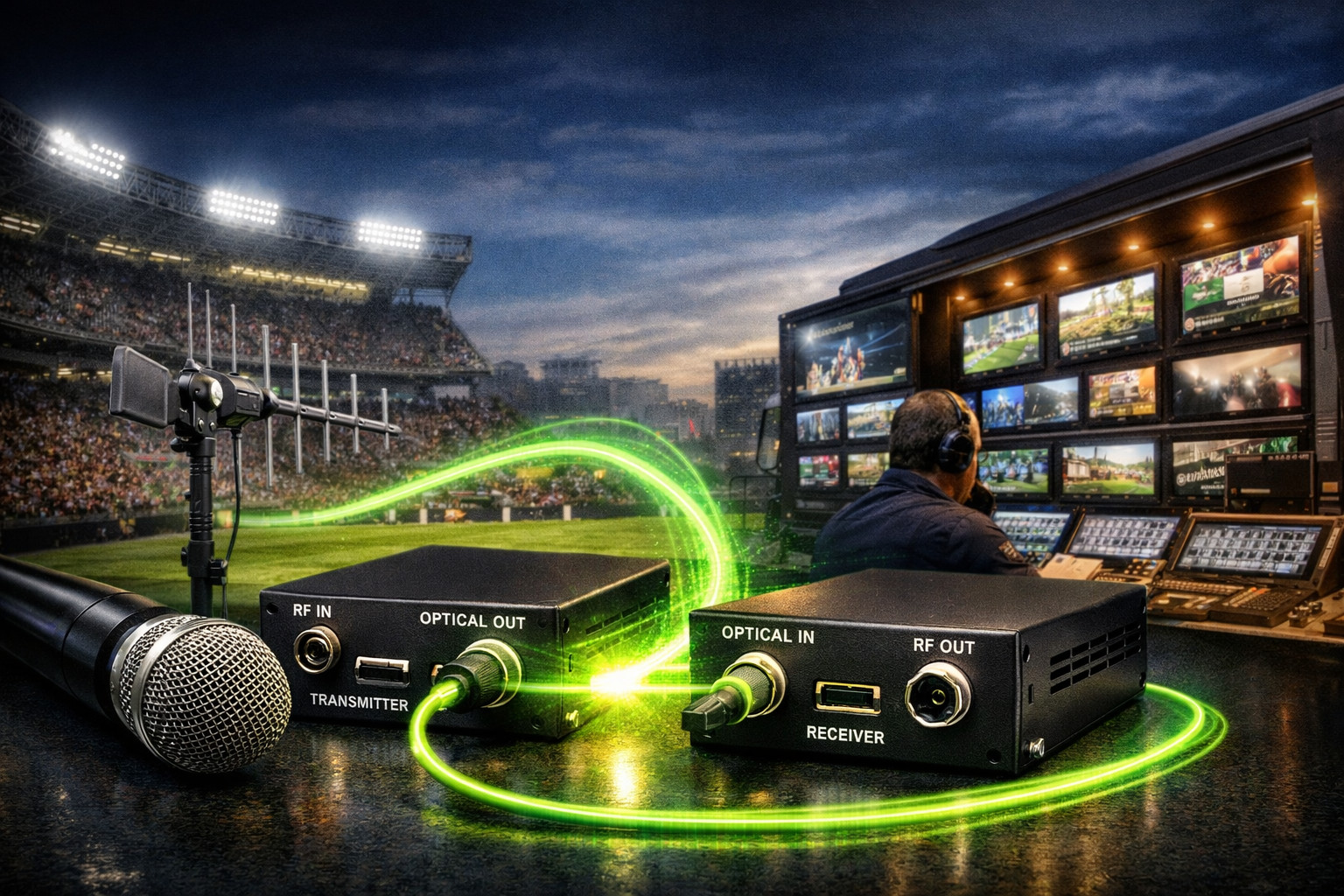
RF Audio Over Fiber for Wireless Microphones, Remote Antennas, Stadiums, and Mobile Production

RF Audio Over Fiber for Wireless Microphones, Remote Antennas, Stadiums, and Mobile Production

In professional audio, live production, and broadcast environments, RF reliability is everything. Wireless microphone systems, in-ear monitors, IFB feeds, and remote antenna distribution all depend on stable RF transport. Traditional coaxial cable can work for short distances, but once the installation becomes larger, longer, or more complex, coax quickly becomes a limitation.

The Thor Broadcast F-RF-AUDIO-TxRx solves this problem by converting RF signals into optical signals and transporting them over single-mode fiber. This allows wireless microphone and RF audio systems to extend antennas over long distances with minimal loss, excellent noise immunity, and much greater installation flexibility.

Table of Contents

  • What Is RF Audio Over Fiber?
  • Why Use Fiber Instead of Coax for RF Audio?
  • Thor Broadcast F-RF-AUDIO-TxRx Overview
  • Popular Applications for RF Audio Over Fiber
  • How a Typical RF Audio over Fiber Signal Path Works
  • Why This Matters for System Designers and Integrators
  • Who Should Consider the F-RF-AUDIO-TxRx?
  • Conclusion
  • Related Product Link

What Is RF Audio Over Fiber?

RF Audio over Fiber, also called RFoF for wireless audio systems, is a technology that transports radio frequency signals over fiber optic cable instead of coax. The concept is simple:

  • The transmitter accepts RF input from antenna feeds or RF audio sources.
  • It converts the RF signal into an optical signal.
  • The optical signal travels over fiber with very low loss.
  • The receiver converts the signal back into RF output for wireless microphone receivers or RF distribution systems.

This architecture preserves signal quality over long distances and removes many of the problems commonly seen with copper-based RF transport. In practical terms, it means you can place antennas exactly where they need to be, while keeping receivers and control equipment safely in a rack room, broadcast truck, control booth, or equipment shelter.


Why Use Fiber Instead of Coax for RF Audio?

Coaxial cable has been the traditional medium for RF transport for years, but it has clear limitations. Every foot of coax introduces loss, and that loss increases with frequency. In wireless microphone systems, where clean and stable RF is critical, long coax runs can reduce signal margin, increase noise, and create performance problems.

Feature Coax Cable Fiber Optic
Distance Limited, practical short-to-medium runs Long distance, 1 km and beyond
Signal Loss Higher and frequency-dependent Very low over long runs
EMI / RFI Immunity Susceptible to interference Immune to EMI and RFI
Weight Heavier, bulkier cable bundles Lightweight, easy to route
Scalability Can become complex with long runs and splitters Excellent for larger and distributed systems

Fiber is especially attractive in professional applications where reliability matters more than simply making a short connection work. For stadiums, houses of worship, broadcast compounds, and remote production facilities, fiber often becomes the cleaner and more future-proof solution.


Thor Broadcast F-RF-AUDIO-TxRx Overview

The F-RF-AUDIO-TxRx is a compact RF over Fiber extender designed for wireless microphone and RF audio transport applications. It is ideal for extending remote antennas, transporting RF signals between buildings or rooms, and simplifying large venue RF system design.

Product page: Wireless Microphone RF Audio Signal over Fiber Optic Extender Antenna – F-RF-AUDIO-TxRx

Key Advantages

  • Long-distance RF transport over single-mode fiber
  • Excellent solution for remote antenna extension
  • Improved system stability compared with long coax runs
  • Reduced risk of RF interference and noise pickup
  • Compact size for easy installation in mobile and fixed systems
  • Useful for stadiums, theaters, worship facilities, OB trucks, and multi-room production environments

Popular Applications for RF Audio Over Fiber

1. Stadium Wireless Microphone Systems

Stadiums are one of the strongest use cases for RF over Fiber. In sports venues, antennas often need to be placed close to the field, stage, or performance area, while receivers and production equipment are located far away in control rooms or broadcast racks. Running long coaxial lines across these distances can create substantial RF loss and make the system harder to maintain.

With the F-RF-AUDIO-TxRx, antennas can be installed in the best RF location while the fiber link carries the signal cleanly back to the rack room. This improves wireless microphone reliability for commentators, referees, halftime entertainment, live presentations, and sideline reporting.

Typical stadium uses include:

  • Sideline reporter wireless microphone transport
  • Field-level antenna extension to central control room
  • Remote RF receive antenna placement for concerts and ceremonies
  • Tunnel, locker room, or concourse microphone coverage

2. Mobile Production and OB Trucks

Outside broadcast trucks and mobile production teams often need to deploy antennas hundreds of feet away from the truck for best coverage. Coax can become heavy, lossy, and awkward to manage in temporary deployments. Fiber offers a much cleaner workflow.

In a mobile production environment, the F-RF-AUDIO-TxRx allows RF signals from remote antennas to be transported back to the truck with less concern about coax attenuation. This is especially valuable for sports, concerts, festivals, red carpet events, and temporary live news positions.

Advantages in mobile production:

  • Reduced cable weight
  • Longer practical deployment distance
  • Cleaner cable management
  • Less RF degradation over the path

3. Multi-Point RF Antenna Over Fiber Systems

Large venues often need multiple RF zones. For example, a theater or convention center may need one antenna position near the stage, another in a lobby, and another near a breakout room or auxiliary hall. Fiber enables centralized equipment design where antennas are distributed remotely but receivers remain in one equipment location.

A multi-point RF antenna over fiber approach makes it possible to build more advanced wireless systems with better coverage and easier management. Instead of dragging long coax everywhere, you can strategically place remote RF points and bring them back over fiber.

This is highly useful for:

  • Convention centers
  • Performing arts venues
  • Corporate campuses
  • Broadcast facilities with multiple studios
  • Large houses of worship

4. Theater and Performing Arts Venues

Modern theater productions often use many wireless microphones, in-ear systems, and backstage communication links. Reliable RF coverage is critical, but the RF receivers are often located in a separate rack room away from the stage. Fiber lets system designers place remote antennas exactly where they perform best while minimizing cable-related RF degradation.

The result is better consistency for actors, presenters, musicians, and stage management teams. It can also help simplify renovation projects where existing conduit space is limited and a lighter fiber solution is easier to install than multiple runs of premium low-loss coax.

5. House of Worship Audio Systems

Many churches and worship facilities have large sanctuaries, fellowship halls, overflow rooms, and production booths located away from the platform. Wireless microphones are used heavily, and antenna placement often becomes a challenge. RF over Fiber allows antenna relocation without the penalties of long coax runs.

This is particularly valuable in larger worship spaces where antenna diversity and stable wireless operation are essential for pastors, singers, musicians, and live streaming production.

6. Corporate AV and Conference Centers

In conference environments, wireless microphones may be used across ballrooms, divisible rooms, meeting spaces, and event halls. RF over Fiber makes it easier to centralize the RF equipment while keeping antenna systems close to each event area. This improves flexibility for rental AV teams, integrators, and facility engineers.

7. Remote Antenna Placement in Challenging RF Environments

Sometimes the best antenna location is not near the receivers. It may be on a catwalk, in a ceiling cavity, at the front of house position, or in an outdoor weather-protected enclosure. Fiber gives designers the freedom to place antennas where RF performance is best rather than where coax length allows.

That flexibility is one of the main reasons RF over Fiber is increasingly attractive in modern professional AV and broadcast systems.


How a Typical RF Audio over Fiber Signal Path Works

A common installation looks like this:

  1. Directional or omnidirectional RF antennas receive wireless microphone signals.
  2. The antenna outputs feed the RF input side of the F-RF-AUDIO-Tx.
  3. The transmitter converts the RF into an optical signal.
  4. The signal travels over single-mode fiber to a remote equipment room.
  5. The F-RF-AUDIO-Rx converts the optical signal back into RF.
  6. The RF outputs feed wireless microphone receivers, RF distribution amplifiers, or monitoring equipment.

This arrangement is much cleaner than using a long analog RF path over copper. It supports better antenna placement, simpler infrastructure, and more predictable RF behavior over distance.


Why This Matters for System Designers and Integrators

Integrators and broadcast engineers are often asked to solve difficult RF problems in environments where interference, distance, and space constraints all work against them. RF over Fiber gives them another tool: instead of fighting coax loss and compromise antenna placement, they can design the system around RF performance first.

This is especially useful when:

  • The antenna location is far from the receiver rack
  • There is high EMI or RFI in the building
  • A lightweight cabling solution is preferred
  • The system may need to expand later
  • Multiple RF zones need to be supported

Who Should Consider the F-RF-AUDIO-TxRx?

The Thor Broadcast F-RF-AUDIO-TxRx is an ideal solution for:

  • Broadcast engineers
  • Live event production teams
  • Stadium AV integrators
  • Wireless microphone system designers
  • House of worship AV departments
  • Theater and performing arts technical teams
  • Conference center and corporate AV installers
  • Mobile production and OB truck operators

Conclusion

Wireless microphone systems are only as good as the RF transport path behind them. When antennas need to be remote, coax is often the weak link. RF over Fiber changes that by allowing long-distance, interference-resistant transport with better flexibility and cleaner system design.

Whether the application is a stadium, a theater, a mobile production truck, a multi-zone conference center, or a house of worship, the F-RF-AUDIO-TxRx RF Audio Over Fiber Extender provides a practical and professional way to move RF antenna signals over fiber.


Related Product Link

Learn more about the product here:
Wireless Microphone RF Audio Signal over Fiber Optic Extender Antenna – F-RF-AUDIO-TxRx



Justin White
Justin White
Broadcast Engineer
Broadcast engineer specializing in turnkey CATV and fiber-transport solutions. Experienced in designing and deploying complete encoding/decoding workflows to move virtually any signal over IP, fiber, and RF. Focused on ultra-low-latency headend architectures and custom mux/demux builds, supporting demanding environments across telecom, sports, education, hospitality, studios, live events, and mission-critical institutions worldwide.
View author page
Contact us

Thor Broadcast Sales

Email: [email protected]
Phone: 1(800)521-THOR (8467) Ext 1
FAX: 1(800)521-6384

Customer Service/ Support

Phone: 1-800 521-THOR(8467) Ext 2
Email: [email protected]

Case Studies

- Converting Clear QAM HDTV Channels to Analog RF NTSC for Multi-Site Distribution
- Stadium IPTV - Replay System
- Hotel HDMI-to-QAM TV Distribution
- University IPTV Lecture Systems

  • CATV Modulators:
    • HDMI RF Modulators
    • HD-SDI converters
    • IP to CATV Edge Modulators
  • DVB Encoders:
    • IPTV Video Encoders
    • Hdmi RTSP RTMP RTSP Encoders
    • Transcoders, MPEG Converters, IP ASI Gateways
  • Decoders (IRD's & STB's):
    • RF input - Video /Audio Ouput
    • IP Broadcast Decoders
    • RF CATV and IPTV OTT STB's
  • Satellite Modulators:
    • DVB-S/S2 Satellite Modulators
  • Fiber Optic Transport:
    • SDI Fiber Optic Extenders, Digital Audio Extenders
    • SDI SD/HD/3G with CWDM
    • Cable TV CATV RF 45-900Mhz
    • L-Band Satellite RF 45-3000Mhz
    • Data & Ethernet over fiber
    • Analog Audio Video
    • Fiber Amplifiers - EDFA
    • DVB - ASI
    • Fiber Jumpers, Cables, Attenuators,
    • Optic Splitters Couplers CWDM Muxes
    • Optical Meters, Test Equipment, Accesories
    • Analog Baseband Video Audio, RS485/422/232 Data, Contact Closure
  • HDMI SDI Switchers, LAN Extenders, and Wireless Video Transport:
    • HD Video Switchers and Signal Format Converters for AV Pros
    • Wireless HD SD Video Data Equipment
    • Video Audio Extenders Over Ethernet LAN IP Network
  • HD 4K Cameras, SDI - HDMI - IP Streaming - PTZ - Broadcast and Security:
    • PTZ Streaming Cameras Broadcast cameras with SDI ,HDMI CVBS USB
  • DIscounted Inventory:
    • Satellite and CATV Broadcast Equipment for Sale
    • Lab Used Broadcast Equipment on sale
    • Past Generation Equipment
  • SDI Monitors:
  • Warehouse:
Thor Broadcast Logo
Email: [email protected]
Phone: 1(800) 521-8467 Ext 1
FAX: 1(800)521-6384
Information:
  • About us
  • Client Portfolio
  • Become a Reseller
  • Contact
  • Articles
  • Return Policy
  • Shipping Policy
  • International Order Policy
Popular:
  • RF Modulator
  • HDMI over COAX
  • HDMI over IP
  • COAX to HDMI
  • HDMI to SDI

Thor Broadcast
Torrance Business Park
2421 W 205th St
Torrance
CA 90501

© 2026 Thor Broadcast
Subscribe to our newsletter

Sign up here to get the latest news, updates and special offers delivered directly to your inbox.

You can unsubscribe at any time
newsletter image