Technical guide to choosing an HDMI mini RF modulator for coax TV: ATSC/QAM/DVB-T support, encoding control, RF quality, and setup.
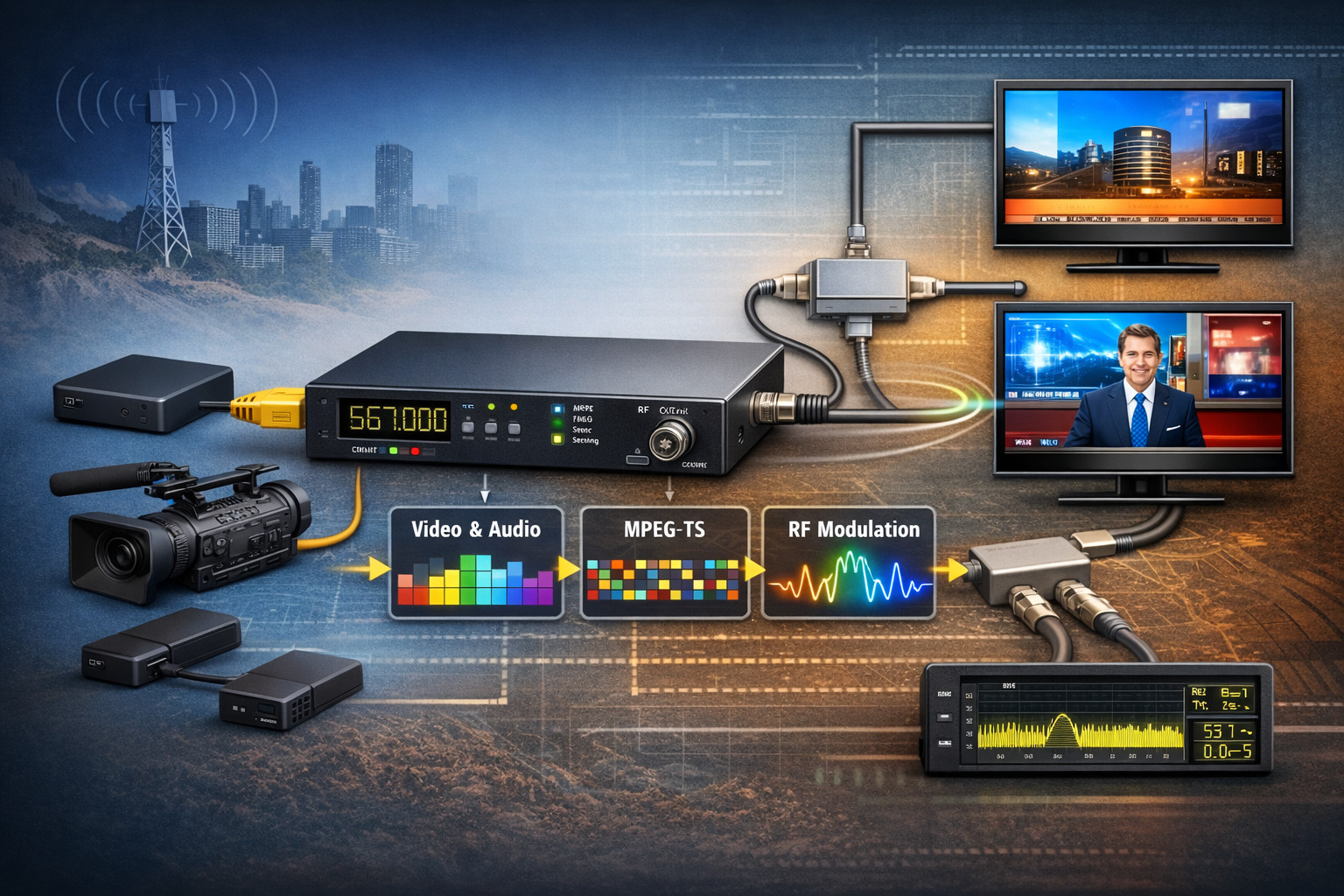
Table of Contents
A good HDMI mini modulator is not a passive converter and not “just an RF output stage.” In most professional deployments, a compact HDMI modulator is a complete encoder-modulator that must acquire an HDMI source, compress audio/video, build a standards-compliant transport stream, and then modulate that stream onto an RF carrier that televisions can tune over coax. The form factor may be pocket-sized, but the engineering requirements are the same ones you would apply to a full rack headend: stable input lock, deterministic encoding behavior, predictable service signaling, clean RF output, and management that makes the system maintainable after the initial install.
When you evaluate an HDMI mini modulator, the most useful mindset is to treat it as the “smallest possible headend” for one channel (or a few channels). You are effectively creating a TV service inside a building. That means you must design for receiver compatibility and for long-term operational stability, not only for a picture that looks fine during a quick bench test. Thor Broadcast’s compact solutions-such as the Petit HDMI RF Modulator and compact dual channel 2ADHD are built around this “mini headend” principle.
The first feature to confirm is the RF output standard. This is non-negotiable because the endpoint tuner decides what “works.” If your TVs expect cable-style tuning, you typically need a QAM/DVB-C style output. If your TVs scan and present ATSC channels, you need ATSC 8-VSB output. If your environment is DVB-T based, you need DVB-T modulation. A mini modulator that supports the wrong family will not become compatible through clever settings; it will simply be untunable or unreliable in the field.
In procurement terms, “support for multiple standards” is valuable only if you truly need it, because your channel plan and operational procedures still need to be consistent. That said, universal compact modulators can be a practical hedge when you deploy across multiple sites with different receiver ecosystems. Thor’s compact mini-modulator families include models positioned for multi-standard operation, including the Petit line and CMOD-style compact encoder-modulators. If you need a compact modulator with IR return-path capability for remote source control over coax, Thor also offers a mini-class device such as HDMI Modulator with return remote control IR, which is engineered for the coax-distribution workflow rather than for a simple “HDMI in, RF out” bench demo.
Buyers often start by asking “Does it support 1080p60?” Resolution support matters, but what matters more in a mini modulator is how reliably it acquires and retains lock to real HDMI sources. HDMI sources are not all alike: set-top boxes, PCs, signage players, and cameras can output different timings, color formats, and audio modes, and some sources change behavior after reboots. A modulator that looks perfect with one HDMI source on a workbench can become a service ticket generator when it meets the actual source mix in the field.
A good mini modulator should behave predictably when the HDMI source is interrupted, power-cycled, or briefly unplugged. It should recover cleanly without manual intervention, because in-building coax distribution multiplies the impact of small headend events across every television. When your system goal is “one HDMI source becomes one channel everywhere,” the stability of the input stage determines whether the channel remains continuously available.
Thor’s compact modulators are typically deployed with the operational assumption that HDMI is short-run and local to the headend. This is why the mini modulator selection should include physical deployment planning: keep HDMI cable runs short, secure connectors, and avoid unintentional strain. The goal is to reduce the probability of HDMI renegotiation events that can ripple into RF channel interruptions.
In an HDMI mini modulator, encoding is not a “bonus feature”; it is the core function that determines quality, robustness, and compatibility. You want control over codec selection (where applicable), bitrate, and video timing. A compact modulator that forces a fixed bitrate or a narrow set of formats may be acceptable for signage, but it becomes limiting when you need to balance picture quality against RF capacity, especially if you are injecting multiple channels into the same coax plant.
A practical evaluation criterion is whether the device allows you to tune bitrate across a realistic range and whether it can maintain stable output behavior under the chosen settings. In coax distribution, predictable transport-rate behavior helps the modulator and multiplex remain stable and improves receiver behavior during tuning. Also consider audio codec support and signaling. Audio is a frequent failure point because a TV can lock RF, show the channel name, and still be silent if the audio codec or signaling is not what the tuner expects.
Thor’s compact CMOD-style product documentation emphasizes codec options and supported resolutions (including common broadcast timings), which is exactly the type of detail you should demand in a mini modulator because it lets you design around your receiver fleet rather than around guesswork. The H-2ADHD-QAM-IPP is an example of a compact unit where the spec focus is clearly on the intersection of input timing, encoding, and tuner-friendly output.
A “good” HDMI mini modulator is one that behaves like a disciplined broadcaster, even though it is producing only one channel. Inside the RF carrier is typically an MPEG Transport Stream, and televisions rely on the stream’s tables and identifiers to decide what the channel is called, how it should be stored in the lineup, and which audio/video components belong together. If service signaling is unstable-because program numbers or identifiers change after reboots, or because tables are inconsistent-TVs may show symptoms that look like RF issues: channels that vanish after rescans, duplicate entries, slow channel acquisition, or intermittent audio.
This is why you should look for features that support “channel identity stability.” Even if the user interface is simple, the device should maintain consistent output identifiers and should allow you to configure naming and mapping in a way that stays persistent over time. A mini modulator that is only easy to configure once is less valuable than a mini modulator that can be configured in a way that stays stable for months in a facility with hundreds of TVs.
The RF stage is where a mini modulator becomes either a professional tool or a fragile gadget. RF quality is commonly described using metrics such as MER and BER at the receiver. A device can produce “some RF” and still be unacceptable if the signal is noisy, unstable, or hard to distribute without degrading margins. A good mini modulator should produce a clean spectrum and provide predictable output levels so the channel can be combined with other RF carriers and distributed through splitters and taps without living on the edge of tuner lock.
In building coax plants, signal quality is a system property. Splitters add insertion loss, long coax runs add attenuation, poor connectors create reflections, and amplifiers can help or harm depending on how they’re set. Because a mini modulator is often used as a simple “channel injector,” its RF output must be compatible with existing distribution hardware and with other carriers already present on the coax. When evaluating devices, ask whether the RF output power is suitable for your topology and whether it can be adjusted to match the rest of the lineup without overdriving downstream amplifiers.
Thor also supports the coax distribution side with purpose-built accessories for combining and splitting RF channels. If your mini modulator is being integrated into an existing coax tree, or you are building a small tree specifically for the injected channel, Thor’s Coax Multiplexers / Splitters / Combiners are examples of the distribution components that often determine whether your RF margins remain healthy at the farthest outlet.
A mini modulator is often deployed into a coax environment that already carries signals-off-air channels, legacy carriers, or other locally generated channels. If you place your new RF channel on a frequency that collides with an existing carrier, or if you choose a channel mapping approach that confuses TVs, you can create unpredictable behavior that looks like “random” tuning failures. Good mini modulators provide enough control to place the output cleanly into a known channel plan and to maintain that plan consistently across changes.
Channel planning is also about future expansion. Even if you are injecting only one channel today, you may add more later. A modulator that is easy to retune and whose output can be integrated cleanly with combiners and splitters is a better long-term choice than a device that locks you into a narrow set of frequencies or behavior. The “best” mini modulator is often the one that makes your future headend growth predictable rather than forcing a redesign.
In professional environments, maintenance cost quickly exceeds hardware cost. That makes management features a core selection criterion. A good mini modulator should be easy to configure, but it should also be easy to verify. You should be able to confirm input status, output configuration, and operational health without physically touching the device every time a user reports “channel is blank.” This is especially important in hospitality and enterprise deployments where the headend might be in a locked closet and where access requires scheduling.
Another management detail that matters in mini-class deployments is configuration persistence and recovery. If the modulator loses power, does it come back with identical settings and identical channel identity? Does it reacquire the HDMI source without manual reset? Do changes apply predictably without breaking the channel map cached by TVs? These are the questions that separate an acceptable bench device from a professional headend component.
Not every “mini modulator” starts from HDMI. In many systems, the program source is already encoded and delivered as an MPEG transport stream over IP (UDP/RTP), and the compact device’s job is to convert that IP transport into RF channels for coax distribution. This is still “mini modulation,” but the input is IP rather than baseband/HDMI/SDI. In such systems, the key features shift to IP stream compatibility, multicast behavior, and deterministic channel creation from transport streams. Thor provides compact IP-to-RF gateway devices in this mini class, such as the IP UDP Multicast to 4ch CATV RF QAM/ATSC Digital Mini Modulator, which is designed to create multiple RF channels from incoming transport streams in a compact format.
Another compact workflow that is uniquely “coax practical” is IR return path for controlling an HDMI source remotely over the coax plant. In hospitality deployments where a set-top box HDMI source lives at the headend but users need to control it from remote rooms, a mini modulator with IR return-path can remove the need for separate control wiring. Thor’s HDMI Modulator with return remote control IR is a compact example of a device designed around that real installation requirement.
Latency in HDMI-to-RF systems is mostly created by encoding and decoding. The modulator’s encoder introduces buffering and GOP-dependent delay, and the TV adds its own decode and presentation delay. A good mini modulator gives you enough control to avoid pathological behavior, such as extremely long channel acquisition times or unstable delay after reboots. If your use case is signage or informational channels, a few seconds of latency may not matter. If your use case is a live event feed distributed throughout a venue, latency becomes a visible quality attribute.
The correct way to evaluate this feature is measurement. Use a timecode or running clock test signal on the HDMI input, then measure the displayed delay on the TVs that will actually be deployed. This is more reliable than assuming a spec-sheet delay because endpoint TVs can dominate perceived latency. A mini modulator that can be tuned for stable channel-change behavior and predictable end-to-end delay will feel “professional” in real deployments even if it is physically small.
If your goal is the simplest “one HDMI source becomes one TV channel,” then a good mini modulator is one that locks reliably to your specific HDMI source, outputs the exact RF standard your TVs require, and maintains stable channel identity across reboots. In Thor’s lineup, compact devices like the Petit HDMI RF Modulator fit that pattern when you want an all-in-one pocket-sized channel injector.
If your use case demands compatibility features such as specific audio behavior or broader configuration controls in a compact encoder-modulator, then CMOD-style compact units like the 2 HDMI YPbPr HD Digital TV Modulator QAM ATSC DVB-T IPTV 1080p/60 are often a better fit because their design intent is explicitly “broadcast-friendly output from compact inputs.”
If your “mini modulator” is actually a compact gateway that must convert existing IP transport streams into RF channels, then the correct feature set emphasizes IP ingestion and deterministic RF channel creation. Thor’s compact gateway class-represented by the IP UDP Multicast to 4ch CATV RF QAM/ATSC Digital Mini Modulator-matches that scenario where baseband HDMI ingestion is not the goal, but “transport to RF in a compact box” is.
The main features to look for in a good HDMI mini modulator are the ones that keep a coax TV service stable after the installer leaves: the correct RF standard for your tuner ecosystem, robust HDMI input lock and recovery, encoding controls that balance quality and capacity, stable MPEG-TS/service signaling, clean RF output with predictable level behavior, and management that enables verification and change control. Compact form factor is valuable only when it does not compromise these fundamentals.
Thor Broadcast’s mini and compact encoder-modulator lineup provides practical choices across these requirements, from single-channel injection using the Petit HDMI RF Modulator, to compact CMOD-class encoder-modulation via the 2 HDMI YPbPr HD Digital TV Modulator QAM ATSC DVB-T IPTV 1080p/60, to compact IP-to-RF gateways such as the IP UDP Multicast to 4ch CATV RF mini modulator, and specialized compact workflows like IR return-path control using the HDMI Modulator with return remote control IR. Select the device class that matches your distribution model, then validate with real sources, real coax runs, and the real TV fleet you must support.
FCC: DTV interference rejection thresholds (PDF)
FCC: Digital Television engineering resources
MIT: TMDS encoding notes (Part 1)
MIT: TMDS encoding notes (Part 2)
University of Maryland (edu): QAM fundamentals (PDF)


 ES
ES