Learn how to transport multiple 3G-SDI video feeds over 30 km single-mode fiber using CWDM, dark fiber, and Thor integrated SDI fiber systems.
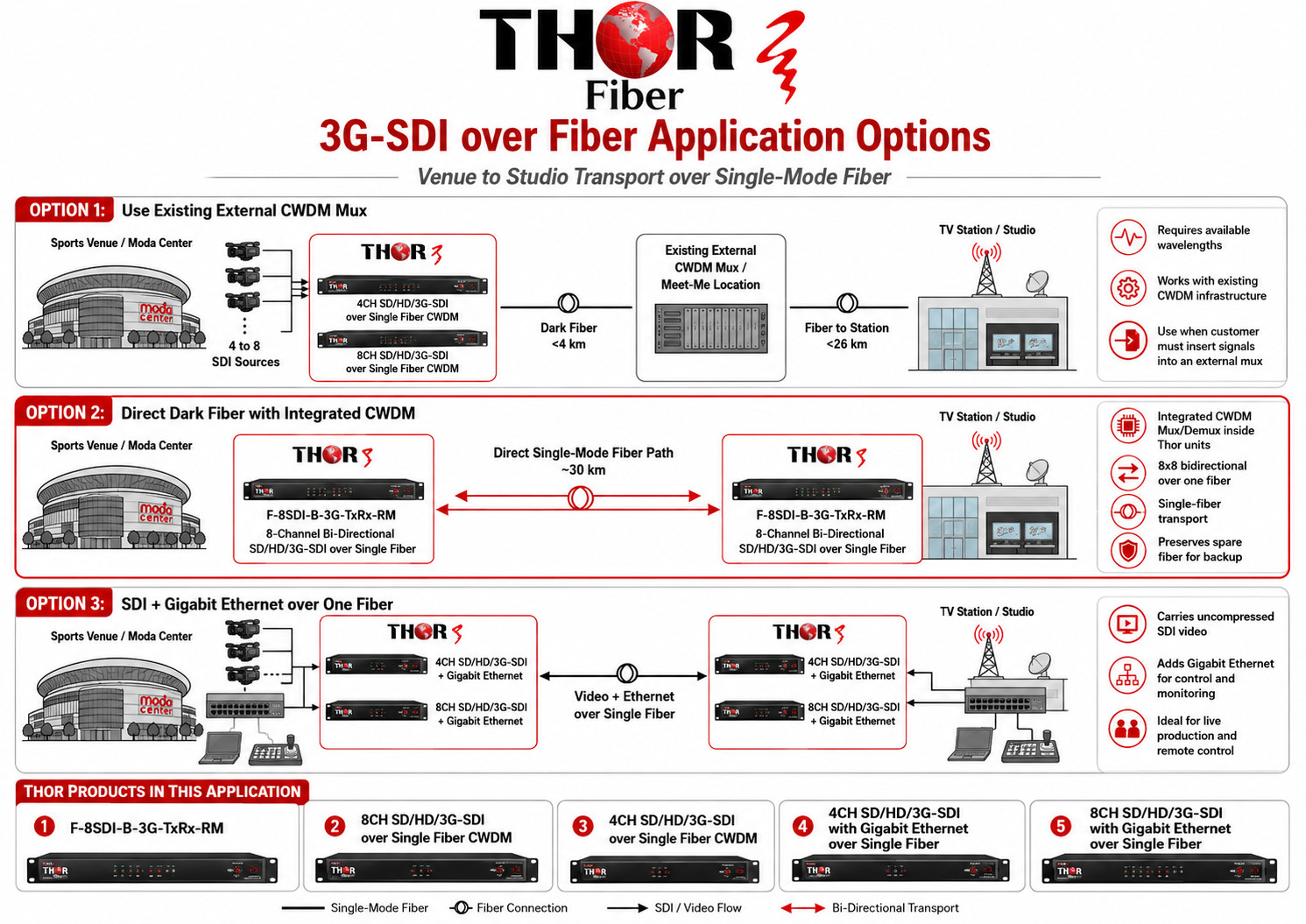
A professional SDI over fiber design example for transporting multiple 3G-SDI video feeds between a sports venue and a broadcast TV station using dark fiber, external CWDM muxes, or Thor integrated CWDM fiber transport systems.
Table of Contents
This case study is based on a real-world broadcast application where a television station needed to transport multiple SD-SDI, HD-SDI, and 3G-SDI video signals between a sports venue and the main studio facility over approximately 30 km of single-mode fiber.
The application involved the Moda Center in Portland, OR, and a TV station facility in Beaverton, OR. The customer had access to dark fiber from the venue to a meet-me location, where an existing Evertz CWDM mux was already in use. From that mux location, the fiber path continued back to the station.
The customer originally requested pricing for CWDM 3G-SDI fiber extenders, preferably using available wavelengths such as 1310 nm and 1590 nm. The minimum requirement was 4 SDI paths, but the customer also wanted pricing for an 8-channel system and a possible bidirectional solution.
Approximately 30 km total fiber path using single-mode fiber.
SD-SDI, HD-SDI, and 3G-SDI uncompressed broadcast video.
Single-mode dark fiber, with possible use of CWDM wavelengths.
Minimum 4 SDI paths, preferred 8 channels, with possible reverse direction video paths.
The customer needed a reliable way to move professional broadcast video between a sports venue and a television station. The system needed to support 3G-SDI video over fiber across a long-distance single-mode fiber route.
The original fiber path was described as:
During the technical discussion, the customer also confirmed that there may be a clean end-to-end dark fiber path from the venue all the way back to the studio. If that direct dark fiber path is available, the system becomes much simpler because the SDI fiber transport equipment can use built-in CWDM muxing without needing to fit into the existing external CWDM system.
The biggest challenge was not only the fiber distance. The main issue was deciding whether the new SDI signals should be inserted into the existing external CWDM mux, or whether the customer should use a direct dark fiber path with Thor equipment that already includes internal CWDM multiplexing.
If the existing external mux only has a few open wavelengths, the system design becomes limited by wavelength availability. If a direct dark fiber path is available, Thor can provide a cleaner integrated solution where the transmitter and receiver already include the optical multiplexing and demultiplexing internally.
One possible design is to use individual SDI fiber transmitters and receivers on available CWDM wavelengths and insert them into the existing external CWDM mux. This approach can work well when enough open wavelengths are available and the wavelength plan is clearly documented.
Each SDI transmitter uses a specific optical wavelength. The external CWDM mux combines multiple optical wavelengths onto one fiber. At the far end, the CWDM demux separates the wavelengths again and sends each optical signal to the correct SDI receiver.
This method is common in broadcast facilities, stadiums, metro fiber networks, and shared fiber systems. However, it requires careful wavelength planning. The available wavelengths must not conflict with existing services already using the CWDM mux.
The cleaner design is to use a direct dark fiber path from the sports venue to the TV station and install a Thor multi-channel SDI over fiber system. Thor multi-channel CWDM SDI transport systems include the optical CWDM mux and demux internally.
This means the user does not need to install separate external CWDM muxes, match individual wavelengths manually, or consume open channels on an existing Evertz mux. The Thor transmitter combines multiple SDI inputs onto one optical fiber, and the Thor receiver separates the signals back into individual SDI outputs at the far end.
With Thor integrated CWDM systems, the CWDM multiplexing is already built into the rackmount transmitter and receiver pair. You connect the SDI video sources to the transmitter, connect one single-mode fiber between the two units, and receive the same SDI signals at the far end.
The internal CWDM design allows multiple uncompressed SDI signals to travel over one fiber without the customer needing to build a separate optical muxing system.
More Thor SDI over fiber products can be found here: Thor SD/HD/3G-SDI Fiber Optic Products with CWDM
This is the most flexible option. It allows 8 SDI signals from the venue to the studio and 8 SDI signals from the studio back to the venue over a single fiber.
This is ideal when the production team wants forward and return video paths, backup routing, confidence monitors, production feeds, or future expansion.
Recommended product:
F-8SDI-B-3G-TxRx-RM
This configuration supports the customer’s stated requirement of 8 SDI paths in one direction and 4 SDI paths in the other direction.
This can be done using one 8-channel SDI fiber system and one 4-channel SDI fiber system, depending on the fiber availability and direction of the required signals.
Products:
8CH 3G-SDI over Single Fiber
4CH 3G-SDI over Single Fiber
This is the most cost-effective option when only 4 SDI signals are required.
It can be used as a simple venue-to-studio link or as part of a larger CWDM transport design.
Recommended product:
4CH SD/HD/3G-SDI over Single Fiber CWDM
In many live production and venue applications, the fiber link is not only used for video. The customer may also need Ethernet for network control, camera control, remote equipment access, intercom systems, IP monitoring, control panels, scoreboards, or production network devices.
For these applications, Thor offers SDI over fiber systems that also include Gigabit Ethernet over the same fiber. This is especially useful when only one dark fiber is available and the customer wants both uncompressed SDI video and IP network connectivity.
Related SDI + Ethernet products:
A traditional CWDM fiber system may require separate SDI transmitters, separate CWDM optical wavelengths, a separate CWDM mux, and a separate demux at the far end. Thor’s integrated CWDM systems simplify this by putting the wavelength management, optical combining, and optical separation inside the rackmount equipment.
Cameras / SDI Sources → Thor SDI Fiber Transmitter → Internal CWDM Mux → One Single-Mode Fiber → Internal CWDM Demux → Thor SDI Fiber Receiver → SDI Outputs
Before ordering a single-fiber integrated CWDM system, the direct end-to-end fiber path should be tested. An OTDR test can confirm the fiber length, splice losses, connector losses, and any possible breaks or reflections.
For long-distance fiber such as 30 km, optical power budget is important. Single-mode fiber loss is typically low, but splices, patch panels, adapters, dirty connectors, and existing passive components can add loss.
Dirty fiber connectors are one of the most common causes of optical problems. Before testing or installing the system, all fiber connectors should be inspected and cleaned.
If the system will connect through an external CWDM mux, the available wavelengths must be confirmed. If only four wavelengths are open, the design may be limited to four optical channels unless a different mux configuration is used.
If the customer has a clean dark fiber path, integrated CWDM equipment is usually easier. If the customer must use an existing fiber mux network, then external wavelength planning may be required.
For this application, the recommended first step is to test the direct dark fiber path from the sports venue to the TV station. If the full path is clean and within optical budget, the simplest and most flexible solution is to use a Thor integrated CWDM SDI over fiber system.
The 8x8 bidirectional SDI over single fiber system is the strongest option when the customer wants maximum flexibility, future expansion, and return video paths while preserving additional dark fiber for backup.
If the direct fiber path cannot be used, then the system can be engineered around the existing external CWDM mux, but available wavelengths must be confirmed before finalizing the design.
Yes. Thor CWDM SDI fiber systems can transmit multiple uncompressed SDI channels over one single-mode fiber by using different optical wavelengths internally.
Not always. If you are using a Thor integrated CWDM SDI fiber system, the mux and demux are already built into the transmitter and receiver units. An external mux is only needed when integrating with an existing CWDM optical network or when using separate wavelength-based modules.
Yes, Thor SDI fiber systems can be configured for long-distance single-mode fiber applications. The exact configuration depends on the optical budget, connector loss, splice loss, fiber condition, and selected optical power.
Yes. Thor offers SDI fiber transport systems with built-in Gigabit Ethernet, allowing uncompressed SDI video and network data to travel over the same single-mode fiber.
An 8x8 bidirectional system provides 8 SDI paths in each direction over one fiber. This is useful for live sports production, return feeds, confidence monitoring, studio-to-venue video, and future expansion.
Thor Broadcast can help design SDI, 3G-SDI, 12G-SDI, CWDM, Ethernet, and bidirectional fiber transport systems for broadcast, sports, government, education, and enterprise video applications.
Contact Thor Broadcast / Thor Fiber for system design, pricing, wavelength planning, and product recommendations.


 EN
EN