Do CATV mini nodes need attenuators on short coax runs? Learn how tap loss and RF levels affect real TV signal design.
Understanding RF signal levels when designing CATV fiber distribution networks
Table of Contents
When designing a CATV RF distribution system using fiber mini nodes, engineers often wonder whether additional RF attenuators are required when the coaxial cable runs are short. This question typically arises when using high-power mini nodes that provide strong RF output levels.
In many cases, attenuators are not required at all if the system uses proper multitap values. This article explains why.
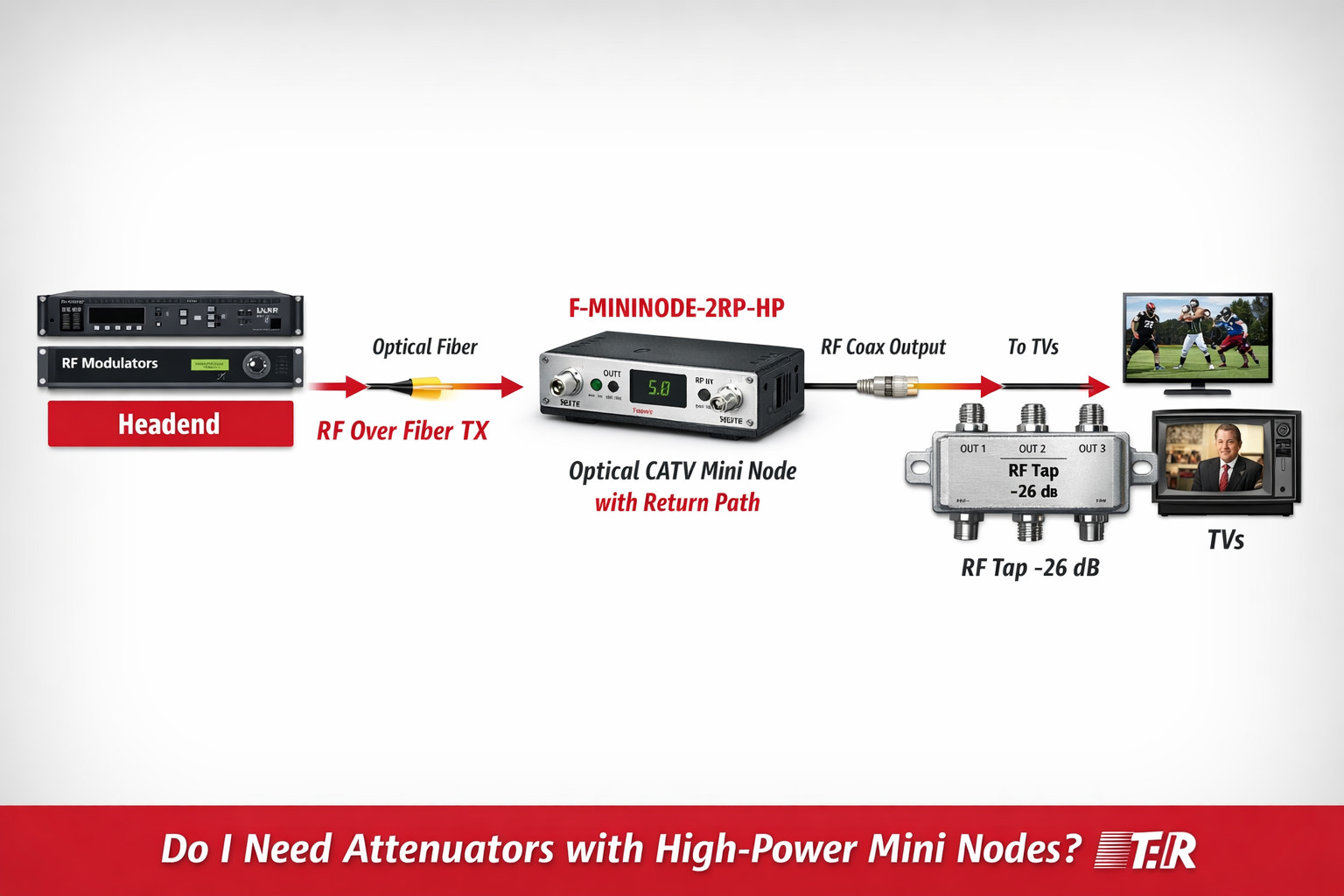
F-MININODE-2RP-HP – Optical CATV Mini Node with Return Path
This high-performance CATV mini node converts RF over fiber signals back to coaxial RF for distribution throughout a building or facility.
This architecture is commonly used in hotels, campuses, cruise ships, stadiums, and other facilities that distribute television signals across large properties.
High-power CATV mini nodes typically output RF levels around:
This level is intentionally designed to support multiple taps, long coax runs, and large distribution networks.
In a properly designed CATV network, televisions are connected through RF multitaps rather than directly to the node output.
For example, a 26 dB tap introduces approximately 26 dB of attenuation at the drop port.
Modern digital televisions can receive signals within a fairly wide range.
Because the signal after the tap is approximately +19 dBmV, it already falls perfectly within the acceptable operating range.
For this reason, additional attenuators are usually unnecessary.
Additional attenuation may only be needed in certain situations:
In most CATV systems using properly selected taps, these situations rarely occur.
Thor Broadcast provides a complete range of RF over fiber solutions for professional CATV and IPTV distribution networks.
Explore available systems here:
RF Over Fiber CATV SolutionsHigh-power CATV mini nodes are designed to support distribution networks with multiple taps and long cable runs. When using correctly sized multitaps, the signal level delivered to each television typically falls within the ideal operating range without requiring additional RF attenuators.
Understanding the relationship between node output power, tap loss, and television input sensitivity helps simplify system design and reduce unnecessary components.


 EN
EN