Thor Broadcast RF over Fiber systems help prisons and correctional facilities distribute CATV, MATV, analog, or QAM TV channels to multiple buildings using fiber while keeping existing coax wiring.
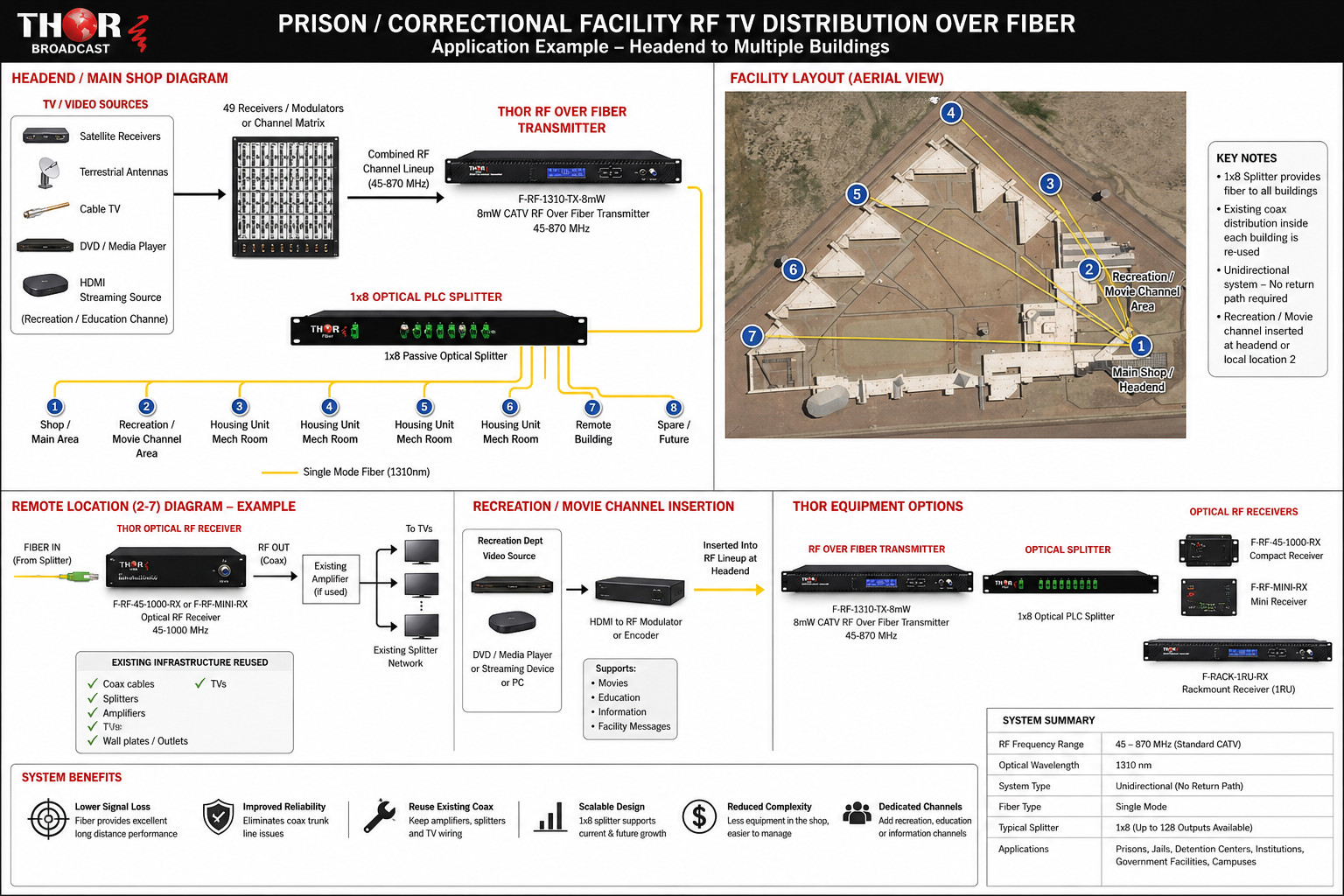
Thor Broadcast RF over Fiber systems help correctional facilities modernize large analog coax TV networks by replacing long coax trunk runs with optical fiber while keeping the existing building splitters, coax drops, and television infrastructure.
View Thor RF Over Fiber ProductsTable of Contents
Many correctional facilities, prisons, detention centers, and institutional campuses still use large coax-based TV distribution systems. These systems often include dozens of satellite receivers, analog modulators, RF combiners, amplifiers, splitters, and long coax runs feeding multiple housing units or buildings.
In this application example, the facility had approximately 49 receivers connected to 49 modulators at the main headend/shop. The combined RF signal was sent through coax to multiple numbered mechanical rooms throughout the prison campus. Each remote location then used amplifiers and splitters to feed TVs inside the housing units.
The goal was to reduce equipment clutter at the shop, simplify the RF distribution path, improve signal reliability, and send the full channel lineup over fiber to each remote building location while reusing the existing coax distribution inside each unit.
The existing system used 49 individual receivers feeding 49 individual modulators, then combined into RF amplifiers and coax distribution. This creates a large amount of rack equipment, cabling, power usage, and maintenance work.
The RF signal had to travel from the shop to multiple remote building locations over coax. Long coax runs can introduce signal loss, noise, grounding issues, and amplifier balancing problems.
Each remote location had its own amplifier and splitter network feeding nearby buildings. This works, but it can become difficult to maintain as the system grows or ages.
The recreation department also wanted the ability to add a movie, DVD, educational, or streaming content channel that could be managed separately from the main TV headend.
The recommended design is a unidirectional CATV RF over Fiber system. The complete combined RF channel lineup is converted from coax RF to optical fiber at the main headend, split through a passive optical splitter, and delivered to each remote mechanical room. At each remote location, a Thor optical RF receiver converts the fiber signal back to standard coax RF.
| System Part | Recommended Thor Product | Purpose |
|---|---|---|
| RF Over Fiber Transmitter | Thor 8mW CATV RF Over Fiber Transmitter | Converts the combined coax CATV/MATV RF signal into optical fiber for long-distance distribution. |
| Optical Splitter | 1x8 Optical PLC Splitter | Splits one optical RF feed into up to eight fiber outputs for multiple building locations. |
| Optical RF Receivers | Thor CATV RF Over Fiber Receivers | Converts the optical fiber signal back to coax RF at each remote mechanical room. |
| Existing Coax Distribution | Existing Building Amplifiers, Splitters, and Coax Runs | The current inside-building RF distribution can usually remain in place, reducing installation cost. |
| Optional Local Video Channel | Thor HDMI / SDI / IP Encoder or RF Modulator | Adds a recreation, education, DVD, or streaming channel into the facility TV lineup. |
Fiber is much better for long-distance signal transport than coax. It avoids many of the RF loss problems caused by long coax trunk runs.
Instead of sending amplified coax through the entire facility, the RF signal can be transported optically and converted back to coax only where needed.
The fiber system feeds the existing coax network at each building, so the facility does not need to replace every TV drop.
A 1x8 optical splitter gives the facility multiple outputs for current buildings and future expansion points.
There are two common design options:
The 1x8 optical splitter can be installed at the main shop where the RF transmitter is located. From there, individual fiber home-runs are sent to each remote mechanical room. This is the simplest design to understand and troubleshoot.
The RF transmitter can send one fiber to a more central point in the facility, such as near location 3 or 4, and the optical splitter can be installed there. From that central point, shorter fiber runs can be sent to the remaining buildings.
In this example, the recreation department wanted to restore a movie or educational channel for inmate programming. This can be done by adding a dedicated source such as a DVD player, media player, streaming decoder, PC, or signage player into a Thor RF modulator or encoder.
The new recreation channel can then be inserted into the main RF lineup and distributed over the same RF over Fiber network to all buildings. If local control is required, the source equipment can be located in the recreation department while the modulated RF output is returned to the headend or inserted at the correct RF combining point.
Distribute controlled TV programming from one headend to multiple housing units over fiber.
Send MATV, CATV, QAM, or analog RF channels to remote buildings while keeping existing coax drops.
Feed multiple buildings from a central RF headend using fiber instead of long coax runs.
Use RF over Fiber to distribute TV channels to multiple buildings, wings, or remote equipment rooms.
For this type of prison TV distribution upgrade, the minimum recommended Thor solution is an 8mW CATV RF over Fiber transmitter, a 1x8 optical PLC splitter, and one optical RF receiver at each remote building location. The system is simple, unidirectional, and designed to work with the facility’s existing coax RF distribution after the optical receiver.
Thor Broadcast can help review the facility layout, estimate optical power levels, recommend the correct transmitter power, and select the proper optical RF receivers for rackmount or compact mechanical-room installation.
Contact Thor Broadcast for System Design Help
Yes. The fiber is used for the long-distance trunk distribution. At each remote location, the Thor optical receiver converts the signal back to coax RF so the existing amplifiers, splitters, and TV drops can continue to be used.
For standard TV channel distribution, no return path is required. The signal is one-way from the headend to the TVs.
Yes. One properly sized Thor RF over Fiber transmitter can feed a passive optical splitter, such as a 1x8 PLC splitter, and distribute the RF signal to multiple building locations.
Yes. A DVD player, media player, streaming decoder, PC, or other video source can be added through a Thor RF modulator or encoder and inserted into the facility’s RF lineup.
The splitter can be installed at the main headend for simple home-run fiber distribution, or at a more central location to reduce total fiber distance. The best choice depends on conduit paths and service access.


 EN
EN