SDI vs HDMI modulators: cabling, lock behavior, handshakes, workflows, latency, and how to choose the right Thor Broadcast headend.
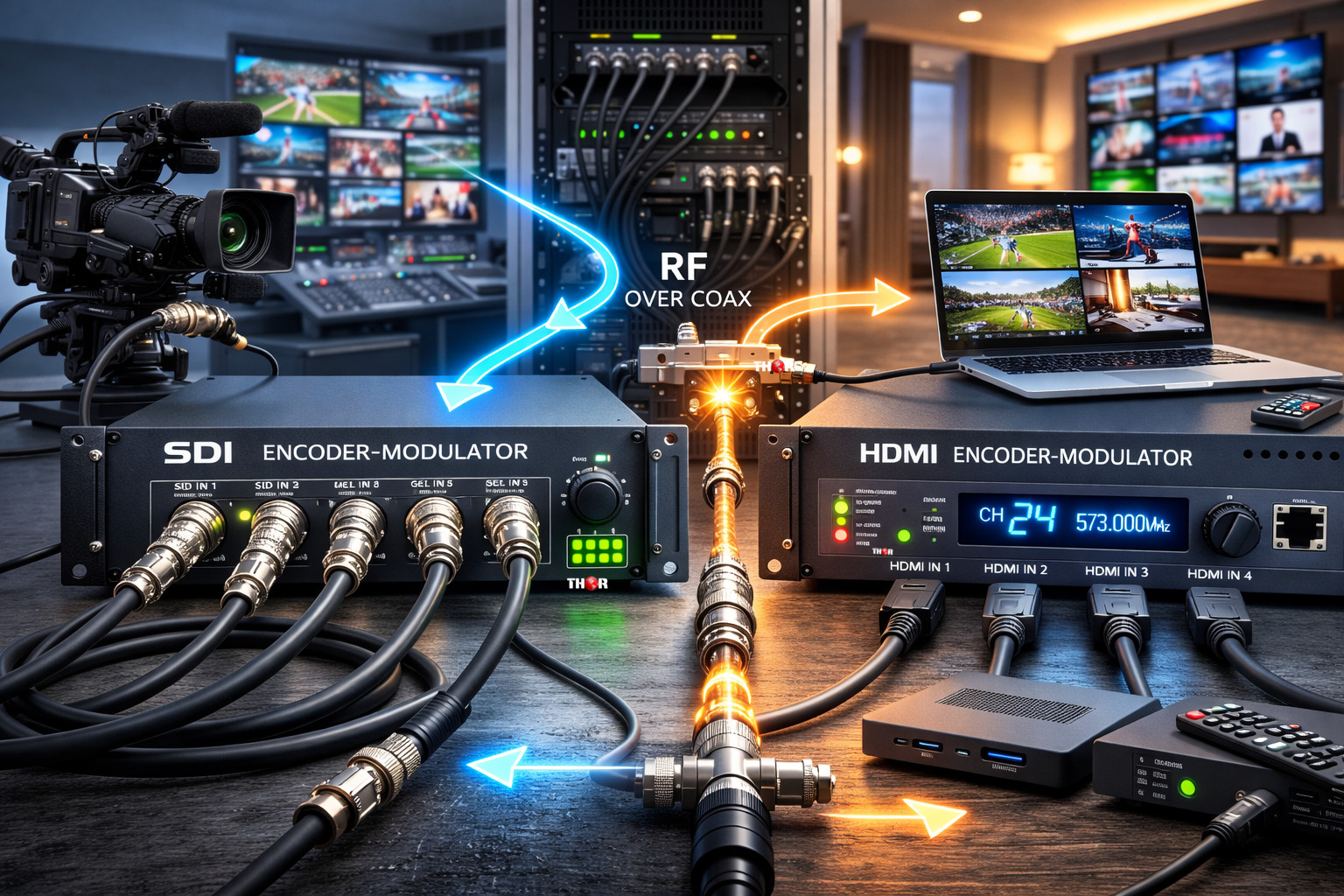
Table of Contents
In coax TV distribution, a “modulator” is typically an encoder-modulator: it ingests baseband video, compresses it into a broadcast-friendly codec, packetizes it into an MPEG transport stream, and then modulates that stream onto an RF carrier (QAM/DVB-C, ATSC, DVB-T, ISDB-T, etc.) for distribution over coax. The modulation layer (RF) may be identical between two products, while the operational experience can be completely different depending on whether the input is SDI or HDMI.
The practical differences between SDI and HDMI modulators therefore start at the very front end: cabling, connectors, clocking, signal negotiation, and how reliably the modulator can lock to the incoming source without human intervention. SDI modulators are usually selected because the facility already runs broadcast-grade SDI routing and needs deterministic behavior over long coax runs. HDMI modulators are usually selected because the sources are consumer/pro-AV devices-set-top boxes, players, PCs, or signage endpoints-where HDMI is the native output. Thor Broadcast supports both families and also offers hybrid platforms that accept either interface, which is useful when your headend must accommodate mixed source types without adding external conversion stages.
SDI is engineered around 75-ohm coaxial cabling and BNC connectors that physically lock. In professional racks, that locking behavior is not cosmetic: it reduces intermittent faults caused by vibration, cable strain, or accidental contact. The cabling ecosystem also supports long runs because SDI was designed for broadcast plants where endpoints may be tens or hundreds of meters apart, and where signal integrity is protected through equalization and reclocking in professional gear.
HDMI is optimized for short-run device interconnect, typically within a room or a rack bay. The connector does not lock, and long HDMI runs are often the first reliability fault line in the field, especially when cable quality varies or when the source and sink renegotiate link parameters after power events. That does not make HDMI unsuitable for headends, but it does mean the “HDMI modulator” choice is often inseparable from your cable-management discipline and how you handle HDMI distribution in the rack.
This is one reason many facilities place HDMI modulators physically close to the HDMI sources and then distribute the RF (or IP/ASI transport stream) over robust media from that point onward. For compact, close-coupled deployments, Thor’s HDMI modulators such as the Petit HDMI RF Modulator or rack-density options like the HDMI RF Modulator Chassis System (1-12 units) align well with a “keep HDMI short, distribute RF widely” design approach.
In day-to-day operations, one of the most visible differences is how the modulator acquires and maintains lock. SDI carries a continuous, broadcast-structured serial bitstream with embedded timing. Professional sources and receivers typically behave predictably: once the SDI signal is present and within tolerance, the receiver locks and stays locked. This determinism is a major reason SDI remains popular in broadcast workflows where any “surprise re-sync” translates to black frames on air or interruptions in downstream encoding.
HDMI, by design, includes negotiation behaviors such as EDID exchange (capability discovery) and, in many real-world source chains, content protection signaling. Sources may change output format after a reboot, after a display chain changes, or after the sink re-advertises different capabilities. In a headend, those behaviors can manifest as intermittent input loss, unexpected resolution shifts, or momentary blanking while the link renegotiates. A well-designed HDMI encoder-modulator mitigates these issues with robust input handling and configuration controls, but the core reality remains: HDMI sources can be “chatty,” and their behavior depends on both sides of the link.
If your environment is broadcast-centric and you want the input to behave like infrastructure rather than like a consumer device, an SDI-input headend platform is often the safer long-term choice. Thor’s SDI modulator ecosystem, including platforms such as HD-SDI to QAM Modulators (CATV/DVB-C), is built for the SDI side of that reliability equation.
SDI workflows usually have tighter expectations around video standards: 720p, 1080i, 1080p, and specific frame rates that match broadcast and production norms. That discipline simplifies headend engineering because you can standardize on a small set of input formats, keep encoder settings consistent, and minimize resync events. It also improves troubleshooting: when every camera chain and router port is configured to a known timing plan, deviations stand out.
HDMI sources, particularly PCs and media players, can output a wider variety of timings and color formats, and they may change those outputs based on perceived sink capabilities. Even when you intend to run 1080p60 everywhere, a device may boot into a different mode, fall back to 720p, or change color depth depending on EDID interpretation. In this context, HDMI modulators are frequently chosen for environments where the source is inherently HDMI-first (hospitality STBs, signage players), and the engineering effort is focused on constraining the source output settings and keeping the HDMI link stable.
For multi-input HDMI headends where you want centralized management and consistent encoding behavior, Thor’s higher-density HDMI families-such as the 1-8 HDMI Digital RF Modulator CC or multi-unit rack approaches like the HDMI RF Modulator Chassis System- are typically easier to operate than a collection of unrelated single-channel boxes because you can standardize configuration and treat the headend like a controlled platform rather than a set of one-off devices.
SDI carries embedded audio and can carry ancillary data in a way that is natural to broadcast workflows. This matters when you are transporting more than just picture and stereo audio-for example, when your production chain uses embedded timecode, signaling, or other metadata that downstream systems depend on. Even if your final distribution is “just TV channels,” SDI’s embedded model tends to be stable: audio is present when video is present, and it is tied to the same timing discipline.
HDMI also carries audio, but it brings additional consumer-oriented behaviors that can complicate headends. Consumer sources may change audio formats, mute briefly during renegotiation, or behave differently depending on whether they believe a downstream device supports specific audio capabilities. HDMI also includes control-oriented features (such as device control signaling) that can be beneficial in a living-room ecosystem but are usually irrelevant-or even undesirable-in a fixed headend. From a modulator perspective, the key engineering question is not whether audio exists, but whether the source will output a consistent audio mode that your receiver population can decode reliably after modulation and transport.
In practice, many installers choose HDMI modulators specifically because they need compatibility features that are common in TV ecosystems. Thor’s HDMI modulator families frequently emphasize broad TV compatibility through configurable encoding and modulation settings, and certain Thor models are positioned with audio codec support aimed at typical television decoding behavior. The operational best practice is still validation: test on the real TVs and STBs you will deploy, including channel scans, audio presence, and long-duration playback.
SDI is typically a professional interface that does not rely on consumer content-protection negotiation in the same way HDMI often does. As a result, SDI modulators generally avoid an entire class of headend failures related to handshake events and device authorization. When SDI is available from the source chain, many engineers value it simply because it behaves like infrastructure.
HDMI sources may enforce content protection policies that affect what downstream devices can ingest. In a headend, this becomes a planning constraint: you must ensure that the HDMI source and the modulator can form a stable, compliant link and that the source is configured to output the desired format consistently. In practical deployments, the biggest risk is not “quality,” but intermittent loss of signal due to renegotiation or device changes after updates and reboots. This is why HDMI headends benefit from tight change control on sources and from selecting modulators designed for managed environments.
If your source environment is HDMI-only and you must build a coax distribution plant from it, selecting a managed Thor HDMI platform such as the 1-8 HDMI Digital RF Modulator CC or a compact single-channel unit such as the Petit HDMI RF Modulator typically provides more operational control than an ad hoc approach, because you can standardize how the headend is configured and monitored over Ethernet rather than relying on physical access and guesswork.
The interface type does not automatically determine end-to-end latency. Latency is dominated by the encoder pipeline: buffering, GOP structure, rate control, and any processing stages in the modulator. However, SDI modulators are frequently deployed in environments where low delay is a hard requirement (venues, live production, real-time monitoring), and those product lines are often engineered and configured with latency as a first-class goal. HDMI modulators are often deployed in distribution contexts (hospitality, signage, in-building channels) where seconds of delay may be acceptable, so the market expectation sometimes favors compatibility and density over “minimum glass-to-glass.”
Thor explicitly supports low-latency configurations in certain chassis families, including SDI-centric and mixed-input designs. If latency is a procurement driver, the correct approach is to select the platform class intended for real-time workflows and then validate in the exact end-to-end path you care about: source → modulator → RF plant → tuner/TV. In systems where SDI is available at the source, SDI ingest also reduces the number of conversion stages, which can indirectly help you keep delay under control.
SDI modulators are typically the better choice when the headend lives inside a professional production ecosystem. If you already have SDI routing, SDI cameras, SDI playout, or SDI monitoring, then an SDI encoder-modulator keeps the chain coherent: one cabling standard, predictable locking, and fewer consumer-interface edge cases. Thor’s SDI-oriented solutions such as HD-SDI to QAM Modulators are aligned with that operational model.
HDMI modulators are typically the better choice when the source environment is inherently HDMI. Hospitality and enterprise channel injection often starts with HDMI set-top boxes or signage players, not with SDI routers. In those cases, the simplest reliable architecture is to accept HDMI directly, keep the HDMI runs short and mechanically protected, and then distribute the RF over coax to as many TVs as necessary. Thor’s HDMI RF modulator catalog, starting at HDMI RF Modulators, covers both compact single-channel and higher-density multi-channel families, allowing you to select based on scale rather than compromise on interface fit.
Many real installations are mixed: a facility might have SDI sources from production gear and HDMI sources from commercial boxes or PCs. In that situation, forcing everything through external SDI↔HDMI converters is rarely ideal. It increases points of failure, adds power supplies, complicates cable management, and makes troubleshooting slower because the failure could be in the converter rather than in the headend.
Hybrid encoder-modulators allow you to ingest both interface types in one managed chassis, which is often the cleanest way to build a headend that must accept heterogeneous sources. Thor offers mixed-input platforms such as the 8-channel SDI and HDMI Clear CATV RF Modulator, as well as balanced-input chassis solutions like the 2 HDMI + 2 SDI to RF Coax Modulators and IPTV Streaming Encoders. In a mixed-source headend, these “hybrid” choices can be the difference between a rack that is serviceable and a rack that becomes a permanent troubleshooting project.
Hybrid designs also make future changes easier. If a source changes from HDMI to SDI (or vice versa) because the upstream gear is upgraded, the headend can remain stable. You are not forced to redesign the rack or repurchase the entire modulation layer; you simply reassign inputs and keep the RF and service plan consistent for the TVs downstream.
Regardless of whether the input is SDI or HDMI, the RF side of the modulator must deliver a clean carrier with adequate MER and low BER across the coax plant. This means you still need an RF plan: channel frequencies, output levels, combining strategy, splitter losses, and verification at the farthest outlets. Interface choice does not exempt you from RF engineering; it only changes how stable the input is and how likely you are to experience upstream disruptions that appear downstream as macroblocking or black screens.
Coax distribution quality is often decided by passive infrastructure: splitters, combiners, taps, termination, and cable integrity. Thor provides practical accessories for building and maintaining these plants, such as Coax Multiplexers / Splitters / Combiners. The best modulator is still vulnerable to a poor splitter tree or overloaded amplification, so modulator selection should be paired with a distribution design that protects your RF margins.
The most valuable way to compare SDI and HDMI modulators is not to debate which interface is “better,” but to decide which failure modes you can tolerate. If your business cannot tolerate signal loss due to renegotiation events, SDI ingest is usually the safer choice when available. If your sources are HDMI-first and cannot be replaced, then the right HDMI modulator is the one that can survive the behaviors of those sources, is manageable over the network, and has predictable recovery behavior after reboots, source swaps, and firmware updates.
In either case, procurement should include structured validation in a realistic environment. Use the exact source devices you will deploy, feed them into the candidate Thor modulator platform, distribute the RF through a representative splitter tree, and test on the actual TV models you will install. Validate channel scanning, audio presence, long-duration stability, and post-reboot recovery. If low latency matters, measure end-to-end delay with a timestamped test signal rather than guessing from specifications. This approach turns “SDI vs HDMI” from a theoretical discussion into an operational decision you can defend.
SDI modulators tend to be chosen when the headend is an extension of a professional broadcast plant: long coax runs, locked connectors, deterministic timing, and an ecosystem built around SDI routing and monitoring. HDMI modulators tend to be chosen when the sources are consumer/pro-AV devices that speak HDMI natively and where the engineering goal is to convert those sources into stable RF channels with minimal complexity. In mixed environments, hybrid SDI/HDMI platforms often provide the cleanest rack design because they avoid external conversion stages and centralize management.
Thor Broadcast’s catalog supports each of these strategies: SDI-centric headends like HD-SDI to QAM Modulators, HDMI-centric platforms like the 1-8 HDMI Digital RF Modulator CC and Petit HDMI RF Modulator, and hybrid options such as the 8-channel SDI/HDMI Clear CATV RF Modulator and 2 HDMI + 2 SDI chassis. Select the interface that matches your source reality, then protect the RF side with disciplined coax distribution engineering and receiver-based validation.
FCC: DTV report on COFDM and 8-VSB performance
FCC: DTV interference rejection thresholds
GovInfo: Federal Register (ATSC/VSB context)
MIT: TMDS encoding notes
MIT: TMDS encoding notes (Part 2)
University of Maine: TMDS differential signaling lecture notes

 EN
EN