Thor Broadcast Logo
Iniciar sesión
Carro (0)
  • en EN
  • Productos
    • CATV Moduladores
      • HDMI los Moduladores de RF
      • HD-SDI convertidores
      • IP para CATV Moduladores Borde
    • DVB Codificadores
      • Los Codificadores De Vídeo
      • Hdmi RTSP RTMP, RTSP Codificadores
      • Transcodificadores, MPEG Convertidores, IP ASI puertas de enlace
    • Decodificadores (IRD y STB)
      • RF Decodificadores del IRD
      • Difusión IP Decodificadores
      • RF CATV de IPTV y OTT STB del
    • Satélite Moduladores
      • DVB-S/S2 Satélite Moduladores
    • De Fibra Óptica De Transporte
      • SDI a lo largo de la Fibra
      • SDI SD/HD/3G con CWDM
      • TV por Cable CATV RF 45-900Mhz
      • L del Satélite en la Banda de RF 45-3000Mhz
      • Datos y Ethernet en fibra
    • Wireless HD SD de Vídeo de Transporte de Datos
      • Wireless HD de Vídeo SD con los Datos de los Equipos
    • Descuento De Inventario
      • Nuevos Equipos De Transmisión En Venta
      • Laboratorio de Equipos de transmisión Utilizados en venta
      • Última Generación De Equipos De
  • About
  • Cartera De Clientes
  • Apoyo
      • Support Center Apoyo
      • User Manuals Manuales
        de Usuario
      • Request an RMA Solicitar una
        RMA
  • ⬇Download
    • Manuals
    • Datasheets
    • Quick Guides
  • Case Studies
    • THOR Gym
    • THOR Stadium
    • THOR Hotel
    • THOR University
  • Videos
  • Contacto
  • Conviértete en un revendedor
  1. Productos
  2. RF Decodificadores del IRD
  3. IRD - Satélite o ATSC Decodificador a SDI, IP, ASI, Subtítulos
back

IRD - Satélite o ATSC Decodificador a SDI, IP, ASI, Subtítulos ATSC off Air Input

2 x Satellite DVBS/S2 RF Input2 x ATSC Tuners RF Input IRDSatellite DVBS/S2 RF Input ATSC off Air Input QAM "Cable" Input DVB-T Off Air Input ISDB-T Input
Model: H-IRD-V3-ATSC
Qty: 0
Product image Previous Next
Product image
Product image
Product image
Product image
Precio: $1,995.00
Disponibilidad: En stock Condición: nuevo QR Code IRD - Satélite o ATSC Decodificador a SDI, IP, ASI, Subtítulos
Envío: starting at $0.00 Garantía: 2Yrs
Cantidad:
preguntar por el producto
Enviar petición
Descripción Caracteristicas Dibujos Vídeo Models Accessories Especificación Q&A
Documents
  • Manual
  • Datasheet
  • Quick Guide
Apoyo
ATSC off Air Input descripcion del modelo
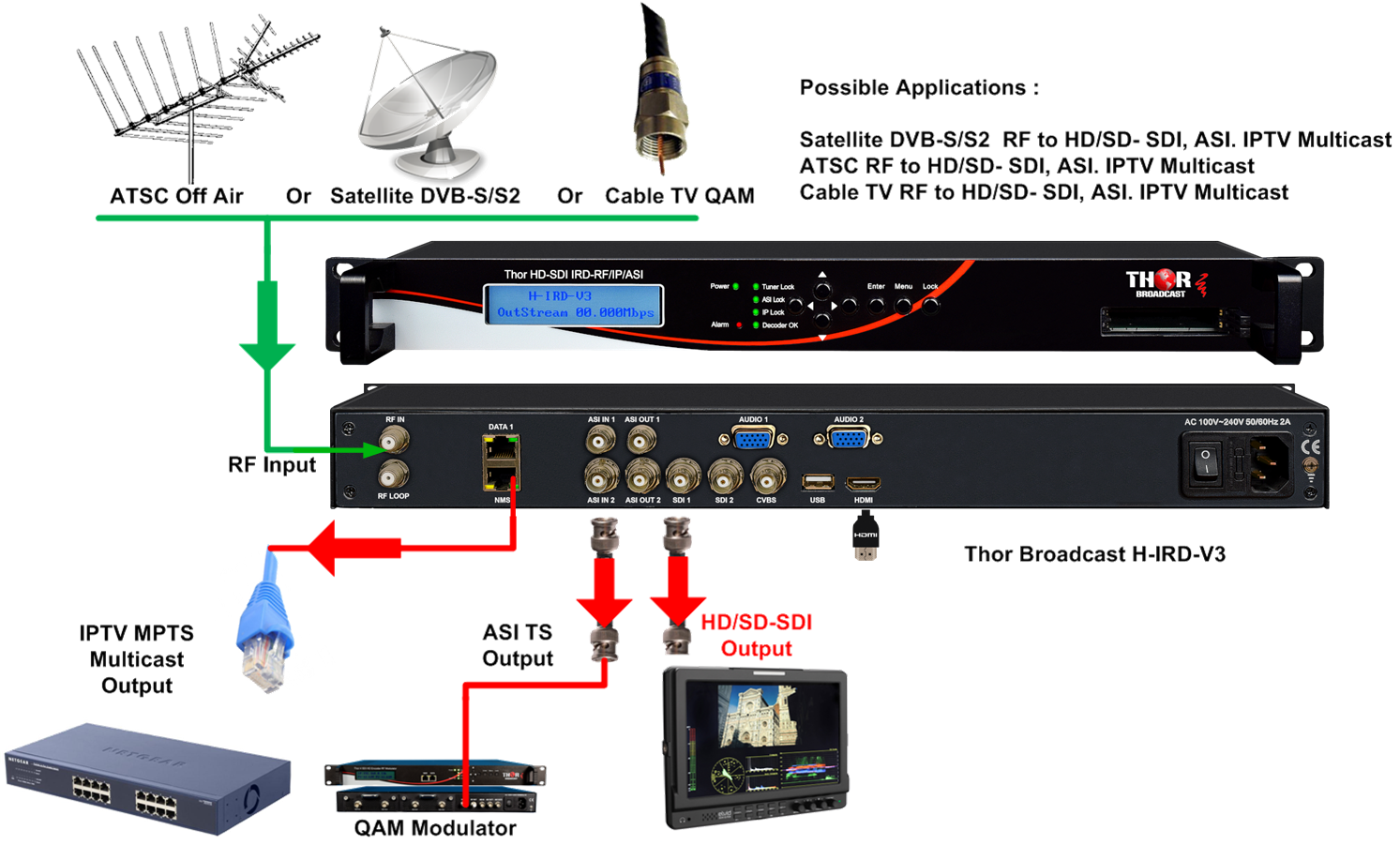
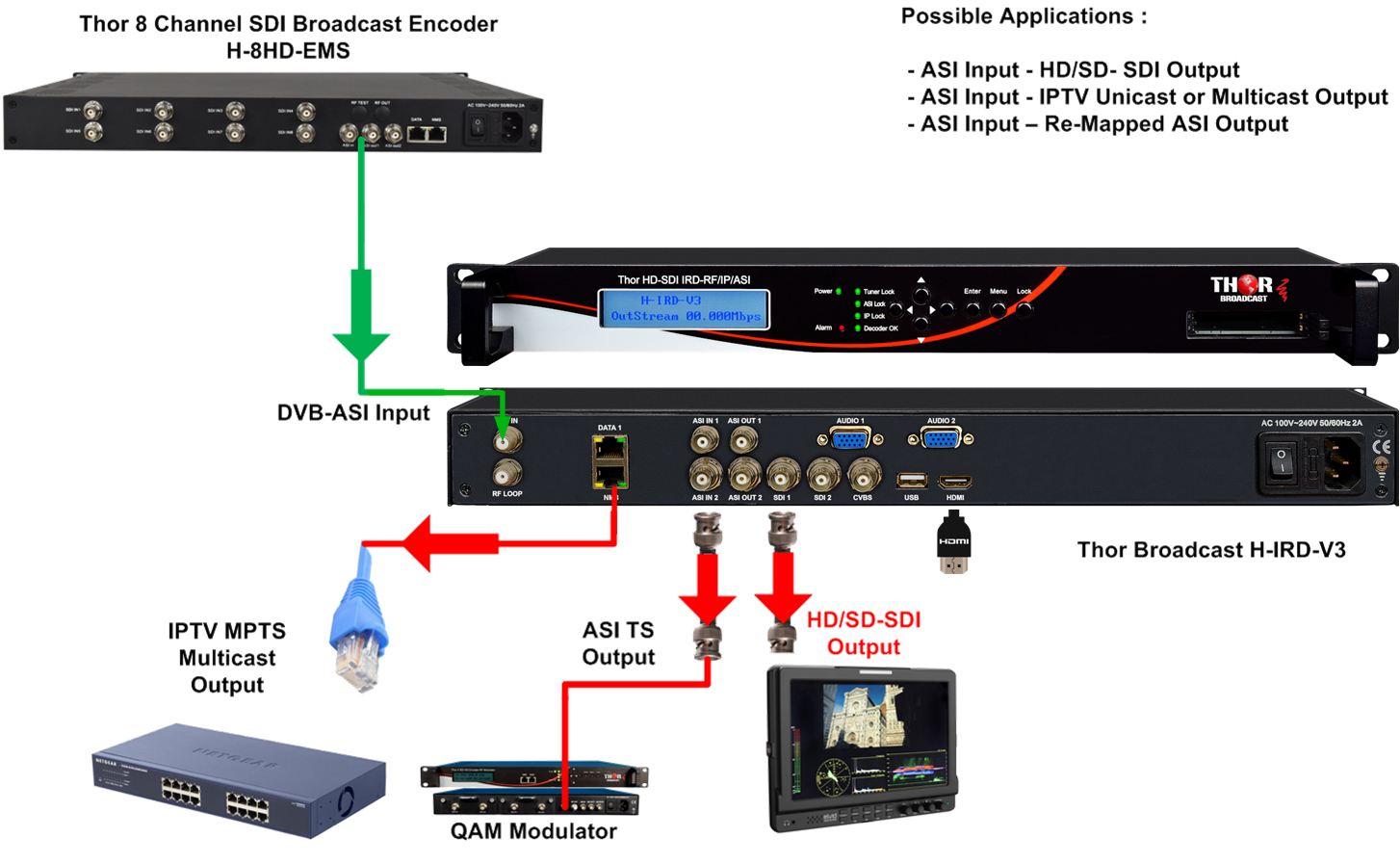
ATSC off Air RF input IRD Decoder with SDI, ASI, IPTV Output PN: H-IRD-V3-ATSC ATSC tuners input to IP TS SPTS multicast or unicast outputs. Each TS program - "subchannel" from any ATSC Channel can be converted to IP stream - UDP/RTP/RTSP Any program could be selected and output as a SDI /HDMI /CVBS Video / Audio, it supports 608/708 CC-Closed captioning

Descripción

Universal de Difusión IRD Decodificador

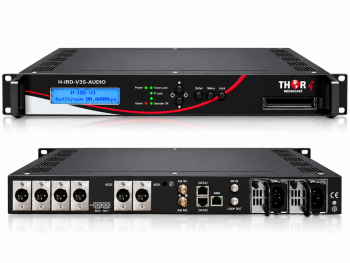
H-IRD-V3 - transmisión de RF (de Satélite DVB-S/S2) Decodificador con SDI, ASI, IPTV de Salida

H-IRD-V3-ATSC - transmisión de RF de la ATSC Fuera del Aire Decodificador con SDI, ASI, IPTV de Salida

H-IRD-V3-QAM - transmisión de RF de QAM Decodificador con SDI, ASI, IPTV de Salida

H-IRD-V3-ANTENA de transmisión de RF DVB-T del Aire Decodificador con SDI, ASI, IPTV de Salida

Programa de Decodificación HD-SDI, HDMI, YPbPr y CVBS con Toslink de audio XLR y

Thor H-HD-IRD Integrados de la serie del Receptor Decodificadores de tener varias aplicaciones para descifrar el contenido del programa de difusión de vídeo de calidad. Equipado con todos los grandes de la se?al de vídeo de salida, incluyendo HD-SDI, Thor H-HD-IRD unidades pueden proporcionar vídeo de alta definición a cualquier pantalla o profesional, el sistema de vídeo. También están disponibles los modernos salidas de audio digitales en ambos óptico Toslink y conectores XLR. Dolby AC/3 transferencia de audio es estándar, y el soporte para subtítulos para ambos 608 y 708 de la subtitulación de los sistemas está presente. La V3 de la plataforma agrega un LCD del panel frontal de la pantalla de vídeo para la confianza de la supervisión, así como un programa interno de multiplexor para combinar el contenido de ambos ASI e IP fuentes simultáneamente. La interfaz web muestra todos los programas disponibles y el PID correspondiente. Cada programa puede ser independiente a?adido a la ASI o IP salidas.

El todos los programas seleccionados son multiplexados en una sola MPTS de salida. Además, la IP de salida puede ser configurada para hasta 32 SPTS único programa de flujo de salidas, cada una con diferentes direcciones y la configuración del puerto. Esto permite que la V3 sistema para ser utilizado como un inteligente ASI a IP o RF a la IP de Puerta de enlace con agregar gota y ASI capacidades de multiplexación. Combinado programa multi secuencias de transporte llevado a través de IP también puede ser separado en su correspondiente programa individual de los arroyos. El sintonizador de RF puede ser configurado para QAM, 8VSB (ATSC, DVB-T, DVB-C o DVB-S2 fuentes de se?al. Dos CAS ranuras de la tarjeta de permitir decodificado de cifrado de programación.

Thor HD-IRD unidades puede ser utilizado para la conversión de banda ancha de programación de vídeo en HD sin comprimir, así como la multiplexación y la retransmisión de los programas tanto ASI e IP salidas. Thor HD-IRD sistemas son fiables y versátiles de la plataforma para la difusión del programa de decodificación y TS conversión de protocolo

Tags: ASI Decoder ASI to IP ASI to SDI Coax Multiplexer DVBS to SDI

Caracteristicas

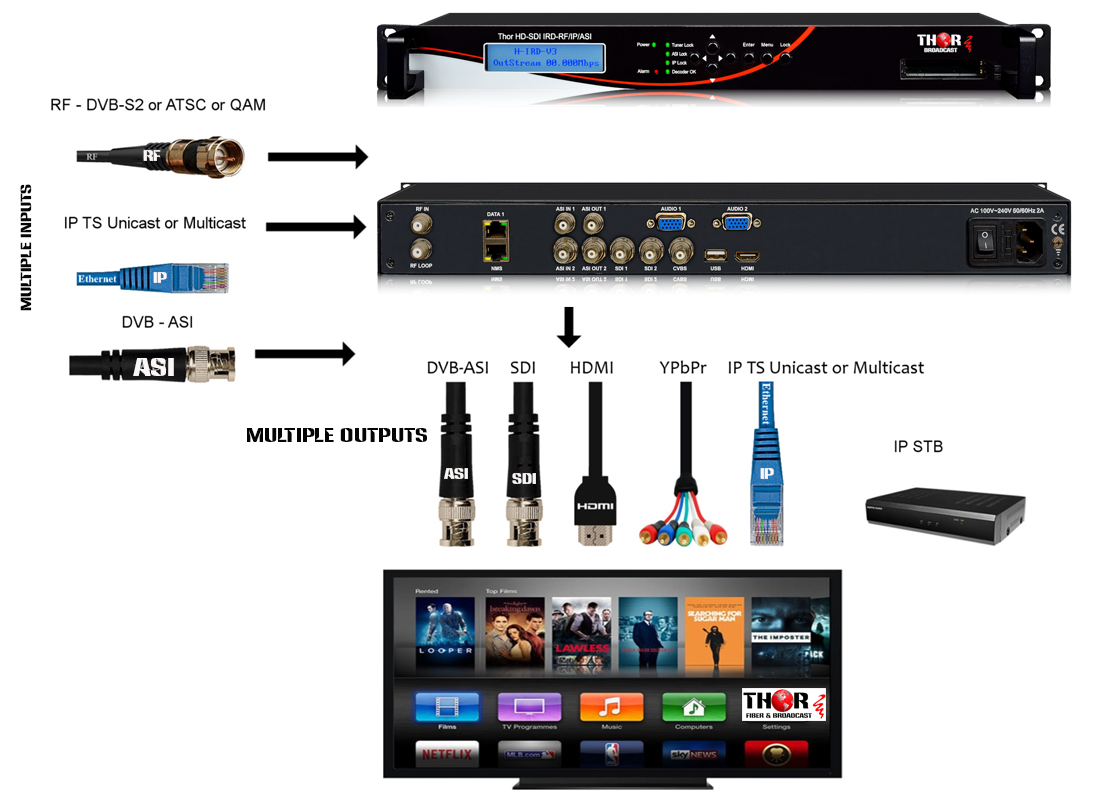
  • RF / IPTV / ASI de ENTRADA - Todos los Audio-Salidas de Vídeo incl. HDSDI, HDMI, CVBS, Suppoty formatos de SD y HD de hasta 1080p/60
  • Sintonizador disponible como FUERA del AIRE ATSC, QAM CABLE, ISDBT, TDT, DVBC, DMBT - Cualquier estándar
  • 10/100 Etherent IPTV, multicast o unicast TS MPEG2/4 Entrada
  • H. 264 y MPEG-2 por Hardware de Descodificación de HD-SDI, HDMI, YPbPr y CVBS Salidas
  • Combinar los programas de ambos y ASI entradas IP a multiplexado ASI e IP Salidas
  • ASI de entrada para Remultiplexer opción para crear un nuevo MUX fuera así 48x ip streaming spts a cabo para el enrutamiento y distribución
  • Cam ranura para tv de programación: descripción
  • Panel frontal del monitor de vídeo para la confianza de supervisión y solución de problemas
  • Aparte de multiplexado programa de transporte de flujos de SPTS IP salidas de 32 Max
  • Interfaz del servidor Web para el navegador seguro y gestión completa de la interfaz del panel frontal
  • Soporta Subtítulos 608 y 708 sistemas, es compatible con Dolby AC/3 Pase a Través de

Dibujos


Vídeo

Product Video
Quick configuration Guide for H-IRD-V3-ATSC. IRD - Satellite or ATSC Decoder to SDI, IP, ASI, CC
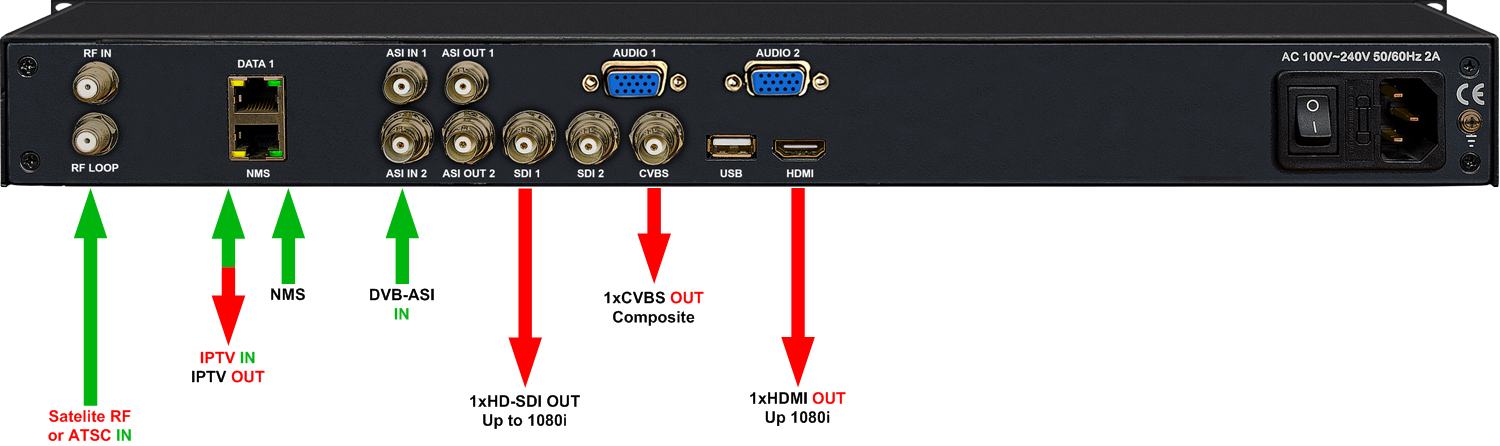
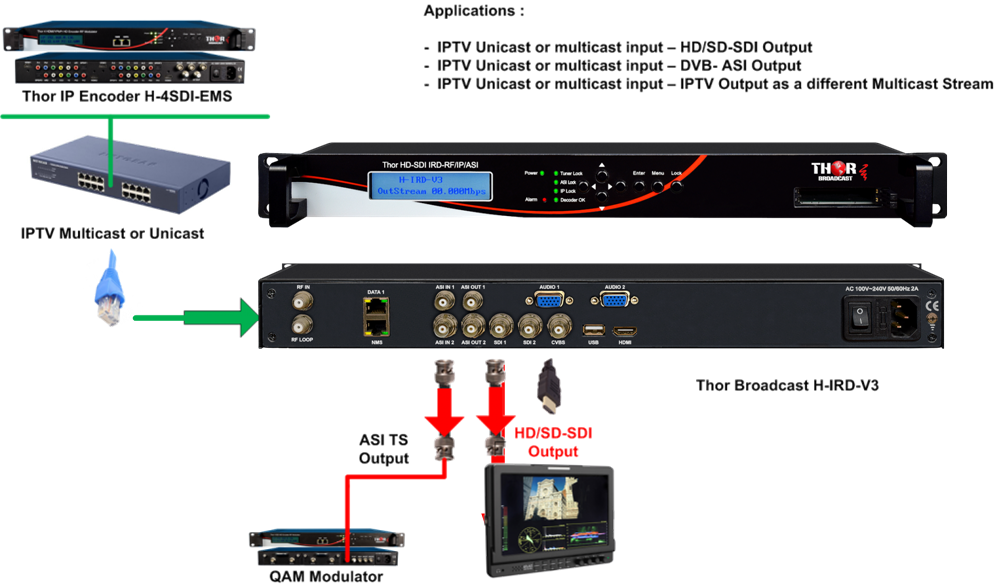
High end state of the art decoder with RF tuner, advanced IP streaming, front LCD confidence monitor, and supports 608 and 708 closed captioning. RF tuners for DVB-S2, ATSC, and QAM are available. All settings and alarm information are available through web browser based network management console. Universal Broadcast IRD Decoder Thor H-HD-IRD series Integrated Receiver Decoders have several applications for decoding program content to broadcast quality video. Equipped with every major video signal output, including HD-SDI, Thor H-HD-IRD units can provide HD video to any display or professional video system. Also available are modern digital audio outputs on both optical Toslink and XLR connectors. Dolby AC/3 audio pass through is standard, and closed caption support for both 608 and 708 captioning systems is present. The V3 platform adds a front panel LCD video display for confidence monitoring, as well as an internal program multiplexer for combining content from both ASI and IP sources simultaneously. The web interface displays all available programs and corresponding PID's. Each program can be independently added to either the ASI or IP outputs. All selected programs are multiplexed into a single MPTS output. Additionally, the IP output can be configured for up to 32 SPTS single program stream outputs, each with different address and port settings. This allows the V3 system to be used as an intelligent ASI to IP or RF to IP Gateway with add drop and ASI video signal multiplexing capabilities. Combined multi program transport streams carried over IP can also be separated into their corresponding single program streams. The RF tuner can be configured for QAM, 8VSB (ATSC), DVB-T, DVB-C, or DVB-S2 signal sources. Two CAS card slots allow decoded of encrypted programing. Thor HD-IRD units can be used for converting broadband programing to uncompressed HD video, as well as multiplexing and retransmitting programs to both ASI and IP outputs. Thor HD-IRD systems are a reliable and versatile platform for broadcast program decoding and TS protocol conversion: There are simplify capabilities of this IRD: Inputs: It can take in different types of signals: ATSC RF: DVB-S/S2 RF QAM RF:. IP UDP Multicast / Unicast: DVB-ASI: Outputs: It can send out signals in various ways: ASI: For distributing MPEG transport streams. IP: Sending content over computer networks. Decoder Video: It can provide video in different formats such as SDI, HDMI, YPbPr (component video), and CVBS (composite video). Applications and Conversions: Decode (SATT DVB-S/S2 RF ) to SDI, HDMI, CVBS, YPbPr Video and Audio Decode (Tersial ATSC RF ) to SDI, HDMI, CVBS, YPbPr Video and Audio Decode (CABLE TV QAM RFor ISDB-T) to SDI, HDMI, CVBS, YPbPr Video and Audio Sattelite DVB-S/S2 RF to IP - UDP Off Air ATSC RF to IP Cable QAM RF to IP Sattelite DVB-S/S2 RF to DVB-ASI Off Air ATSC RF to DVB-ASI Cable QAM RF to DVB-ASI IP-ASI It can change IP input streams into two ASI streams. ASI-IP It can convert ASI input as IP output . You can merge two ASI streams into one. It supports IP streaming with one MPTS and eight SPTS streams over UDP and RTP/RTSP, with ASI output. IP to VIDEO/AUDIO - It can convert IP streams to video formats like SDI, HDMI, CVBS, and YPbPr. ASI to VIDEO/AUDIO ASI streams can be converted to video formats too, like SDI, HDMI, CVBS, and YPbPr. In simple terms, this IRD is like a translator for different types of TV signals. It can take in signals from antennas, satellites, cables, the internet, and other sources, and then it can change them into different types of signals or video formats, so you can watch them on your TV or send them over the internet. RF / IPTV / ASI INPUT - All Audio-Video Outputs incl. HDSDI, HDMI, CVBS, Suppoty SD and HD formats up to 1080p/60 Tuner available as OFF AIR ATSC, QAM CABLE, ISDBT, DVBT, DVBC, DMBT - Any standard 10/100 Etherent for IPTV multicast or unicast TS MPEG2/4 Input H.264 and MPEG-2 Hardware Decoding to HD-SDI, HDMI, YPbPr, and CVBS Outputs Combine programs from both ASI and IP inputs to multiplexed ASI and IP Outputs ASI input for Remultiplexer option to create a new MUX out as well 48x ip streaming spts out for routing and distribution Cam slot for tv programing description Front panel video monitor for confidence monitoring and troubleshooting Separate multiplexed program transport streams to SPTS IP outputs 32 Max Web server interface for secure browser management and full front panel interface Supports Closed Caption 608 and 708 systems, supports Dolby AC/3 Pass Through

Selección de modelo

H-IRD-V3 - transmisión de RF (de Satélite DVB-S/S2) Decodificador con SDI, ASI, IPTV de Salida

H-IRD-V3-ATSC - transmisión de RF de la ATSC Fuera del Aire Decodificador con SDI, ASI, IPTV de Salida

H-IRD-V3-QAM - transmisión de RF de QAM Decodificador con SDI, ASI, IPTV de Salida

H-IRD-V3-TDT - transmisión de RF DVB-T Decodificador con SDI, ASI, IPTV de Salida

H-IRD-V3-ISDBT - transmisión de RF de la ISDB-T Decodificador con SDI, ASI, IPTV de Salida

Accessories & Upgrades

Especificación

Specification

*All Specifications Subject to Change Without Notice

  • Input

1 X RF Tuner  ATSC Off Air -Inputs  -F type 
2 x DVB-ASI Inputs (BNC)
- Network IP Input  (RJ45)

  • Supported Output Resolutions

HD-SDI 1080i, 720p, 720i, 576i, 480i

HDMI 1080i, 720p, 720i

YPbPr 1080i, 720p, 720i

CVBS 576i, 480i

  • Video Codecs

H.264 - MPEG-2

  • Audio Codecs

MPEG1 Layer 2, MPEG2 Layer 2

 Dolby AC/3, HD-AAC V2, LC-AAC

  • ASI Input

1x BNC 188/204 format up to 200 Mbps

  • IP Input

1x RJ-45 10/100 UDP or RTP up to 85 Mbps

  • RF Input

1 x Type-F  

1 x ATSC (8VSB) : 54-860 MHz  6M Bandwidth

  • Audio Output

2x BNC - Analog Unbalanced

2x XLR - Digital AES/EBU

  • IP Transport Stream Output

1x MPTS UDP or RTP

1-32x SPTS UDP or RTP

  • ASI Transport Stream Output

2x ASI Multiplexed Output

2x ASI Tuner Pass Through

  • Management Interface

Web Based Browser Interface

Full Front Panel LCD Interface

  • Dimensions

19 x 10 x 1.25 Inches 

  • Weight

7 lbs

  • Operating Temperature

28º ~110º F

Question and Answers

Question:

I would like to take 2 x HDSDI signals from a remote location flip to IP send over AT&T Internet and Decode the 2 x HDSDI signals at our location to feed our Router

Answer:
We have 2 ways to do it.
First H-NVS3500 is a SDI RTSP encoder/decoder, design to reliable send SDI over the public internet, doesn't requires big bandwidth to do it, just about 3Mbps
You would need to use 4pcs to do 2 Videos; 2 as encoders, 2 as a decoders
https://thorbroadcast.com/product/3g-sdi-hdmi-1080p50-60-streaming-video-server-encoder-client-8230.html
 
Or the secound option:
 
1pcs 2 x SDI encoder H-2SDI-QAM-IPLL  2 SDI input IP streams output
https://thorbroadcast.com/product/1-4-sdi-to-qam-modulators-and-iptv-streaming-encoders.html/5
2pcs IRD decoder H-IRD-V3s IP input SDI output
https://thorbroadcast.com/product/ird-satellite-or-atsc-decoder-to-sdi-ip-asi-8230.html/75
 

Question:

Hello, I m searching for DVB-S2 receiver with SDI output for our client , the CI slot needed. Can you suggest and offer, please? I found https://thorbroadcast.com/t/dvbs-to-sdi and I d like to ask you to send me your best price for the product as many alternatives as you can offer.

Answer:
The only way we can do DVBS-S2 to SDI would be using the H-IRD-V3s IRD decoder.
This is a multifunction device with a lot of different futures, one of them is DVBS-S2 to SDI /HDMI / CVBS video output.
It does have CI slot for the CI card, Common Interface (also called DVB-CI) is a technology which allows decryption of pay TV channels.
The Common Interface allows TV manufacturers to support many different pay TV stations, by allowing to plug in exchangeable conditional-access modules (CAM) for various encryption schemes. Smart cards and encryption          BISS Cisco Videoscape         VideoGuard Conax Irdeto Cryptoworks Digicipher HDCP KeyFly Nagravision PowerVu RAS SECA Mediaguard Verimatrix Viaccess

Question:

I have been on tech support with Thor and Axis (Camera Manufacturer)  today. The camera is now set up to send a multicast stream and we can see the camera in the multicast group on the network. I don't know how to make the IRD device join the multicast group. The following link is from Axis for this case. They asked that you upload your stream requirements to the case and see if we can make the two devices talk to one another. It probably is a good idea for me to get out of the middle at this point. Would you be so kind as to give them the requirements including what has to be used as the address so that we can make this work for the customer?

Answer:

Please check the attached screenshot for the place where you need to put multicast information into our IRD :


image.png
image.png

Question:

Would like to ask if you have an encoder/decoder to satisfy the attached SLD

Answer:
We do have a solution for integrated Video encoder and satellite DVB-S/2 modulator
please check these links:
 
SDI or HDMI Encoder / DVBS-s 2 modulator, that will be installed in your Transmitting Site
https://thorbroadcast.com/product/sdi-to-dvb-s-s2-satellite-modulator.html
 
On the Receiving side, you can use Sat IRD to receive and decode sat signal to HDMI or SDI
H-IRD-V3S
 
Please see those links and specifications and let me know if that would work for you
You can use 1 IRD, but you would be able to get video from one or the other encoder or you could use 2 IRD's to receive both feeds at the same time
 

Question:

Wondering if the ATSC RF input to ASI decoder will allow ALL services from a single 8VSB source to pass on the ASI-TS output. Such as in the case of a translator site with ALL subchannels available in the ASI-TS output.

Answer:
Yes, that is correct. The 8VSB will take the entire frequency and all data within it and output to the ASI. 
So if you have any subchannels, data like closed captions etc, everything will be passed onto the ASI TS. 

Question:
I wonder if H-IRD-V3 can fit these requirements:

IRD input MPEG4, DVB-S2 satellite.

Which contains a TS with a video with two embedded audios (one in AC3 and the other in MPEG1). 

That it can receive the same signal through a TS via IP.

It demodulates and delivers the second audio program into balanced analog audio outputs (it is the signal sent by the radio transmitter). That transcodes the video signal with its associated audio (which arrives in AC3) to MPEG2 to generate a TS with the necessary bitrate for the ATSC signal (19.39 Mbps).

That the processed signal is delivered through two ASI outputs. Basically this is the processing that they require from the IRD to deliver the signal to the MUX (where the ATSC and PSIP tables are inserted) and from there to the TDT transmitters.

Answer:

The IRD works as a Gateway, which means that if the Satellite RF signal carries MPEG4 and MPEG1 or AC3 audio, you will have exactly the same TS on the IP or ASI output with all encoded audios. We cannot transcode it to MPEG2. Basically, whatever goes in will go out.

If the Sat channel has multiple TS's, we can modify it in the MUX setting, but please note that we cannot modify the TS bitrate. Whatever TS is encoded, it will stay the same.

At the same time, we can decode the video and audio to SDI/HDMI/CVBS and Analog Audio. We can only decode 1 stereo audio of your choice. So, even if the TS has, let's say, 1 Spanish + 2 English audio tracks, we can decode one of them.

Since you need MPEG2 video, the easiest way would be to decode that signal to SDI and then re-encode it using an MPEG2/AC3 encoder.

like this one :

https://thorbroadcast.com/product/1-ch-sdi-or-hdmi-hd-encoder-mpeg2-h264.html/120

https://thorbroadcast.com/product/all-inputs-iptv-streaming-and-asi-hd-encoder-608-708-captioning-8230.html


Question:

 I have a client that currently 30 tuners that are 8 years old or so, and they are looking potentially to repalce them as they currently are having issues with their current tuners. I was looking at this product and it seems like a good fit for replacement. It seems like this unit will produce 2 streams, either IP, HS-SDI, or ASI. Is that correct?

Answer:

We have one ATSC tuner IRD – H-IRD-V3-ATSC or a two-ATSC tuner IRD  H-IRD-V3-ATSC-2 available. 

The H-IRD-V3-2 is a 2-channel ATSC tuner capable of generating multiple IP/ASI TS streams, which are modulated on two ATSC carriers.

For example, if a channel contains subchannels like 2.1, 2.2, 2.3, and 3.1, 3.2, 3.3, we can output all six of them as UDP multicast or unicast IP streams simultaneously, as well as through muxed MPTS ASI output.

However, the unit can decode SDI/HDMI video/audio for only one program at a time (e.g., 2.1 or 2.2), but not both simultaneously, as it has only one SDI/HDMI video output.


Please let me know how the customer is using their existing tuners. Do they output video as IP, ASI, SDI, or all of them at once? I can then recommend the best solution.

Question:

We had another question about these IRD-Decoders. Can any of these units take in both RF and ASI, and output as SDI/HDMI? The idea is to have 2 separate inputs, but to switch between which input to monitor via the output.

I’m also trying to figure out which unit option takes ASI in and can output SDI/HDMI.

Answer:

Thor Broadcast


12:25?PM (7 minutes ago)
   
 
to Cory


Yes, the device can accept RF, ASI, and IP (UDP/RTP) inputs. The unit will display all the TS (transport streams) from these inputs, and you can select any of those TS streams to decode to SDI/HDMI (the same video will be displayed on both).

So, the answer is yes, you can, but only one TS can be decoded at a time. It can be selected from RF, ASI, or IP inputs.

Basically, you can use the same unit or the second unit and use it for ASI to SDI converter, but not at the same time as an RF to SDI

Please let me know if this is clear.

Question:

Howdy, we have a strong need for this product. But I have some technical questions I was hoping you could answer. We are looking to demodulate and decode ATSC 1.0 and extract only the AC-3 Audio. The H-IRD-V3 has the 8VSB demod built-in right? is it hardware or software defined? I am trying to determine if the latency is deterministic

Answer:

The H-IRD-V3 is our IRD (Integrated Receiver Decoder) platform. You can order it in a number of variations to support different RF modulation standards.


Specifically, for your needs this specific PN: H-IRD-V3-ATSC. (Hardware decoder)

This model includes an ATSC 1.0 (8VSB) tuner.

How would you like to extract the AC-3 audio to analog?

The decoding latency is very minimal, - below 50 ms.


These models do come with audio break out cables

Question:

Do we have the ability to remove the PTS compliance with the IRD we purchased? If so, do we have single stream control over that? What I mean is, for each output can we dictate the PTS compliance? If so, it would further reduce our latency, which is our main priority. Alternatively, is there anything else that we can adjust to reduce latency?

Answer:
Please find the answers to your questions regarding latency reduction for the H-IRD-V3-ATSC-2 below:
 
1. Can PTS compliance be removed?
No. PTS (Presentation Time Stamp) is an essential part of the MPEG transport stream timing model. The IRD must follow PTS/DTS timing to maintain audio/video synchronization, prevent buffer issues, and ensure decoder stability.
 
2. Is there per-output (per-stream) PTS control?
No, this is not a configurable option.
 
3. Is there anything else that can be adjusted to reduce latency?
Since latency is your priority, we recommend adjusting the following settings on your encoder side:
 
- Reduce GOP size: Using a smaller GOP (e.g., 12–15 instead of 60) will lower latency. We recommend using IP or IBP instead of long GOP.
- Disable B-frames: Setting B-frames to 0 reduces decode delay, though there is a slight tradeoff in compression efficiency.
- Use CBR + stable PCR: A cleaner stream requires less buffering from the IRD.
 

Question:

Topic: Delivering Multi-Channel TV Programming to Remote Transmitters Using ASI or IP

Customer:
Hi, I have a question. I’m building a low-power television network. I’m planning to have nine transmitters, and I’m trying to understand the best way to deliver programming to them.

Answer:

1. Is ASI obsolete, or is IP now the standard?

Customer:
I’ve been talking to different people, and some are telling me that ASI is basically obsolete now, and that programming should instead be delivered over the internet using IP streaming, possibly with protocols like SRT. Is that true?

Thor Fiber:
Not exactly. DVB-ASI is not discontinued or unusable. It is still a perfectly valid transport method. It’s just that many newer devices no longer include ASI interfaces by default, so more people are using IP-based workflows. But if you prefer ASI, there is nothing wrong with using it.


2. Current setup: 4 channels into one ASI stream

Customer:
Right now, I have one transmitter with an ASI input, and I use your H-4ADHD unit to combine four HDMI channels into one ASI output, which then goes into the transmitter. That gives me four subchannels on one transmitter.

What I want to know is: what hardware would let me do the same thing over IP instead of ASI?

Thor Fiber:
The same encoder can already do that. The H-4ADHD-QAM-IPLL has not only ASI output, but also IP output through the data port. So it can generate the same multi-program stream over IP.

https://thorbroadcast.com/product/4-hdmi-component-hd-to-coax-and-iptv-hd-8230.html/21


3. How do multiple subchannels work over IP?

Customer:
That’s where I get confused. I understand how four subchannels are carried on ASI, but I don’t understand how that works using IP.

Thor Fiber:
It works by creating an MPTS, which stands for Multi-Program Transport Stream.
That means the unit combines multiple encoded programs into one transport stream, just like ASI does, but instead of sending it through an ASI interface, it sends it as an IP stream, typically as UDP.

So in simple terms:

  • ASI = one physical way to carry a transport stream

  • IP = another physical way to carry that same transport stream

The content structure can be the same in both cases.


4. Can H.265 be used for ATSC broadcast?

Customer:
Some people mentioned H.265. Could I use H.265 for this?

Thor Fiber:
Not if you are broadcasting for standard ATSC 1.0 tuners.
For normal U.S. ATSC broadcasting, you need MPEG-2 video.

  • H.265 / HEVC is generally for ATSC 3.0

  • Standard ATSC receivers will not properly decode H.265 in ATSC 1.0 transmission

So if your transmitters are for current ATSC 1.0 broadcasting, you need to stay with MPEG-2 transport streams.


5. Remote transmitter locations and public internet

Thor Fiber:
Are these transmitters all in the same facility, or are they at remote sites?

Customer:
They are at remote sites. I do have fiber service to those locations, but it’s not my own private network — it’s essentially Ethernet over fiber using a provider, with public internet and static IP addresses.

Thor Fiber:
That’s an important distinction. Since it is not a private LAN, you would be using point-to-point IP transport, not multicast across your own local network.


6. What equipment is needed on the receiving side?

Customer:
If I send the multi-program stream over IP, what do I need at the far end by the transmitter?

Thor Fiber:
On the receiving side, you would use an IRD.
For example, the H-IRD-V3-ATSC can receive the IP stream and output ASI. That way:

https://thorbroadcast.com/product/ird-satellite-or-atsc-decoder-to-sdi-ip-asi-8230.html/76

  1. The H-4ADHD creates the MPTS

  2. It sends that stream over IP

  3. The IRD receives it at the remote site

  4. The IRD outputs ASI

  5. The ASI feeds directly into the transmitter

So this effectively gives you an IP-to-ASI gateway.


7. Should the transmitters use ASI input or direct IP input?

Customer:
So if I’m buying nine new transmitters, what is the better choice?
Should I buy transmitters with ASI input, or transmitters that can accept multi-program transport stream input over IP directly?

Thor Fiber:
Either can work.

Option 1 — Simpler / safer:

Use transmitters with ASI input, and put an IRD at each site.

Option 2 — More direct:

If the transmitter itself can directly accept MPTS over IP, then you may not need the IRD.

So the key question when choosing transmitters is:

Can the transmitter directly accept a multi-program UDP transport stream?

If yes, you may go IP directly.
If not, use the IRD to convert IP back to ASI.


8. How many H-4ADHD units would be needed?

Customer:
If I need four subchannels for each of the nine transmitters, does that mean I would need nine H-4ADHD units at the headend, one per remote transmitter?

Thor Fiber:
Yes, if each transmitter needs its own independent four-program stream, then you would typically need one H-4ADHD per unique transport stream.

So if all nine sites carry different content, that would mean:

  • 9 encoding/multiplexing units at the headend

  • 9 receiving devices (IRDs) at the far ends, unless the transmitters accept MPTS directly


9. Is this point-to-point or point-to-multipoint?

Customer:
Would this be point-to-point or point-to-multipoint?

Thor Fiber:
In your case, because this is over the public internet, it would be point-to-point.

If all of your locations were on your own private local network, then we could use multicast, which would allow one stream to be sent to multiple receivers. But across public internet connections, the practical setup is one stream from one encoder to one receiver.


10. Static IPs and port setup

Customer:
We will have static IPs at all locations. Does that help?

Thor Fiber:
Yes, that helps. But usually static IPs are assigned to the router, so there may still be some network setup involved.
In most cases, you would need to configure the sender and receiver properly and possibly open or forward the needed ports on both ends.

But yes, it can absolutely be set up.


11. Is ASI still the simplest approach?

Customer:
It sounds like even though people say everyone uses IP now, it might still be simpler for me to just keep using ASI at the transmitter side.

Thor Fiber:
Yes, that may very well be the easiest and most cost-effective solution.

If your encoder already creates the stream, and the receiver can convert IP back to ASI, then your remote transmitter setup remains straightforward:

  • Headend generates stream

  • Stream travels over IP

  • IRD outputs ASI

  • Transmitter receives ASI

That allows you to keep a known and reliable workflow.


12. How many channels can be carried?

Customer:
Is the IRD limited to four channels?

Thor Fiber:
No, not directly. The limitation is really bandwidth, not the IRD itself.

One ATSC channel carries about 19.39 Mbps total.
You can divide that bandwidth among multiple subchannels, but the more channels you add, the lower the bitrate for each one, and the lower the video quality becomes.

So while more than four channels is technically possible, four is usually a practical limit if you still want acceptable video quality.


13. Can multiple encoders be cascaded?

Customer:
Can the system be expanded beyond four channels if needed?

Thor Fiber:
Yes. Multiple units can be cascaded using ASI in and ASI out, so you can build larger transport streams if necessary. But again, the real constraint is total ATSC bandwidth and maintaining good picture quality.


14. Alternative idea: receive off-air and remultiplex locally

Thor Fiber:
There is another possible approach in some locations.
If one transmitter site can receive another station off-air, then you could potentially:

  1. Receive that RF signal

  2. Demodulate it back to transport stream / ASI

  3. Feed it into another transmitter

  4. Modify or replace parts of the stream as needed

This can function somewhat like a translator arrangement.

Customer:
That’s interesting. So in some cases I could receive a station over the air, pull the ASI out of it, and then inject it into another transmitter while still modifying local IDs or local content as needed.

Thor Fiber:
Exactly. That is another architecture to consider depending on the site layout and signal coverage.


15. Customer’s actual project structure

Customer:
Part of the project is a co-channel network.
I’m planning to have four co-channel transmitters covering different areas, but because of licensing and local origination requirements, they still need to maintain different station IDs and separate control of their program streams.

In addition to that, I have several other transmitters that will operate as independent channels.

Thor Fiber:
That makes sense. In that case, separate stream generation for each site may still be necessary, especially where different IDs or local programming requirements must be maintained.


16. Final recommendation

Customer:
So the main takeaway is that I can either:

  1. Use the H-4ADHD to generate a four-program MPTS over IP, then use an IRD at the transmitter site to convert it back to ASI, or

  2. Buy transmitters that directly accept multi-program transport stream over IP

Is that correct?

Thor Fiber:
Yes, exactly.

And if you want the simplest and most familiar workflow, using ASI at the transmitter side with an IRD at the remote end is likely the most straightforward path.


17. Next step

Thor Fiber:
If you send an email to [email protected], I can send you links to the relevant products and an application drawing so you can visualize the setup.

Customer:
That would be great. I still need to talk with the transmitter manufacturers as well so I can compare options and pricing between ASI input and IP input.

Thor Fiber:
Of course. My name is Stan. If you have more questions, feel free to call back and I’ll be happy to explain further.

Customer:
Thanks very much. I appreciate it.


Main Technical Takeaways from the Call

Customer is trying to determine:

  • How to distribute programming from one master control / headend

  • To nine remote ATSC transmitters

  • Each carrying about four subchannels

  • While deciding whether to use:

    • ASI

    • IP transport

    • Or a mix of both

Main solution discussed:

  • Use H-4ADHD units at the headend to create 4-program MPTS streams

  • Send those streams over IP / UDP

  • Use IRD receivers at remote locations to convert IP back to ASI

  • Feed ASI into the remote transmitters

Important technical points clarified:

  • ASI is not obsolete

  • IP transport can carry the same MPTS content as ASI

  • ATSC 1.0 requires MPEG-2, not H.265

  • Public internet = point-to-point

  • Private LAN = multicast possible

  • More subchannels = lower bitrate per channel

  • Four channels is a practical number for good quality


Documentos

h-ird-v3-2023-model-user-manual.pdf
h-ird-v3-s2-user-s-manual.pdf
h-hd-ird-v3-atsc-user-s-manual.pdf
quick-configuration-guide-h-ird-v3-atsc-2023.pdf
H-IRD-V3-QAM - QUICK SETUP GUIDE
H-IRD-V3S2 - QUICK SETUP GUIDE
H-IRD-V3S - QUICK SETUP GUIDE
H-IRD-V3-ATSC - QUICK SETUP GUIDE
H-IRD-V3-ATSC-2 - QUICK SETUP GUIDE
atsc-off-air-us-television-channels-center-frequency-mhz-chart-for-atsc-tuner.pdf
h-ird-v3-2023-.pdf
1111 (model: 2 x ATSC Tuners RF Input IRD)

IRD - Satélite o ATSC Decodificador a SDI, IP, ASI, Subtítulos

Previous Next
Ask about IRD - Satélite o ATSC Decodificador a SDI, IP, ASI, Subtítulos

Formulario de contacto

This site is protected by reCAPTCHA and the Google Privacy Policy and Terms of Service apply.
*necesario
Thor Broadcast Sales

Email: [email protected]
Phone: 1(800) 521 8467 Ext 1
FAX: 1(800)521-6384


Get In Touch
Customer Service/ Support

Phone: 1-800 521 8467 Ext 2
Email: [email protected]
Login

Login


Forgot your password? Remind password
Don't have an Account? Register
Login by:facebookGoogle
The product has been added to the basket:
IRD - Satélite o ATSC Decodificador a SDI, IP, ASI, Subtítulos
Go to shopping cart
Productos similares:

8 x ATSC o Satelliete Sintonizadores de Antena para la IPTV & Salida ASI de 8 x ATSC o Satelliete Sintonizadores de Antena para la IPTV & Salida ASI de

8 x ATSC Sintonizadores de Antena para la IPTV & Salida ASI, 8 x CABLE QAM Sintonizadores de IPTV & Salida ASI, 8 x Satélite DVB-S2 Sintonizadores de IPTV & Salida ASI, 8 x DVB-T Sintonizadores de IPTV & Salida ASI, 8 x ISDB-TTuners para IPTV & Salida ASI,

16 RF Tuners to IPTV TS & RF Transmodulator Output 16 RF Tuners to IPTV TS & RF Transmodulator Output

The transmodulator is a multi-standard RF CATV device used for the multiconversion of digital transmissions, supporting QAM, ATSC, and satellite DVB-S/S2, as well as DVB-T, DVB-C, and ISDB-T for both inputs and outputs. It facilitates various modulation conversions, such as ATSC to QAM, QAM to ATSC, QAM to QAM, DVB-S/S2 to QAM, DVB-S/S2 to ATSC, DVB-S/S2 to DVB-T, and DVB-S/S2 to ISDB-T

Popular

ASI Decoder
ASI to IP
ASI to SDI
Coax Multiplexer
DVBS to SDI


Contáctenos

Thor Broadcast Ventas

[email protected]
1(800)521-THOR (8467) Ext 1
1(800)521-6384

Servicio al Cliente / Soporte

1(800)521-THOR (8467) Ext 2
[email protected]


  • CATV Moduladores:
    • HDMI los Moduladores de RF
    • HD-SDI convertidores
    • IP para CATV Moduladores Borde
  • DVB Codificadores:
    • Los Codificadores De Vídeo
    • Hdmi RTSP RTMP, RTSP Codificadores
    • Transcodificadores, MPEG Convertidores, IP ASI puertas de enlace
  • Decodificadores (IRD y STB):
    • RF Decodificadores del IRD
    • Difusión IP Decodificadores
    • RF CATV de IPTV y OTT STB del
  • Satélite Moduladores:
    • DVB-S/S2 Satélite Moduladores
  • De Fibra Óptica De Transporte:
    • SDI a lo largo de la Fibra
    • SDI SD/HD/3G con CWDM
    • TV por Cable CATV RF 45-900Mhz
    • L del Satélite en la Banda de RF 45-3000Mhz
    • Datos y Ethernet en fibra
    • Analógica De Audio Y Vídeo
    • La fibra de Amplificadores EDFA
    • DVB - ASI
    • Fibra De Puentes, Cables, Atenuadores,
    • Óptica Acopladores Divisores CWDM Une
    • Óptica Metros, La Prueba De Equipos, Accesorios
    • Analógica en Banda base de Audio y Vídeo, RS485/422/232 Datos, Cierre de Contacto
  • Wireless HD SD de Vídeo de Transporte de Datos:
    • Wireless HD de Vídeo SD con los Datos de los Equipos
  • HD Cámaras 4K, SDI - HDMI - IP Streaming - PTZ - Linea y Seciurity:
  • Descuento De Inventario:
    • Nuevos Equipos De Transmisión En Venta
    • Laboratorio de Equipos de transmisión Utilizados en venta
    • Última Generación De Equipos De


Thor Broadcast Logo
Email: [email protected]
Phone: 1(800) 521-8467 Ext 1
FAX: 1(800)521-6384
Information:
  • About us
  • Client Portfolio
  • Become a Reseller
  • Contact
  • Articles
  • Return Policy
  • Shipping Policy
  • International Order Policy
Popular:
  • RF Modulator
  • HDMI over COAX
  • HDMI over IP
  • COAX to HDMI
  • HDMI to SDI

Thor Broadcast
Torrance Business Park
2421 W 205th St
Torrance
CA 90501

© 2026 Thor Broadcast
Suscríbete a nuestro boletín

Regístrese aquí para recibir las últimas noticias, actualizaciones y ofertas especiales directamente en su bandeja de entrada.

Puedes darte de baja en cualquier momento
newsletter image