Need HDMI from coax? Learn how coax-to-HDMI converters decode RF signals, where they’re used, and how to pick the best option for your setup.
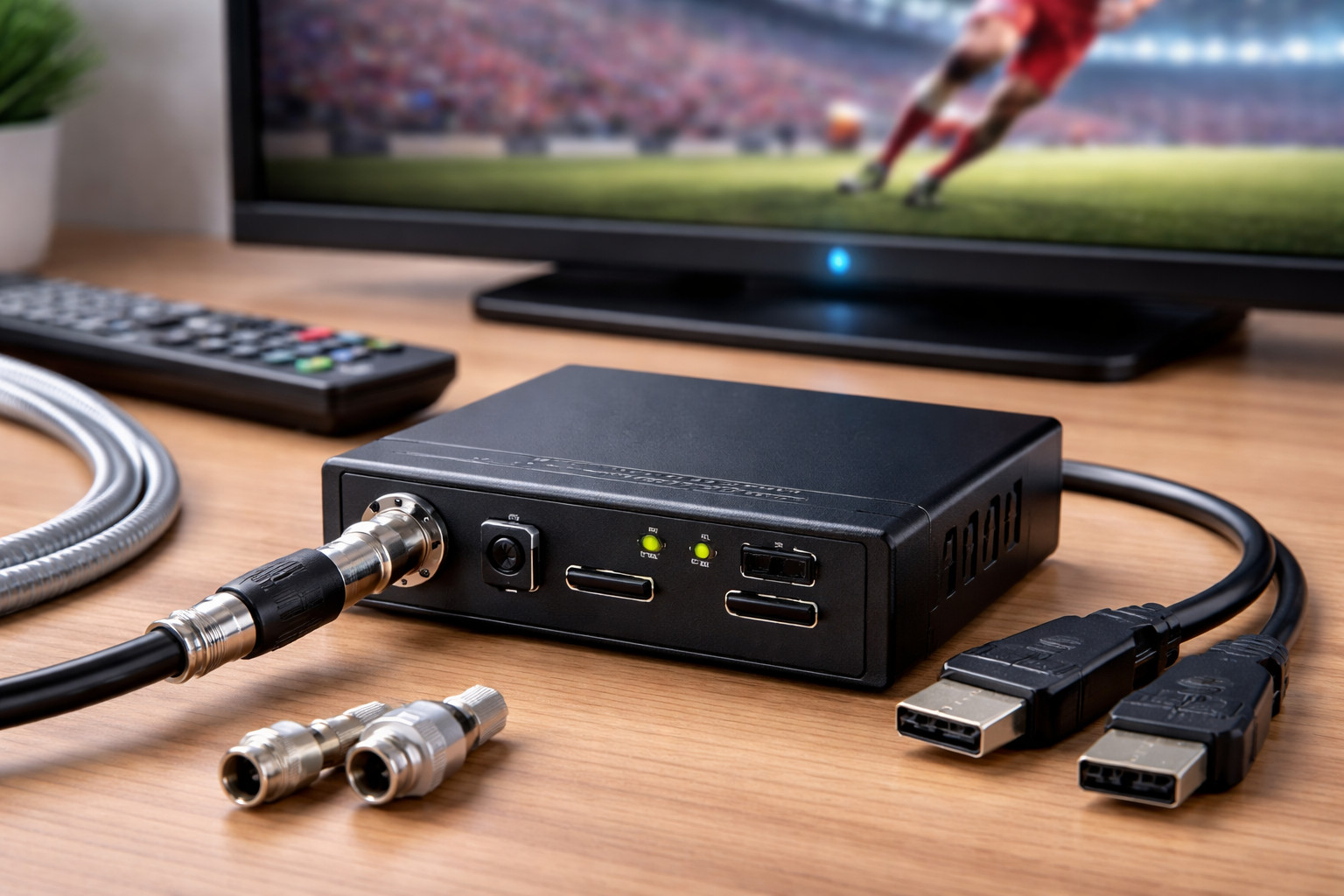
If you’re trying to connect legacy coax-based video systems to modern TVs, monitors, or projectors, a coax to HDMI solution is the bridge. Whether you need a coaxial to HDMI converter for home entertainment, digital signage, hospitality TV, or professional broadcast environments, choosing the right device (and the right signal standard) saves time, cost, and frustration.
At Thor Broadcast, we build professional-grade AV tools for broadcasters and installers. Signal conversion and distribution are at the heart of what we do. Explore our full lineup of deployment-ready products here: https://thorbroadcast.com/.
Table of Contents
A coaxial to HDMI converter is a device that accepts a signal coming through a coaxial cable (often RF television distribution) and outputs HDMI so modern displays can show it. In many buildings, coax wiring is already installed and works reliably across long distances. The problem is that most modern TVs, monitors, and projectors expect HDMI — not RF coax.
In simple terms:
Think of coax-to-HDMI devices as the missing link between legacy infrastructure and today’s screens.
You typically need a coax to HDMI device when your video source or distribution network outputs RF over coax, but your display only accepts HDMI.
Common situations include:
In other words: if your coax feed carries a TV channel signal, the converter acts like a tuner/decoder + HDMI output in one box.
Coax-to-HDMI conversion is not a passive connection. A simple cable won’t do it. The device must receive, tune, demodulate, and decode the RF signal before outputting HDMI.
This is why specs matter: if the converter doesn’t support your RF standard (or the channel is encrypted), it won’t display anything.
People often say coax to HDMI adapter and coaxial to HDMI converter interchangeably, but in practice there’s a difference in expectations.
If you see a product marketed as an “adapter” but it has no tuner/standard support listed, treat that as a red flag.
The #1 reason coax-to-HDMI setups fail is mismatched RF standards. Coax is just the cable — what matters is what signal is riding on it.
ATSC (common in North America for over-the-air broadcasts):
QAM (common in cable distribution):
DVB (common across many regions outside North America):
Rule of thumb: choose a converter that explicitly lists support for your source format (ATSC, Clear QAM, DVB-C, etc.).
Coax-to-HDMI conversion shows up in more places than people expect. Here are practical examples.
Home Theater & Residential
Commercial AV & Digital Signage
Broadcast & Professional Installations
The common theme: keep the coax backbone, modernize the endpoints.
Use this checklist before buying. It prevents almost every compatibility problem.
1) Confirm your RF standard
2) Check encryption status
3) Video resolution and output options
4) Usability
5) Reliability for continuous operation
If you’re deploying across multiple displays, also consider whether you need one decoder per TV, or a centralized headend approach.
Thor Broadcast designs professional AV tools for installers and broadcasters who need dependable conversion and distribution.
Typical building blocks include:
If you’re building a scalable system for hospitality, campus, or commercial AV, that mix (decoding + modulation) often creates a flexible, serviceable architecture.
See product options and deployment-ready solutions here: https://thorbroadcast.com/.
Q: Can I use a simple coax to HDMI adapter for any TV?
A: Only if the device is an actual powered converter with a tuner/decoder that matches your RF signal (ATSC, Clear QAM, DVB, etc.). A passive adapter won’t work for RF-to-HDMI conversion.
Q: Does a coax to HDMI converter improve picture quality?
A: It doesn’t improve the original signal, but a good converter preserves quality during decoding and outputs a stable HDMI signal with fewer artifacts and dropouts.
Q: Are coax to HDMI converters compatible with HDMI 2.0?
A: Many units output standard HDMI signals that work with HDMI 2.0 displays, but always verify supported resolutions, frame rates, and HDCP behavior in the product specs.
Q: What if my coax signal is encrypted?
A: Encrypted channels usually require an authorized decryption method (often a provider set-top box). From there you can distribute HDMI or re-encode/modulate depending on the system design.
Q: Is one converter needed per TV?
A: Often yes for display-side decoding. For larger installations, a centralized headend can decode once and distribute via HDMI/IP/RF depending on your architecture.


 ES
ES