Compare HDMI mini modulators to rack models: quality drivers (bitrate, RF margins), management, channel scaling, and real total cost.
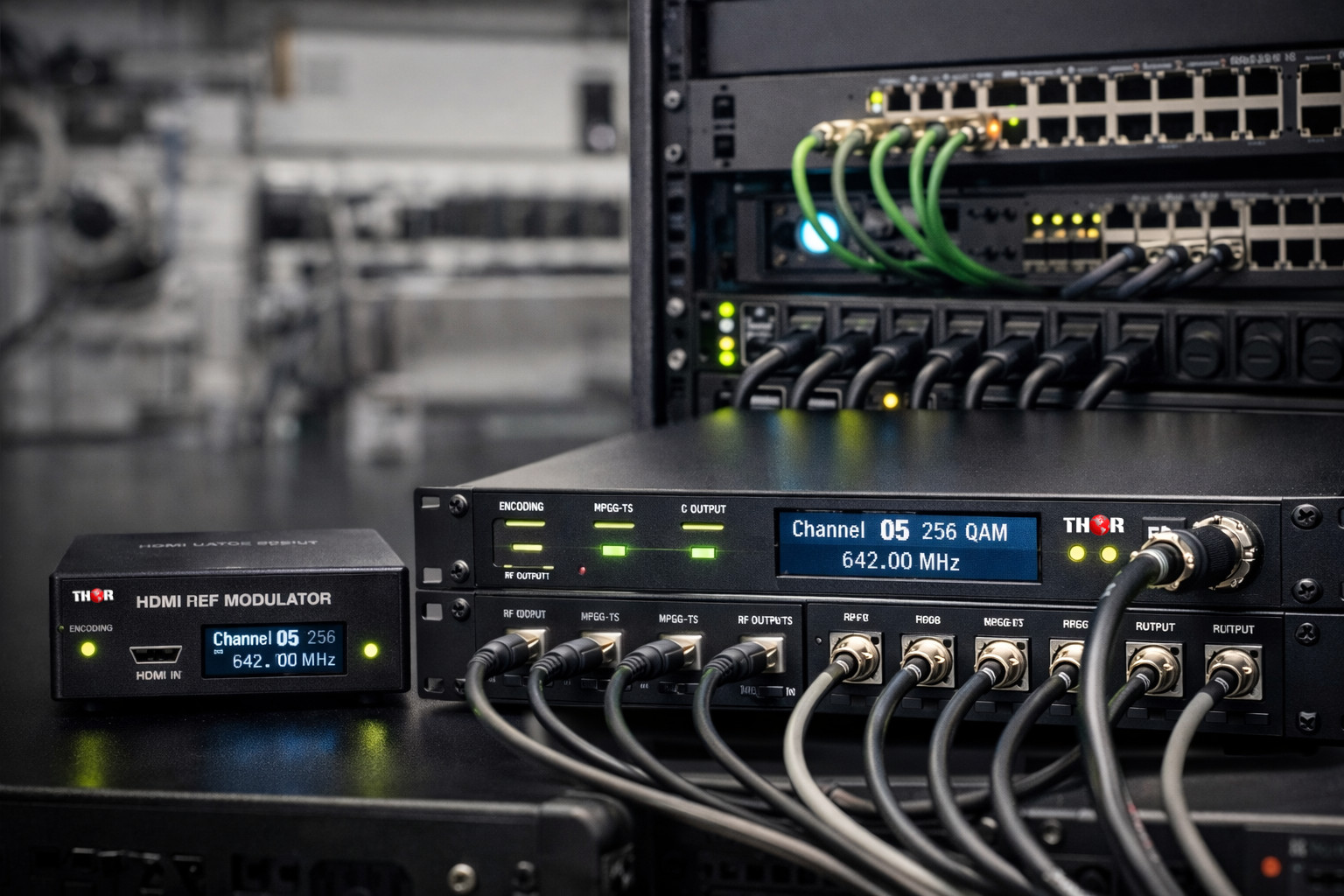
Table of Contents
When people compare HDMI mini modulators to larger rack units, they often assume the difference is mostly about footprint. In professional coax TV distribution, the more meaningful difference is architectural. A “mini” HDMI modulator is usually optimized for single-channel (or very low channel-count) injection, where one HDMI program becomes one tunable RF channel on a coax plant. A larger model-typically a rackmount, multi-input, or chassis-based encoder-modulator-is optimized for headend density, centralized control, predictable scaling, and long-term operational consistency across many services.
In both cases, the device is typically an encoder-modulator. It must lock to an HDMI source, compress audio/video, generate a standards-compliant transport stream (with service signaling televisions can scan and store), and modulate that stream onto an RF carrier (QAM/ATSC/DVB-T/ISDB-T, depending on your endpoint tuner ecosystem). Thor Broadcast’s compact and rack-class families cover both ends of this spectrum, from single-source injection using the Petit HDMI RF Modulator to higher-density platforms such as the 1-8 HDMI Digital RF Modulator CC and integrated headend chassis like 1-4 HDMI to QAM Modulators and IPTV Streaming Encoders.
In HDMI modulation, perceived “quality” is a combination of compression quality and RF delivery quality. Compression quality is primarily driven by the encoder’s bitrate, codec profile, rate-control behavior, and GOP structure. RF delivery quality is driven by modulation integrity (often described by MER/BER margins at the receiver), output level planning, and the health of the coax distribution network (splitters, taps, cable runs, connectors, and amplifiers). A larger unit is not automatically “higher quality” if both devices create the same encoded bitrate and the same RF modulation standard; the outcome at the TV can be identical if the system is engineered correctly.
Where larger units often win in real deployments is not a magical improvement in picture quality at a given bitrate, but a practical improvement in controllability and consistency. Rack-class platforms tend to expose more tuning knobs, provide more deterministic behavior when the input changes, and offer centralized configuration across multiple channels. That makes it easier to standardize encoding parameters across an entire lineup, which is often what keeps subjective quality “even” from channel to channel and prevents some services from looking soft or blocky compared to others.
Thor’s rack and headend-style units are often deployed with precisely this goal: keep a uniform encoding strategy and uniform RF output discipline. For example, the multi-input 1-8 HDMI Digital RF Modulator CC is positioned as an all-in-one platform for encoding and modulation, which is attractive when quality consistency across many sources matters more than squeezing everything into the smallest possible enclosure.
A good HDMI mini modulator can absolutely match a larger model in picture quality when you compare like-for-like conditions. If you set the same output resolution, the same bitrate, and the same codec behavior, then-assuming both units are stable and the coax plant has adequate RF margins-many viewers will not be able to tell which class of hardware generated the channel. Mini modulators can be especially effective for signage channels, lobby channels, a single camera program, or a single set-top box feed that must be distributed to many televisions over coax.
The compact advantage is simplicity. A single-channel modulator has fewer internal interactions to manage. There is no complex multiplex planning across many services, and there are fewer opportunities for configuration drift between channels because there is only one channel. In that sense, a compact device like the Petit HDMI RF Modulator can be “quality-equivalent” to larger systems for the single-channel problem, as long as you engineer the RF output levels and confirm the endpoint TVs decode the service reliably.
The caveat is that HDMI is a negotiation-heavy interface. If the HDMI source is unstable-format changes after reboots, audio mode shifts, or intermittent cable issues-then the entire facility channel can blink, because the mini modulator is the single point that translates HDMI into RF. This is not a picture-quality limitation; it is an operational stability constraint. Mini modulators work best when you can keep HDMI cable runs short, strain-relieved, and consistent, and when the HDMI source is configured to output a stable video timing and audio mode.
Larger rack-class HDMI modulators often feel higher quality because they reduce real-world failure modes that are common in high-uptime environments. When you distribute multiple HDMI sources as multiple RF channels, the system’s perceived quality includes whether channels stay present after power events, whether TVs retain channels without repeated rescans, and whether encoding settings remain consistent across time and across firmware updates. Larger platforms are typically built for that headend reality: stable channel identity, centralized management, and consistent service signaling.
For example, a multi-input, headend-oriented platform such as 1-4 HDMI to QAM Modulators and IPTV Streaming Encoders is designed around controlled RF output and predictable parameters across several sources. In many deployments, this translates directly into fewer “channel disappears” tickets because service signaling and transport behavior can be configured and preserved systematically rather than managed as a collection of unrelated small boxes.
Another practical “quality” factor is how well the unit supports operational monitoring and remote configuration. The less frequently technicians must physically access the rack to resolve issues, the more stable the service becomes over time, especially in hospitality and institutional environments where racks are locked, remote, or shared with other infrastructure.
Both mini and larger modulators can only be “good” if they output the RF standard your TVs can tune. This is the first gating criterion, regardless of size: QAM/DVB-C for cable-style tuners, ATSC 8-VSB for ATSC environments, DVB-T for terrestrial DVB tuning, and so on. A mini unit that outputs the wrong standard is not a budget compromise; it is simply the wrong tool. Likewise, a rack unit with more features does not help if the TVs cannot lock the modulation family.
Thor’s product lines exist across these standards, so the comparison between mini and rack can stay focused on density, controls, and management rather than being forced by standard availability. The best practice is to inventory the receiving fleet (TVs and set-top boxes), confirm what they support, and then choose the modulator class that matches your channel count and operational model.
A mini modulator is usually cheaper to buy for a single channel because you are purchasing only what you need: one HDMI input path, one encoder pipeline, one transport, one RF output. If your project truly has one channel and will stay one channel, a compact unit often has the lowest initial cost and the lowest deployment complexity. That is why mini modulators are popular for single-program use cases like information channels, camera feeds, or a single set-top source distributed to many rooms.
The cost equation changes as soon as you add channels. If you build a 6-channel system from six independent mini modulators, you may find that the “cheap boxes” become expensive in aggregate when you include rack mounting, power distribution, cooling, cable management, and the technician time required to configure and maintain six independent devices. At this point, larger rack units or chassis-based architectures often win economically, not because their per-box cost is lower, but because they reduce integration friction and lower the operational cost of keeping the lineup consistent.
Thor addresses this middle ground explicitly with chassis-style scaling. Instead of jumping immediately to a single monolithic headend, you can use a structured rack approach like the HDMI RF Modulator Chassis System 1-12 Units to mount multiple compact modulators coherently. This can keep initial cost closer to the mini-modulator model while improving rack discipline and making expansion predictable.
In real projects, the cost-per-channel breakpoint is rarely a fixed number because it depends on how much you value centralized control and how expensive your support labor is. In a small bar or a retail store, the break-even might be several channels because physical access is easy and the service impact of occasional issues is modest. In a hospital or hotel, the break-even can be as low as a few channels because the cost of dispatching staff and touching many TVs is high. In these environments, a larger headend platform is often “cheaper” even if the purchase price is higher, because it reduces the probability of systemic issues and reduces the time to diagnose and correct problems.
A multi-input rack solution like the 1-8 HDMI Digital RF Modulator CC is often selected when the real project cost is dominated by stability and manageability rather than by initial hardware spend. If your lineup is moderate and your distribution standard is cable-style QAM, the integrated headend approach in 1-4 HDMI to QAM Modulators and IPTV Streaming Encoders similarly aligns with the “lower operational cost per channel” mindset.
Larger models often provide a robustness advantage simply because they are designed to live in racks with predictable airflow and structured cabling. Mini modulators can be very stable, but they are more frequently deployed in ad hoc ways: loose power supplies, poorly strain-relieved HDMI cables, and minimal airflow planning. Those choices do not show up on a specification table, but they are a major reason why “mini systems” sometimes earn a reputation for being less reliable.
Thor’s chassis-oriented approach is a practical compromise: mini modulators can be mounted in a disciplined way using rack systems intended for multi-unit deployment. This reduces accidental disconnects and improves serviceability. If your design requires multiple compact units, a chassis architecture like HDMI RF Modulator Chassis System 1-12 Units can bring a “rack quality” physical outcome to a mini-modulator electrical architecture.
As you move from mini to rack-class units, you typically gain deeper control of transport and modulation parameters, more extensive monitoring, and headend-friendly management. This matters because TVs are sensitive not only to RF lock but also to service signaling and transport consistency. Larger platforms are often better suited to preserving stable service IDs, naming conventions, and channel mapping across reboots and lineup changes, which reduces the need for endpoint rescans. In many facilities, the biggest “quality” win is not sharper pixels; it is fewer channel-map surprises.
Larger platforms also tend to support mixed distribution approaches, such as simultaneously providing RF channels for coax and IPTV outputs for monitoring or secondary distribution. Headend designs like 1-4 HDMI to QAM Modulators and IPTV Streaming Encoders are typical of this “RF plus IP” pattern, which can reduce troubleshooting time because you can verify the encoded stream without relying solely on RF measurements at outlets.
No modulator class can compensate for a poorly engineered coax distribution system. If the coax network has excessive loss, poor connectors, impedance mismatches, or overdriven amplification, your TVs may experience macroblocking, audio dropouts, or intermittent channel loss regardless of whether the RF was generated by a mini modulator or a large rack unit. That is why the “quality and price” discussion should always include distribution engineering: output level planning, combiner/splitter topology, and verification at the farthest outlets.
Thor provides distribution building blocks that are commonly used to implement structured coax topologies, such as Coax Multiplexers / Splitters / Combiners. When you compare mini and rack units, keep in mind that a stable RF plant often delivers a bigger improvement in perceived quality than switching modulator models at the headend.
Mini HDMI modulators are usually the better buy when you need one channel, you can control the HDMI source behavior, and you want the lowest complexity path to “one HDMI program becomes one tunable coax channel.” They are also attractive when you anticipate no future channel growth and where the operational cost of occasional physical access is low. In those situations, a compact device like the Petit HDMI RF Modulator can deliver professional results if the RF standard matches your TVs and the coax plant is engineered with healthy margins.
Larger rack units become the better buy when channel count grows, when you need consistent management across multiple services, when uptime requirements are high, and when the cost of endpoint disruption is significant. Multi-input systems such as the 1-8 HDMI Digital RF Modulator CC or integrated headend platforms like 1-4 HDMI to QAM Modulators and IPTV Streaming Encoders typically justify their higher purchase price by lowering operational friction and by making the channel lineup easier to keep stable over long periods.
HDMI mini modulators and larger rack models can deliver similar video quality when configured equivalently and when the coax plant is engineered properly. The difference is not that “big equals better picture” by default; the difference is that larger models typically deliver better control, better lineup consistency, and lower operational risk as channel counts and uptime demands rise. Mini modulators are often the most economical and practical choice for single-channel injection, while rack and chassis-based Thor Broadcast platforms become the better value as soon as you scale beyond a few channels or when your environment makes service calls expensive.
A disciplined selection process starts with the endpoint tuner ecosystem (QAM/ATSC/DVB-T), then confirms encoding and service signaling stability, then designs the coax distribution for adequate RF margins at every outlet. From there, the correct product class usually reveals itself: compact injection with the Petit HDMI RF Modulator, structured scaling with the HDMI RF Modulator Chassis System 1-12 Units, or integrated headend density with the 1-8 HDMI Digital RF Modulator CC and the 1-4 HDMI to QAM Modulators and IPTV Streaming Encoders.
FCC: Digital Television engineering resources
FCC: DTV interference rejection thresholds (PDF)
MIT: TMDS encoding notes (Part 1)
MIT: TMDS encoding notes (Part 2)
University of Maryland (edu): QAM fundamentals (PDF)


 ES
ES