Choose RF channels by mapping existing spectrum, avoiding OTA conflicts, managing spacing/levels, and validating MER on real TVs.
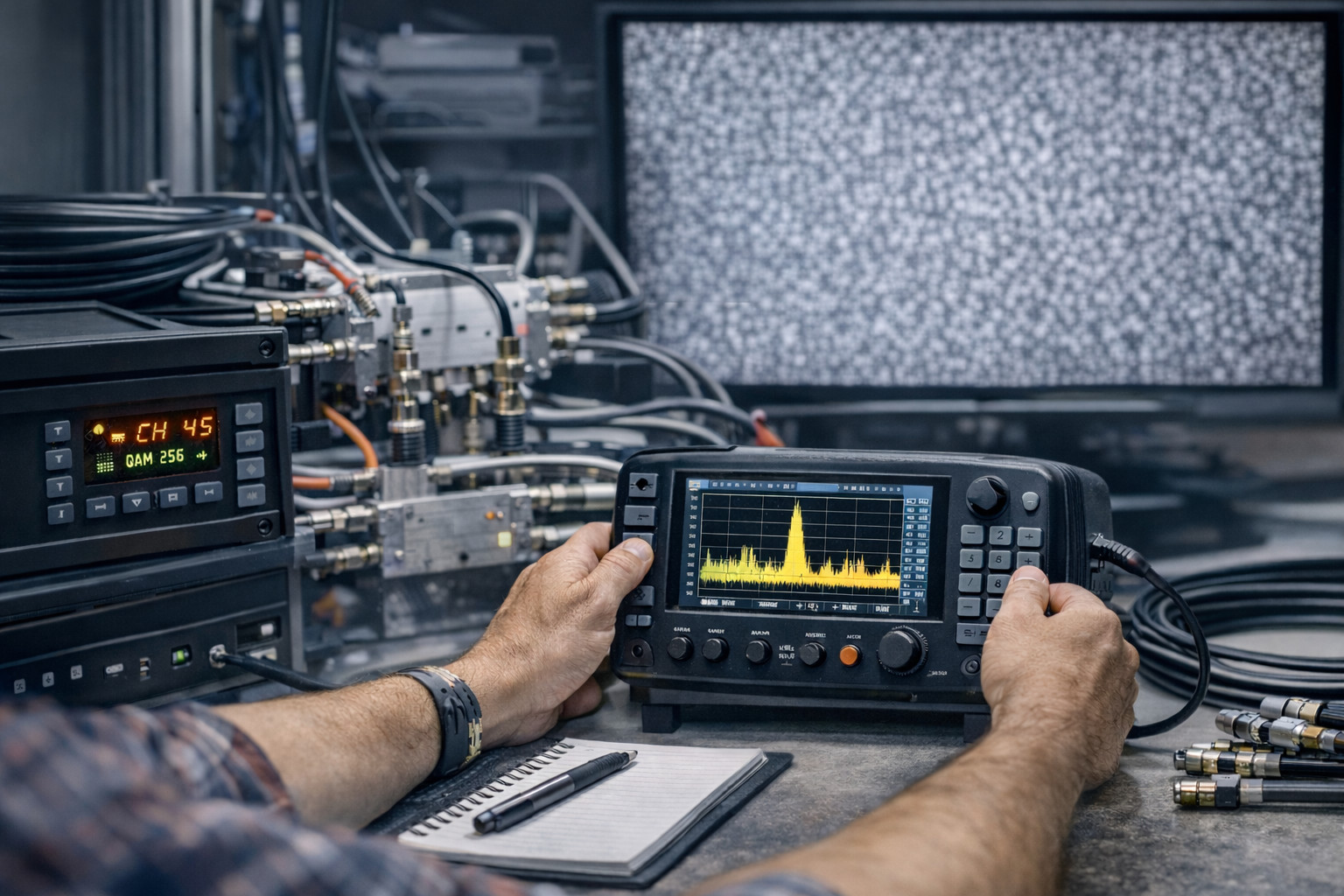
Table of Contents
In a coax-based TV distribution system, the RF channel plan is the “operating system” that determines whether every television locks quickly, stays stable, and delivers the expected picture quality. When you add your own channels using an RF modulator, you are effectively inserting new carriers into spectrum that may already contain over-the-air (OTA) broadcasts, cable carriers, in-building services, or broadband return/forward-path signals. A poor channel choice can create hard-to-diagnose issues such as intermittent pixelation, tuner lock failures on some TV models but not others, audio dropouts, or reduced modulation error ratio (MER) after combining multiple carriers.
The goal is not simply to “pick an empty number.” The practical goal is to design a frequency plan that fits your modulation standard (QAM/ATSC/DVB-T/ISDB-T), respects regional regulations and local allocations, avoids co-channel and adjacent-channel interference, and remains maintainable as you add or move channels in the future. Thor Broadcast RF modulators are designed specifically for agile channel selection across broad CATV ranges, which makes careful planning even more important because you have the freedom to tune almost anywhere in-band. For example, Thor’s HDMI-to-RF modulators can be set to multiple standards and tuned over wide RF ranges, enabling you to place channels where your distribution network performs best while avoiding spectrum you don’t control.
The first constraint is the modulation standard used by your televisions and by the distribution environment. In North American-style coax distribution, digital QAM channels typically occupy 6 MHz slots, while many DVB-T regions, most of the world, use 8 MHz channel spacing in UHF for terrestrial allocations. ATSC (8VSB) also uses 6 MHz channels in the U.S. Whether you are distributing QAM over coax inside a building, injecting an ATSC channel into an antenna-fed network, or generating DVB-T carriers for local reception, you must align your RF output channel spacing with what tuners expect for that standard and region. A mismatch between “channel number” and actual center frequency/spacing leads to scanning issues and unpredictable reception, especially across mixed TV brands.
This is where Thor Broadcast’s format-flexible modulators are useful, because you can output in the format that best matches your televisions. A compact example is the Thunder-1, which supports multiple RF standards (including QAM/ATSC/DVB-T/ISDB-T) and agile tuning across a wide frequency range. Format flexibility is not a substitute for planning; it simply means you can design the channel plan around real constraints in your facility rather than being forced into a single output type.
Before selecting any RF channel, you need a baseline spectrum map of what exists on the coax today. In many buildings, coax wiring originally installed for cable TV may now be used for a mix of services: OTA antenna distribution, internal modulators, satellite IF in some segments, or cable modem services in hybrid-fiber-coax (HFC) style environments. Even if your site “doesn’t subscribe to cable,” there may still be legacy splitters, amplifiers, or wall plates optimized for specific bands that shape the spectrum and create ripple, tilt, or notches at certain frequencies.
The most reliable approach is to measure. A spectrum analyzer (or a field meter with digital channel measurement) will show you which frequencies are occupied, which are noisy, and which have unexpected ingress. If test equipment is not available, you can still build a partial map by scanning TVs at multiple outlets and documenting what channels lock and how strong they appear, but measurement is strongly preferred because it exposes off-channel energy and spurious carriers that TV menus do not show.
When your system includes OTA distribution, use local channel/frequency allocations as your reference and treat those carriers as “protected.” Television channel center frequencies and allocations vary by country and system, and UHF channel plans in DVB-T regions are commonly documented by channel number and center frequency. Using those references helps ensure you do not accidentally place an in-house modulated carrier directly on top of an OTA multiplex or too close to it. Planning against a known frequency table also makes it easier to communicate the channel lineup to installers and support teams later.
Co-channel interference occurs when two carriers occupy the same channel frequency (or effectively overlap), while adjacent-channel interference (ACI) occurs when energy from one channel leaks into its neighbor or the receiver cannot sufficiently reject a strong adjacent signal. Even in closed coax environments, ACI is a real risk because in-building systems often combine carriers of unequal power and may have legacy amplifiers, taps, or splitters that were not designed for dense digital lineups. A very strong internal channel placed next to a weaker channel can desensitize tuners, raising the effective noise floor and reducing MER on the weaker carrier.
Digital systems are often more tolerant than analog in terms of visual artifacts, but when they fail, they fail abruptly: once MER/SNR falls below the threshold for the modulation and FEC, the picture can freeze, macroblock, or disappear. For that reason, many installers intentionally leave guard spacing (for example, not placing newly generated carriers immediately adjacent to sensitive OTA channels, or leaving at least one empty slot between very high-power and lower-power carriers). The right spacing depends on your combiner quality, amplifier linearity, and the tuner selectivity of the installed TV population.
Thor Broadcast high-density modulators can help with orderly spacing because they are designed to generate multiple RF channels in a controlled way. For IP-to-RF channel creation, devices like the H-IPRF-16/32QAM are explicitly described as outputting multiple non-adjacent QAM carriers across a broad RF range, which aligns with a conservative frequency plan strategy where you avoid stacking carriers back-to-back until you have validated margin in the field. If you need to ingest many IP streams and produce a structured RF lineup while also handling transcoding needs, the H-HERMES-64 is an example of a headend-oriented platform for building and maintaining that lineup.
A common mistake is to assume that an in-building coax network is “off the grid,” so any frequency is fair game. In reality, regulations and allocations still matter for several reasons. First, coax networks are not perfectly sealed: poorly terminated outlets, damaged cable, or low-quality splitters can leak RF energy (egress), and external signals can leak in (ingress). If you inject carriers that overlap licensed services and your plant leaks, you can create interference outside the building. Second, in many regions the same coax plant might share pathways with broadband services, and certain bands may be reserved for upstream return paths or other functions.
In the United States, the FCC Table of Frequency Allocations and related rules provide an authoritative reference for frequency usage. While you may not be operating as a broadcast station, the table is still useful as a high-level guide to which services occupy which bands and why some frequency blocks are particularly sensitive. In practice, the safer approach is to keep in-building channels within the bands and channel plans commonly used for TV distribution in your region, then verify that your plant is properly shielded and terminated so leakage is minimized.
Even if a channel is “vacant,” it may be a bad choice if that portion of the spectrum is noisy or distorted in your building. Common causes include LTE/5G ingress near poorly shielded drop cables, impulse noise from power supplies, or legacy distribution amplifiers that add distortion at higher frequencies. Coax attenuation increases with frequency, so higher channels naturally arrive weaker at distant outlets unless the system is equalized. That means a channel that looks fine at the headend can be marginal at the far end if placed too high in frequency without proper amplification and slope compensation.
The practical method is to measure MER/SNR at representative endpoints for candidate channels. If you cannot measure MER directly, you can still do a structured validation by placing a test channel on a candidate frequency and verifying consistent tuner lock across multiple TV models and outlets. If a specific band consistently causes trouble, move the carrier. Thor Broadcast agile modulators make this kind of iterative commissioning realistic: you can retune the RF output frequency without changing the content workflow.
If your distribution distances are long, or if you need to traverse electrically noisy environments, consider transporting the combined RF spectrum over fiber rather than pushing high-level RF over long coax. Thor Broadcast offers RF-over-fiber options designed for CATV-band transport, such as products in the Cable TV CATV RF 45–900 MHz category, which are intended to carry wideband RF (including multiple TV carriers) over optical links. Using RF-over-fiber can reduce susceptibility to ingress and can preserve signal quality over long runs where coax loss and ground potential differences become problematic.
Frequency planning is not only an RF engineering problem; it is also a usability problem. TVs present channels as logical numbers, and scanning behavior varies widely. Some televisions prioritize OTA channel maps, some prioritize cable maps, and some will rename or reorder channels depending on whether they detect ATSC, QAM, or DVB-T style services. If you place an in-house carrier on a frequency that corresponds to a well-known OTA channel number in your region, users may confuse it with the “real” station or the TV may merge entries in unexpected ways.
For controlled environments like hotels, campuses, gyms, or enterprise facilities, the cleanest approach is usually to define a dedicated “house lineup” range and keep it stable. If you are injecting channels into an existing OTA distribution, keep your injected carriers in frequencies that do not collide with active local multiplexes and document the exact RF channel and standard so service teams can replicate the configuration. Thor Broadcast modulators used for this purpose are typically configured with a fixed RF channel assignment per source, and the ability to manage settings through a web GUI can help keep large deployments consistent (as described for Thor’s compact HDMI modulators).
RF channel choice and RF level planning are inseparable. A channel that is perfectly chosen in frequency can still fail if its output power is mismatched relative to other carriers in the combined spectrum. When you combine multiple modulators into a single coax feed, levels add in power terms, and if your combiner or amplifier stages are driven too hard, intermodulation products can appear across the band. These products may land directly on otherwise empty channels, raising the noise floor and harming MER. The risk increases as you add more carriers and as you push higher aggregate output levels to overcome distribution loss.
The practical approach is to define a target per-carrier level at the headend and ensure it remains within the linear operating range of combiners and amplifiers. Then verify that end-of-line outlets still meet the minimum required level for reliable tuner lock without being so high that the tuner overloads. If you find you must run extremely hot levels to reach distant outlets, that is often a sign the plant needs segmentation (additional distribution points) or an optical transport strategy rather than more power.
In multi-channel systems built from multiple HDMI sources, Thor Broadcast HDMI RF modulators can be deployed per source, and their agility allows you to place carriers in a planned pattern that reduces adjacent-channel stress. For larger IP-fed deployments, Thor’s IP-to-RF platforms in the IP to CATV Edge Modulators family are designed to consolidate many streams into a structured RF output, which can simplify level management because the RF generation is centralized rather than spread across many independent devices.
One of the most overlooked considerations is future expansion. Even small systems tend to grow: a hotel adds a signage channel, a campus adds a live events channel, or a facility adds additional camera feeds for internal monitoring. If your initial plan packs carriers tightly into the first available gaps, you may later be forced to renumber channels or retune multiple modulators to make room. That is disruptive because TVs may need rescanning, printed channel guides may become wrong, and troubleshooting becomes more complex when channels move frequently.
A more maintainable strategy is to reserve a contiguous “house band” for internally generated channels and leave deliberate gaps for expansion, testing, or temporary maintenance moves. If you later need to troubleshoot interference, having spare spectrum makes it easy to move one channel at a time and observe whether the problem follows the content source or stays with the frequency. Thor Broadcast agile modulators support this operational style because you can retune channels without changing the content source wiring. In environments where uptime matters, that agility can be the difference between a quick fix and a long outage window.
Final channel selection should always be validated with the devices that will actually be used: consumer televisions have different tuner selectivity, different front-end overload points, and different scan heuristics. A channel plan that works perfectly on one TV model may show intermittent issues on another, especially when adjacent channels are strong or when the plant has uneven frequency response. Validation should include outlets at the extremes of the coax network: the closest outlet (risk of overload) and the farthest outlet (risk of low level and noise).
When validating, pay attention to lock time, stability over hours, and behavior during other network events (for example, when adjacent channels are added, or when an amplifier stage is powered down and back up). If you observe sensitivity to adjacency, consider increasing spacing, reducing per-carrier output levels, improving filtering/combining, or relocating the carrier to a cleaner band. Thor Broadcast systems that support web-based management can make controlled experiments easier because you can record exact settings, change one parameter at a time, and roll back quickly if needed.
A robust RF channel choice process is a workflow, not a single decision. Start by defining the output standard that matches your TVs and region. Inventory existing signals on the coax and identify protected services like OTA multiplexes. Use authoritative frequency references to translate channel numbers into real center frequencies and bandwidth expectations. Choose candidate channels in bands where your plant has good performance, then validate with measurements and real TVs at representative outlets. Finally, document the plan and reserve room for growth.
In Thor Broadcast-based systems, the workflow is supported by a portfolio that covers single-source HDMI injection, high-density IP-to-RF headends, and long-distance RF transport options. For HDMI sources that must become a tunable channel, a compact modulator such as the H-HDMI-RF-Petit-IR is a practical building block. For larger deployments where channel planning and spacing must be enforced across many services, Thor’s IP edge modulators like the H-IPRF-16/32QAM and gateway platforms like the H-HERMES-64 support structured RF lineups. And when distance or interference risk pushes coax beyond its comfort zone, Thor’s RF-over-fiber CATV solutions can preserve spectrum integrity across longer runs. With these tools, the best RF channel is the one that is clean, compliant, measurable, and maintainable-not merely the first one that appears unused.
Television channel frequencies
Adjacent-channel interference
Television channel (adjacent channels and cable/OTA considerations)
FCC Online Table of Frequency Allocations (PDF)
47 CFR Part 73, Subpart E (Television Broadcast Stations; channel width reference)
RLE Technical Report (discussion of adjacent-channel interference)
TV reception and interference analysis (PDF)
Notes referencing adjacent-channel interference and mitigation (PDF)

 ES
ES