Thor Broadcast Logo
Iniciar sesión
Carro (0)
  • en EN
  • Productos
    • CATV Moduladores
      • HDMI los Moduladores de RF
      • HD-SDI convertidores
      • IP para CATV Moduladores Borde
    • DVB Codificadores
      • Los Codificadores De Vídeo
      • Hdmi RTSP RTMP, RTSP Codificadores
      • Transcodificadores, MPEG Convertidores, IP ASI puertas de enlace
    • Decodificadores (IRD y STB)
      • RF Decodificadores del IRD
      • Difusión IP Decodificadores
      • RF CATV de IPTV y OTT STB del
    • Satélite Moduladores
      • DVB-S/S2 Satélite Moduladores
    • De Fibra Óptica De Transporte
      • SDI a lo largo de la Fibra
      • SDI SD/HD/3G con CWDM
      • TV por Cable CATV RF 45-900Mhz
      • L del Satélite en la Banda de RF 45-3000Mhz
      • Datos y Ethernet en fibra
    • Wireless HD SD de Vídeo de Transporte de Datos
      • Wireless HD de Vídeo SD con los Datos de los Equipos
    • Descuento De Inventario
      • Nuevos Equipos De Transmisión En Venta
      • Laboratorio de Equipos de transmisión Utilizados en venta
      • Última Generación De Equipos De
  • About
  • Cartera De Clientes
  • Apoyo
      • Support Center Apoyo
      • User Manuals Manuales
        de Usuario
      • Request an RMA Solicitar una
        RMA
  • ⬇Download
    • Manuals
    • Datasheets
    • Quick Guides
  • Case Studies
    • THOR Gym
    • THOR Stadium
    • THOR Hotel
    • THOR University
  • Videos
  • Contacto
  • Conviértete en un revendedor

RF Over Fiber System Design Guide

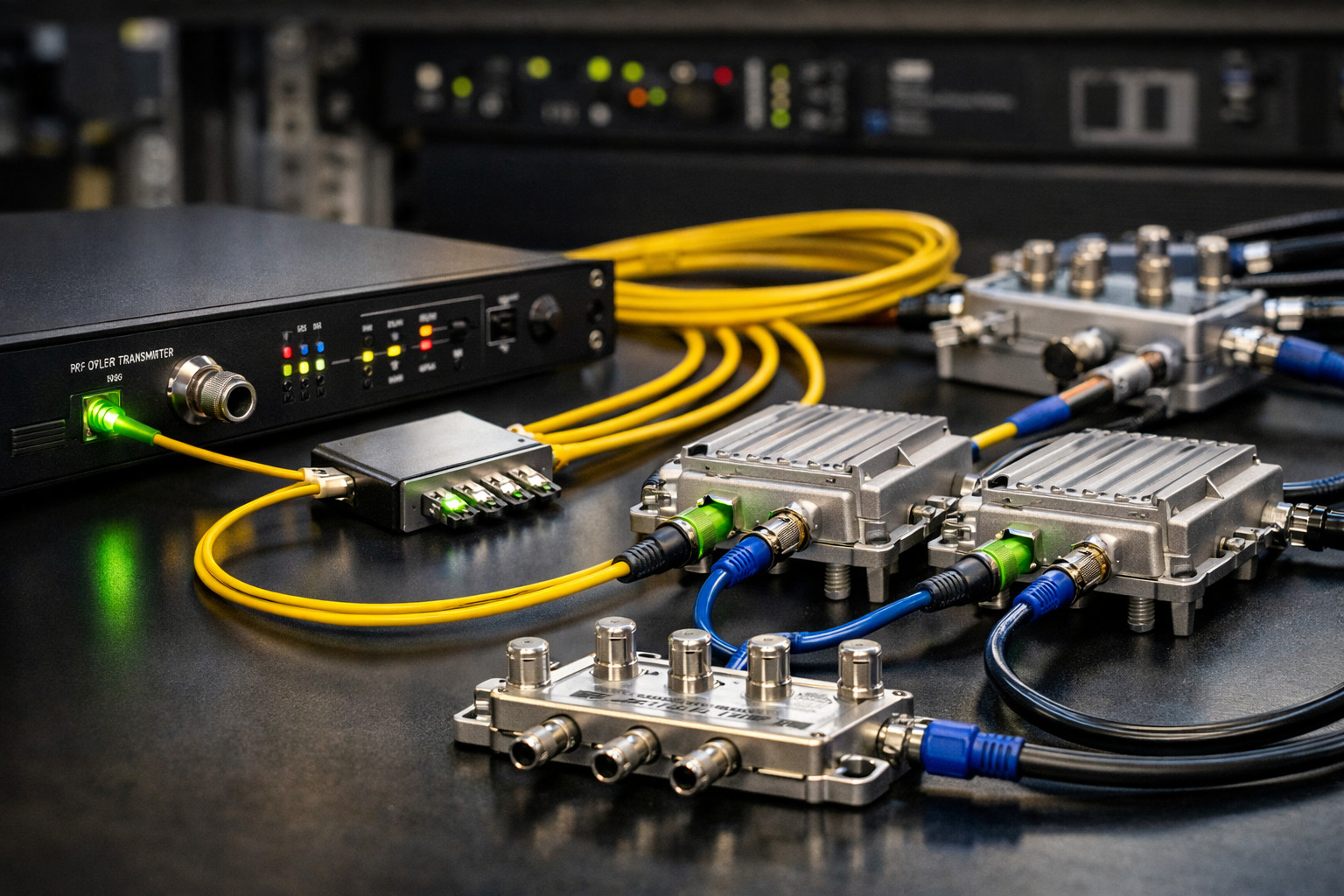
Learn how to properly select a CATV RF over fiber transmitter, optical splitter, and mini node receiver for reliable QAM and analog RF distribution over single-mode fiber.
RF Over Fiber System Design Guide

Learn how to properly select a CATV RF over fiber transmitter, optical splitter, and mini node receiver for reliable QAM and analog RF distribution over single-mode fiber. This guide explains splitter insertion loss, optical budget, mini node input targets, RF attenuation, and how to design for long-term expansion.

Key Takeaway: In RF over fiber systems, splitter insertion loss and RF output balancing matter just as much as fiber distance. A 1x4 splitter typically introduces about 7 dB of optical loss, while a 1x8 splitter introduces about 11 dB. That is why an 8 mW optical transmitter is often the right choice for 1x8 systems, especially when you want the mini node to receive optical power close to 0 dBm for the best results.

Table of Contents

  • Overview
  • System Diagram
  • Recommended Products
  • Why Transmitter Power Matters
  • Optical Splitter Insertion Loss Explained
  • Why the Mini Node Should Receive Optical Power Close to 0 dBm
  • RF Attenuation After the Mini Node
  • Practical Design Example
  • Frequently Asked Questions

Overview

A properly designed RF over fiber system can distribute CATV, QAM, and broadband RF signals over long distances using single-mode fiber while maintaining excellent signal quality. The most important parts of the design are:

  • Choosing the correct optical transmitter power
  • Selecting the correct optical splitter
  • Ensuring the mini node receives the right optical level
  • Balancing RF output with proper attenuation after the node

This article is based on a real-world customer consultation where the goal was to deliver RF over single-mode fiber with a return path while keeping the system scalable for future expansion.

System Diagram

RF Source / Headend
QAM, CATV, Broadband RF
↓
RF Over Fiber Optical Transmitter
4 mW TX or 8 mW TX
↓
Single-Mode Fiber Link
Includes connectors, splices, and optical path loss
↓
PLC Optical Splitter
1x4 Splitter (~7 dB insertion loss)
or
1x8 Splitter (~11 dB insertion loss)


Mini Node 1
F-MININODE-2RP-HP
Mini Node 2
F-MININODE-2RP-HP
Mini Node 3
F-MININODE-2RP-HP
Mini Node 4
F-MININODE-2RP-HP
↓
↓
↓
↓
RF Output Distribution
Splitters, taps, TVs, QAM tuners, amplifiers
RF Output Distribution
Splitters, taps, TVs, QAM tuners, amplifiers
RF Output Distribution
Splitters, taps, TVs, QAM tuners, amplifiers
RF Output Distribution
Splitters, taps, TVs, QAM tuners, amplifiers

Recommended Products

4 mW RF Over Fiber Transmitter

Best for smaller systems using a 1x4 splitter and shorter total optical loss budgets.

View 4 mW Transmitter

8 mW RF Over Fiber Transmitter

Recommended for 1x8 splitters, longer runs, future expansion, and improved optical margin.

View 8 mW Transmitter

Mini Node with Return Path

High-performance CATV optical receiver with return path support for forward and reverse RF transport.

View F-MININODE-2RP-HP

1x4 Optical Splitter

PLC splitter with approximately 7 dB insertion loss, suitable for four-way distribution.

View 1x4 Splitter

1x8 Optical Splitter

PLC splitter with approximately 11 dB insertion loss, ideal for long-term scalability and future expansion.

View 1x8 Splitter

Why Transmitter Power Matters

The first major design question is whether to use a 4 mW transmitter or an 8 mW transmitter.

4 mW Transmitter

A 4 mW CATV RF over fiber transmitter is a good choice when:

  • You are using a 1x4 splitter
  • Fiber runs are moderate
  • There are limited splices and connectors
  • You do not expect major expansion

8 mW Transmitter

An 8 mW CATV RF over fiber transmitter is recommended when:

  • You want to use a 1x8 splitter
  • You need more optical margin
  • You have longer fiber runs, extra connectors, or splices
  • You want to future-proof the system
Why 8 mW is needed for a 1x8 splitter:
A 1x8 optical splitter typically introduces about 11 dB of insertion loss. That is a substantial power reduction before the signal even reaches the mini nodes. The higher optical output of the 8 mW transmitter helps ensure the mini nodes still receive optical power close to 0 dBm, which is the preferred operating point for the best RF results.

Optical Splitter Insertion Loss Explained

Optical splitters divide one optical signal into multiple outputs. This is convenient for multi-node distribution, but every split introduces insertion loss.

Splitter Type Typical Insertion Loss Use Case
1x4 Optical Splitter ~7 dB Smaller systems with four optical outputs
1x8 Optical Splitter ~11 dB Larger systems or installations planned for expansion

Beyond splitter loss, your total optical budget also includes:

  • Connector loss
  • Splice loss
  • Fiber attenuation over distance

Even if the fiber distance is not extremely long, a system with a 1x8 splitter and several connectors can quickly consume the available optical budget. That is why the 8 mW transmitter is often the safer and more scalable choice.

Why the Mini Node Should Receive Optical Power Close to 0 dBm

The F-MININODE-2RP-HP mini node performs best when the received optical level is close to 0 dBm.

This matters because the optical input level directly affects the RF output quality of the node. When the node receives the proper optical level:

  • RF output is strong and stable
  • QAM channels lock more reliably
  • MER performance is better
  • The system has more operating margin

What happens if optical level is too low?

  • RF output may be weaker than expected
  • Noise performance can degrade
  • Digital channels may become unstable

What happens if optical level is too high?

  • The node can be overdriven
  • Signal distortion may occur
  • Digital modulation quality may suffer
Best practice: Design the system so each mini node receives optical input as close as practical to 0 dBm. This is one of the biggest reasons to choose the correct transmitter and splitter combination.

RF Attenuation After the Mini Node

One of the most overlooked parts of an RF over fiber system is what happens after the mini node.

Mini nodes typically deliver a strong RF output. That is good because it allows downstream distribution, but it also means the signal often needs to be attenuated before feeding tuners, televisions, amplifiers, or additional RF splitters.

What is RF attenuation?

RF attenuation is the deliberate reduction of signal level so the downstream equipment receives a signal within its proper operating range.

Why does RF attenuation matter?

If the RF level is too high:

  • QAM tuners may fail to lock
  • Digital channels may show errors or pixelation
  • Amplifiers or set-top equipment can be overdriven
  • System performance can become unstable even though the signal appears strong

In digital RF systems, more signal is not always better. A signal that is too hot can be just as problematic as one that is too weak.

How much attenuation is needed?

That depends on:

  • The RF output level of the mini node
  • How many RF splits happen after the node
  • The length and quality of the coax run
  • The sensitivity of the downstream tuners or displays

RF split loss after the node

RF Splitter Typical RF Loss
2-way RF splitter ~3.5 dB
4-way RF splitter ~7 dB
8-way RF splitter ~11 dB

For example, if the mini node output is strong and then feeds only one or two devices, you may need significant RF attenuation pads. But if the node feeds a long coax run and then several downstream RF splits, less external attenuation may be needed because those components already reduce the level.

Important: RF attenuation should always be determined based on the full downstream distribution path. The correct amount depends on how many splits come after the node, how long the coax path is, and what signal level the receiving equipment expects.

Practical Design Example

A customer needed to feed several remote endpoints over single-mode fiber. The installation used:

  • One optical transmitter at the headend
  • A multi-way optical split
  • Mini nodes at remote endpoints
  • Return path support

Since the project included multiple branches and possible future expansion, the recommended design was:

  • 8 mW optical transmitter
  • 1x8 optical splitter
  • Multiple F-MININODE-2RP-HP mini nodes

This approach gave the installer better optical margin, future expansion capability, and a better chance of keeping the mini nodes near the desired optical input level.

Frequently Asked Questions

Q: When should I use a 4 mW transmitter?

Use a 4 mW transmitter when the system is relatively small, typically with a 1x4 splitter, moderate fiber distances, and minimal total optical loss.

Q: When should I use an 8 mW transmitter?

Use an 8 mW transmitter when you are using a 1x8 splitter, planning future expansion, or want additional optical margin to keep the mini nodes close to 0 dBm input.

Q: Why is the 1x8 splitter harder on the optical budget?

Because it introduces about 11 dB of insertion loss, compared to about 7 dB for a 1x4 splitter. That extra loss can make a major difference at the node input.

Q: Why should the mini node get close to 0 dBm optical input?

Because that is typically the sweet spot for stable and strong RF output with good digital performance.

Q: Why do I need RF attenuation after the mini node?

Mini nodes often output very high RF levels. Without attenuation, the downstream equipment may be overdriven, causing digital channels to fail or degrade.

Q: How do I know how much RF attenuation I need?

It depends on the node output level, the number of RF splits after the node, coax length, and the acceptable level at the receiving equipment. The correct approach is to calculate the full downstream RF path.


Justin White
Justin White
Broadcast Engineer
Broadcast engineer specializing in turnkey CATV and fiber-transport solutions. Experienced in designing and deploying complete encoding/decoding workflows to move virtually any signal over IP, fiber, and RF. Focused on ultra-low-latency headend architectures and custom mux/demux builds, supporting demanding environments across telecom, sports, education, hospitality, studios, live events, and mission-critical institutions worldwide.
View author page
Contact us

Thor Broadcast Sales

Email: [email protected]
Phone: 1(800)521-THOR (8467) Ext 1
FAX: 1(800)521-6384

Customer Service/ Support

Phone: 1-800 521-THOR(8467) Ext 2
Email: [email protected]

Case Studies

- Converting Clear QAM HDTV Channels to Analog RF NTSC for Multi-Site Distribution
- Stadium IPTV - Replay System
- Hotel HDMI-to-QAM TV Distribution
- University IPTV Lecture Systems

  • CATV Moduladores:
    • HDMI los Moduladores de RF
    • HD-SDI convertidores
    • IP para CATV Moduladores Borde
  • DVB Codificadores:
    • Los Codificadores De Vídeo
    • Hdmi RTSP RTMP, RTSP Codificadores
    • Transcodificadores, MPEG Convertidores, IP ASI puertas de enlace
  • Decodificadores (IRD y STB):
    • RF Decodificadores del IRD
    • Difusión IP Decodificadores
    • RF CATV de IPTV y OTT STB del
  • Satélite Moduladores:
    • DVB-S/S2 Satélite Moduladores
  • De Fibra Óptica De Transporte:
    • SDI a lo largo de la Fibra
    • SDI SD/HD/3G con CWDM
    • TV por Cable CATV RF 45-900Mhz
    • L del Satélite en la Banda de RF 45-3000Mhz
    • Datos y Ethernet en fibra
    • Analógica De Audio Y Vídeo
    • La fibra de Amplificadores EDFA
    • DVB - ASI
    • Fibra De Puentes, Cables, Atenuadores,
    • Óptica Acopladores Divisores CWDM Une
    • Óptica Metros, La Prueba De Equipos, Accesorios
    • Analógica en Banda base de Audio y Vídeo, RS485/422/232 Datos, Cierre de Contacto
  • Wireless HD SD de Vídeo de Transporte de Datos:
    • Wireless HD de Vídeo SD con los Datos de los Equipos
  • HD Cámaras 4K, SDI - HDMI - IP Streaming - PTZ - Linea y Seciurity:
  • Descuento De Inventario:
    • Nuevos Equipos De Transmisión En Venta
    • Laboratorio de Equipos de transmisión Utilizados en venta
    • Última Generación De Equipos De
Thor Broadcast Logo
Email: [email protected]
Phone: 1(800) 521-8467 Ext 1
FAX: 1(800)521-6384
Information:
  • About us
  • Client Portfolio
  • Become a Reseller
  • Contact
  • Articles
  • Return Policy
  • Shipping Policy
  • International Order Policy
Popular:
  • RF Modulator
  • HDMI over COAX
  • HDMI over IP
  • COAX to HDMI
  • HDMI to SDI

Thor Broadcast
Torrance Business Park
2421 W 205th St
Torrance
CA 90501

© 2026 Thor Broadcast
Suscríbete a nuestro boletín

Regístrese aquí para recibir las últimas noticias, actualizaciones y ofertas especiales directamente en su bandeja de entrada.

Puedes darte de baja en cualquier momento
newsletter image