Thor Broadcast Logo
Iniciar sesión
Carro (0)
  • en EN
  • Productos
    • CATV Moduladores
      • HDMI los Moduladores de RF
      • HD-SDI convertidores
      • IP para CATV Moduladores Borde
    • DVB Codificadores
      • Los Codificadores De Vídeo
      • Hdmi RTSP RTMP, RTSP Codificadores
      • Transcodificadores, MPEG Convertidores, IP ASI puertas de enlace
    • Decodificadores (IRD y STB)
      • RF Decodificadores del IRD
      • Difusión IP Decodificadores
      • RF CATV de IPTV y OTT STB del
    • Satélite Moduladores
      • DVB-S/S2 Satélite Moduladores
    • De Fibra Óptica De Transporte
      • SDI a lo largo de la Fibra
      • SDI SD/HD/3G con CWDM
      • TV por Cable CATV RF 45-900Mhz
      • L del Satélite en la Banda de RF 45-3000Mhz
      • Datos y Ethernet en fibra
    • Wireless HD SD de Vídeo de Transporte de Datos
      • Wireless HD de Vídeo SD con los Datos de los Equipos
    • Descuento De Inventario
      • Nuevos Equipos De Transmisión En Venta
      • Laboratorio de Equipos de transmisión Utilizados en venta
      • Última Generación De Equipos De
  • About
  • Cartera De Clientes
  • Apoyo
      • Support Center Apoyo
      • User Manuals Manuales
        de Usuario
      • Request an RMA Solicitar una
        RMA
  • ⬇Download
    • Manuals
    • Datasheets
    • Quick Guides
  • Case Studies
    • THOR Gym
    • THOR Stadium
    • THOR Hotel
    • THOR University
  • Videos
  • Contacto
  • Conviértete en un revendedor

SDI Fiber Extenders: Extending Your Video Signals without Compromis

SDI fiber extenders revolutionize broadcasting by taking the ability to keep video signals far greater distances without compromising the quality.
SDI Fiber Extenders - Extending Your Video Signals without Compromis.jpg

Table of Contents

  • Understanding SDI and Its Limitations
  • The Role of Fiber Optics in Broadcasting
  • Advantages of Using SDI Fiber Extenders
    • Extended Range
    • Signal Integrity
    • Flexibility and Scalability
    • Cost-Effectiveness
    • Easy Integration with Multiplexers
  • Applications of SDI Fiber Extenders in Broadcasting
    • Live Event Broadcasting
    • Studio Productions
    • Remote Production
    • Multi-Camera Setups
  • Conclusion

Undeniably, the integrity of the signal for any broadcast or video production over substantial lengths has always presented a big challenge. As technology continues to get better and higher-resolution content increasingly more accessible, traditional copper cables prove grossly inadequate more often than not. It is here that the SDI fiber extenders make their foray, therefore, offering a very reasonable solution with regard to the transmission of video signals over longer distances without loss of quality. A discussion on how SDI fiber extenders work, their advantages, and their benefits in various forms of broadcasting follows.

Understanding SDI and Its Limitations

SDI finds their application in a number of sectors including broadcasting and television, along with filmmaking. A few varieties of SDI include:

  • HD-SDI: Supports 1080p at 1.5 Gbps. [Read More]
  • 3G SDI: 1080p at 3 Gbps. This allows for higher frame rates. [Read More]
  • 12G SDI: The support will be for 4K video at 60 frames per second, and up to 12 Gbps bandwidth. [Read More]

While SDI indeed guarantees very high-quality video, traditional coax cables have a number of inherent weaknesses. These can actually transit signals over relatively small distances-up to about 100 meters for HD-SDI-and even smaller distances for higher bandwidths such as 12G SDI. Beyond that range, degradation starts setting in, leading to loss of quality and reliability.

The Role of Fiber Optics in Broadcasting

It is where fiber optic technology intervened in the transmission of video signals. While copper cables depend on the basis of electrical signals for transportation, fiber optics depend on the light to carry information. Some of the advantages which accrue from this method include the following:

This maintains a clear signal with no interruption in areas that have an immense amount of electronic equipment.

High Bandwidth: Fiber optic cables support much higher bandwidth. This means that 4K and 8K content, among other signals, are transmitted perfectly without compression.

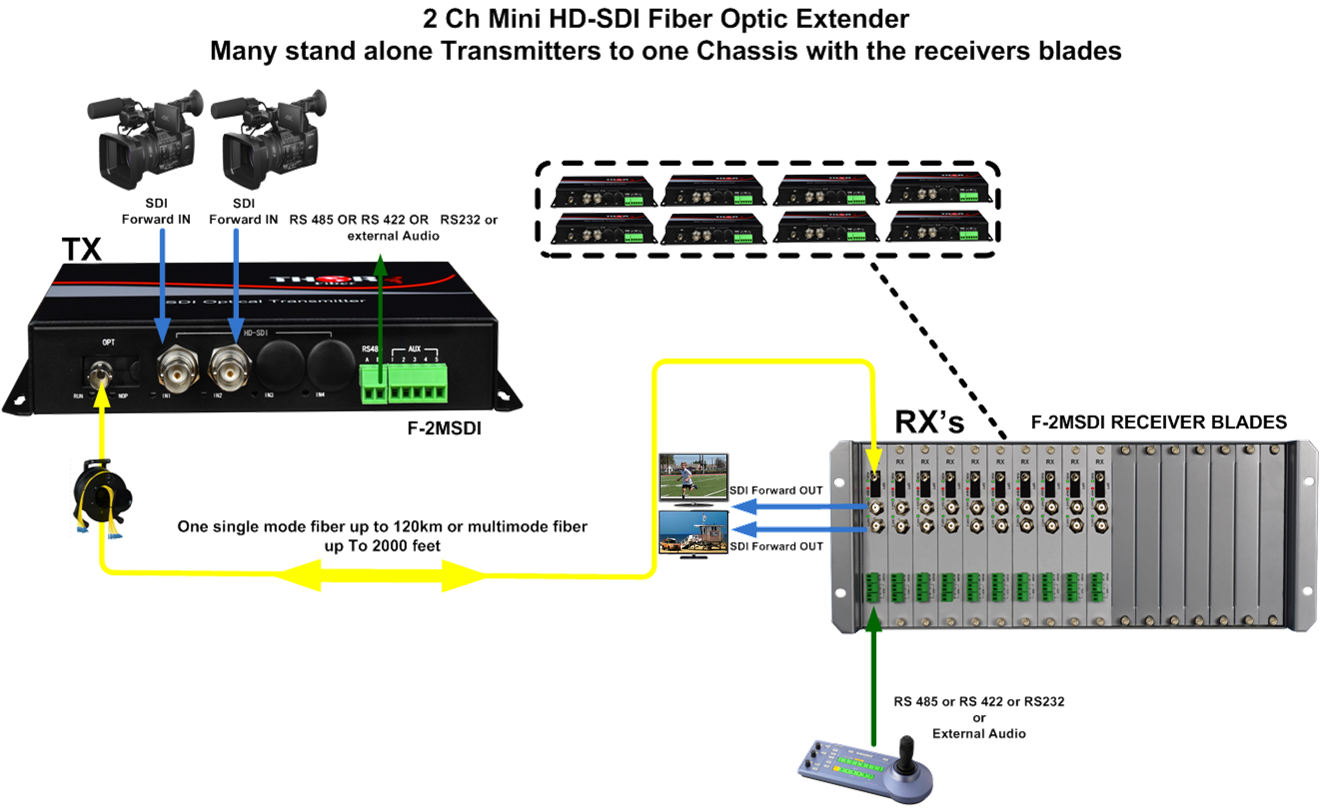
Signal Conversion: It is here that an SDI fiber extender comes in; it converts the electrical signal into an optical one once the HD-SDI, 3G SDI, or 12G SDI signal is fed inside. 
Advantages of Using SDI Fiber Extenders

SDI Fiber Extenders

1. Extended Range

The advantages accruable with an SDI fiber extender lie in their ability to extend the range on a video signal. In case the SDI is converted to an optical signal, the range will go further than it would normally by using copper cables. This simply makes it very handy for everything from live sports broadcasts down to studio setup.

2. Signal Integrity

Using fiber optics, the video signal travels uncompressed and uncompressed for very long distances without interference. SDI over fiber extends the integrity of the signal to ensure crisp, clear video with no artifacts or degradation, especially in professional broadcasting, where it should be superb.

3. Flexibility and Scalability

The extenders of SDI fiber are flexible in nature and can be installed along with an already installed system quite easily. Be it migrating from HD-SDI to 3G SDI or planning for future migrations to 12G SDI, extenders will support a lot of different formats without changing the infrastructure. This flexibility in scalability for the broadcasters falls in the category of advantages.

4. Cost-Effectiveness

Although the initial investment in fiber optic infrastructure is a bit higher than that compared with conventional coaxial systems, there is a long-term saving therein. Fiber optic cables are lighter and require less maintenance when compared to copper cables. Moreover, since it would take only a single fiber line to carry multiple signals, the overall installation and operational expenses become reduced.

5. Easy Integration with Multiplexers

SDI fiber extenders work well with both SDI multiplexers and SDI fiber multiplexers. These are used in the combination of several SDI signals that are transmitted over one fiber optic cable to further enhance efficiency in broadcast operations. An SDI Mux therefore can be used together with the fiber extenders for management of different feeds of cameras by a broadcaster without the complication of many cable runs.

Applications of SDI Fiber Extenders in Broadcasting

Studio Productions - Live Broadcasting

Live Event Broadcasting

Among the most important applications involving the SDI fiber extender is in live event broadcasting. Quite often, many cameras are used in stadiums and concert halls, very often being kept far away from the production truck or a control room. SDI fiber extenders support the dependable transmission of high-quality video feeds of these cameras back to the control room for complete coverage of the event.

Studio Productions

The cameras in studio applications are connected to the production equipment by SDI Fiber extenders. Since studios are continuously upgrading and adding more and newer technologies, cable runs will obviously get longer-and a fact that fiber extenders ensure will not degrade signal quality in the slightest.

Remote Production

These SDI fiber extenders also play an important role in the increasing trend of remote production, whereby the controls of broadcasts come from elsewhere rather than the event site. They facilitate the transmission of high-quality video signals from remote locations to central facilities for high-end broadcast productions from distant sites.

Multi-Camera Setups

In many camera productions-such as a talk show or panel discussion, to name a couple of examples-the SDI fiber extenders easily integrate a number of video feeds into one. Combined with just a few multiplexers, several camera angles and sources can be handled with ease for a production.

Conclusion

SDI fiber extenders revolutionize broadcasting by taking the ability to keep video signals far greater distances without compromising the quality. They are designed to convert the SDI signal into optical format and, therefore, enable broadcasters to maintain the integrity of their video feeds to ensure sharp, high-definition content for their viewers.

As the industry continues to evolve, SDI fiber extenders will need to be integrated into the workflow in order to meet the demands of high-quality content delivery. Be it broadcasting of events, studio productions, or remotely set-up tasks, SDI fiber extenders ensure reliability, flexibility, and scalability to be enrooted in today's broadcasting. Keeping this in mind, one is moving not a step but a leap into video transmission.

Read More:
  • Serial digital interface - Wikipedia
  • HD-SDI - Wikipedia
  • 3G-SDI - Wikipedia
  • 12G-SDI - Wikipedia
  • Fiber-optic communication - Wikipedia
  • Optical fiber - Wikipedia
  • Fiber-optic cable - Wikipedia
  • Broadcast engineering - Wikipedia
  • Outside broadcasting - Wikipedia
  • Fiber Optic Communications - University of Texas at Dallas (PDF)
Justin White
Justin White
Broadcast Engineer
Broadcast engineer specializing in turnkey CATV and fiber-transport solutions. Experienced in designing and deploying complete encoding/decoding workflows to move virtually any signal over IP, fiber, and RF. Focused on ultra-low-latency headend architectures and custom mux/demux builds, supporting demanding environments across telecom, sports, education, hospitality, studios, live events, and mission-critical institutions worldwide.
View author page
Contact us

Thor Broadcast Sales

Email: [email protected]
Phone: 1(800)521-THOR (8467) Ext 1
FAX: 1(800)521-6384

Customer Service/ Support

Phone: 1-800 521-THOR(8467) Ext 2
Email: [email protected]

Case Studies

- Converting Clear QAM HDTV Channels to Analog RF NTSC for Multi-Site Distribution
- Stadium IPTV - Replay System
- Hotel HDMI-to-QAM TV Distribution
- University IPTV Lecture Systems

  • CATV Moduladores:
    • HDMI los Moduladores de RF
    • HD-SDI convertidores
    • IP para CATV Moduladores Borde
  • DVB Codificadores:
    • Los Codificadores De Vídeo
    • Hdmi RTSP RTMP, RTSP Codificadores
    • Transcodificadores, MPEG Convertidores, IP ASI puertas de enlace
  • Decodificadores (IRD y STB):
    • RF Decodificadores del IRD
    • Difusión IP Decodificadores
    • RF CATV de IPTV y OTT STB del
  • Satélite Moduladores:
    • DVB-S/S2 Satélite Moduladores
  • De Fibra Óptica De Transporte:
    • SDI a lo largo de la Fibra
    • SDI SD/HD/3G con CWDM
    • TV por Cable CATV RF 45-900Mhz
    • L del Satélite en la Banda de RF 45-3000Mhz
    • Datos y Ethernet en fibra
    • Analógica De Audio Y Vídeo
    • La fibra de Amplificadores EDFA
    • DVB - ASI
    • Fibra De Puentes, Cables, Atenuadores,
    • Óptica Acopladores Divisores CWDM Une
    • Óptica Metros, La Prueba De Equipos, Accesorios
    • Analógica en Banda base de Audio y Vídeo, RS485/422/232 Datos, Cierre de Contacto
  • Wireless HD SD de Vídeo de Transporte de Datos:
    • Wireless HD de Vídeo SD con los Datos de los Equipos
  • HD Cámaras 4K, SDI - HDMI - IP Streaming - PTZ - Linea y Seciurity:
  • Descuento De Inventario:
    • Nuevos Equipos De Transmisión En Venta
    • Laboratorio de Equipos de transmisión Utilizados en venta
    • Última Generación De Equipos De
Thor Broadcast Logo
Email: [email protected]
Phone: 1(800) 521-8467 Ext 1
FAX: 1(800)521-6384
Information:
  • About us
  • Client Portfolio
  • Become a Reseller
  • Contact
  • Articles
  • Return Policy
  • Shipping Policy
  • International Order Policy
Popular:
  • RF Modulator
  • HDMI over COAX
  • HDMI over IP
  • COAX to HDMI
  • HDMI to SDI

Thor Broadcast
Torrance Business Park
2421 W 205th St
Torrance
CA 90501

© 2026 Thor Broadcast
Suscríbete a nuestro boletín

Regístrese aquí para recibir las últimas noticias, actualizaciones y ofertas especiales directamente en su bandeja de entrada.

Puedes darte de baja en cualquier momento
newsletter image