Clear vs Encrypted QAM: why Comcast often needs STBs + HDMI encoders for IPTV, and when a hybrid coax/IP headend is best.
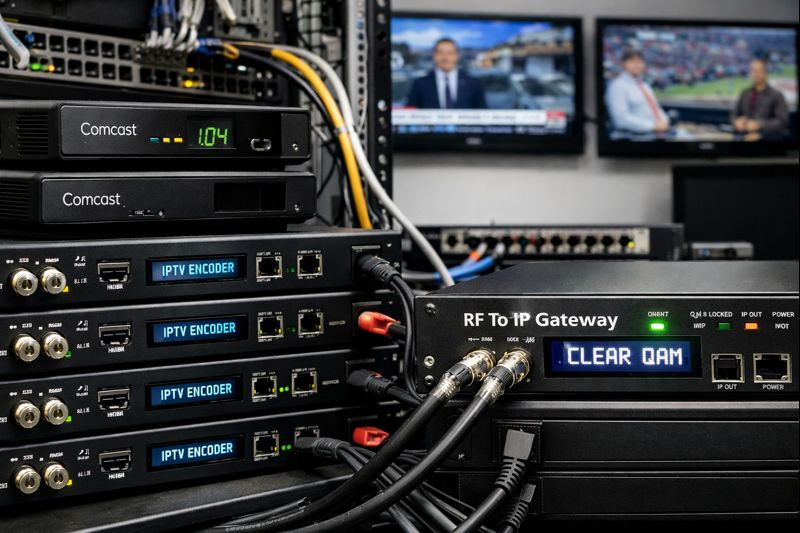
Table of Contents
When planning a video distribution system-especially in environments like hotels, campuses, or large facilities-one of the most fundamental considerations is how the incoming television signal is delivered and whether it can be distributed efficiently throughout the venue. With providers like Comcast, television signals are typically delivered over coaxial cable using a modulation standard called QAM (Quadrature Amplitude Modulation). This method has been widely used for decades because it reliably carries digital TV channels over existing cable infrastructure.
In theory, QAM channels can be converted directly into IP streams for distribution across an Ethernet network, but this depends entirely on whether the signal is Clear QAM or Encrypted QAM. Clear QAM signals are unencrypted and can be received and decoded directly by tuners or IPTV-enabled devices. Unfortunately, in most commercial installations today, Comcast supplies Encrypted QAM, which means the channels are protected and cannot be decoded without the provider’s equipment. This encryption prevents direct conversion to IP without an intermediary step.
When dealing with Encrypted QAM, the only practical way to bring that content into an IP distribution environment is first to decode it using a provider-issued set-top box (STB). The set-top box decrypts the QAM signal and outputs it as HDMI video. That HDMI feed then can be input into an IPTV encoder, which converts the video into network streams. For example, a professional multi-channel solution such as the Thor 24 HDMI IPTV Streaming Encoder H-HDPerformux-24 supports multiple HDMI inputs and outputs them as multicast IP streams for delivery across a network. For deployments with many channels, there are other scalable encoder options from Thor that support various numbers of inputs and advanced streaming protocols, such as the Thor 4-Channel HDMI Broadcast Encoder or the Thor Broadcast H-SPARTAN-1 Encoder Streamer.
It’s important to recognize that converting many encrypted channels in this way quickly increases cost and complexity. For instance, if you needed to distribute around seventy Comcast channels, you would require roughly seventy Comcast STBs plus a corresponding number of encoders to convert each HDMI signal into IP - a significant investment in hardware, rack space, power, and maintenance. Even though products like the Thor Broadcast H-SPARTAN-4 4 Channel HDMI CVBS Network Encoder or Thor Broadcast H-SPARTAN-2 Network Encoder can consolidate multiple inputs into fewer units, the overall infrastructure remains substantial.
In contrast, if Comcast were supplying Clear QAM - which is increasingly rare - conversion would be much simpler. Clear QAM channels could be received directly by compatible hardware, such as the Thor Broadcast RF to IP Gateways which can be ordered with 4, 8, or 16 QAM RF tuners which directly convert those RF Major and Minor channels to multicast IP without requiring set-top boxes. This is a simple high density Gateway quickly resolves issues for applications that require a Hybrid setup or creating a headend in one building, then sending that IP multicast to other buildings in the network that can use IPRF-32QAM Edge modulators or simply use IP STB’s for decoding. These hybrid setups can be particularly useful in headend installations where both traditional coax distribution and IP streams are needed.
In University campus applications; you can build out a QAM CATV headend, convert to IP for easy transmission over the fiber backbone, and still utilize CATV RF in residence halls or classroom settings using the Edge modulators, but still have tangible benefits of having the entire channel lineup in IP as well. This means sending one headend to countless buildings can become simpler since you’re not sending RF over FIber, but rather IP which is much easier to control and handle traffic via multicast. The benefits of a Hybrid topology of CATV via Coax and IP can then be expanded quickly and easily without a redesign; simply add in new hardware to any new construction or existing facilities utilizing the existing RG6 or RJ45 copper cabling.
Another critical piece of the distribution puzzle lies at the display end. If you are using hospitality-grade TVs, these often include IPTV clients capable of receiving multicast streams directly via Ethernet. This allows the TVs to tune channels via IP without additional set-top boxes. However, in many institutions, standard consumer-grade TVs are used instead. These displays do not natively support IP multicast input and therefore cannot decode IP streams on their own. To enable IP-based video distribution to these TVs, you need an IP decoder or set-top box at each display. Thor offers compact solutions such as the 4K HEVC IP and USB HD Video Decoder, IP-HDMI-SDI-4K-D, which accepts IP streams and outputs them via HDMI for compatibility with virtually any television. This type of device bridges the gap between a network-based video feed and a traditional HDMI-only TV.
It is worth noting that Thor also supplies dedicated IP set-top boxes such as the H-STB-IP, which are designed specifically to decode standard multicast IPTV streams and provide HDMI outputs directly to consumer displays that are inexpensive and proven solutions. These units support both MPEG-2 and H.264 codecs and are compatible with large multicast deployments, enabling hundreds of displays on a single network segment.
Because of all these considerations, many experienced engineers recommend a hybrid approach rather than attempting to convert every signal to IP. Keeping the core video distribution on coaxial QAM where feasible, and transitioning to IP only where necessary for specific applications or remote areas, often results in a more dependable system with lower operational costs. Full IP conversion offers great flexibility and future scalability but comes with significant initial investment and continued complexity, especially when dealing with encrypted signals and large channel counts.
The decision about how to build or upgrade your video distribution system hinges on whether your incoming Comcast signal is Clear or Encrypted QAM and what types of displays you plan to use. Because Encrypted QAM cannot be directly converted to IP, you generally need set-top boxes and encoders to bring that content into an IP network. Products such as those available from Thor Broadcast provide practical tools for encoders, modulators, and decoders that can form part of a hybrid or full-IP system depending on your specific needs. Choosing the right configuration requires balancing cost, complexity, and long-term operational requirements.


 EN
EN