| Availability: | Check availability | Condition: | new |
|
| Shipping: | starting at $0.00 | Warranty: | 1Yrs |
Wavelength Division Multiplexing has been used for decades to increase the capacity of a fiber optic cable. A fiber optic cable acts as a waveguide, carrying light signals with low loss over long distances. Due to the nature of light, optical signals on different wavelengths of light do not interfere with each other. Because of this fact, many optical signals can be overlapped on the same fiber. These signals can be transported over the same fiber right next to each other and then separated at the other end. Thor specializes in combining different types of optical signals. You can send baseband video on one wavelength, and SDI or Ethernet on another. By incorporating CWDM and DWDM optics, the number of optical channels can be dramatically increased. This technology also makes add/drop configurations possible.
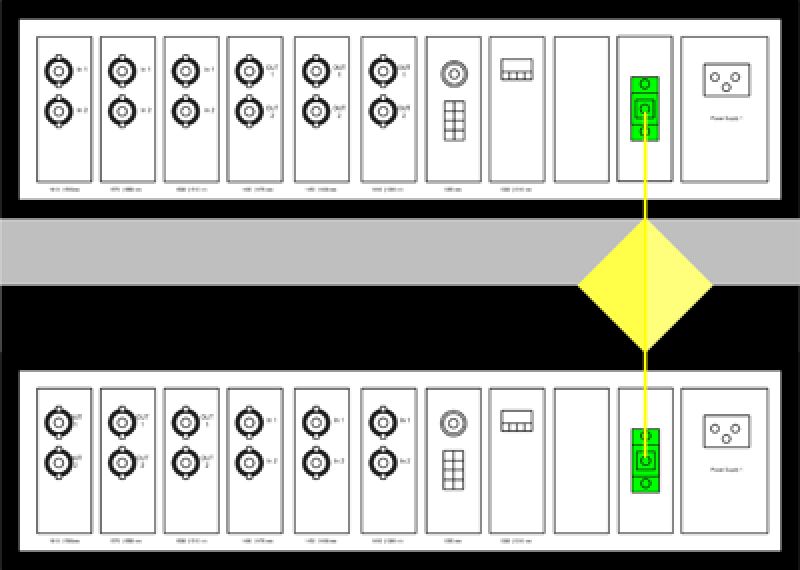
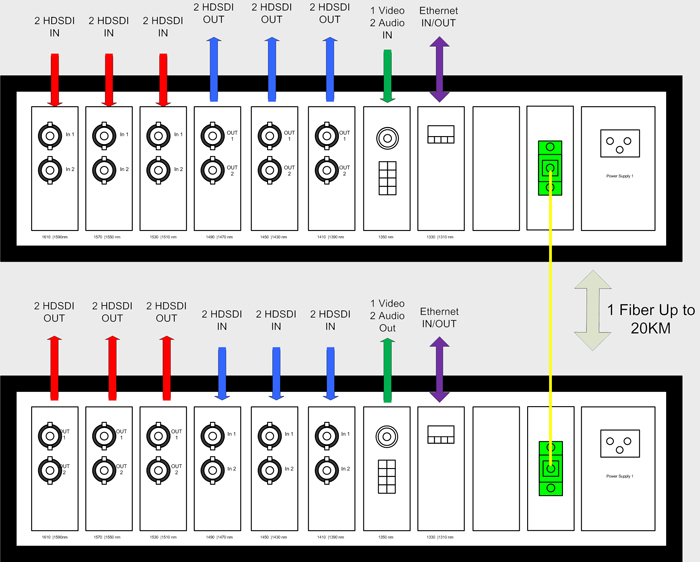
The following example illustrates a typical F-CHASSIS system. This chassis consists of a single fiber link. There are 15 wavelengths used for transport in both directions. 12 of those wavelengths are used for full-rate HD-SDI, 2 are used for Gigabit Ethernet, and 1 is used for a baseband video and audio channel. Any combination of chassis cards can be used. This configuration is useful for video production. There are 6 HD-SDI signals going in both directions over fiber. This is useful for linking production SDI video switchers at two separate locations. The Gigabit Ethernet can be used for transporting production files, and the baseband video is useful for monitoring. This setup is very useful for linking a studio to a video production and editing center.
With this setup, two HD-SDI routers can be linked over a great distance. This allows live HD video to be shared in real time at two locations via HD-SDI routing switches. The Gigabit Ethernet link is used to connect the servers at both locations. Not only can the video be shared in real time, edited files can be quickly and effortlessly transported over the link. This is ideal for a broadcast production operation where real-time editing and content overlay may not take place at the same facility. Contact Thor today for more help in determining which equipment will work best for your situation.
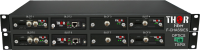 Chassis Multiplexing System for SDI, Ethernet, Gigabit Ethernet, RS Data, Analog Audio Video, RF
Flexible Fiber Optic Multiplexing Chassis System for: - SD-SDI, HD-SDI, 3G SDI - DVB-ASI, SMPTE 310M - Baseband Video (PAL/NTSC) and Audio - Gigabit Ethernet or Standard 10/100 BASE-T - RS422, RS485, RS232
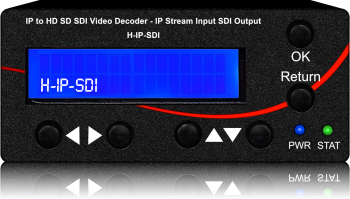 IP to HD SD SDI Video Decoder - IP Stream Input SDI Output
The H-IP-SDI is a managed IPTV to SDI video decoder that can accept a TS signal and decode almost any incoming HEVC, H.265, H.264, and Mpeg-2 stream at up to 1920x1080@ 60fps and 3840x2160@ 30fps. It supports various protocols, including IPv4/v6, TCP, UDP, HTTP, HLS, RTP, RTSP, RTMP, FTP, and IGMP(Multicast). This allows you to interface with and broadcast from all types of websites, encoders, servers, and hosts, from YouTube to private UDP streams. The unit comes equipped with a GUI interface, so you can access it remotely.

 ES
ES