| Availability: | Check availability | Condition: | new |
|
| Shipping: | starting at $0.00 | Warranty: | 2Yrs |
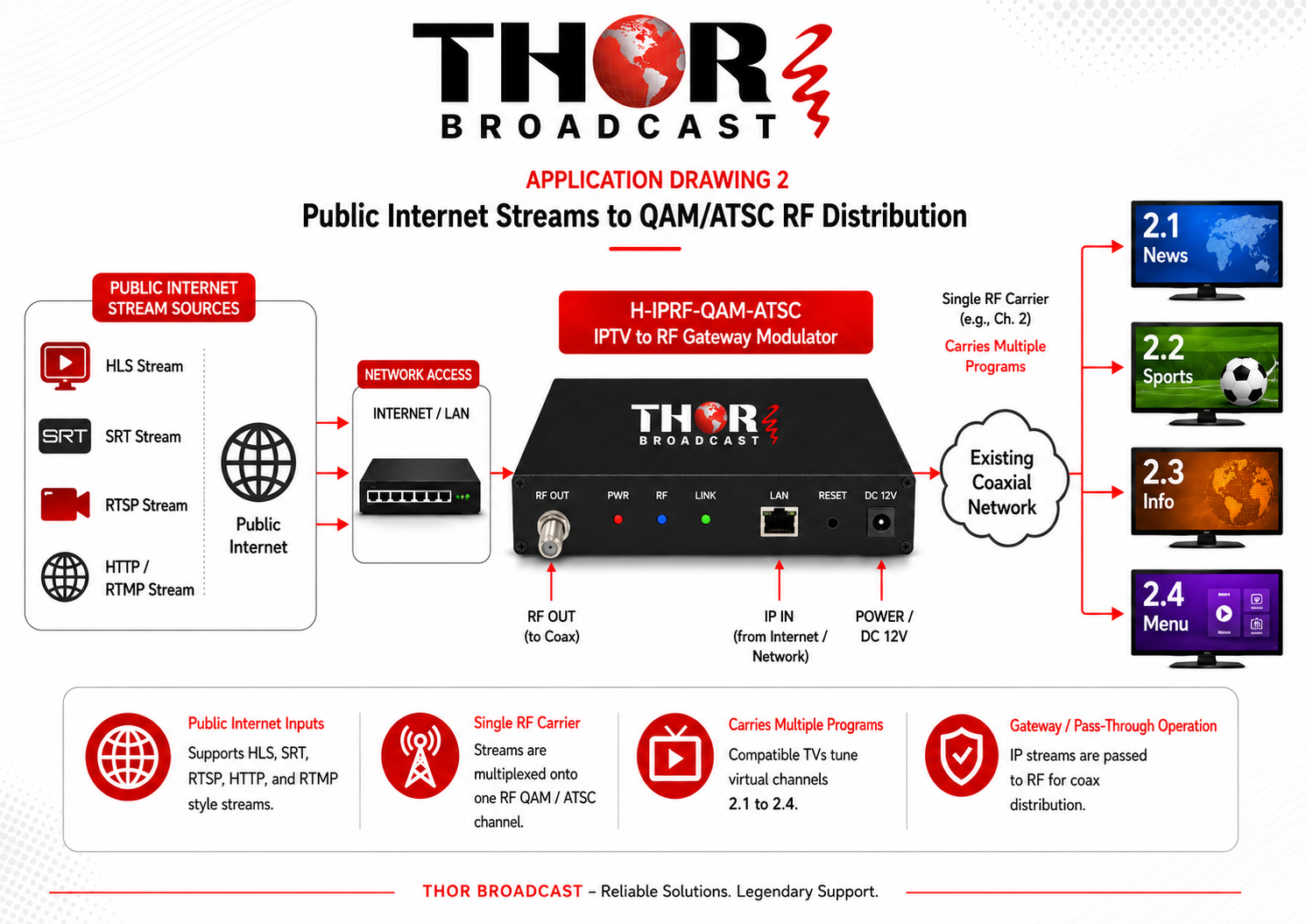
The H-IPRF-QAM-ATSC is ideal for systems where IP video, IPTV streams, network encoders, media servers, camera streams, or transport streams need to be delivered over a standard coaxial TV distribution network. The unit outputs one RF carrier, but that RF carrier can carry one or multiple programs depending on the incoming transport stream structure and the available RF bitrate capacity.
This product is designed as a gateway-style IP to RF modulator. It does not normally re-encode or transcode the video. The encoded stream received at the input is passed through and modulated to RF. This allows the unit to support MPEG-2, H.264, H.265/HEVC, HD, and 4K-ready workflows when the source stream, bitrate, modulation standard, and receiving TV or set-top box are compatible.
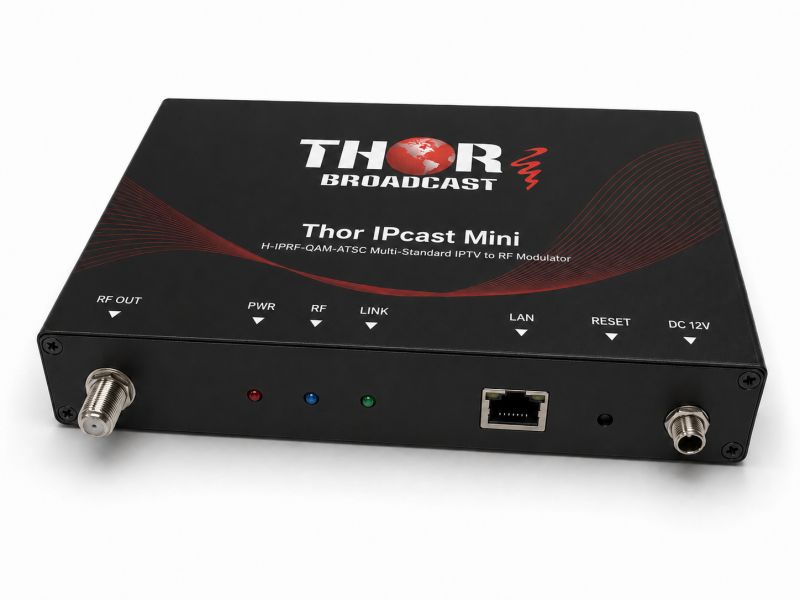
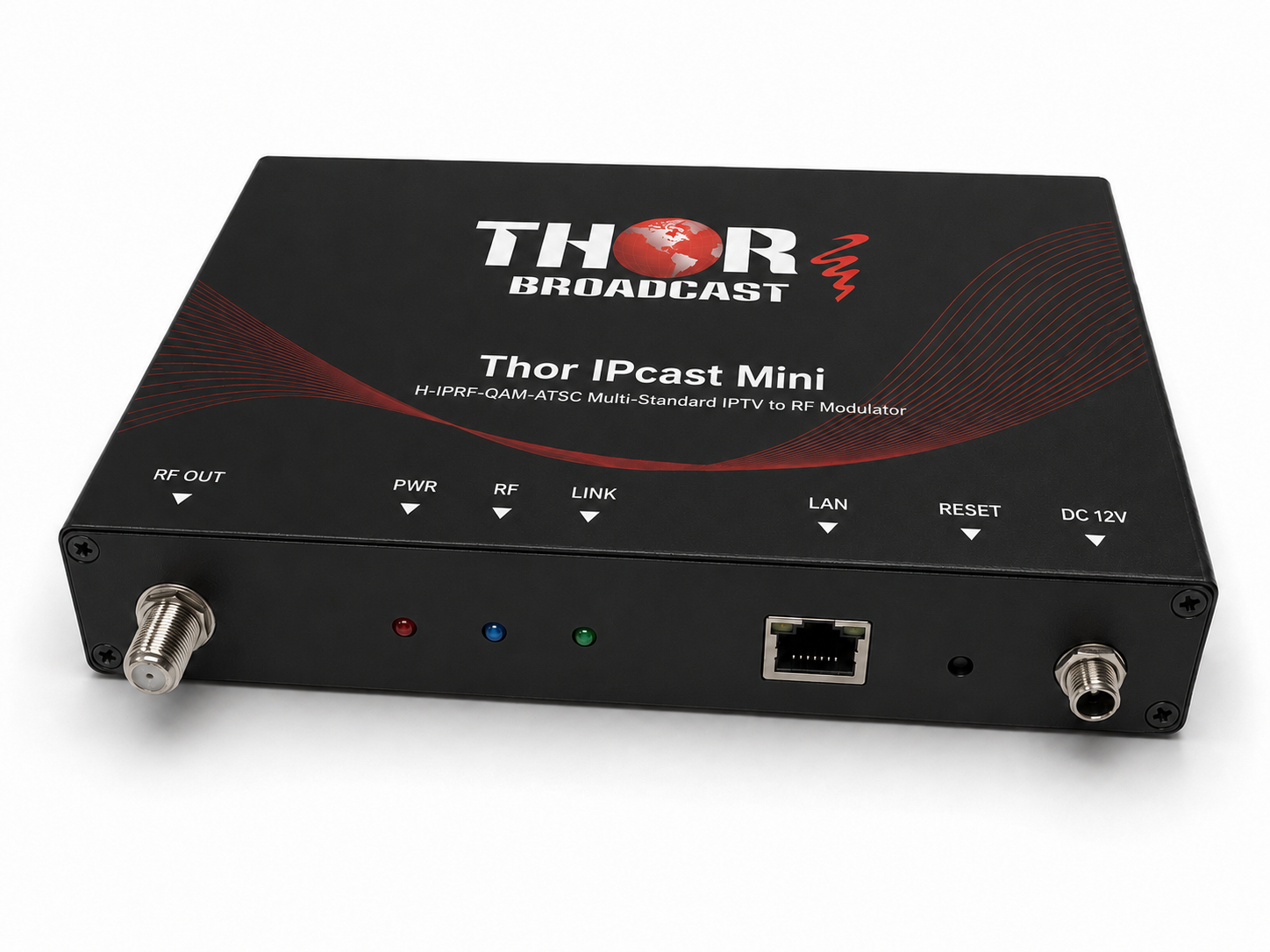
The Thor Broadcast H-IPRF-QAM-ATSC is a professional IPTV to RF modulator built for converting IP-based video sources into a digital television RF channel over coax. It is designed for hotels, schools, corporate buildings, sports venues, digital signage systems, houses of worship, government facilities, private cable systems, IPTV headends, and broadcast test environments.
The unit receives IP video over Ethernet and modulates the selected stream or transport stream onto one RF output carrier. The RF output standard can be configured as QAM/DVB-C, ATSC, DVB-T, or ISDB-T, making the unit flexible for North American cable TV systems, ATSC RF systems, DVB-T terrestrial systems, and ISDB-T regions.
One of the main advantages of the H-IPRF-QAM-ATSC is its flexible IP input design. For internet-style stream sources, the unit supports RTSP, RTMP, HTTP, HLS, and SRT, with up to 4 IP channel inputs. This is useful when working with streaming servers, IP cameras, software encoders, cloud-style video links, media appliances, or other streaming devices.
For Ethernet transport stream applications, the unit supports unicast and multicast UDP/RTP input. In this mode, there is no fixed limit such as 1, 2, or 4 programs. The number of programs that can be carried depends on the total bitrate of the transport stream and the maximum payload capacity of the selected RF modulation. For example, a typical 6 MHz QAM 256 channel can carry approximately 38 Mbps of usable payload. If each program is encoded at 6 Mbps, then approximately six programs can fit inside the same RF carrier.
The H-IPRF-QAM-ATSC works as a gateway modulator. It receives the already encoded stream and places it onto RF. If the source stream is MPEG-2, H.264, or H.265/HEVC, the unit passes that encoded content through to the RF output. The modulator does not convert the codec, upscale video, downscale video, or change H.264 into H.265. Whatever compatible encoded transport stream is received is what will be carried through the RF output.
Because of this pass-through design, the unit can be considered 4K ready when used with the correct source and receiver. If the input is a properly encoded 4K H.265 transport stream, the bitrate fits within the modulation capacity, and the receiving 4K TV or set-top box supports the RF standard and codec, the system can deliver 4K programming over RF.
| Input Type | Supported Protocols | Channel / Program Capacity | Typical Use |
|---|---|---|---|
| Internet Stream Input | RTSP, RTMP, HTTP, HLS, SRT | Up to 4 IP channel inputs | IP cameras, streaming servers, software encoders, SRT links, media servers, internet-style stream sources |
| Ethernet Transport Stream Input | Unicast UDP/RTP, Multicast UDP/RTP | No fixed program count. The number of programs depends on total bitrate and RF modulation capacity. | IPTV headends, transport stream encoders, multicast video systems, MPTS distribution, LAN-based video transport |
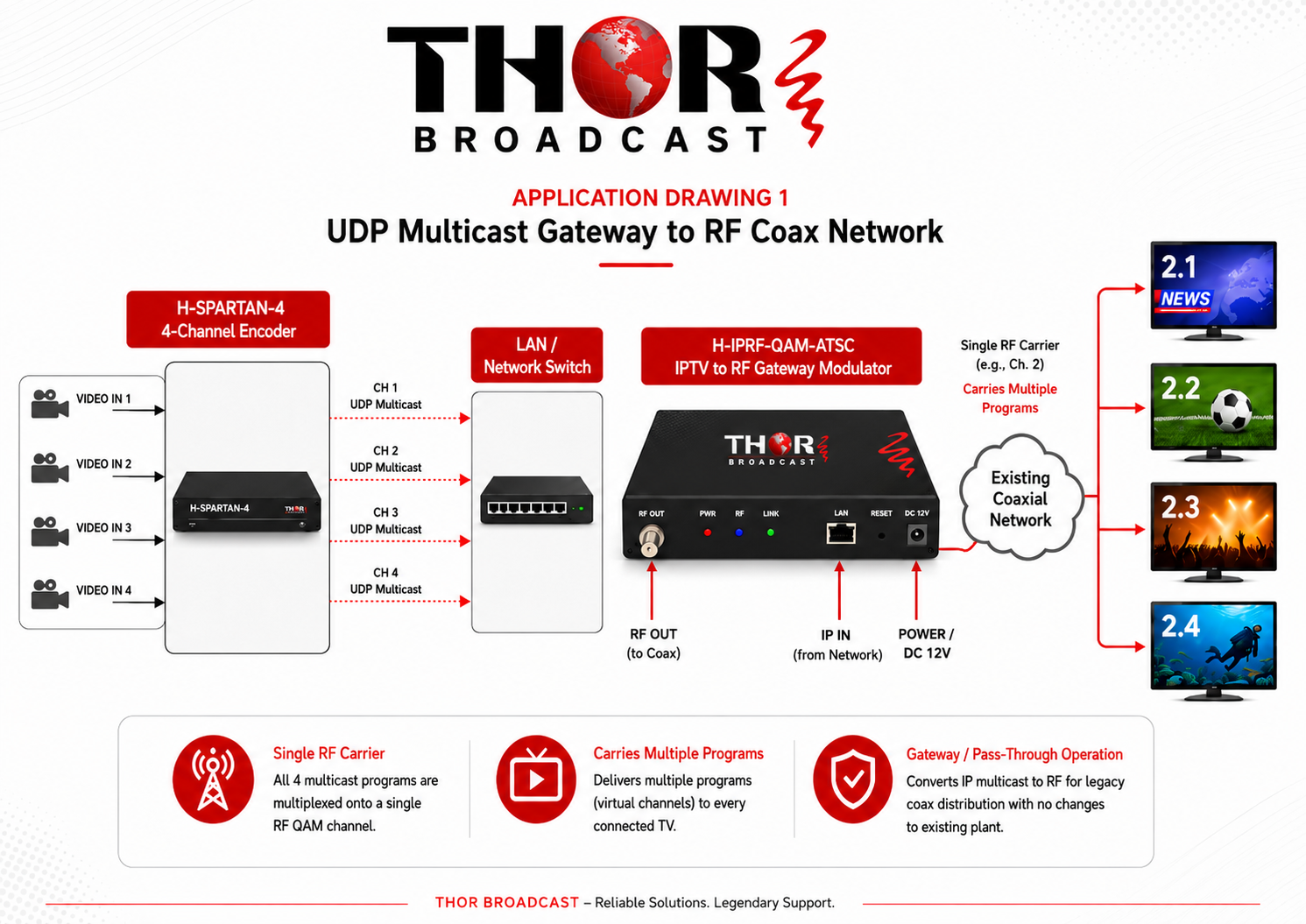
The H-IPRF-QAM-ATSC creates one RF output carrier. This is important to understand: the unit does not create four separate RF frequencies. It creates one RF channel, but that one RF channel can contain multiple programs when the input transport stream and bitrate allow it.
In digital RF systems, one RF channel can carry a multiplex of programs. The total number of programs depends on the bitrate of each encoded video stream and the maximum bitrate capacity of the selected RF standard and modulation settings.
For example, a typical 6 MHz QAM 256 RF channel can carry approximately 38 Mbps of usable payload. If each video program is encoded at approximately 6 Mbps, then six programs can fit inside one RF channel:
6 programs x 6 Mbps = 36 Mbps total bitrate
In this example, the receiving TVs or set-top boxes may display the services as virtual channels such as 2.1, 2.2, 2.3, 2.4, 2.5, and 2.6, depending on the transport stream tables, channel mapping, and receiver compatibility.
The H-IPRF-QAM-ATSC operates like an IP-to-RF gateway. It receives an already encoded IP stream or transport stream and maps it to the selected RF output modulation. The unit does not normally re-encode the video, so it does not change the source codec or compression format.
If the incoming stream is MPEG-2, the RF output carries MPEG-2. If the incoming stream is H.264, the RF output carries H.264. If the incoming stream is H.265/HEVC, the RF output carries H.265/HEVC. The final decoding is performed by the TV, set-top box, or RF receiver.
This makes the unit flexible for different system designs. Older systems may use MPEG-2 for maximum legacy TV compatibility. Newer systems may use H.264 for better compression. Advanced systems may use H.265/HEVC for lower bitrate HD or 4K applications.
The H-IPRF-QAM-ATSC is 4K ready when used with a compatible 4K encoded source stream and compatible receiving equipment. Since the unit passes the encoded stream through without converting the codec, a properly encoded 4K H.265/HEVC transport stream can be modulated to RF as long as the bitrate fits within the available RF channel capacity.
For example, a customer can provide a 4K H.265 stream from a compatible encoder or streaming source. The H-IPRF-QAM-ATSC can place that stream onto the selected RF channel. A compatible 4K TV or set-top box that supports the selected RF standard and H.265/HEVC decoding can then decode and display the 4K program.
A video source such as an IPTV encoder, media server, IP camera, SRT decoder/source, or multicast transport stream server sends video over the network. The H-IPRF-QAM-ATSC receives the stream through its Ethernet port, selects the desired input/program, and modulates it onto one RF output carrier. The RF output is then connected to a coax distribution system, RF combiner, amplifier, splitter, or MATV/CATV network.
Example signal flow:
IP Video Source / Encoder / IPTV Server / Camera to Network Switch to H-IPRF-QAM-ATSC to RF Coax Distribution to TVs or RF Set-Top Boxes
| Example | Approximate Bitrate | Result |
|---|---|---|
| 1 HD program | 6 Mbps | Fits easily inside one typical QAM 256 RF channel |
| 4 HD programs | 4 x 6 Mbps = 24 Mbps | Fits inside one typical QAM 256 RF channel with room for overhead |
| 6 HD programs | 6 x 6 Mbps = 36 Mbps | Can fit inside an approximately 38 Mbps QAM 256 RF channel if the transport stream is properly built |
| 1 4K H.265 program | Depends on encoder settings | Can be supported if the bitrate fits and the receiving device supports the RF standard and codec |
| Feature | H-IPRF-QAM-ATSC | H-IPRF-4QAM |
|---|---|---|
| Best Use | Flexible single RF channel gateway with many IP protocol options | Multi-channel UDP/RTP IP to RF modulation where multiple RF carriers are required |
| RF Output | One RF carrier/channel | Multiple RF carriers/channels depending on model configuration |
| Programs per RF Channel | Can carry multiple programs inside one RF channel when bitrate allows | Designed for multiple RF channel output applications |
| Internet Stream Input | RTSP, RTMP, HTTP, HLS, SRT, up to 4 IP channel inputs | Primarily UDP/RTP transport stream based |
| Ethernet TS Input | Unicast/multicast UDP/RTP, program count depends on modulation bitrate capacity | UDP/RTP transport stream input for multi-channel RF output workflows |
| RF Standards | QAM/DVB-C, ATSC, DVB-T, ISDB-T | Depends on model and configuration |
| Best Customer Fit | Customers needing one RF channel with flexible stream input protocols | Customers needing several separate RF output channels from IP transport streams |
Thor Broadcast can help determine whether your project requires a single RF channel IPTV to RF gateway, a multi-channel IP to QAM system, an HDMI encoder, or a complete IPTV-to-coax headend.
Contact Thor Broadcast with your input stream type, codec, bitrate, number of programs, desired RF standard, and TV or set-top box model.
| Category | Specification |
|---|---|
| Model | H-IPcast-Mini "H-IPRF-QAM-ATSC" |
| Product Type | Single RF channel IPTV to RF gateway modulator |
| IP Input Interface | 1000 Base-T Ethernet, RJ45 |
| Internet Stream Input Protocols | RTSP, RTMP, HTTP, HLS, SRT |
| Internet Stream Input Capacity | Up to 4 IP channel inputs |
| Ethernet Transport Stream Input | Unicast UDP/RTP and multicast UDP/RTP |
| UDP/RTP Program Capacity | No fixed channel count. The number of programs depends on the total transport stream bitrate and the maximum bitrate capacity of the selected RF modulation. |
| Transport Stream Support | SPTS and MPTS workflows supported depending on input mode and stream configuration |
| Video Codec Handling | Gateway-style pass-through. MPEG-2, H.264, H.265/HEVC, HD, and 4K support depend on the source stream and receiving device compatibility. |
| RF Output Channel | One RF carrier/channel output. Multiple programs may be carried inside the RF channel when total bitrate allows. |
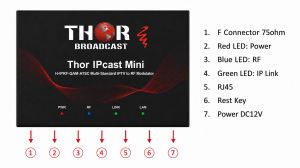
| RF Output Connector | F connector, 75 ohm |
| RF Output Standards | QAM/DVB-C, ATSC, DVB-T, ISDB-T |
| RF Frequency Range | 50 MHz to 950 MHz |
| Frequency Step | 1 kHz |
| RF Output Level | 100 dBuV |
| MER | Typical 35 dB |
| DVB-C / QAM Constellation | 16QAM, 32QAM, 64QAM, 128QAM, 256QAM |
| Typical QAM 256 Capacity | Approximately 38 Mbps usable payload per 6 MHz QAM 256 channel, depending on RF standard, symbol rate, configuration, and system overhead |
| DVB-T Bandwidth | 6 MHz, 7 MHz, 8 MHz |
| DVB-T Constellation | QPSK, 16QAM, 64QAM |
| DVB-T Code Rate | 1/2, 3/5, 2/3, 3/4, 5/6, 7/8 |
| DVB-T Guard Interval | 1/4, 1/8, 1/16, 1/32 |
| DVB-T FFT | 2K, 8K |
| ATSC Constellation | 8VSB |
| ISDB-T Constellation | QPSK, 16QAM, 64QAM |
| ISDB-T Code Rate | 1/2, 3/5, 2/3, 3/4, 5/6, 7/8 |
| ISDB-T Guard Interval | 1/4, 1/8, 1/16, 1/32 |
| ISDB-T Mode | Mode 1, Mode 2, Mode 3 |
| Management | Web GUI over Ethernet |
| Default Management IP | 192.168.0.168 |
| Default Login | Username: admin, Password: admin |
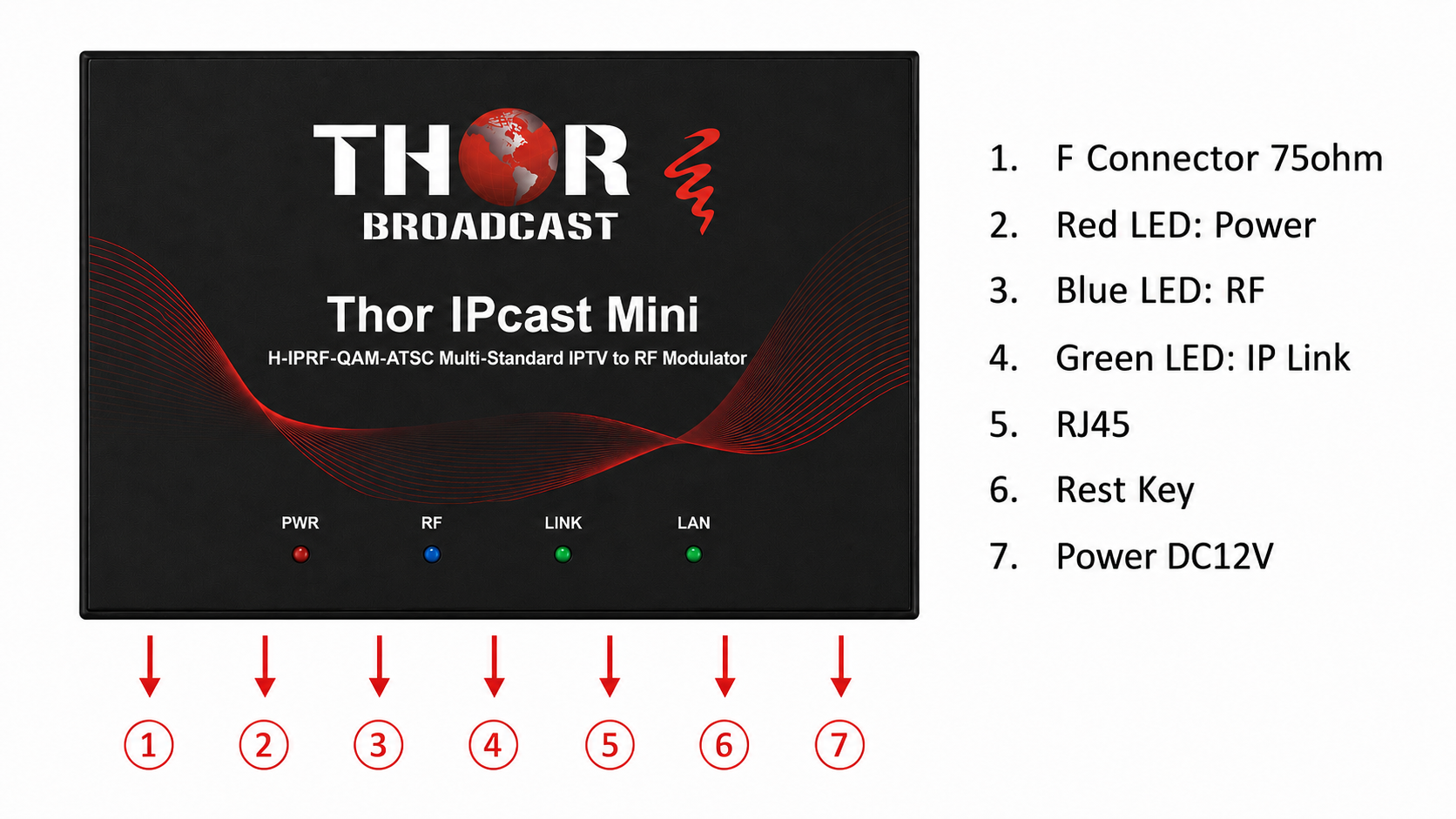
| LED Indicators | Power, RF output, network link |
| Upgrade Method | Ethernet / Web GUI software upgrade |
| Power Supply | DC 12V, 2A |
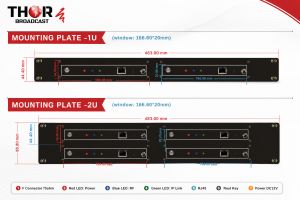
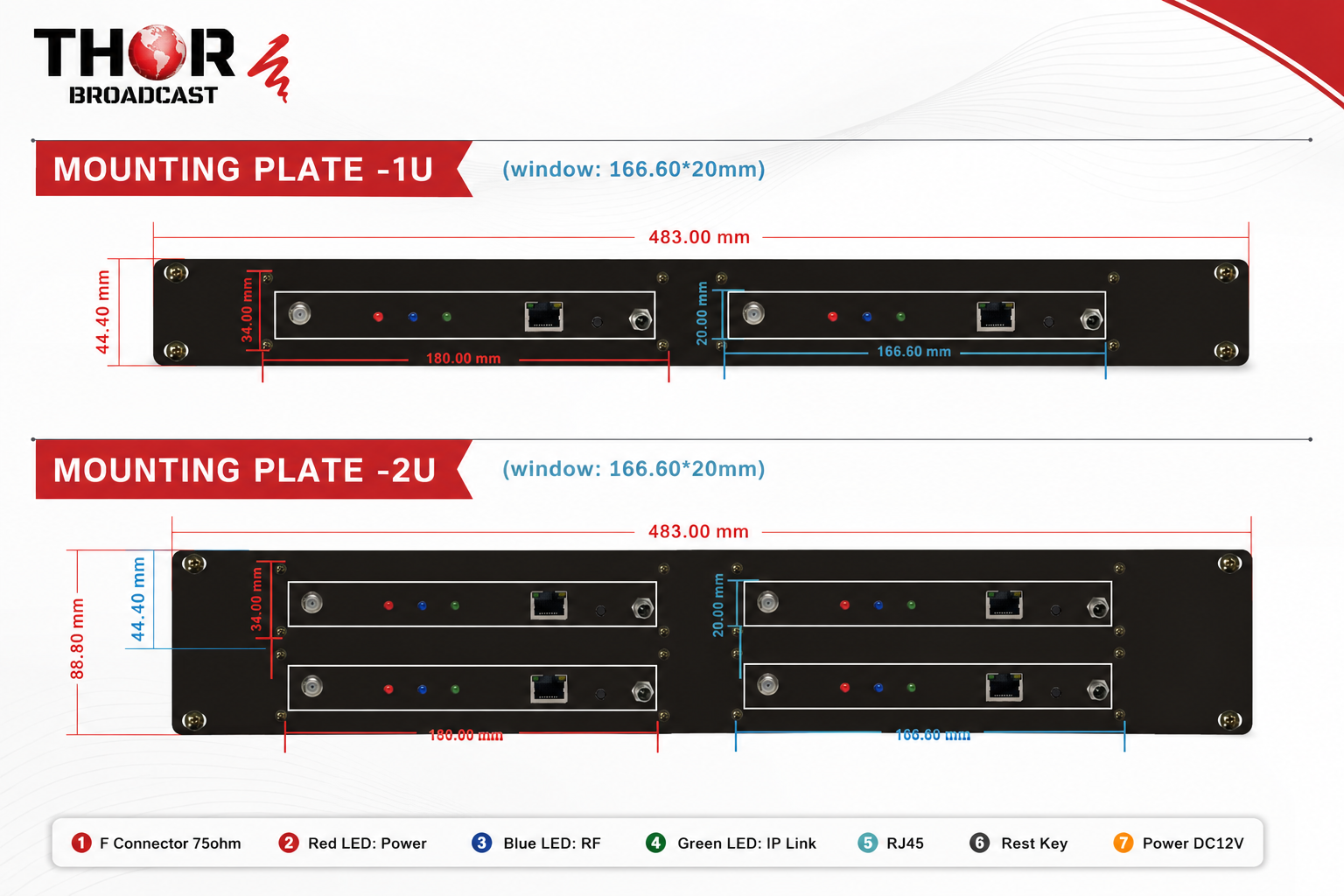
| Dimensions | 174.9 mm x 100 mm |
| Warranty | 2 years |
The H-IPRF-QAM-ATSC outputs one RF carrier/channel. However, that one RF channel can contain multiple video programs if the total bitrate fits within the selected modulation capacity.
How many IP streams can the unit receive?For internet stream protocols such as RTSP, RTMP, HTTP, HLS, and SRT, the unit supports up to 4 IP channel inputs. For Ethernet UDP/RTP unicast or multicast transport stream input, there is no fixed program limit. The number of programs depends on the total transport stream bitrate and the RF modulation capacity.
Can one QAM channel carry multiple programs?Yes. A single QAM channel can carry multiple programs if the combined bitrate fits inside the available RF channel capacity. For example, a typical QAM 256 channel can carry approximately 38 Mbps of usable payload. Six programs encoded at 6 Mbps each would use approximately 36 Mbps.
Does the unit transcode video?No. The H-IPRF-QAM-ATSC should be treated as a gateway-style modulator. It passes the encoded stream through to the RF output. The source codec must be supported by the receiving TV or set-top box.
Can it support 4K?Yes, it is 4K ready when used with a compatible 4K encoded source stream, proper bitrate, suitable RF modulation capacity, and a 4K receiver or TV that can decode the stream.
Can it convert SRT to RF?Yes. The unit supports SRT as one of the internet stream input protocols, with up to 4 IP channel inputs.
Can it convert UDP multicast to QAM?Yes. The unit supports multicast UDP/RTP transport stream input and can modulate the stream to QAM/DVB-C RF output.
Can it output ATSC?Yes. The unit supports ATSC RF output using 8VSB modulation.
Can it output DVB-T or ISDB-T?Yes. The unit supports DVB-T and ISDB-T in addition to QAM/DVB-C and ATSC.
Does it have HDMI input?No. This model receives IP streams over Ethernet. If the source is HDMI, an HDMI encoder should be used first to create the IP stream, and then the H-IPRF-QAM-ATSC can modulate that IP stream to RF.
The H-IPRF-QAM-ATSC is configured through a browser-based web GUI. The installer can set the network address, enter the stream source, verify stream status, select the desired program, configure RF modulation parameters, and monitor the RF output condition.
Basic Setup Process ASI to QAM or ATSC CATV RF Modulator
Digital modulator with ASI input and CATV RF output - QAM, ATSC, DVB-T, or ISDBT (model dependent) Also IP output in UDP/RTP/RTSP - SPTS/MPTS, unicast/multicast
 IPTV to 16/32 CLEAR CHANNEL RF QAM/ATSC Modulator
CABLE TV Headend in a Box. QAM modulator for IP Edge QAM / ATSC / DVB-T / ISDB-T applications. This 1RU chassis has 2 GE inputs with an SFP interface, allowing up to 1024 channels of TS streams over UDP / RTP, unicast, and multicast streams. Maximum input for each GE input is 840 Mbps, which will be output through the RF output on 16 non-adjacent QAM carriers in the range of 50-960MHz.

 ES
ES