See how IPTV encoders and decoders deliver reliable HDMI over IP video between buildings over fiber Ethernet networks.
Organizations often need to distribute HDMI video feeds across multiple buildings while maintaining reliability, low latency, and high video quality. Traditional HDMI cables are limited in distance and become impractical when buildings are connected through fiber Ethernet networks and Layer-2 switches.
This application example shows how Thor Broadcast IPTV encoders and IP decoder set-top boxes can deliver HDMI video feeds across multiple buildings using standard Ethernet and fiber infrastructure.
The result is a scalable HDMI over IP monitoring system that can distribute video feeds to multiple displays anywhere on the network.
Table of Contents
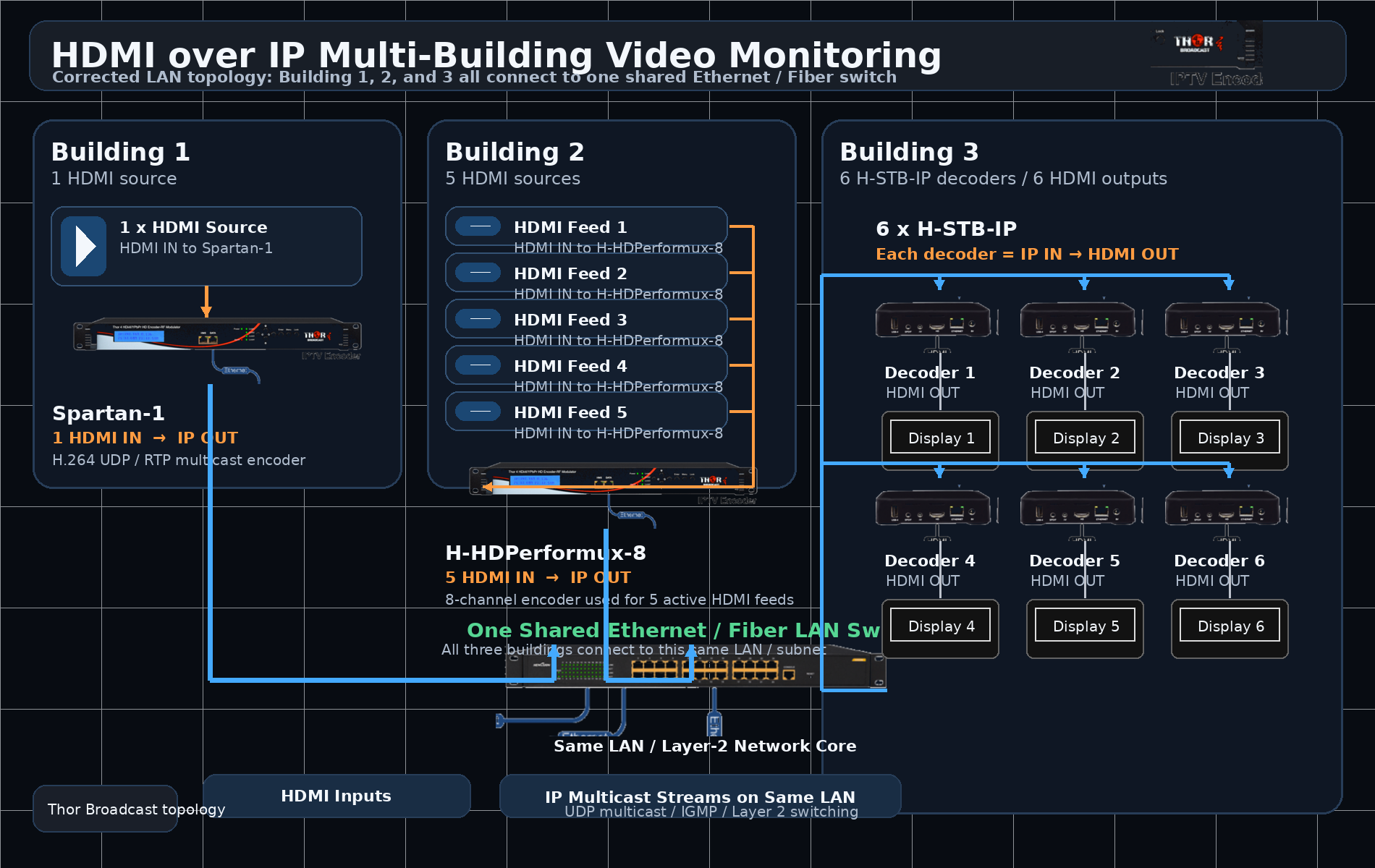
The deployment consists of three buildings connected by a fiber Ethernet network.
To transport HDMI signals across the network, the HDMI sources are converted into IP multicast streams using H.264 IPTV encoders.
The encoded streams travel across the existing Ethernet switches and fiber uplinks and are decoded back into HDMI signals at the destination displays.
This architecture is commonly referred to as:
Product used:
Spartan-1 HDMI / SDI / CVBS H.264 IPTV Encoder
The Spartan-1 HDMI IPTV encoder converts the HDMI signal into an H.264 compressed IP stream.
The encoded video is transmitted across the Layer-2 Ethernet network connecting the buildings.
Building 2 required encoding five HDMI sources. Two deployment options were recommended.
Product links:
Use a single multi-channel IPTV encoder:
4 / 8 / 16 / 24 Channel HDMI IPTV Streaming Encoder
Once the HDMI sources are encoded, they are transmitted using UDP multicast streams. This allows a single encoder to distribute video to multiple displays simultaneously.
In this deployment, all buildings were already on the same LAN and subnet, making multicast IPTV streaming an ideal solution.
Product used:
H-STB-IP Compact IP Decoder Set-Top Box
The H-STB-IP decoder receives the multicast video stream and converts it back to HDMI for display. Each monitor is connected to a dedicated decoder.
HDMI signals are encoded into H.264 IPTV streams.
The streams travel across the fiber Ethernet network between buildings.
IP set-top box decoders convert the IP stream back to HDMI.
The HDMI signal is displayed on monitors in the monitoring room.
Using IPTV technology provides several advantages compared to traditional HDMI extension systems.
Video can travel across fiber networks, campuses, or city-wide infrastructure.
Additional displays can be added simply by installing more decoders.
Uses existing Ethernet network equipment instead of dedicated video cabling.
This type of HDMI over IP system is ideal for:
HDMI over IP is a technology that converts HDMI video signals into IP packets so they can be transmitted across Ethernet networks.
An IPTV encoder converts HDMI or SDI video into IP streams such as H.264 or H.265 for distribution across networks.
An IPTV decoder converts the IP video stream back into HDMI output for display on TVs or monitors.
No. HDMI over IP solutions typically run on existing Ethernet infrastructure, provided it supports multicast and sufficient bandwidth.
Typical IPTV encoding systems have approximately 1–2 seconds of latency, depending on compression settings.
Using Thor Broadcast IPTV encoders and compact IP decoder set-top boxes, organizations can build reliable HDMI video monitoring systems across multiple buildings.
The solution leverages existing Ethernet and fiber infrastructure, supports multicast streaming, and allows virtually unlimited scalability.
This makes it an ideal architecture for professional video monitoring, broadcast distribution, and campus-wide IPTV systems.


 ES
ES