Turn HDMI into RF using a Thor Broadcast modulator, then split and amplify the coax network to feed many TVs reliably.
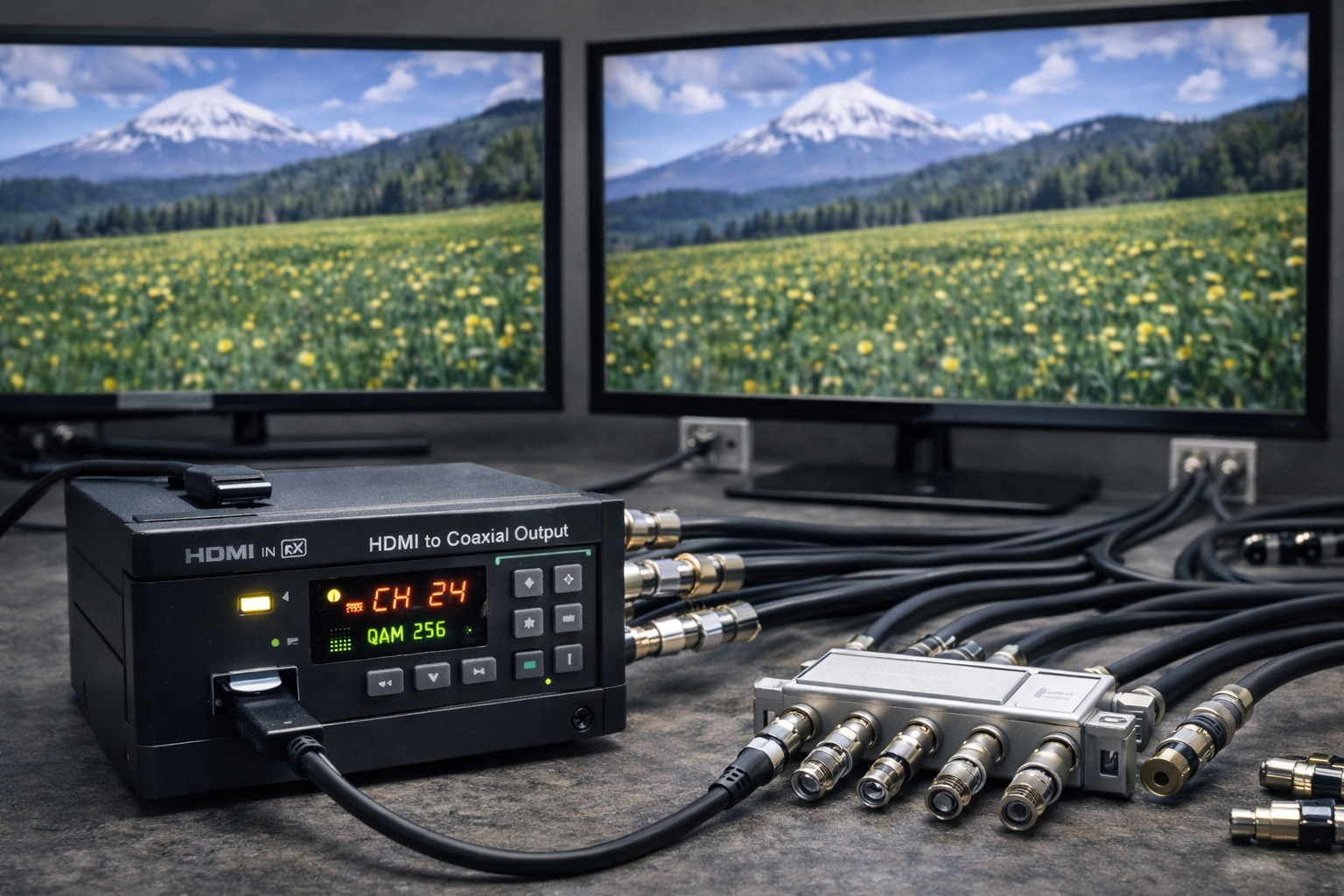
Table of Contents
If you search for an “HDMI to coaxial cable splitter,” it sounds like a simple box that accepts one HDMI input and produces multiple coax outputs for many TVs. In practice, that single box is rarely the correct way to describe a professional distribution system. HDMI is a point-to-point digital A/V interface designed for short runs, tight timing, and direct device handshakes. Coaxial distribution, on the other hand, is typically a one-to-many RF transport method where the same program (or multiple programs) is carried as modulated RF channels and then passively or actively distributed through splitters, taps, and amplifiers.
The practical architecture is: convert HDMI into an RF television channel (or a set of channels) using an HDMI-to-coax converter/modulator, then distribute that RF over coax using splitters and (where needed) distribution amplifiers. This is exactly why there is no single universal “HDMI to coax splitter” device: the “split” happens in RF after modulation, not in baseband HDMI. In real deployments-hotels, campuses, MDUs, hospitals, sports venues-the correct solution is an HDMI encoder/modulator feeding a coax distribution network sized for the number of televisions, cable lengths, and acceptable signal margins.
HDMI carries uncompressed video and audio (with auxiliary data) over a high-speed differential signaling scheme. It expects the source and sink to negotiate capabilities, often including content protection and EDID exchange. This design is excellent for connecting a player to a nearby display, but it is not optimized for long runs across a building with many endpoints. You can extend HDMI, but at scale it becomes a management task: endpoints must be addressed, conversion points must maintain link integrity, and every additional branch can introduce handshake complexity.
RF distribution over coax is different: the coax becomes a shared medium that transports one or more modulated carriers. Each television (or set-top box) simply tunes to the assigned channel frequency and decodes the program. This tuning model is stable, scalable, and familiar to technicians who have built CATV/SMATV systems for decades. When you convert HDMI to RF using a professional modulator, you’re effectively creating your own in-house “TV channel” that behaves like a broadcast or cable channel everywhere the coax reaches.
The key building block is the HDMI-to-coax modulator: it accepts HDMI, encodes the audio/video into a broadcast-style compressed stream, multiplexes it as needed, and then modulates that stream onto an RF carrier suitable for coax distribution. Thor Broadcast offers multiple families of HDMI RF modulators so you can match the output format to the televisions and tuners in your environment.
For cable-style systems, QAM is common in many CATV/MATV deployments. Thor’s HDMI-to-QAM solutions combine multi-channel encoding and agile QAM output so you can create one or more RF channels and inject them into an existing coax lineup. A good starting point for QAM-based distribution is Thor’s HDMI to QAM modulator family: HDMI to QAM Modulators & IPTV Streaming Encoders . When your environment requires ATSC (8VSB) off-air style tuning (common in North America for “antenna” tuners), Thor also provides: HDMI to ATSC Modulators & IPTV Streaming Encoders . And for DVB-T environments, Thor’s DVB-T modulator line supports building internal DVB-T channels on coax: HDMI to DVB-T Digital Modulators & IPTV Streaming Encoders .
The modulator is the “converter” portion of the overall “HDMI to coax splitter” concept. Once the HDMI is converted into an RF channel plan, the coax network can be split and extended just like any other RF distribution system. Importantly, choosing the modulation format should be driven by what the TVs can tune directly. If the TVs have QAM tuners, QAM is natural. If the TVs are expecting ATSC-style tuning, ATSC modulators are the straightforward approach. If DVB-T tuners are present, DVB-T is a logical match.
Not every site needs a multi-channel headend chassis. Sometimes you just need one in-house channel from a single HDMI source, distributed to a modest number of displays. In these cases, a compact HDMI RF modulator can be a clean and economical approach, especially when space is limited and the system requirements are straightforward. Thor offers compact modulator options intended for high-value deployments where you still need professional RF output behavior.
For example, Thor’s compact modulator series supports full-HD distribution over coax in multiple modulation formats depending on configuration: Compact HDMI RF Digital Modulator (CMOD series) . For larger builds, Thor’s multi-channel chassis families are designed to encode multiple HDMI inputs, multiplex programs, and generate agile RF outputs suitable for injection into broadband coax networks. Thor’s HDMI RF product hub is a useful way to navigate platform options by output standard and channel count: Thor Broadcast HDMI RF Modulators .
A practical sizing rule is to start from the number of distinct programs you must distribute (one channel vs. multiple channels), then decide whether you need a compact modulator or a multi-channel headend chassis. Once you know your channel count and required output standard (QAM, ATSC, DVB-T), you can build the downstream coax distribution around predictable RF parameters: carrier levels, noise margin, and splitter/amplifier losses.
After modulation, the signal on the coax is RF. This is the moment where splitting becomes simple. A coax splitter is a passive RF component that divides signal power from one input into multiple outputs. It does not “understand” HDMI or video compression; it simply divides RF energy across ports. Splitting is inherently lossy: the signal power is shared, and the splitter itself introduces insertion loss. In a well-designed coax system, you account for these losses and add amplification only when needed so that every TV receives an adequate carrier level with sufficient signal-to-noise ratio.
Thor Broadcast offers RF splitters/combiners designed for CATV/antenna frequency ranges with F-type connectors and multiple port-count options: Coax Splitters/Combiners (2, 4, 8, 12, 16, 24-way) . In many sites, you will use a small number of splitters near a central point (a closet or headend), then additional splitters on each floor or wing. This hierarchical approach helps manage cable runs and keeps signal budgets predictable.
It’s also common to combine multiple RF sources. If you generate in-house channels on one frequency plan and also ingest an external feed (such as antenna or cable service), a coax combiner approach can merge them onto a single distribution trunk-provided levels are balanced and the combined spectrum remains clean. A splitter that supports bidirectional use can often be used as a combiner in RF distribution design when the frequency range and port characteristics match the application.
Coaxial cable is used for RF distribution because it supports wide bandwidth with shielding that helps contain signals and reduce susceptibility to interference. In TV distribution, 75-ohm coax is the norm; this characteristic impedance is a key system assumption that influences reflections, standing waves, and overall frequency response when components are mismatched. In practice, maintaining consistent 75-ohm paths-cable, connectors, splitters, amplifiers, and terminations-improves reliability and keeps your RF channel plan stable.
Cable type and connector quality also matter. RG-6 is common in many TV distribution settings, but the right choice depends on run length, frequency plan, and shielding needs. As frequencies rise (especially when you occupy upper portions of the CATV spectrum), cable attenuation increases and connector integrity becomes more important. The longer the run, the more the system depends on a sensible layout: minimize unnecessary splitters, keep trunk cables robust, and use well-placed distribution amplifiers rather than “over-splitting” at the headend.
When you deploy a Thor HDMI RF modulator, you’re generating carriers that must arrive at the TVs with enough margin. That margin is reduced by coax attenuation (which scales with both frequency and length) and by splitter insertion loss. A technical design mindset-rather than trial-and-error-helps you reach stable outcomes: choose channel frequencies, predict losses, set modulator output levels appropriately, and then select amplification only where it provides net benefit without overdriving downstream tuners.
Passive splitters are simple and reliable, but every split reduces signal level. When you distribute to many TVs or when cable runs are long, you often need a distribution amplifier to restore carrier levels and preserve SNR at the far end. In coax TV systems, the amplifier must be appropriate for the bandwidth you’re carrying (for example, 54–1000 MHz in many CATV-style systems) and it must be linear enough to avoid distortion when multiple carriers are present.
Thor Broadcast provides distribution amplifiers designed for broadband CATV/SMATV applications. For common requirements, Thor offers a 40 dB-class option suitable for demanding distribution scenarios: H-RF-AMP-40 (40 dB Bi-Directional Distribution Amplifier) . It is also available in a 1RU chassis as well, Rackmount Amp.
Amplifier placement is as important as amplifier gain. A distribution amplifier located after the modulator and before heavy splitting can lift the entire RF bundle to a level that survives downstream losses. In some designs, you may also use amplification at intermediate points (for example, at a floor closet) to compensate for long trunk lengths before additional splitting. The goal is not “maximum level everywhere,” but “adequate and consistent level everywhere” while preserving headroom so multiple carriers remain clean and tunable.
The phrase “HDMI to coax” hides a critical decision: what modulation format do you want the TVs to tune? In cable-style plants, QAM is widely used and fits well when the televisions or tuners support clear-QAM tuning. Thor’s QAM platform is purpose-built for adding locally generated HD channels to an RF lineup: Thor HDMI to QAM Modulator Platform . This approach can be very efficient because a single QAM carrier can carry one or more programs depending on encoding and multiplexing configuration.
In North American “antenna-tuning” contexts, ATSC (8VSB) is often the most straightforward choice because many displays natively tune ATSC channels. Thor’s ATSC HDMI modulators provide an in-building ATSC channel you can treat like a local broadcast signal on coax: Thor HDMI to ATSC Modulators . In DVB-T regions or DVB-T-based private networks, Thor’s DVB-T modulators are a direct match: Thor HDMI to DVB-T Modulators .
Good channel planning also considers coexistence with other services on the same coax. If the building already carries external cable channels, you must place your internally generated channels in unused spectrum slots and balance RF levels to avoid interference or tuner overload. Thor modulators are typically agile within their supported bands, enabling you to pick an RF channel that aligns with your plant’s frequency plan, minimizes conflicts, and keeps distribution stable across splitters and long cable paths.
A reliable “HDMI to coax splitter” build is really a signal-budget exercise. You start with the RF output level from the Thor modulator, then subtract the losses your network introduces. Losses come from coax attenuation (dependent on length and frequency) and from passive components such as splitters. Each split reduces available signal power at each output, and in multi-stage networks the reductions compound. The design target is a usable RF level at each TV input, with enough margin for noise and real-world variability.
When the calculated level at the farthest outlets is too low, you don’t solve it by adding random splitters or increasing modulator output blindly. Instead, you choose an amplification strategy using appropriate Thor distribution amplifiers and place them where they recover losses most efficiently. For example, lifting signal before a large split tree can be more effective than trying to amplify small branches individually. Conversely, if one wing is much farther away than others, a mid-span amplifier can be the cleanest solution.
Equally important, avoid creating an “over-hot” plant. Too much signal can be as problematic as too little; tuner front ends can overload, and amplifiers can introduce distortion if driven beyond linear range-especially when multiple digital carriers are present. A well-designed system aims for consistency, not extremes: stable tuning across all televisions, minimal callbacks, and predictable expansion when more TVs or channels are added later.
In a commercial environment, the simplest systems are usually the most maintainable. The coax distribution side is passive-heavy and robust, while the “active intelligence” lives in the modulator. Thor’s modulator platforms typically provide web-based configuration so you can manage encoding parameters, channel assignment, and program metadata without physically visiting each display. That makes expansion straightforward: adding a new HDMI source often means adding another modulator channel (or another chassis) and then merging the RF output into the coax plant.
If your site grows, the coax distribution can scale too. Thor’s coax splitters/combiners allow you to extend to more branches, while Thor distribution amplifiers support maintaining levels as the network becomes more complex. When you design with headroom-both RF level headroom and physical topology headroom-your “HDMI to coax” system remains future-proof: additional TVs and additional in-house channels can be added without having to replace the entire plant.
The key is to treat the system like a miniature headend: HDMI sources in, RF channels out, coax distribution sized to the building. Once you adopt that mental model, the original confusion disappears. You’re not looking for an “HDMI to coax splitter” box; you’re building an RF channel distribution system using Thor Broadcast modulators and Thor coax distribution components that behave like professional CATV/SMATV infrastructure.
There is no single universal “HDMI to coax splitter” device because HDMI and coax distribution work at different layers. The correct professional method is to convert HDMI into a tunable RF channel using a Thor Broadcast HDMI RF modulator, then distribute that RF over coax using Thor splitters/combiners and, where necessary, Thor distribution amplifiers. With the modulation format selected to match your TVs (QAM, ATSC, or DVB-T), and with a simple signal-budget approach to splitter and cable losses, you can deliver stable full-HD content to an unlimited number of televisions over existing coax infrastructure.
HDMI
Coaxial cable
QAM (television)
Quadrature amplitude modulation
DTV Report on COFDM and 8-VSB Performance (PDF)
Television Receiving Antenna System Component (PDF)
CATV 75-ohm coax discussion (PDF)
Coaxial Cable Specification (PDF)


 ES
ES