Thor Broadcast Logo
Log in
Cart (0)
  • es ES
  • Products
    • CATV Modulators
      • HDMI RF Modulators
      • HD-SDI converters
      • IP to CATV Edge Modulators
    • DVB Encoders
      • IPTV Video Encoders
      • Hdmi RTSP RTMP RTSP Encoders
      • Transcoders, MPEG Converters, IP ASI Gateways
    • Decoders (IRD's & STB's)
      • RF input - Video /Audio Ouput
      • IP Broadcast Decoders
      • RF CATV and IPTV OTT STB's
    • Satellite Modulators
      • DVB-S/S2 Satellite Modulators
    • Fiber Optic Transport
      • SDI Fiber Optic Extenders, Digital Audio Extenders
      • SDI SD/HD/3G with CWDM
      • Cable TV CATV RF 45-900Mhz
      • L-Band Satellite RF 45-3000Mhz
      • Data & Ethernet over fiber
    • HDMI SDI Switchers, LAN Extenders, and Wireless Video Transport
      • HD Video Switchers and Signal Format Converters for AV Pros
      • Wireless HD SD Video Data Equipment
      • Video Audio Extenders Over Ethernet LAN IP Network
    • DIscounted Inventory
      • Satellite and CATV Broadcast Equipment for Sale
      • Lab Used Broadcast Equipment on sale
      • Past Generation Equipment
    • SDI Monitors
    • Warehouse
  • About
  • Client Portfolio
  • Support
      • Support Center Support Center
      • User Manuals User
        Manuals
      • Request an RMA Request an
        RMA
  • ⬇Download
    • Manuals
    • Datasheets
    • Quick Guides
  • Case Studies
    • THOR Gym
    • THOR Stadium
    • THOR Hotel
    • THOR University
  • Videos
  • Contact
  • Become a Reseller

How to Design an RF over Fiber Network (1x8, 1x32, 1x64)

Design RF over Fiber networks for CATV, QAM, ATSC, and antenna systems using transmitters, splitters, and receivers.

How to Design an RF over Fiber Network (1x8, 1x32, 1x64)

How to Design an RF over Fiber Network (1x8, 1x32, 1x64)

A complete guide to building CATV, QAM, ATSC, antenna, and analog RF distribution over fiber using Thor Broadcast modulators, optical transmitters, splitters, and receivers.

Table of Contents

  • Why RF over Fiber?
  • Real System Diagram Using Thor Products
  • Step-by-Step RF over Fiber Design Method
  • Design Stories Using Thor Parts
  • Choose Your Transmitter
  • Internal Linking Strategy for SEO
  • Frequently Asked Questions

Why RF over Fiber?

RF over Fiber is one of the most practical ways to transport full-band television RF over long distances with far lower loss than coax alone. Instead of trying to push multi-channel RF through long copper runs, the complete RF spectrum is converted into optical form, sent over single-mode fiber, then converted back into coaxial RF at the remote location.

This architecture works well for Analog RF (NTSC / PAL), Digital QAM / QAM J.83B, ATSC 1.0 (8VSB), ATSC 3.0, and off-air antenna feeds within the supported RF band.

Typical applications include hotels, apartment buildings, campuses, sports venues, remote buildings, military bases, hospitals, private CATV systems, and hybrid headends where HDMI sources are first modulated to RF and then distributed across fiber.

Real System Diagram Using Thor Products

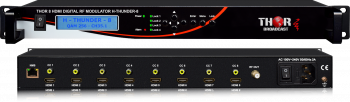
Example signal flow: HDMI sources enter a Thor modulator, the RF output feeds an RF optical transmitter, the fiber is split using PLC splitters, and multiple optical RF receivers convert the signal back to coax for TVs or local RF amplifiers.

HDMI Sources
Cameras, Set-Top Boxes,
Media Players, PCs
→
H-THUNDER-8 QAM / ATSC Modulator
Thor H-THUNDER HDMI to QAM ATSC RF Modulator
Creates RF channels from HDMI sources
→
RF over Fiber Transmitter
Thor RF over Fiber CATV transmitter
8mW / 16mW / 32mW options
→
F-PLC Optical Splitter
Thor PLC optical splitter
1x8 / 1x16 / 1x32 / 1x64
→
F-RF-RX-RM Receivers
Thor rack mount CATV RF optical receiver
Optical to coax RF conversion
→
TVs / Local RF Network
TVs, RF amps,
MATV / CATV branches

Step-by-Step RF over Fiber Design Method

1) Start with the RF source

In many systems, the RF source is a multi-channel modulator such as the H-THUNDER-8. It converts HDMI inputs into cable-ready or broadcast-ready RF channels. In other systems, the source may be an antenna feed, an existing cable TV lineup, a MATV system, or a legacy analog RF source.

2) Choose the correct RF transmitter power

The transmitter is selected mainly by split ratio, fiber length, connector count, and the amount of engineering margin you want to keep. Larger splits and longer distances require more optical power.

3) Calculate the optical budget

Estimated received optical power = TX output (dBm) − splitter loss (dB) − fiber loss (dB) − connector / patch loss (dB)

For planning purposes, engineers often estimate:

  • Single-mode fiber loss around 0.35 dB/km at 1310nm
  • Connector / patch / splice reserve around 0.5 dB to 2 dB total depending on the path
  • Typical PLC splitter planning loss around:
    • 1x8 ≈ 10.5 to 11 dB
    • 1x16 ≈ 13.5 to 14 dB
    • 1x32 ≈ 16.5 to 17.5 dB
    • 1x64 ≈ 19.5 to 21 dB

4) Keep safety margin

A practical design should not run right at the edge. Leave margin for patch panels, connector contamination, future changes, seasonal drift, and installation variation. A comfortable engineering margin is often 2 to 3 dB.

5) Match the receiver and final RF layout

At the far end, the optical receiver converts the light back into RF on coax. From there, the signal can go directly to TVs, into a local RF amplifier, or into a small in-building coax distribution network.

Thor Parts Used in This Example

  • H-THUNDER HDMI RF Modulators
  • RF over Fiber Transmitters
  • 8mW TX Example
  • F-PLC Splitters
  • F-RF-RX-RM Receiver
  • CATV RF over Fiber Category

Best Fit by Network Size

SmallPoint-to-point / 1x8
Medium1x16 / 1x32
Large1x32 / 1x64

Design Stories Using Thor Parts

Example A – 1x8 Hotel TV Distribution

A hotel wants to distribute eight in-house channels to several buildings. The headend uses an H-THUNDER-8 to create RF channels from HDMI sources. The RF output feeds an 8mW RF over Fiber transmitter, then a 1x8 F-PLC splitter, and finally one F-RF-RX-RM receiver per building or closet.

This design is attractive because one RF source can feed many endpoints while keeping the familiar coax RF format at the far end.

Example B – 1x32 Campus MATV Network

A university needs RF service across multiple dorms and common areas. A central modulator stack feeds a 16mW transmitter. The optical signal is split through 1x32 PLC splitting and received by rack optical receivers in each building. This avoids very long coax trunks and keeps RF levels consistent across campus.

Example C – 1x64 FTTH or Stadium RF Overlay

A large venue or residential development needs one-to-many RF distribution over a wide fiber footprint. Here, a 32mW transmitter is typically the better fit, especially when the optical path includes more distance, more connectors, and large split ratios such as 1x64.

Choose Your Transmitter

This quick estimator helps customers choose between 8mW, 16mW, and 32mW transmitters. It uses planning values, so it is best used for preliminary design.

Enter your values and click the button.

Internal Linking Strategy for SEO

To improve search ranking and keep users moving through the site, link this article to the main RF over Fiber product ecosystem.

Recommended anchor links inside the article

  • HDMI RF Modulators – for visitors starting from the signal source side
  • RF over Fiber Transmitters – for optical transport model selection
  • PLC Fiber Splitters – for split ratio design
  • CATV RF Fiber Receivers – for endpoint conversion
  • CATV RF 45–900 MHz category – for broader discovery

Recommended supporting article topics

  • How to transport QAM over fiber
  • How to distribute antenna RF over single-mode fiber
  • When to choose 8mW vs 16mW vs 32mW RF transmitter
  • How to size optical splitters for MATV and CATV systems
  • QAM vs ATSC for private TV distribution

Frequently Asked Questions

Can I use RF over Fiber for Analog TV and Digital QAM?

Yes. These systems are commonly used for analog NTSC / PAL, digital QAM / J.83B, ATSC 1.0, ATSC 3.0, and antenna RF feeds within the supported band.

When should I use 8mW vs 16mW vs 32mW?

As a rule of thumb, 8mW is often suitable for point-to-point and smaller 1x8 layouts, 16mW is often a better fit for larger splitter designs such as 1x16 or 1x32, and 32mW is usually preferred when building high-split or longer-distance networks such as 1x32 and 1x64.

Can one modulator feed many buildings?

Yes. A modulator can create the RF lineup, and the optical transmitter plus PLC splitter network can carry that lineup to many remote receivers.

Do I need special coax TVs at the far end?

No special fiber TV is needed. The optical receiver converts the signal back to standard RF on coax, so the remote side behaves like a normal RF distribution system.

What connector type should I use?

Thor’s transmitter page specifically notes the importance of using SC/APC to reduce reflections in these CATV RF optical links.


Justin White
Justin White
Broadcast Engineer
Broadcast engineer specializing in turnkey CATV and fiber-transport solutions. Experienced in designing and deploying complete encoding/decoding workflows to move virtually any signal over IP, fiber, and RF. Focused on ultra-low-latency headend architectures and custom mux/demux builds, supporting demanding environments across telecom, sports, education, hospitality, studios, live events, and mission-critical institutions worldwide.
View author page
Contact us

Thor Broadcast Sales

Email: [email protected]
Phone: 1(800)521-THOR (8467) Ext 1
FAX: 1(800)521-6384

Customer Service/ Support

Phone: 1-800 521-THOR(8467) Ext 2
Email: [email protected]

Case Studies

- Converting Clear QAM HDTV Channels to Analog RF NTSC for Multi-Site Distribution
- Stadium IPTV - Replay System
- Hotel HDMI-to-QAM TV Distribution
- University IPTV Lecture Systems

  • CATV Modulators:
    • HDMI RF Modulators
    • HD-SDI converters
    • IP to CATV Edge Modulators
  • DVB Encoders:
    • IPTV Video Encoders
    • Hdmi RTSP RTMP RTSP Encoders
    • Transcoders, MPEG Converters, IP ASI Gateways
  • Decoders (IRD's & STB's):
    • RF input - Video /Audio Ouput
    • IP Broadcast Decoders
    • RF CATV and IPTV OTT STB's
  • Satellite Modulators:
    • DVB-S/S2 Satellite Modulators
  • Fiber Optic Transport:
    • SDI Fiber Optic Extenders, Digital Audio Extenders
    • SDI SD/HD/3G with CWDM
    • Cable TV CATV RF 45-900Mhz
    • L-Band Satellite RF 45-3000Mhz
    • Data & Ethernet over fiber
    • Analog Audio Video
    • Fiber Amplifiers - EDFA
    • DVB - ASI
    • Fiber Jumpers, Cables, Attenuators,
    • Optic Splitters Couplers CWDM Muxes
    • Optical Meters, Test Equipment, Accesories
    • Analog Baseband Video Audio, RS485/422/232 Data, Contact Closure
  • HDMI SDI Switchers, LAN Extenders, and Wireless Video Transport:
    • HD Video Switchers and Signal Format Converters for AV Pros
    • Wireless HD SD Video Data Equipment
    • Video Audio Extenders Over Ethernet LAN IP Network
  • HD 4K Cameras, SDI - HDMI - IP Streaming - PTZ - Broadcast and Security:
    • PTZ Streaming Cameras Broadcast cameras with SDI ,HDMI CVBS USB
  • DIscounted Inventory:
    • Satellite and CATV Broadcast Equipment for Sale
    • Lab Used Broadcast Equipment on sale
    • Past Generation Equipment
  • SDI Monitors:
  • Warehouse:
Thor Broadcast Logo
Email: [email protected]
Phone: 1(800) 521-8467 Ext 1
FAX: 1(800)521-6384
Information:
  • About us
  • Client Portfolio
  • Become a Reseller
  • Contact
  • Articles
  • Return Policy
  • Shipping Policy
  • International Order Policy
Popular:
  • RF Modulator
  • HDMI over COAX
  • HDMI over IP
  • COAX to HDMI
  • HDMI to SDI

Thor Broadcast
Torrance Business Park
2421 W 205th St
Torrance
CA 90501

© 2026 Thor Broadcast
Subscribe to our newsletter

Sign up here to get the latest news, updates and special offers delivered directly to your inbox.

You can unsubscribe at any time
newsletter image