Learn how DOCSIS, CMTS, and RF over fiber deliver scalable internet and TV across marinas, campuses, and large properties.
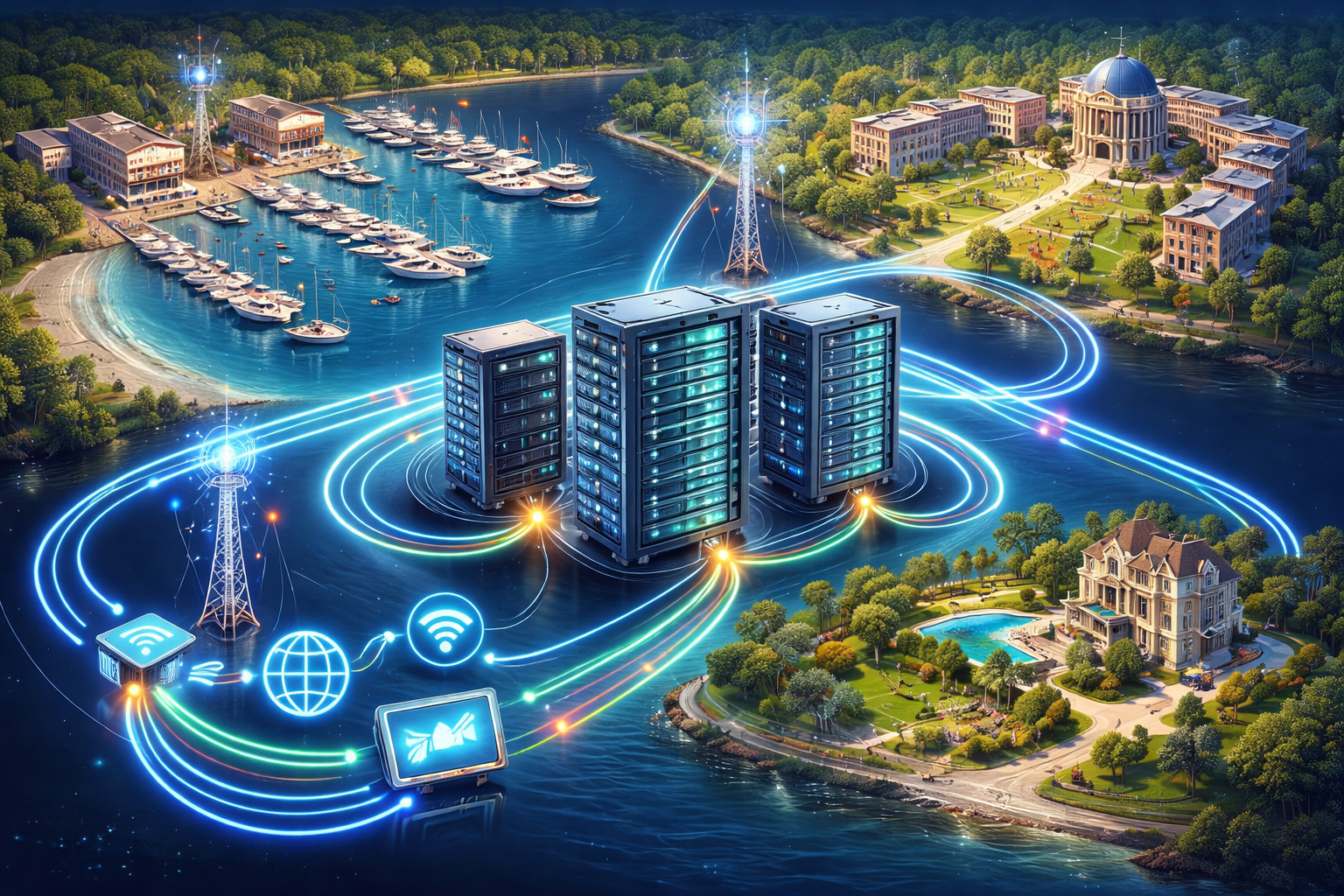
How to deliver scalable internet and TV to hundreds or thousands of users using Thor Broadcast RF over fiber systems
Modern marina, harbor, campus, and hospitality environments require reliable high-speed internet across large distances. Traditional coax-only networks become difficult to manage due to signal loss, noise, and amplification requirements.
The solution is to combine:
CMTS (Cable Modem Termination System) is the central controller of a cable modem network.
It performs:
The CMTS is essentially the “brain” of the system.
DOCSIS (Data Over Cable Service Interface Specification) defines how data is transmitted over RF cable systems.
It includes:
At first, it seems impossible for hundreds of modems to share one RF network.
The upstream channel is divided into microsecond time slots.
This is called Time Division Multiple Access (TDMA).
If 500 modems exist:
Each modem is calibrated for distance.
CMTS ensures all signals arrive at the correct time.
Modems send short RF bursts only during assigned windows.
Each node uses:
RF signals can be generated by:
The H-THUNDER-8 converts HDMI into RF channels (QAM/ATSC).
| Qty | Product | Link |
|---|---|---|
| 1 | F-RF-1310-TX-8mW | View |
| 1 | 1x8 Splitter | View |
| 8 | F-MININODE-2RP-HP | View |
| 2 | F-RF-RP4RX | View |
DOCSIS works because of timing and control.
RF over fiber works because it preserves that behavior while improving distance and quality.


 EN
EN