Build a reliable health club TV distribution system with HDMI to QAM/ATSC modulators, coax RF distribution, amplifiers, and meters.
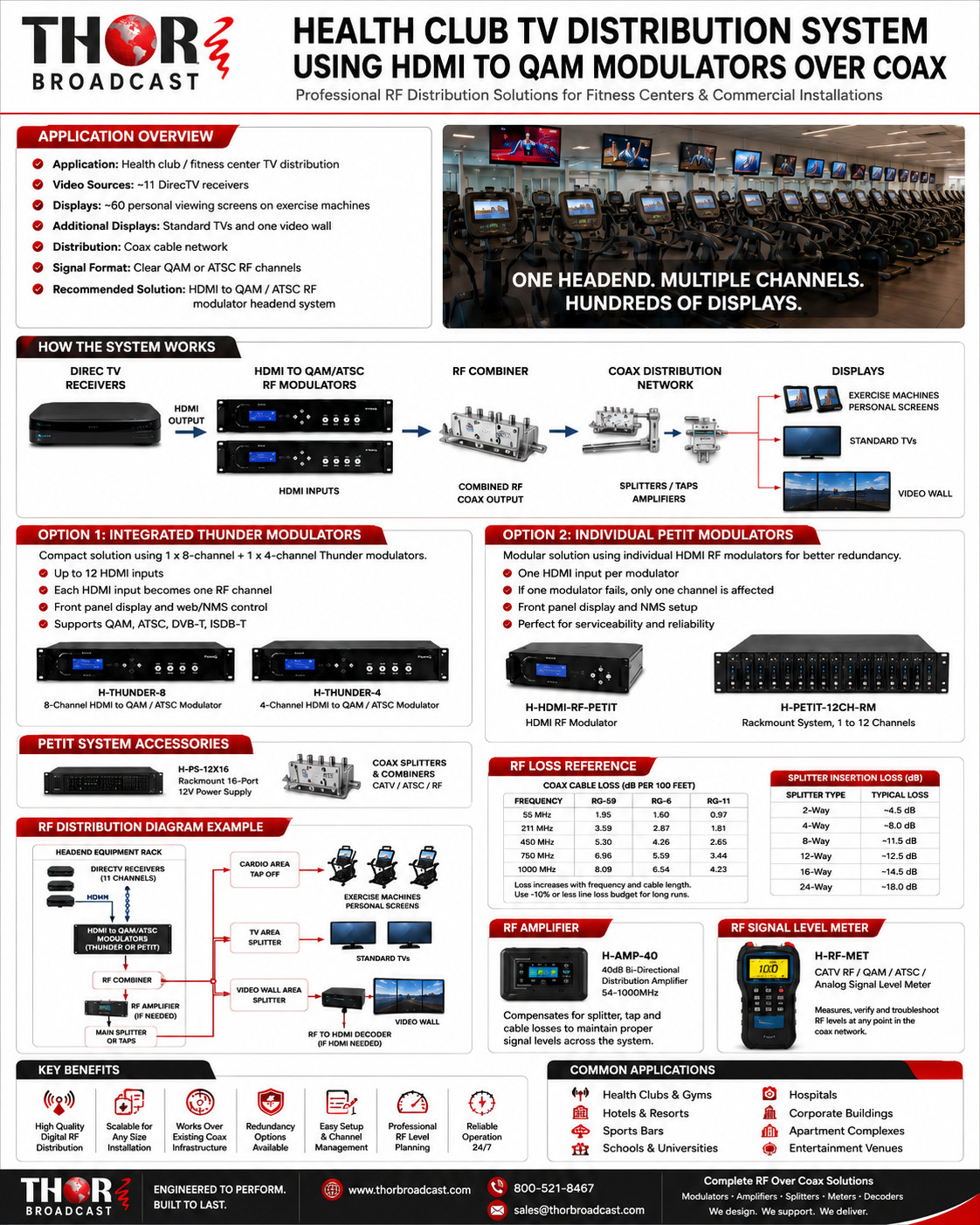
A professional RF distribution guide for gyms, fitness centers, hotels, schools, commercial buildings, and entertainment venues that need to distribute multiple HDMI sources to many TVs using coax cable.
Table of Contents
Health clubs, gyms, hotels, schools, commercial buildings, and entertainment venues often need to distribute multiple video channels to many TVs over one coax cable system. A common example is a fitness club with personal viewing screens on exercise machines, several wall-mounted TVs, and one video wall.
In this example, the customer needs to distribute approximately 11 DirecTV receiver channels to about 60 personal viewing screens, several standard TVs, and one video wall. The system is designed to replace older analog modulation with a higher-quality digital RF distribution system using HDMI to QAM or HDMI to ATSC modulators.
Each DirecTV receiver is assigned to one TV channel and outputs video through HDMI. The HDMI signal is connected to an HDMI RF modulator. The modulator converts the HDMI signal into a digital RF television channel such as Clear QAM or ATSC.
After modulation, all RF channels are combined onto one coax cable. The combined RF signal is then distributed through the building using splitters, taps, coax cable, and RF amplifiers if needed.
At each TV or exercise machine screen, the tuner scans the coax system and receives the channels like normal digital cable or off-air TV channels.
Commercial satellite and cable receivers may use HDCP or other content protection on HDMI outputs. The system design should always be verified with the receiver model, content provider agreement, and the display/distribution requirements. For commercial installations, the customer should confirm that the video sources are authorized for redistribution inside the facility.
The most compact solution is to use Thor Thunder multi-channel HDMI RF modulators. For an 11-channel system, a typical configuration would be:
This gives up to 12 HDMI inputs, which covers 11 DirecTV receivers and leaves one extra input for future expansion.
Each HDMI input becomes its own RF channel. The RF output from the two modulators can be combined into one coax feed and distributed through the building.
Multi-channel HDMI input modulator for creating digital RF channels over coax. Ideal for compact headend installations where multiple HDMI sources need to be distributed as QAM or ATSC channels.
View Thunder HDMI RF Modulator
For customers who prefer a modular headend with better redundancy, individual Thor Petit HDMI RF modulators are a strong option.
Each Petit modulator takes one HDMI source and creates one RF channel. If one modulator fails, only that one channel is affected. The rest of the channels continue working. This is often preferred in health clubs because the customer does not want the entire club video system to go down because of one device failure.
One HDMI input to one QAM / ATSC RF channel. Ideal for modular headends and channel-by-channel redundancy.
View Petit ModulatorRackmount system for multiple individual Petit modulators in a clean professional installation.
View Rackmount System19 inch rackmount 12V power supply for powering multiple compact RF modulator units.
View Power Supply
After the HDMI sources are converted to RF channels, the combined coax signal must be distributed to all TVs and exercise machine screens. This is where RF level planning becomes very important.
A health club with 60 personal screens can have a large amount of RF loss because the signal passes through splitters, taps, long coax cable runs, wall plates, connectors, and sometimes multiple distribution zones.
Thor coax splitters and combiners are used to split or combine CATV, ATSC, QAM, satellite, or RF signals over coax. These are simple plug-and-play devices with F-type connectors and can be used in many commercial RF distribution systems.
Available in multiple configurations for combining or splitting RF channels in coax distribution systems.
View RF Splitters / CombinersThor splitter / combiner models include 2-way, 4-way, 8-way, 12-way, 16-way, and 24-way versions. The 2, 4, and 8-way versions support wideband RF operation, while larger rackmount versions are commonly used for CATV, QAM, ATSC, and commercial coax distribution systems.
| Model | Type | Frequency Range | Typical Insertion Loss |
|---|---|---|---|
| H-SP-1x2 | 2-way splitter / combiner | 5 to 2100 MHz | 4.5 dB |
| H-SP-1x4 | 4-way splitter / combiner | 5 to 2100 MHz | 8 dB |
| H-SP-1x8 | 8-way splitter / combiner | 5 to 2100 MHz | 11.5 dB |
| H-SP-1x12-RM | 12-way rackmount splitter / combiner | 5 to 1000 MHz | 12.5 dB |
| H-SP-1x16 | 16-way splitter / combiner | 5 to 1000 MHz | 14.5 dB |
| H-SP-1x24-RM | 24-way rackmount splitter / combiner | 5 to 1000 MHz | 18 dB |
The exact RF level must be calculated based on the number of splitters, taps, cable length, cable type, and channel frequency. A system that looks simple on paper can lose a large amount of signal when it is split 40, 50, or 60 times across a health club.
Coax cable also creates RF loss. The longer the cable run, the more signal is lost. Higher frequencies also lose more signal than lower frequencies. This means a QAM or ATSC channel at a higher RF frequency may arrive weaker than a lower-frequency channel after a long coax run.
The most common coax cable types are RG-59, RG-6, and RG-11.
| Frequency | RG-59 Loss | RG-6 Loss | RG-11 Loss |
|---|---|---|---|
| 55 MHz | About 1.95 dB / 100 ft | About 1.60 dB / 100 ft | About 0.97 dB / 100 ft |
| 211 MHz | About 3.59 dB / 100 ft | About 2.87 dB / 100 ft | About 1.81 dB / 100 ft |
| 450 MHz | About 5.30 dB / 100 ft | About 4.26 dB / 100 ft | About 2.65 dB / 100 ft |
| 750 MHz | About 6.96 dB / 100 ft | About 5.59 dB / 100 ft | About 3.44 dB / 100 ft |
| 1000 MHz | About 8.09 dB / 100 ft | About 6.54 dB / 100 ft | About 4.23 dB / 100 ft |
Below is a simplified example of how RF loss can add up in a fitness center installation.
| System Part | Example Loss |
|---|---|
| Modulator RF output | Strong RF output from headend |
| 2-way split to two zones | About 4.5 dB loss |
| 8-way splitter feeding machine rows | About 11.5 dB loss |
| 100 ft RG-6 cable at higher frequency | About 5 to 6.5 dB loss |
| Connectors, wall plates, and patch cables | Additional small losses |
| Total possible loss | Often 20 dB or more depending on layout |
If the total loss is too high, the TVs or personal viewing screens may show weak signal, pixelation, missing channels, or poor scan results. In this case, an RF amplifier should be added at the correct point in the system.
An RF amplifier is used to restore signal level after distribution losses. It should not be used blindly. Too much RF level can also cause problems, including tuner overload, distortion, and poor digital performance.
Used to boost RF level in large coax distribution systems after splitter, tap, and cable losses.
View 40dB RF AmplifierThe amplifier should be selected and adjusted based on the actual RF loss in the system. The goal is to keep the signal strong enough at every TV without overdriving the closest TVs.
For this type of project, an RF signal level meter is highly recommended. It allows the installer to measure the RF signal at the headend, after the amplifier, after splitters, at taps, and directly at the TVs or exercise machine screens.
A handy field meter for checking RF signal levels in QAM, ATSC, CATV, NTSC, and PAL coax distribution systems.
View RF Signal Level Meter| Tool / Product | Purpose | Link |
|---|---|---|
| HDMI to QAM / ATSC Modulator | Converts HDMI sources into RF TV channels | Thunder HDMI RF Modulator |
| Petit HDMI RF Modulator | One-channel modular HDMI to RF conversion | Petit HDMI RF Modulator |
| RF Splitters / Combiners | Split or combine RF signals over coax | Thor RF Splitters / Combiners |
| RF Amplifier | Boosts RF level after cable and splitter losses | Thor 40dB RF Amplifier |
| RF Signal Level Meter | Measures RF signal levels during installation | Thor H-RF-MET Signal Level Meter |
| QAM / ATSC to HDMI Decoder | Converts RF channel back to HDMI for video wall or monitor | Thor QAM / ATSC RF to HDMI Decoder |
If the video wall processor needs HDMI input instead of RF coax input, a QAM / ATSC RF to HDMI decoder can be used. The decoder receives one selected RF channel from the coax system and converts it back to HDMI.
This is useful when the same distributed RF channels need to be sent to a video wall controller, monitor, projector, or display system that does not have a QAM tuner.
Converts a selected Clear QAM or ATSC RF channel back to HDMI for video wall systems, monitors, projectors, or display processors.
View RF to HDMI DecoderTo correctly design the RF distribution system, the following information is helpful:
A health club TV distribution system must be designed as a complete RF network, not only as a modulator system. The HDMI to QAM / ATSC modulators create the TV channels, but the splitters, taps, coax cable, amplifier, and RF signal meter determine how reliable the final system will be.
For compact installations, the Thor Thunder multi-channel HDMI RF modulator system is usually the cleanest solution. For installations where redundancy is the highest priority, individual Thor Petit HDMI RF modulators are a strong choice.
Thor can provide the complete system, including modulators, splitters, combiners, RF amplifiers, rack power supplies, RF meters, and QAM / ATSC to HDMI decoders for video wall integration.

 EN
EN