Thor Broadcast Logo
Log in
Cart (0)
  • es ES
  • Products
    • CATV Modulators
      • HDMI RF Modulators
      • HD-SDI converters
      • IP to CATV Edge Modulators
    • DVB Encoders
      • IPTV Video Encoders
      • Hdmi RTSP RTMP RTSP Encoders
      • Transcoders, MPEG Converters, IP ASI Gateways
    • Decoders (IRD's & STB's)
      • RF input - Video /Audio Ouput
      • IP Broadcast Decoders
      • RF CATV and IPTV OTT STB's
    • Satellite Modulators
      • DVB-S/S2 Satellite Modulators
    • Fiber Optic Transport
      • SDI Fiber Optic Extenders, Digital Audio Extenders
      • SDI SD/HD/3G with CWDM
      • Cable TV CATV RF 45-900Mhz
      • L-Band Satellite RF 45-3000Mhz
      • Data & Ethernet over fiber
    • HDMI SDI Switchers, LAN Extenders, and Wireless Video Transport
      • HD Video Switchers and Signal Format Converters for AV Pros
      • Wireless HD SD Video Data Equipment
      • Video Audio Extenders Over Ethernet LAN IP Network
    • DIscounted Inventory
      • Satellite and CATV Broadcast Equipment for Sale
      • Lab Used Broadcast Equipment on sale
      • Past Generation Equipment
    • SDI Monitors
    • Warehouse
  • About
  • Client Portfolio
  • Support
      • Support Center Support Center
      • User Manuals User
        Manuals
      • Request an RMA Request an
        RMA
  • ⬇Download
    • Manuals
    • Datasheets
    • Quick Guides
  • Case Studies
    • THOR Gym
    • THOR Stadium
    • THOR Hotel
    • THOR University
  • Videos
  • Contact
  • Become a Reseller

Health Club TV Distribution System Using HDMI to QAM Modulators Over Coax

Build a reliable health club TV distribution system with HDMI to QAM/ATSC modulators, coax RF distribution, amplifiers, and meters.
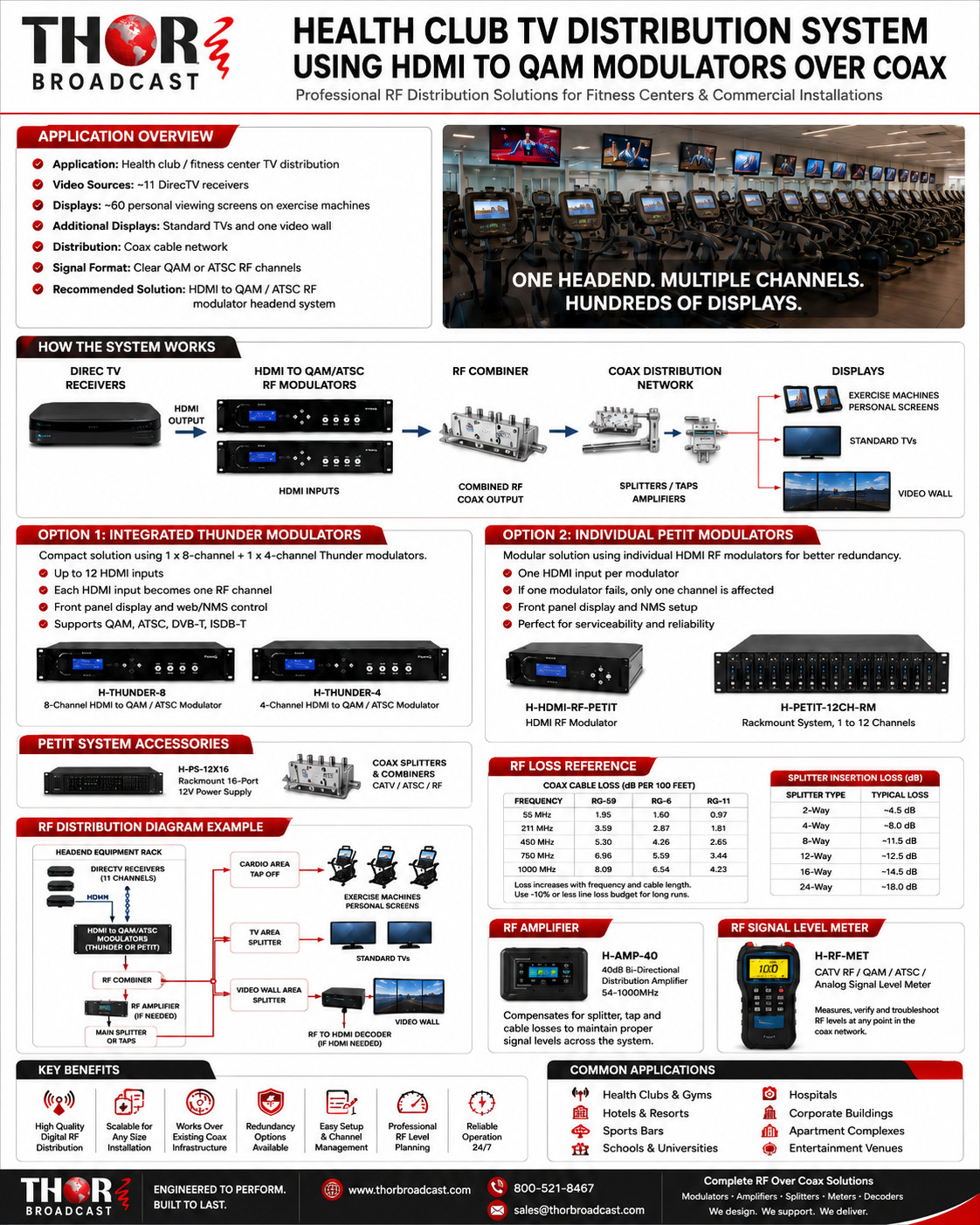
Health Club TV Distribution System Using HDMI to QAM Modulators Over Coax

A professional RF distribution guide for gyms, fitness centers, hotels, schools, commercial buildings, and entertainment venues that need to distribute multiple HDMI sources to many TVs using coax cable.

Table of Contents

  • Application Summary
  • How the System Works
  • Option 1: Integrated Thunder HDMI to QAM / ATSC Modulators
  • Option 2: Individual Petit HDMI RF Modulators for Redundancy
  • RF Distribution After the Modulators
  • RF Splitters, Combiners, and CATV RF Mixers
  • Coax Cable Loss in RF Distribution Systems
  • RF Budget Example for a Health Club
  • Using an RF Amplifier
  • RF Signal Meter: Very Useful for Installation and Troubleshooting
  • Recommended Tools for Proper RF Setup
  • Video Wall Integration
  • Suggested Health Club System Design
  • Information Needed for Final RF Design
  • Common Problems This System Solves
  • Conclusion

Health clubs, gyms, hotels, schools, commercial buildings, and entertainment venues often need to distribute multiple video channels to many TVs over one coax cable system. A common example is a fitness club with personal viewing screens on exercise machines, several wall-mounted TVs, and one video wall.

In this example, the customer needs to distribute approximately 11 DirecTV receiver channels to about 60 personal viewing screens, several standard TVs, and one video wall. The system is designed to replace older analog modulation with a higher-quality digital RF distribution system using HDMI to QAM or HDMI to ATSC modulators.

Application Summary

  • Application: Health club / fitness center TV distribution
  • Video sources: Approximately 11 DirecTV receivers
  • Displays: Around 60 personal viewing screens on exercise machines
  • Additional displays: Standard TVs and one video wall
  • Distribution cable: Coax cable network
  • Signal format: Clear QAM or ATSC RF channels
  • Recommended products: HDMI to QAM / ATSC RF modulators, RF splitters, taps, amplifiers, and RF signal meter

How the System Works

Each DirecTV receiver is assigned to one TV channel and outputs video through HDMI. The HDMI signal is connected to an HDMI RF modulator. The modulator converts the HDMI signal into a digital RF television channel such as Clear QAM or ATSC.

After modulation, all RF channels are combined onto one coax cable. The combined RF signal is then distributed through the building using splitters, taps, coax cable, and RF amplifiers if needed.

At each TV or exercise machine screen, the tuner scans the coax system and receives the channels like normal digital cable or off-air TV channels.

Basic Signal Flow:
DirecTV Receiver HDMI Output → HDMI to QAM / ATSC Modulator → RF Combiner → RF Amplifier if required → Coax Splitters / Taps → TVs, Exercise Machine Screens, or RF to HDMI Decoder

Important Note About Source Compatibility

Commercial satellite and cable receivers may use HDCP or other content protection on HDMI outputs. The system design should always be verified with the receiver model, content provider agreement, and the display/distribution requirements. For commercial installations, the customer should confirm that the video sources are authorized for redistribution inside the facility.

Option 1: Integrated Thunder HDMI to QAM / ATSC Modulators

The most compact solution is to use Thor Thunder multi-channel HDMI RF modulators. For an 11-channel system, a typical configuration would be:

  • 1 x 8-channel Thunder HDMI to QAM / ATSC modulator
  • 1 x 4-channel Thunder HDMI to QAM / ATSC modulator

This gives up to 12 HDMI inputs, which covers 11 DirecTV receivers and leaves one extra input for future expansion.

Each HDMI input becomes its own RF channel. The RF output from the two modulators can be combined into one coax feed and distributed through the building.

Thor Thunder HDMI to QAM / ATSC RF Modulator

Multi-channel HDMI input modulator for creating digital RF channels over coax. Ideal for compact headend installations where multiple HDMI sources need to be distributed as QAM or ATSC channels.

View Thunder HDMI RF Modulator

Thunder HDMI to QAM / ATSC RF Modulator

Advantages of the Thunder System

  • Compact headend design
  • Fewer individual boxes
  • Less wiring and cleaner rack installation
  • Front-panel display and control
  • Web / NMS setup interface
  • Supports QAM and ATSC RF output
  • Good for fast installation and easy channel management

Option 2: Individual Petit HDMI RF Modulators for Redundancy

For customers who prefer a modular headend with better redundancy, individual Thor Petit HDMI RF modulators are a strong option.

Each Petit modulator takes one HDMI source and creates one RF channel. If one modulator fails, only that one channel is affected. The rest of the channels continue working. This is often preferred in health clubs because the customer does not want the entire club video system to go down because of one device failure.

Single Petit HDMI RF Modulator

One HDMI input to one QAM / ATSC RF channel. Ideal for modular headends and channel-by-channel redundancy.

View Petit Modulator

1 to 12 Channel Petit Rackmount System

Rackmount system for multiple individual Petit modulators in a clean professional installation.

View Rackmount System

16-Port Rackmount Power Supply

19 inch rackmount 12V power supply for powering multiple compact RF modulator units.

View Power Supply

Petit HDMI RF MODULATOR

Advantages of the Petit Modular System

  • One HDMI input per modulator
  • One RF channel per modulator
  • Better serviceability
  • Better redundancy
  • If one channel fails, the rest of the system keeps working
  • Very similar to traditional analog modulator rack systems
  • Good for installers who prefer modular headend equipment

RF Distribution After the Modulators

After the HDMI sources are converted to RF channels, the combined coax signal must be distributed to all TVs and exercise machine screens. This is where RF level planning becomes very important.

A health club with 60 personal screens can have a large amount of RF loss because the signal passes through splitters, taps, long coax cable runs, wall plates, connectors, and sometimes multiple distribution zones.

Common Distribution Methods

  • Central headend: All receivers and modulators are installed in one equipment rack.
  • Home-run coax: Separate coax lines run from the headend or distribution point to each TV area.
  • Main trunk with taps: A main coax line runs through the cardio area, and taps feed each exercise machine.
  • Split zones: One zone feeds cardio machines, another zone feeds TVs, and another zone feeds the video wall.
  • Amplified distribution: An RF amplifier is used when splitter, tap, and coax losses are too high.

RF Splitters, Combiners, and CATV RF Mixers

Thor coax splitters and combiners are used to split or combine CATV, ATSC, QAM, satellite, or RF signals over coax. These are simple plug-and-play devices with F-type connectors and can be used in many commercial RF distribution systems.

Thor Coax Multiplexers, Splitters, Combiners, F-Type CATV / ATSC / RF

Available in multiple configurations for combining or splitting RF channels in coax distribution systems.

View RF Splitters / Combiners

Thor splitter / combiner models include 2-way, 4-way, 8-way, 12-way, 16-way, and 24-way versions. The 2, 4, and 8-way versions support wideband RF operation, while larger rackmount versions are commonly used for CATV, QAM, ATSC, and commercial coax distribution systems.

Typical Thor Splitter Insertion Loss

Model Type Frequency Range Typical Insertion Loss
H-SP-1x2 2-way splitter / combiner 5 to 2100 MHz 4.5 dB
H-SP-1x4 4-way splitter / combiner 5 to 2100 MHz 8 dB
H-SP-1x8 8-way splitter / combiner 5 to 2100 MHz 11.5 dB
H-SP-1x12-RM 12-way rackmount splitter / combiner 5 to 1000 MHz 12.5 dB
H-SP-1x16 16-way splitter / combiner 5 to 1000 MHz 14.5 dB
H-SP-1x24-RM 24-way rackmount splitter / combiner 5 to 1000 MHz 18 dB

The exact RF level must be calculated based on the number of splitters, taps, cable length, cable type, and channel frequency. A system that looks simple on paper can lose a large amount of signal when it is split 40, 50, or 60 times across a health club.

Coax Cable Loss in RF Distribution Systems

Coax cable also creates RF loss. The longer the cable run, the more signal is lost. Higher frequencies also lose more signal than lower frequencies. This means a QAM or ATSC channel at a higher RF frequency may arrive weaker than a lower-frequency channel after a long coax run.

The most common coax cable types are RG-59, RG-6, and RG-11.

  • RG-59: Higher loss, usually not preferred for long commercial RF runs.
  • RG-6: Common for standard TV and CATV distribution.
  • RG-11: Lower loss, better for long trunk runs and larger buildings.

Example Coax Loss Per 100 Feet

Frequency RG-59 Loss RG-6 Loss RG-11 Loss
55 MHz About 1.95 dB / 100 ft About 1.60 dB / 100 ft About 0.97 dB / 100 ft
211 MHz About 3.59 dB / 100 ft About 2.87 dB / 100 ft About 1.81 dB / 100 ft
450 MHz About 5.30 dB / 100 ft About 4.26 dB / 100 ft About 2.65 dB / 100 ft
750 MHz About 6.96 dB / 100 ft About 5.59 dB / 100 ft About 3.44 dB / 100 ft
1000 MHz About 8.09 dB / 100 ft About 6.54 dB / 100 ft About 4.23 dB / 100 ft
Important installation note:
A 200-foot RG-6 run at a high RF frequency can lose more than 10 dB before the signal even reaches the TV, and that is before adding splitter or tap loss.

RF Budget Example for a Health Club

Below is a simplified example of how RF loss can add up in a fitness center installation.

System Part Example Loss
Modulator RF output Strong RF output from headend
2-way split to two zones About 4.5 dB loss
8-way splitter feeding machine rows About 11.5 dB loss
100 ft RG-6 cable at higher frequency About 5 to 6.5 dB loss
Connectors, wall plates, and patch cables Additional small losses
Total possible loss Often 20 dB or more depending on layout

If the total loss is too high, the TVs or personal viewing screens may show weak signal, pixelation, missing channels, or poor scan results. In this case, an RF amplifier should be added at the correct point in the system.

Using an RF Amplifier

An RF amplifier is used to restore signal level after distribution losses. It should not be used blindly. Too much RF level can also cause problems, including tuner overload, distortion, and poor digital performance.

Thor 40dB CATV RF Distribution Amplifier

Used to boost RF level in large coax distribution systems after splitter, tap, and cable losses.

View 40dB RF Amplifier

The amplifier should be selected and adjusted based on the actual RF loss in the system. The goal is to keep the signal strong enough at every TV without overdriving the closest TVs.

RF Signal Meter: Very Useful for Installation and Troubleshooting

For this type of project, an RF signal level meter is highly recommended. It allows the installer to measure the RF signal at the headend, after the amplifier, after splitters, at taps, and directly at the TVs or exercise machine screens.

Thor H-RF-MET CATV RF QAM / ATSC / Analog Signal Level Meter

A handy field meter for checking RF signal levels in QAM, ATSC, CATV, NTSC, and PAL coax distribution systems.

View RF Signal Level Meter

Why the RF Meter Is Helpful

  • Confirms RF level at the modulator output
  • Checks RF level after splitters and combiners
  • Measures signal at the end of long coax runs
  • Helps identify bad cables, bad connectors, or excessive splitter loss
  • Helps adjust RF amplifiers correctly
  • Prevents over-amplification and weak signal problems
  • Useful during installation, service calls, and future troubleshooting

Recommended Tools for Proper RF Setup

Tool / Product Purpose Link
HDMI to QAM / ATSC Modulator Converts HDMI sources into RF TV channels Thunder HDMI RF Modulator
Petit HDMI RF Modulator One-channel modular HDMI to RF conversion Petit HDMI RF Modulator
RF Splitters / Combiners Split or combine RF signals over coax Thor RF Splitters / Combiners
RF Amplifier Boosts RF level after cable and splitter losses Thor 40dB RF Amplifier
RF Signal Level Meter Measures RF signal levels during installation Thor H-RF-MET Signal Level Meter
QAM / ATSC to HDMI Decoder Converts RF channel back to HDMI for video wall or monitor Thor QAM / ATSC RF to HDMI Decoder

Video Wall Integration

If the video wall processor needs HDMI input instead of RF coax input, a QAM / ATSC RF to HDMI decoder can be used. The decoder receives one selected RF channel from the coax system and converts it back to HDMI.

This is useful when the same distributed RF channels need to be sent to a video wall controller, monitor, projector, or display system that does not have a QAM tuner.

Thor QAM / ATSC RF to HDMI Decoder

Converts a selected Clear QAM or ATSC RF channel back to HDMI for video wall systems, monitors, projectors, or display processors.

View RF to HDMI Decoder

Suggested Health Club System Design

Compact Thunder-Based Design

  • 11 x DirecTV receivers
  • 1 x 8-channel Thunder HDMI to QAM / ATSC modulator
  • 1 x 4-channel Thunder HDMI to QAM / ATSC modulator
  • RF combiner or loop-through RF combining
  • RF amplifier if required by system loss
  • RF splitters and taps for machine rows and TVs
  • RF meter for setup and troubleshooting
  • Optional RF to HDMI decoder for video wall feed

Redundant Petit-Based Design

  • 11 x DirecTV receivers
  • 11 x Petit HDMI RF modulators
  • 1 x rackmount 16-port 12V power supply
  • RF combiner / splitter system
  • RF amplifier if needed
  • RF taps and splitters for exercise machines and TVs
  • RF meter for balancing the system
  • Optional RF to HDMI decoder for video wall feed

Information Needed for Final RF Design

To correctly design the RF distribution system, the following information is helpful:

  • Number of source receivers
  • Number of RF channels required
  • Number of personal viewing screens
  • Number of standard TVs
  • Video wall input requirement, RF or HDMI
  • Coax cable type: RG-59, RG-6, or RG-11
  • Approximate cable run lengths
  • Number and type of splitters
  • Number and value of taps
  • Whether the TVs support Clear QAM or ATSC
  • Preferred channel lineup
  • Whether the customer prefers compact design or redundancy

Common Problems This System Solves

  • Replacing old analog modulators with digital RF channels
  • Distributing satellite or media player channels to many TVs
  • Reducing the number of receivers needed at display locations
  • Using existing coax instead of pulling new HDMI cables
  • Feeding many exercise machine screens from one headend
  • Combining multiple channels into one coax distribution system
  • Providing a video wall feed from the same channel lineup
  • Balancing RF signal levels across a large building

Conclusion

A health club TV distribution system must be designed as a complete RF network, not only as a modulator system. The HDMI to QAM / ATSC modulators create the TV channels, but the splitters, taps, coax cable, amplifier, and RF signal meter determine how reliable the final system will be.

For compact installations, the Thor Thunder multi-channel HDMI RF modulator system is usually the cleanest solution. For installations where redundancy is the highest priority, individual Thor Petit HDMI RF modulators are a strong choice.

Thor can provide the complete system, including modulators, splitters, combiners, RF amplifiers, rack power supplies, RF meters, and QAM / ATSC to HDMI decoders for video wall integration.

Justin White
Justin White
Broadcast Engineer
Broadcast engineer specializing in turnkey CATV and fiber-transport solutions. Experienced in designing and deploying complete encoding/decoding workflows to move virtually any signal over IP, fiber, and RF. Focused on ultra-low-latency headend architectures and custom mux/demux builds, supporting demanding environments across telecom, sports, education, hospitality, studios, live events, and mission-critical institutions worldwide.
View author page
Contact us

Thor Broadcast Sales

Email: [email protected]
Phone: 1(800)521-THOR (8467) Ext 1
FAX: 1(800)521-6384

Customer Service/ Support

Phone: 1-800 521-THOR(8467) Ext 2
Email: [email protected]

Case Studies

- Converting Clear QAM HDTV Channels to Analog RF NTSC for Multi-Site Distribution
- Stadium IPTV - Replay System
- Hotel HDMI-to-QAM TV Distribution
- University IPTV Lecture Systems

  • CATV Modulators:
    • HDMI RF Modulators
    • HD-SDI converters
    • IP to CATV Edge Modulators
  • DVB Encoders:
    • IPTV Video Encoders
    • Hdmi RTSP RTMP RTSP Encoders
    • Transcoders, MPEG Converters, IP ASI Gateways
  • Decoders (IRD's & STB's):
    • RF input - Video /Audio Ouput
    • IP Broadcast Decoders
    • RF CATV and IPTV OTT STB's
  • Satellite Modulators:
    • DVB-S/S2 Satellite Modulators
  • Fiber Optic Transport:
    • SDI Fiber Optic Extenders, Digital Audio Extenders
    • SDI SD/HD/3G with CWDM
    • Cable TV CATV RF 45-900Mhz
    • L-Band Satellite RF 45-3000Mhz
    • Data & Ethernet over fiber
    • Analog Audio Video
    • Fiber Amplifiers - EDFA
    • DVB - ASI
    • Fiber Jumpers, Cables, Attenuators,
    • Optic Splitters Couplers CWDM Muxes
    • Optical Meters, Test Equipment, Accesories
    • Analog Baseband Video Audio, RS485/422/232 Data, Contact Closure
  • HDMI SDI Switchers, LAN Extenders, and Wireless Video Transport:
    • HD Video Switchers and Signal Format Converters for AV Pros
    • Wireless HD SD Video Data Equipment
    • Video Audio Extenders Over Ethernet LAN IP Network
  • HD 4K Cameras, SDI - HDMI - IP Streaming - PTZ - Broadcast and Security:
    • PTZ Streaming Cameras Broadcast cameras with SDI ,HDMI CVBS USB
  • DIscounted Inventory:
    • Satellite and CATV Broadcast Equipment for Sale
    • Lab Used Broadcast Equipment on sale
    • Past Generation Equipment
  • SDI Monitors:
  • Warehouse:
Thor Broadcast Logo
Email: [email protected]
Phone: 1(800) 521-8467 Ext 1
FAX: 1(800)521-6384
Information:
  • About us
  • Client Portfolio
  • Become a Reseller
  • Contact
  • Articles
  • Return Policy
  • Shipping Policy
  • International Order Policy
Popular:
  • RF Modulator
  • HDMI over COAX
  • HDMI over IP
  • COAX to HDMI
  • HDMI to SDI

Thor Broadcast
Torrance Business Park
2421 W 205th St
Torrance
CA 90501

© 2026 Thor Broadcast
Subscribe to our newsletter

Sign up here to get the latest news, updates and special offers delivered directly to your inbox.

You can unsubscribe at any time
newsletter image