Thor Broadcast Logo
Iniciar sesión
Carro (0)
  • en EN
  • Productos
    • CATV Moduladores
      • HDMI los Moduladores de RF
      • HD-SDI convertidores
      • IP para CATV Moduladores Borde
    • DVB Codificadores
      • Los Codificadores De Vídeo
      • Hdmi RTSP RTMP, RTSP Codificadores
      • Transcodificadores, MPEG Convertidores, IP ASI puertas de enlace
    • Decodificadores (IRD y STB)
      • RF Decodificadores del IRD
      • Difusión IP Decodificadores
      • RF CATV de IPTV y OTT STB del
    • Satélite Moduladores
      • DVB-S/S2 Satélite Moduladores
    • De Fibra Óptica De Transporte
      • SDI a lo largo de la Fibra
      • SDI SD/HD/3G con CWDM
      • TV por Cable CATV RF 45-900Mhz
      • L del Satélite en la Banda de RF 45-3000Mhz
      • Datos y Ethernet en fibra
    • Wireless HD SD de Vídeo de Transporte de Datos
      • Wireless HD de Vídeo SD con los Datos de los Equipos
    • Descuento De Inventario
      • Nuevos Equipos De Transmisión En Venta
      • Laboratorio de Equipos de transmisión Utilizados en venta
      • Última Generación De Equipos De
  • About
  • Cartera De Clientes
  • Apoyo
      • Support Center Apoyo
      • User Manuals Manuales
        de Usuario
      • Request an RMA Solicitar una
        RMA
  • ⬇Download
    • Manuals
    • Datasheets
    • Quick Guides
  • Case Studies
    • THOR Gym
    • THOR Stadium
    • THOR Hotel
    • THOR University
  • Videos
  • Contacto
  • Conviértete en un revendedor

Understanding RF levels in digital QAM / ATSC systems versus analog NTSC / PAL systems

High-power mini nodes in CATV systems do not always require attenuators. Learn how digital QAM and ATSC RF levels differ from analog NTSC and PAL, and why proper tap selection often keeps TV signal levels within an acceptable range without extra attenuati
Understanding RF levels in digital QAM / ATSC systems versus analog NTSC / PAL systems

Table of Contents

  • Featured Product
  • Typical System Topology
  • Why High-Power Mini Nodes Are Used
  • Digital QAM / ATSC Levels Are Different from Analog NTSC / PAL
  • Typical Digital TV RF Acceptance Range
  • When Attenuators May Still Be Required
  • Use an RF Meter to Verify the Real Signal Level
  • RF Over Fiber Product Family
  • Conclusion

When designing a CATV distribution system with high-power mini nodes, many engineers assume that short coax runs automatically require additional attenuators. In practice, that is often not the case.

A common reason for confusion is that digital RF systems such as QAM and ATSC do not behave exactly the same way as analog RF systems such as NTSC or PAL. Signal level targets that may have been considered ideal in older analog systems are often unnecessarily strict for modern digital TV distribution.

Featured Product: F-MININODE-2RP-HP

Optical CATV Mini Node with Return Path

The F-MININODE-2RP-HP is designed for CATV RF over fiber systems and provides a strong RF output suitable for structured coaxial distribution networks using taps, splitters, and cascaded drops.

Product Link:
https://thorbroadcast.com/product/optical-mini-node-catv-rf-receiver-with-return-path-8230.html

View Product

Typical System Topology

Headend / RF Modulators ↓ RF Over Fiber Transmitter ↓ Optical Fiber ↓ F-MININODE-2RP-HP ↓ RF Multitap ↓ TV Receivers

This architecture is common in hotels, hospitals, apartment buildings, campuses, offshore vessels, and other facilities where television signals must be distributed efficiently over coax.

Why High-Power Mini Nodes Are Used

High-power mini nodes are not designed only for long cable runs. They are also designed to support:

  • RF taps with large drop loss values
  • Multiple cascaded drops
  • Distribution networks with amplifiers and splitters
  • Large buildings or structured CATV layouts
Example:
If a mini node outputs approximately +45 dBmV and the TV is fed through a 26 dB RF tap, the signal at the TV drop is approximately:

+45 dBmV − 26 dB = about +19 dBmV

That level is usually perfectly acceptable for digital television reception.

Digital QAM / ATSC Levels Are Different from Analog NTSC / PAL

This is one of the most important points in CATV system design.

Analog NTSC / PAL

Analog RF systems are much more visually sensitive to level variations, noise, ghosting, and distortion. In analog systems, installers often targeted narrower “ideal” ranges because picture quality would visibly degrade if levels drifted too high or too low.

Digital QAM / ATSC

Digital television receivers generally tolerate a wider usable RF range. As long as the signal is inside the tuner’s acceptable window and the MER / BER is good, the TV will usually decode the channel without visible issues.

Important Design Note:
A signal level target that may have been considered ideal for analog NTSC or PAL is often too conservative for digital QAM or ATSC. This is why designers sometimes assume they need attenuators when they actually do not.

Typical Digital TV RF Acceptance Range

While exact tuner performance varies by manufacturer, digital televisions and set-top boxes usually operate reliably over a relatively broad RF input range.

System Type General Behavior Design Impact
Analog NTSC / PAL More visually sensitive to level variation, ingress, and distortion Often requires tighter level targets
Digital QAM / ATSC More tolerant as long as RF level and digital quality remain within tuner limits Usually does not require extra attenuation if taps are sized properly

In many real-world digital systems, a level around +19 dBmV at the TV is completely acceptable. That is why a 26 dB tap on the output of a high-power mini node often eliminates the need for separate attenuators.

When Attenuators May Still Be Required

Additional attenuators may be needed in cases such as:

  • Direct connection from the mini node to a TV without a tap
  • Very short coax runs with almost no passive loss
  • Overdriven amplifier stages
  • Measured RF levels that are clearly above the safe tuner range
  • Improperly balanced legacy analog infrastructure

But in a properly structured system using multitaps, attenuators are often unnecessary.

Use an RF Meter to Verify the Real Signal Level

The best way to confirm whether attenuators are actually needed is to measure the RF signal level at the television location rather than rely only on conservative theoretical calculations.

A professional RF meter allows you to verify:

  • Analog RF signal levels
  • Digital QAM signal levels
  • ATSC channel levels
  • System balance at taps, drops, and amplifier locations

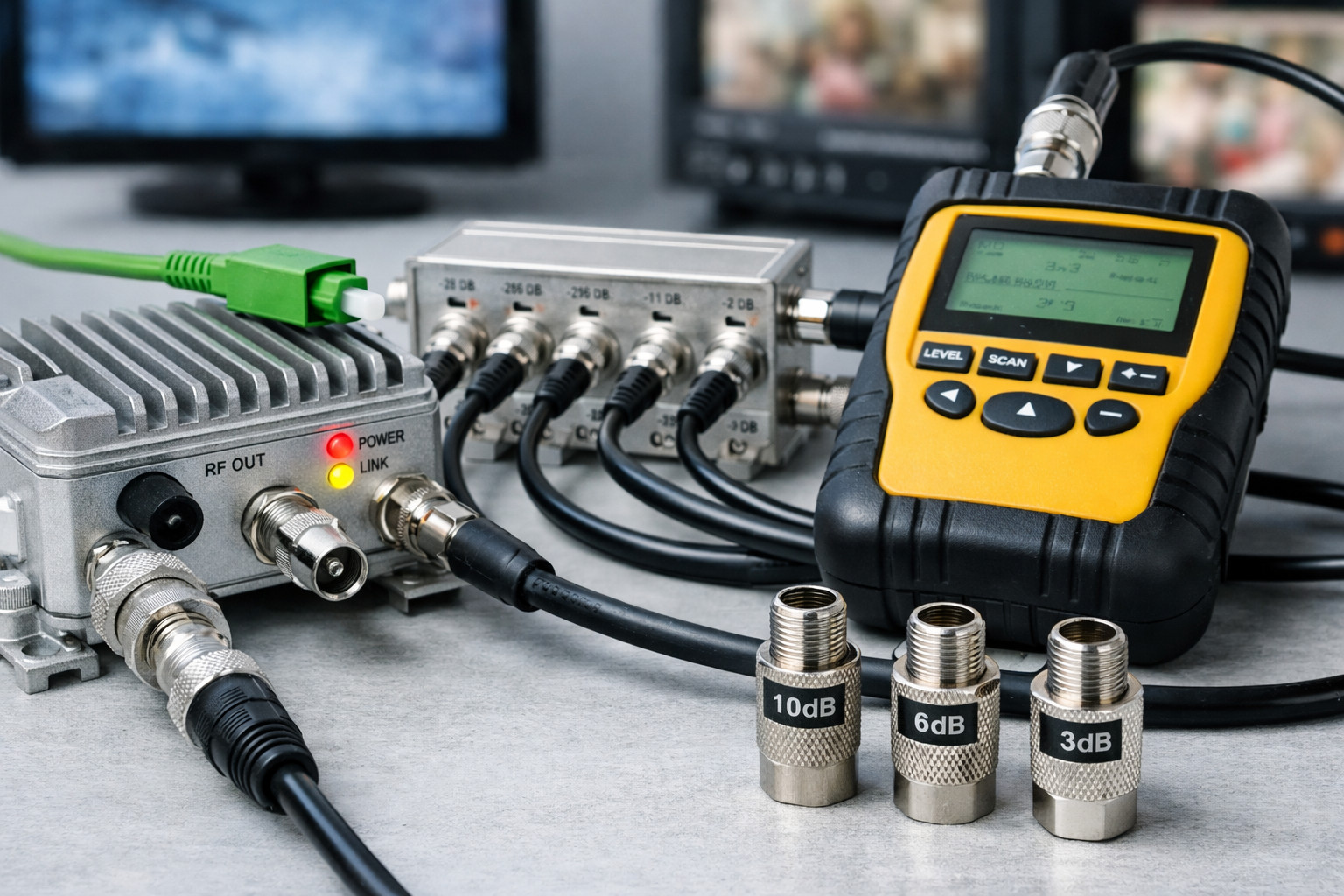
Recommended Tool: CATV RF QAM / ATSC / Analog NTSC / PAL Signal Level Meter

For field verification and final balancing, Thor Broadcast offers an RF signal level meter that can be used to measure both digital and analog CATV environments.

Product Link:
https://thorbroadcast.com/product/catv-rf-qam-atsc-analog-ntsc-pal-signal-level-meter-8230.html

View RF Meter
Best Practice:
If the calculated design looks borderline, measure the actual RF level at the TV outlet with an RF meter before adding unnecessary attenuators. In many cases, the system is already within a perfectly acceptable operating range.

RF Over Fiber Product Family

Thor Broadcast offers complete RF over fiber solutions for CATV and MATV systems, including transmitters, receivers, mini nodes, return path equipment, and supporting accessories.

Product Category Link:
https://thorbroadcast.com/products/cable-tv-catv-rf-45-900mhz

Explore RF Over Fiber Solutions

Conclusion

In CATV systems using high-power mini nodes, it is easy to assume that short coax runs require additional attenuation. However, once the signal passes through properly selected RF taps, the actual level at the TV is often already ideal.

The key point is that digital QAM and ATSC systems should not be judged by the same practical assumptions used for analog NTSC or PAL systems. Digital tuners typically tolerate a broader signal range, so an RF level that may seem “high” on paper can still be completely acceptable in the field.

When in doubt, verify the real signal level with an RF meter and balance the network based on measured performance, not overly strict analog-era assumptions.


Justin White
Justin White
Broadcast Engineer
Broadcast engineer specializing in turnkey CATV and fiber-transport solutions. Experienced in designing and deploying complete encoding/decoding workflows to move virtually any signal over IP, fiber, and RF. Focused on ultra-low-latency headend architectures and custom mux/demux builds, supporting demanding environments across telecom, sports, education, hospitality, studios, live events, and mission-critical institutions worldwide.
View author page
Contact us

Thor Broadcast Sales

Email: [email protected]
Phone: 1(800)521-THOR (8467) Ext 1
FAX: 1(800)521-6384

Customer Service/ Support

Phone: 1-800 521-THOR(8467) Ext 2
Email: [email protected]

Case Studies

- Converting Clear QAM HDTV Channels to Analog RF NTSC for Multi-Site Distribution
- Stadium IPTV - Replay System
- Hotel HDMI-to-QAM TV Distribution
- University IPTV Lecture Systems

  • CATV Moduladores:
    • HDMI los Moduladores de RF
    • HD-SDI convertidores
    • IP para CATV Moduladores Borde
  • DVB Codificadores:
    • Los Codificadores De Vídeo
    • Hdmi RTSP RTMP, RTSP Codificadores
    • Transcodificadores, MPEG Convertidores, IP ASI puertas de enlace
  • Decodificadores (IRD y STB):
    • RF Decodificadores del IRD
    • Difusión IP Decodificadores
    • RF CATV de IPTV y OTT STB del
  • Satélite Moduladores:
    • DVB-S/S2 Satélite Moduladores
  • De Fibra Óptica De Transporte:
    • SDI a lo largo de la Fibra
    • SDI SD/HD/3G con CWDM
    • TV por Cable CATV RF 45-900Mhz
    • L del Satélite en la Banda de RF 45-3000Mhz
    • Datos y Ethernet en fibra
    • Analógica De Audio Y Vídeo
    • La fibra de Amplificadores EDFA
    • DVB - ASI
    • Fibra De Puentes, Cables, Atenuadores,
    • Óptica Acopladores Divisores CWDM Une
    • Óptica Metros, La Prueba De Equipos, Accesorios
    • Analógica en Banda base de Audio y Vídeo, RS485/422/232 Datos, Cierre de Contacto
  • Wireless HD SD de Vídeo de Transporte de Datos:
    • Wireless HD de Vídeo SD con los Datos de los Equipos
  • HD Cámaras 4K, SDI - HDMI - IP Streaming - PTZ - Linea y Seciurity:
  • Descuento De Inventario:
    • Nuevos Equipos De Transmisión En Venta
    • Laboratorio de Equipos de transmisión Utilizados en venta
    • Última Generación De Equipos De
Thor Broadcast Logo
Email: [email protected]
Phone: 1(800) 521-8467 Ext 1
FAX: 1(800)521-6384
Information:
  • About us
  • Client Portfolio
  • Become a Reseller
  • Contact
  • Articles
  • Return Policy
  • Shipping Policy
  • International Order Policy
Popular:
  • RF Modulator
  • HDMI over COAX
  • HDMI over IP
  • COAX to HDMI
  • HDMI to SDI

Thor Broadcast
Torrance Business Park
2421 W 205th St
Torrance
CA 90501

© 2026 Thor Broadcast
Suscríbete a nuestro boletín

Regístrese aquí para recibir las últimas noticias, actualizaciones y ofertas especiales directamente en su bandeja de entrada.

Puedes darte de baja en cualquier momento
newsletter image