High-power mini nodes in CATV systems do not always require attenuators. Learn how digital QAM and ATSC RF levels differ from analog NTSC and PAL, and why proper tap selection often keeps TV signal levels within an acceptable range without extra attenuati
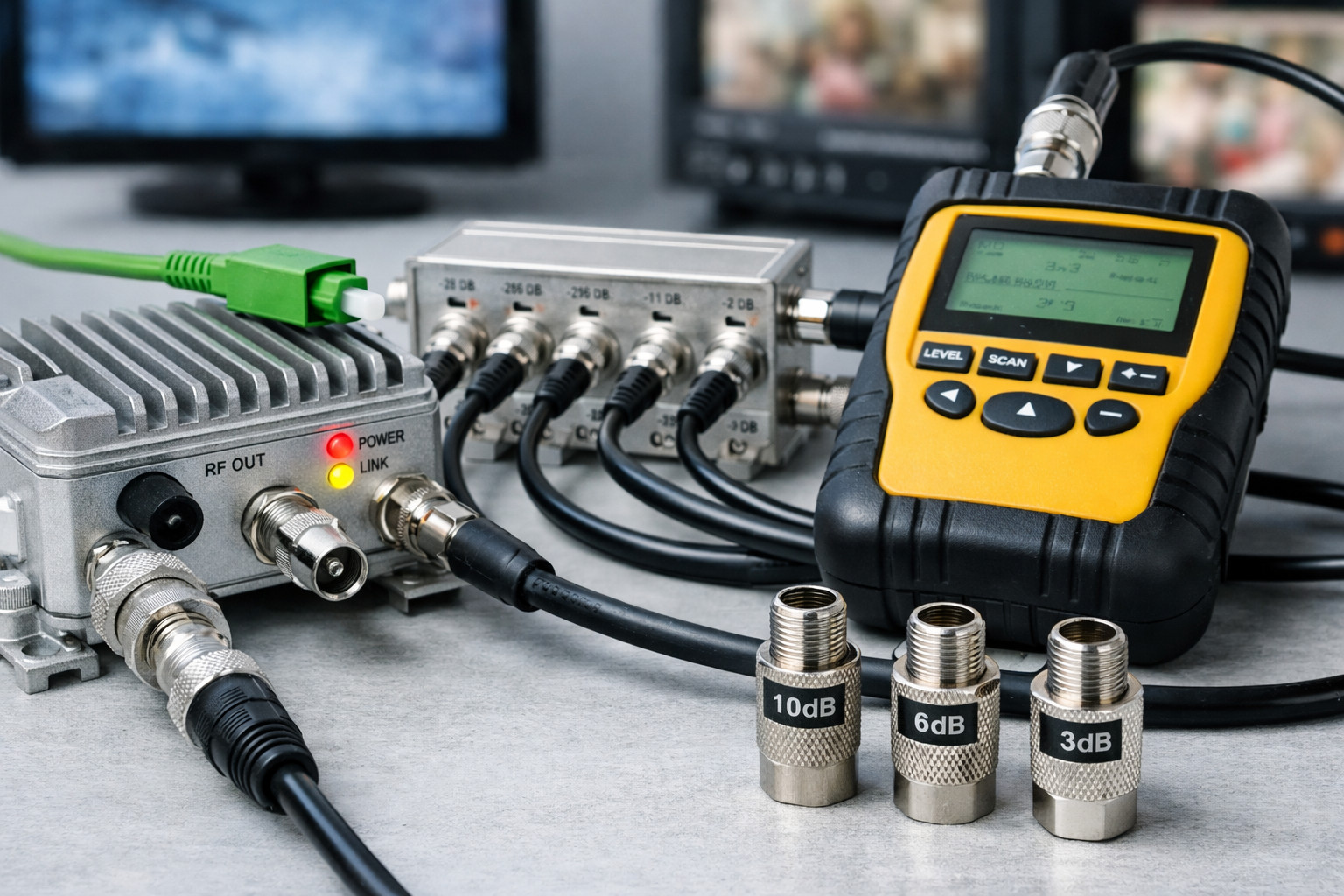
Table of Contents
When designing a CATV distribution system with high-power mini nodes, many engineers assume that short coax runs automatically require additional attenuators. In practice, that is often not the case.
A common reason for confusion is that digital RF systems such as QAM and ATSC do not behave exactly the same way as analog RF systems such as NTSC or PAL. Signal level targets that may have been considered ideal in older analog systems are often unnecessarily strict for modern digital TV distribution.
Optical CATV Mini Node with Return Path
The F-MININODE-2RP-HP is designed for CATV RF over fiber systems and provides a strong RF output suitable for structured coaxial distribution networks using taps, splitters, and cascaded drops.
Product Link:
https://thorbroadcast.com/product/optical-mini-node-catv-rf-receiver-with-return-path-8230.html
This architecture is common in hotels, hospitals, apartment buildings, campuses, offshore vessels, and other facilities where television signals must be distributed efficiently over coax.
High-power mini nodes are not designed only for long cable runs. They are also designed to support:
That level is usually perfectly acceptable for digital television reception.
This is one of the most important points in CATV system design.
Analog RF systems are much more visually sensitive to level variations, noise, ghosting, and distortion. In analog systems, installers often targeted narrower “ideal” ranges because picture quality would visibly degrade if levels drifted too high or too low.
Digital television receivers generally tolerate a wider usable RF range. As long as the signal is inside the tuner’s acceptable window and the MER / BER is good, the TV will usually decode the channel without visible issues.
While exact tuner performance varies by manufacturer, digital televisions and set-top boxes usually operate reliably over a relatively broad RF input range.
| System Type | General Behavior | Design Impact |
|---|---|---|
| Analog NTSC / PAL | More visually sensitive to level variation, ingress, and distortion | Often requires tighter level targets |
| Digital QAM / ATSC | More tolerant as long as RF level and digital quality remain within tuner limits | Usually does not require extra attenuation if taps are sized properly |
In many real-world digital systems, a level around +19 dBmV at the TV is completely acceptable. That is why a 26 dB tap on the output of a high-power mini node often eliminates the need for separate attenuators.
Additional attenuators may be needed in cases such as:
But in a properly structured system using multitaps, attenuators are often unnecessary.
The best way to confirm whether attenuators are actually needed is to measure the RF signal level at the television location rather than rely only on conservative theoretical calculations.
A professional RF meter allows you to verify:
For field verification and final balancing, Thor Broadcast offers an RF signal level meter that can be used to measure both digital and analog CATV environments.
Product Link:
https://thorbroadcast.com/product/catv-rf-qam-atsc-analog-ntsc-pal-signal-level-meter-8230.html
Thor Broadcast offers complete RF over fiber solutions for CATV and MATV systems, including transmitters, receivers, mini nodes, return path equipment, and supporting accessories.
Product Category Link:
https://thorbroadcast.com/products/cable-tv-catv-rf-45-900mhz
In CATV systems using high-power mini nodes, it is easy to assume that short coax runs require additional attenuation. However, once the signal passes through properly selected RF taps, the actual level at the TV is often already ideal.
The key point is that digital QAM and ATSC systems should not be judged by the same practical assumptions used for analog NTSC or PAL systems. Digital tuners typically tolerate a broader signal range, so an RF level that may seem “high” on paper can still be completely acceptable in the field.
When in doubt, verify the real signal level with an RF meter and balance the network based on measured performance, not overly strict analog-era assumptions.


 ES
ES