| Availability: | In stock | Condition: | new |
|
| Shipping: | starting at $0.00 | Warranty: | 5Yrs |
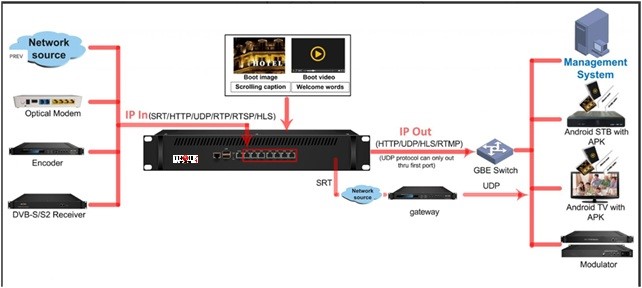
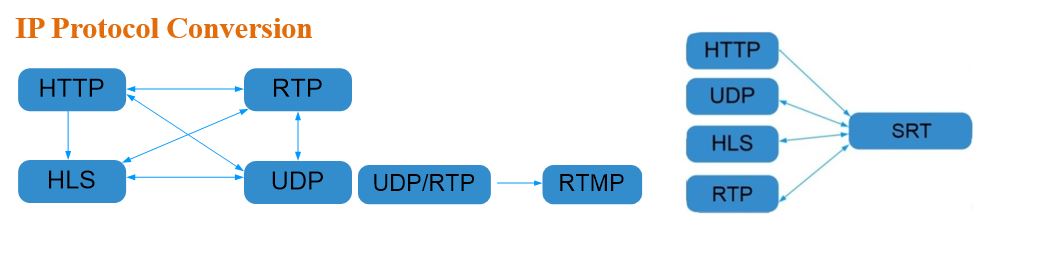
It is designed for protocol conversion and streaming media distribution applications. The unit can convert broadcast network IP streams over SRT, HTTP, UDP, RTP, RTSP, HLS, and TS file formats into SRT, HTTP, UDP, HLS, and RTMP protocols.
Additionally, it integrates a full IPTV system with support for VOD (Video on Demand), allowing users to upload content directly using its large internal storage capacity.
In summary, this all-in-one, fully featured device is ideal for small CATV head-end systems, especially in hospitality environments such as hotel TV systems.
|
IP Input |
DATA CH 1-7(1000M) ports: IP input over SRT, HTTP,UDP(SPTS),RTP(SPTS),RTSP (over UDP, payload: mpeg TS) and HLS |
|
|
TS files uploading through Web management |
||
|
IP output |
First Data port (1000M): IP out over SRT, HTTP (Unicast), UDP(SPTS, Multicast) HLS and RTMP (Program source should be H.264 and AAC encoding) |
|
|
|
||
|
System |
Channel switching time with Thor’ STB: HTTP (1-3s), HLS (0.4-0.7s) |
|
|
Play programs with APK downloaded android STB and TV |
||
|
About 80 HD/SD programs (Bitrate at 2Mbps) when HTTP/RTP/RTSP/HLS is converted into UDP (Multicast),the actual application shall prevail, and suggest maximum 80% CPU utilization |
||
|
IPTV system function |
support Live channel, VOD, Hotel introduction, Dining, Hotel service, APPS, scenery introduction and so on (Please install Thor IPTV APK) |
|
|
IPTV system main interface |
support adding scrolling caption, welcome words, pictures, advertisement, video, music (Please install Thor IPTV APK) |
|
|
web-based NMS management thru DATA port |
||
|
General |
Temperature |
0~45?(operation), -20~80?(storage) |
|
Power Supply |
AC100V±10%, 50/60Hz or AC 220V±10%, 50/60Hz |
|
| WEIGHT: 14.0 lb BOX SIZE (IN): 22.25 x 19.5 x 5.25 in BOX SIZE (MM): 566 x 496 x 134 mm UNIT SIZE (IN): 19 x 13 x 3.5 in UNIT SIZE (MM): 483 x 331 x 89 mm |
||
Test data for reference:
|
Protocol Cconversion |
Programs |
Bitrate |
Terminals |
CPU Utilization |
|
|
H-IPTV- GATEWAY Users |
H-IPTV-HD- GATEWAY Users |
||||
|
HTTP/RTP/RTSP/HLS to UDP |
80 |
2M |
--- |
--- |
55% |
|
HTTP to HTTP |
30 |
2M |
300 |
600 |
80% |
|
50 |
2M |
160 |
320 |
80% |
|
|
HTTP to HLS |
50 |
2M |
400 |
800 |
46% |
|
UDP to HLS |
50 |
2M |
400 |
800 |
50% |
|
80 |
2M |
300 |
600 |
72% |
|
|
UDP to HTTP |
50 |
2M |
240 |
480 |
50% |
|
UDP to SRT |
50 |
2M |
--- |
--- |
50% |
|
UDP to SRT |
50 |
2M |
--- |
--- |
75% |
Order Guide:
|
Model No. |
Feature |
|
Memory |
CPU |
Solid-State Disk(SSD) |
Mechanical Hard Disk |
|
H-IPTV- GATEWAY |
Gateway + IPTV server |
|
8G |
i5/i7 (3rd Generation) |
120G/240G random |
/ |
|
|
||||||
|
|
||||||
|
H-IPTV- HD- GATEWAY |
Gateway + IPTV server |
|
16G |
i7 (6th Generation) |
120G/240G random |
4T |
Yes, you can use the H-IPTV-GATEWAY-HD as the central gateway/server for a private “Netflix-style” IPTV system. The exact number of streams and simultaneous users will depend on the bitrate, protocols being used, and whether this is running over a private LAN or through the public Internet.
The basic system would work like this:
1. First, the video sources need to be encoded into IP streams.
For example, if you have HDMI sources, you can use our H-HDPerformux-24, which accepts up to 24 HDMI inputs and encodes them into H.264 IP streams over UDP/RTP.
Product: H-HDPerformux-4/8/16/24 HDMI IPTV Encoder
If your sources are already RF television signals, such as ATSC, QAM, DVB-S/S2 satellite, or DVB-T/T2, you can instead use one of our 16-tuner RF-to-IP gateways, such as the H-16ATSC-IP / H-16DVBS-IP. These units receive the RF channels and output them as IP SPTS multicast/unicast streams.
2. The multicast IP streams are then sent to the H-IPTV-GATEWAY-HD.
The gateway can receive UDP/RTP/RTSP/HTTP/HLS/SRT streams and perform protocol conversion. For example, you can take the UDP multicast streams coming from the encoders or RF-to-IP gateways and convert them to HLS for delivery to users.
Based on the application and approximately 2 Mbps per program, typical capacity is:
UDP/RTP/RTSP/HLS/HTTP → UDP: approximately 80 programs
HTTP/UDP → HLS: approximately 80 programs
UDP → HTTP: approximately 50 programs
UDP → SRT: approximately 50 programs
So, for example, you could have 24 HDMI channels coming from one H-HDPerformux-24 and convert/distribute those channels through the IPTV Gateway.
3. At the user side, there are several ways to watch the channels.
For a dedicated television installation, you can use our H-STB-IP IPTV set-top box. It receives the IP stream and provides HDMI output directly to the TV. It supports MPEG-2/H.264 and unicast or multicast transport streams.
The streams could also potentially be viewed with software players such as VLC, computers, compatible Smart TVs, tablets, or custom applications, depending on the protocol being used.
A typical architecture would therefore be:
HDMI / ATSC / DVB-S/S2 sources → Encoder or RF-to-IP Gateway → UDP/RTP Multicast → H-IPTV-GATEWAY-HD → HLS / HTTP / SRT / other IP format → Network → H-STB-IP / Smart TV / PC / VLC / mobile device
For the number of simultaneous end users, we would need to know the expected number of channels, average bitrate per channel, whether users are watching over LAN or Internet, and approximately how many simultaneous viewers you expect. The total user capacity will ultimately also depend on the available network/server bandwidth.
For example, if you have 100 simultaneous viewers watching 4 Mbps streams, the network could require approximately 400 Mbps of outgoing bandwidth when using individual unicast/HLS sessions.
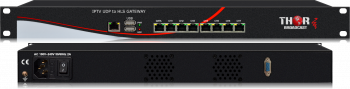 IPTV UDP to HLS GATEWAY
Thor IPTV Gateway is a device used for protocol conversion and streaming media distribution scenarios. It is a matrix converter between UDP, HLS, RTMP, HTTP, RTSP, and RTP.
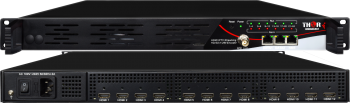 12 HDMI IPTV Streaming HD/SD H.264 Encoder
The 12 HDMI IPTV Streaming HD/SD H.264 Encoder is a highly integrated professional device that includes encoding, multiplexing, scrambling, and modulation.

 ES
ES