Learn how to distribute 64 IPTV video streams over 32 QAM channels using the Thor H-HERMES-64 IP-to-QAM transcoder. Explore H.264-to-MPEG-2 conversion, coaxial TV distribution, IPTV gateway integration, network bandwidth requirements, and recommended syst
This knowledge base explains how to receive H.264 video streams from satellite receivers, IPTV providers, or IP video networks, transcode them into MPEG-2, and distribute up to 64 television programs over an existing coaxial cable TV network using the Thor H-HERMES-64. It also explains how to add IPTV distribution using the H-16QAM-IP, when a separate transcoder is required, and the differences between IP-to-QAM modulators and QAM-to-IP gateways. The application is based on a customer in Toronto, Canada, who requires 64-channel QAM distribution and would also like lower-bitrate IPTV streams for an internal network.
Table of Contents
Product: Product Page / Technical Datasheet
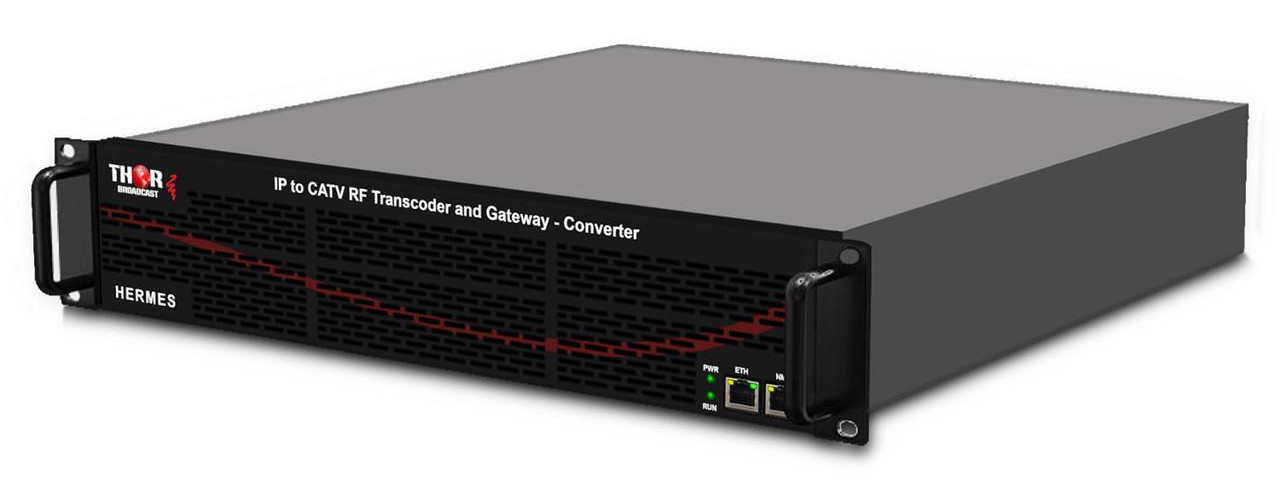
The H-HERMES-64 combines a professional MPEG video transcoder, transport-stream multiplexer, and RF modulator in a single rackmount system. It is designed for hospitality facilities, cable television headends, MDUs, universities, commercial buildings, and other applications requiring large numbers of TV programs over existing coaxial infrastructure.
Key capabilities
Receives up to 64 IP video streams using UDP or RTP.
Supports multicast and unicast input.
Transcodes H.264 video into MPEG-2.
Supports MPEG-2 output with AC-3 audio.
Outputs up to 32 QAM RF carriers, with two television programs per carrier.
Supports configurable transcoding bitrates, listed as 1-19 Mbps in the datasheet.
Provides a web-based Network Management System (NMS) and separate video data interface.
Supports video resolutions up to 1080p60, subject to the configured input and output capabilities.
The product documentation explicitly lists H.264 transcoding. H.265 input compatibility should not be assumed without factory confirmation. The customer's proposed 20 Mbps input streams should also be validated against the device's processing and network capacity.
Each QAM RF carrier contains a multiplexed transport stream with up to two television programs. Therefore, 64 incoming programs can be distributed using 32 RF carriers.
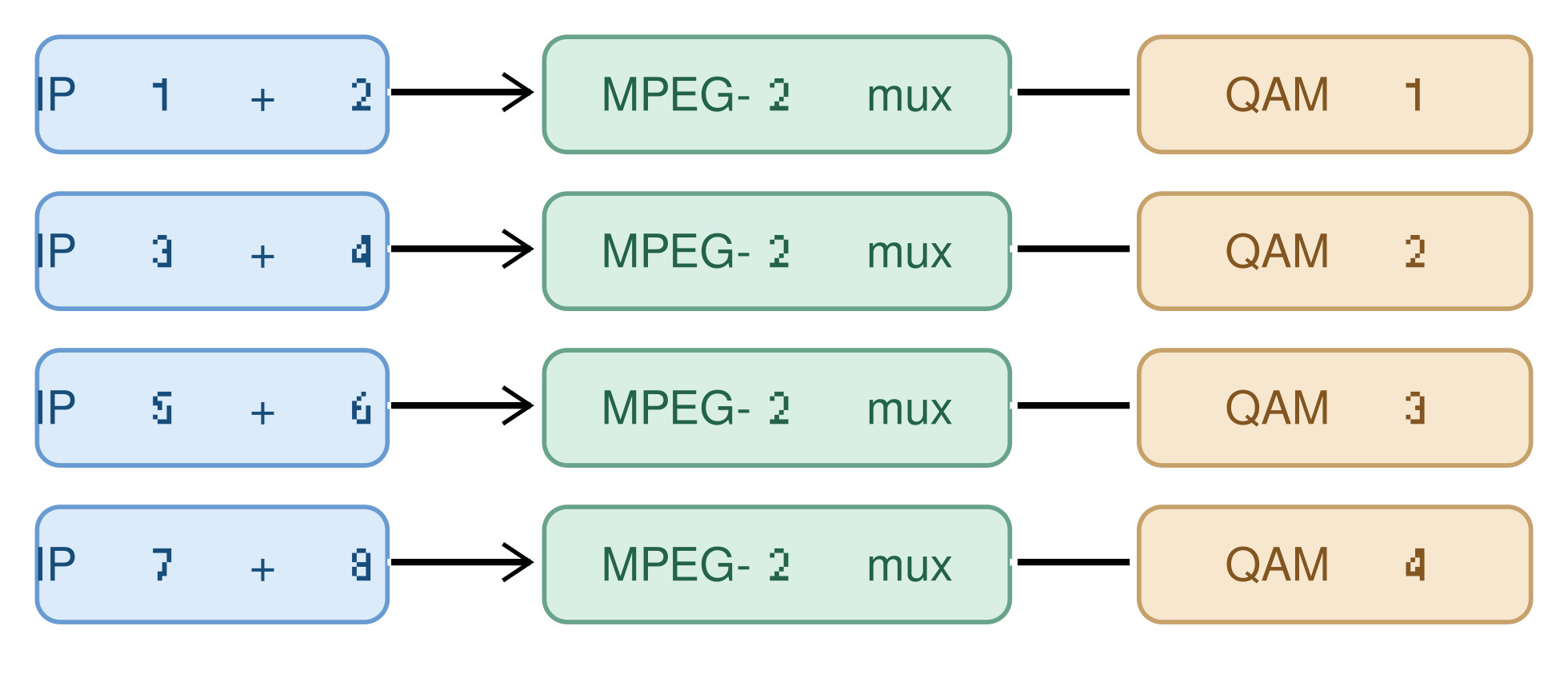
Diagram: Illustration of the first four carriers. The same mapping continues through QAM 32 for all 64 programs.
The HERMES-64 is designed primarily for IP-to-RF operation. It does not provide a simultaneous MPEG-2 IPTV output.
Product: Product Page / Technical Datasheet
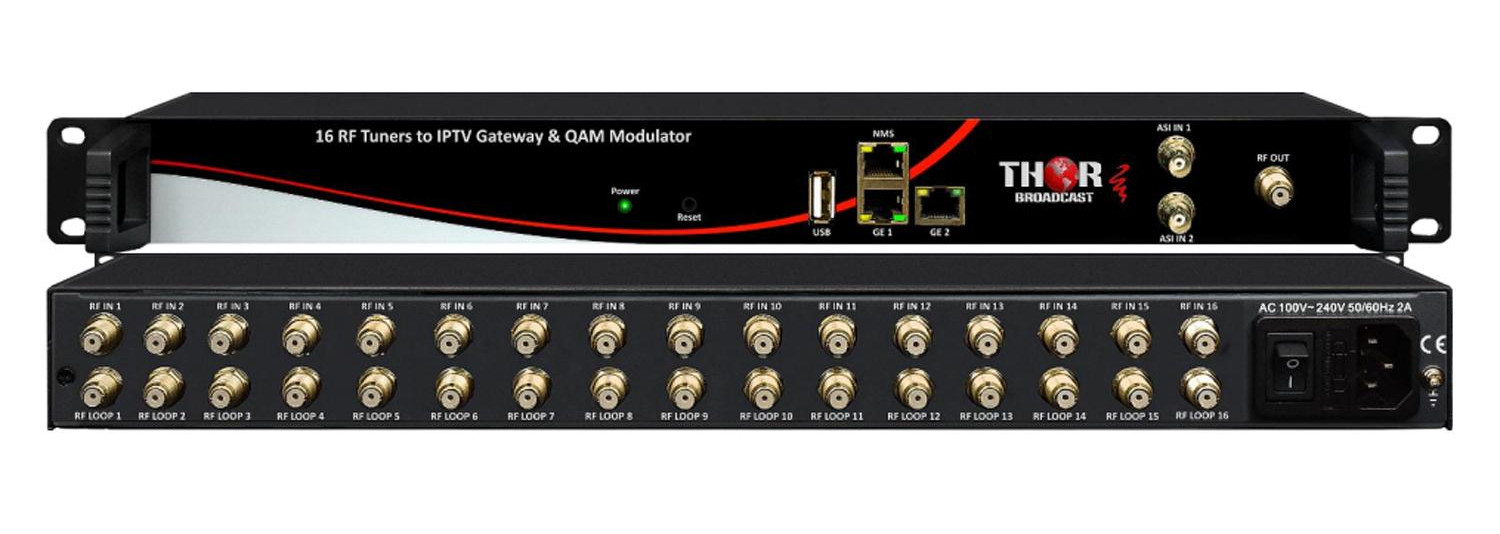
The H-16QAM-IP is an optional addition to the HERMES-64 system. It allows a facility to retain its existing QAM coaxial TV distribution while making the same programs available over Ethernet. The gateway contains 16 independent QAM RF tuners. Each tuner can be assigned to a particular RF frequency and can extract the programs carried within that QAM channel. Unlike a video transcoder, it does not decode and re-encode the video. It passes the original MPEG transport-stream content to the IP network, preserving the encoded quality and bitrate.
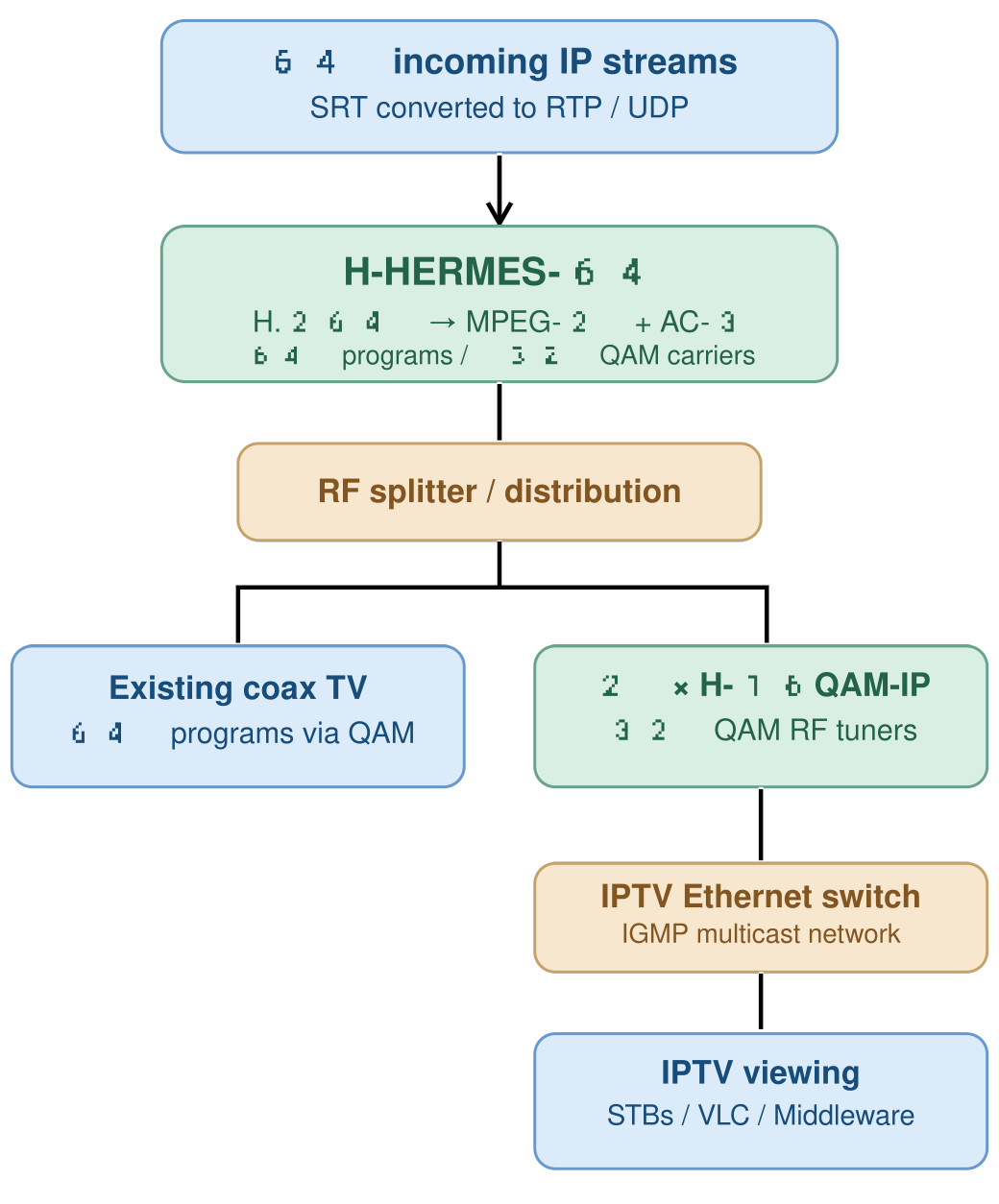
Diagram: Proposed dual-output architecture. RF and IPTV paths carry the same MPEG-2 encoded programs. A separate transcoder is needed for lower-bitrate IPTV.
|
HERMES output |
Gateway quantity |
Total tuner capacity |
|---|---|---|
|
Up to 16 QAM carriers |
1 |
16 |
|
Up to 32 QAM carriers |
2 |
32 |
|
Up to 48 QAM carriers |
3 |
48 |
For the full HERMES-64 system, two H-16QAM-IP units provide 32 RF tuners, matching its 32 QAM output carriers. Each gateway receives the combined RF channel lineup, with RF splitting or loop-through arranged to maintain the correct signal levels. Individual tuners are assigned to different frequencies. Because each QAM carrier can contain two MPEG-2 programs, the gateway may recover both programs from that carrier as separate IP streams, subject to the gateway's stream-output configuration and aggregate bandwidth capacity.
The H-16QAM-IP is not a bitrate-reduction device. For example, if the HERMES-64 creates a 10 Mbps MPEG-2 program, the H-16QAM-IP will output essentially that same encoded program over IP, with transport overhead as applicable. It cannot independently convert that MPEG-2 program to a 5 Mbps H.264 or H.265 stream.
The H-8QAM-IP serves the same general purpose as the 16-tuner model but is intended for smaller systems with fewer QAM RF carriers. It is useful when a facility needs IPTV access to only a selected portion of its cable channel lineup, such as eight QAM frequencies rather than all 32. For the customer's full 64-program system, the H-16QAM-IP is the more practical choice because fewer chassis are required.
These devices provide alternative input, output, and distribution options. They are not all required in the proposed HERMES-64 installation.
|
Product |
Function |
Product information |
|---|---|---|
|
H-IPRF-16/32QAM |
IP transport-stream to 16 or 32 QAM RF carriers. Alternative when video is already in a TV-compatible codec and transcoding is unnecessary. |
|
|
H-16QAM-IP-16QAM |
QAM RF input to both IP and re-modulated QAM RF output. Useful for channel remapping and simultaneous RF/IP distribution, but not independent video bitrate reduction. |
|
|
H-THUNDER-8 |
Converts eight HDMI sources to QAM RF and IP streams. Useful when the original sources are HDMI rather than incoming IP feeds. |
|
|
H-HYBRID-RF-8 |
Multi-input HDMI/SDI to RF modulator for local video sources. |
|
|
H-STB-IP |
IPTV set-top box for decoding compatible IPTV streams and displaying them over HDMI on a television. |
|
|
H-SP-1x8 / H-SP-1x16 |
RF splitters/combiners for distributing the QAM RF lineup to gateway inputs while managing RF levels. |
The H-IPRF series differs fundamentally from HERMES: it primarily remodulates existing IP transport streams onto RF carriers and should not be treated as a substitute for H.264-to-MPEG-2 transcoding.
|
Function |
H-HERMES-64 |
H-16QAM-IP |
H-IPRF-16/32QAM |
|---|---|---|---|
|
IP video input |
Yes |
No, for primary QAM tuner function |
Yes |
|
QAM RF input |
No |
Yes |
No |
|
MPEG-2 transcoding |
Yes, from H.264 |
No |
No, standard gateway operation |
|
QAM RF output |
Yes |
No |
Yes |
|
IPTV output |
No |
Yes |
No |
|
Changes video bitrate |
Yes |
No |
No |
|
Main application |
IP to MPEG-2 QAM |
QAM to IPTV |
IP transport streams to QAM |
The key distinction is between transcoding and transport-stream conversion. Transcoding changes the encoded video format or bitrate, such as converting a 20 Mbps H.264 stream into an 8 Mbps MPEG-2 stream. Gateway conversion changes how the existing transport stream is delivered, such as moving it from QAM RF onto Ethernet, without changing the video compression.
For the Toronto customer's application, the ideal end result would be:
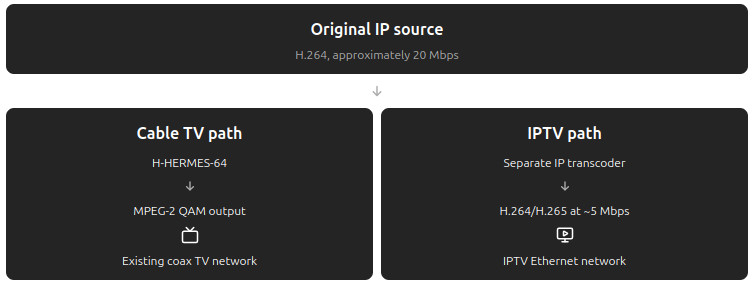
There are two possible approaches.
This configuration makes the MPEG-2 QAM television programs available on both the existing coax network and the IPTV network. It requires two H-16QAM-IP gateways for all 32 QAM carriers. The IPTV output retains the MPEG-2 encoding and bitrate established by the HERMES-64.
The incoming IP streams are distributed to two processing systems. HERMES-64 handles the QAM distribution, while a separate IP-to-IP transcoder produces H.264 or H.265 streams at approximately 5 Mbps for IPTV. This offers greater flexibility because the cable TV and IPTV networks can have different encoding formats and bitrates. The specific IP transcoder model and capacity must be selected separately. For a new installation requiring substantially lower IPTV bitrates, Option B is generally the more efficient architecture because it avoids converting the streams to RF and back to IP.
The HERMES-64 uses separate network connections for management and video input.
This port is used for the web management interface, including configuring incoming streams, transcoding settings, QAM modulation, program assignments, and system status.
This interface receives the UDP/RTP transport streams. The recommended approach is multicast delivery over a properly configured Ethernet network. For reliable operation, the network should support IGMP snooping and appropriate multicast routing where required. A dedicated video VLAN or network segment is recommended for large systems.
This is a critical engineering consideration. The published HERMES-64 specification identifies a 100/1000 Mbps IP input port. A full set of 64 streams at 20 Mbps each would exceed the capacity of a single 1GbE interface. Therefore, the customer's proposed 64 × 20 Mbps input configuration cannot be assumed to work on one HERMES-64. The actual input bitrates, aggregate traffic, and hardware capacity must be confirmed before quotation or deployment. For comparison, 64 streams averaging 10 Mbps would require 640 Mbps before network overhead, which is more realistic for a gigabit interface, although the transcoder's processing limits still need verification.
Can the HERMES-64 receive SRT streams directly?
No. The published specifications list UDP and RTP. SRT streams must first be converted to a supported transport protocol.
Can the HERMES-64 convert H.265 to MPEG-2?
H.264-to-MPEG-2 transcoding is documented. H.265 compatibility requires confirmation.
Can one HERMES-64 provide 64 separate QAM frequencies?
No. It supports up to 64 television programs distributed across 32 QAM carriers, with two programs per carrier.
Can the H-16QAM-IP recover all 64 television programs?
Two gateways provide the 32 tuners required for the 32 QAM carriers. Each tuner can extract programs within its selected transport stream, subject to the device's program-output and bandwidth limitations.
Will a QAM-to-IP gateway reduce the MPEG-2 bitrate?
No. It converts the RF transport stream to IP without video re-encoding.
Can the IPTV and QAM systems operate simultaneously?
Yes, using the additional equipment described above. The HERMES-64 alone does not provide simultaneous IP and QAM output.
Does the H-16QAM-IP include an IPTV channel guide or middleware?
No. It provides the transport streams. A compatible IPTV set-top box, VLC player, or separate middleware system is needed for viewing and channel management.
For this customer, the H-HERMES-64 remains the primary proposed device because QAM cable TV distribution is the mandatory requirement.
The H-16QAM-IP provides a straightforward future expansion path for making those same QAM programs available over Ethernet. However, it should not be presented as a solution for independently reducing IPTV bitrates.
Before proceeding with the demonstration or purchase, Thor Engineering should confirm three critical items: H.265 input compatibility, aggregate input bandwidth, and the supported transcoding capacity for the customer's source streams.
H-HERMES-64 product and specifications
QAM-to-IP conversion application guide
Thor configuration and quick setup guides


 ES