Thor Broadcast Logo
Log in
Cart (0)
  • es ES
  • Products
    • CATV Modulators
      • HDMI RF Modulators
      • HD-SDI converters
      • IP to CATV Edge Modulators
    • DVB Encoders
      • IPTV Video Encoders
      • Hdmi RTSP RTMP RTSP Encoders
      • Transcoders, MPEG Converters, IP ASI Gateways
    • Decoders (IRD's & STB's)
      • RF input - Video /Audio Ouput
      • IP Broadcast Decoders
      • RF CATV and IPTV OTT STB's
    • Satellite Modulators
      • DVB-S/S2 Satellite Modulators
    • Fiber Optic Transport
      • SDI Fiber Optic Extenders, Digital Audio Extenders
      • SDI SD/HD/3G with CWDM
      • Cable TV CATV RF 45-900Mhz
      • L-Band Satellite RF 45-3000Mhz
      • Data & Ethernet over fiber
    • HDMI SDI Switchers, LAN Extenders, and Wireless Video Transport
      • HD Video Switchers and Signal Format Converters for AV Pros
      • Wireless HD SD Video Data Equipment
      • Video Audio Extenders Over Ethernet LAN IP Network
    • DIscounted Inventory
      • Satellite and CATV Broadcast Equipment for Sale
      • Lab Used Broadcast Equipment on sale
      • Past Generation Equipment
    • SDI Monitors
    • Warehouse
  • About
  • Client Portfolio
  • Support
      • Support Center Support Center
      • User Manuals User
        Manuals
      • Request an RMA Request an
        RMA
  • ⬇Download
    • Manuals
    • Datasheets
    • Quick Guides
  • Case Studies
    • THOR Gym
    • THOR Stadium
    • THOR Hotel
    • THOR University
  • Videos
  • Contact
  • Become a Reseller

How to Deliver DOCSIS Cable Modem Internet Over Fiber in Marinas, Harbors, Campuses, and Large Properties

Thor Broadcast case study on using RF over fiber, CMTS, and mini nodes to scale DOCSIS internet across large sites.
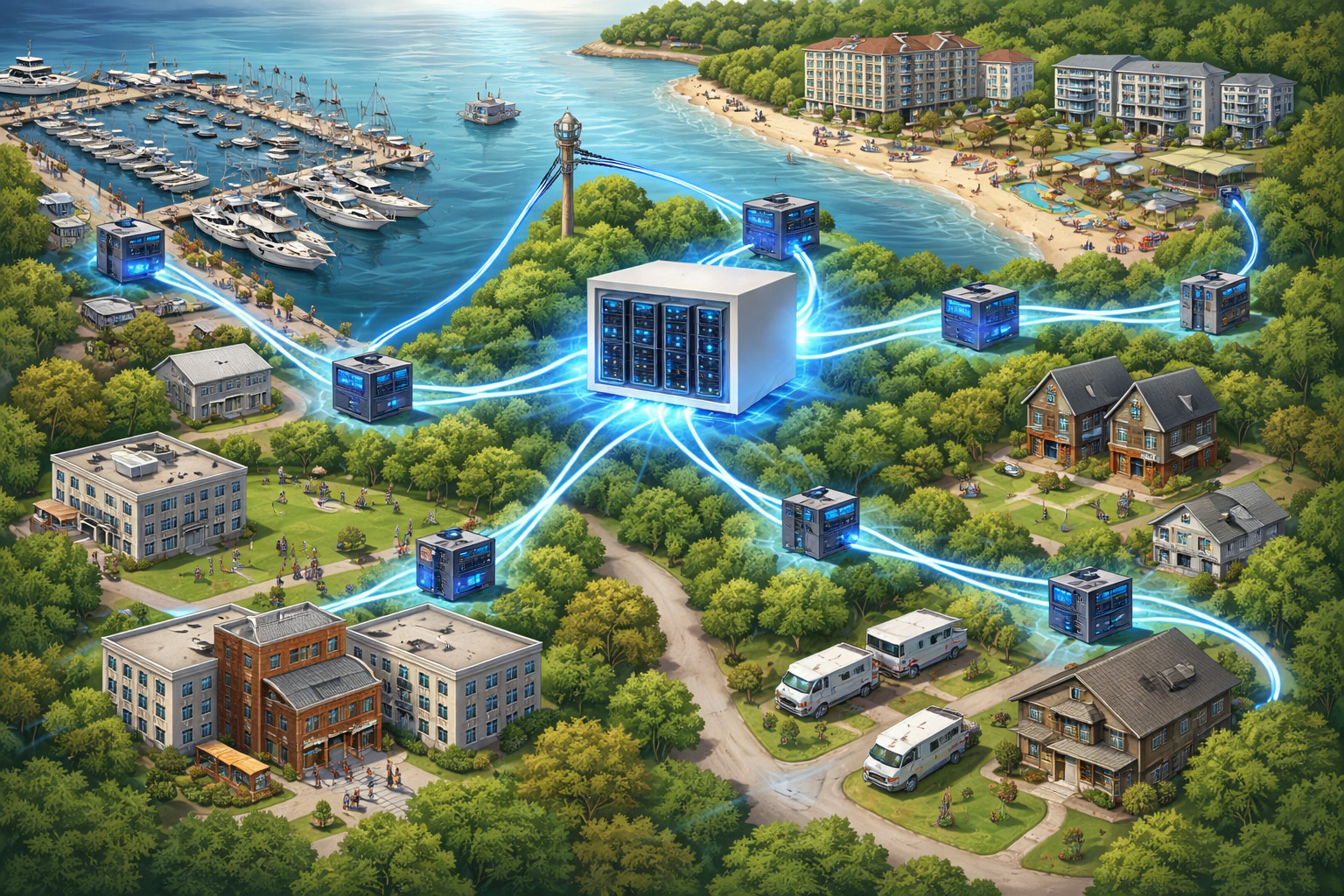
How to Deliver DOCSIS Cable Modem Internet Over Fiber in Marinas, Harbors, Campuses, and Large Properties


How to Deliver DOCSIS Cable Modem Internet Over Fiber in Marinas, Harbors, Campuses, and Large Properties

A detailed Thor Broadcast case study explaining how CMTS and DOCSIS work, why RF over fiber is often a better architecture than long coax-only systems, and how to deploy a scalable forward and return-path design using optical transmitters, passive splitters, return receivers, and mini nodes.

Table of Contents

  • Overview
  • What Does CMTS Stand For?
  • How Is It Possible to Connect 500 or 1,000 Cable Modems on the Same Network?
  • Why RF Over Fiber Works So Well with DOCSIS and CMTS
  • Why Fiber and Nodes Are Better Than Long Coax-Only Distribution
  • Thor Broadcast Example Architecture – 1x8 Forward Path Deployment
  • Proposed BOM – 8 Node Example
  • Detailed Engineering Logic Behind the BOM
  • What Makes This Architecture Ideal for Marinas and Harbors?
  • Future Expansion Options
  • Conclusion

Overview

Large marina and harbor properties often need to deliver internet service to many boats, slips, docks, or remote utility pedestals spread across long distances. In many of these projects, a traditional coax-only architecture becomes difficult because long coax runs introduce RF attenuation, return-path balancing challenges, amplifier cascades, and ongoing maintenance issues.

Thor Broadcast RF over fiber equipment allows the operator to extend the RF portion of a cable modem network over single-mode fiber while keeping the familiar DOCSIS and CMTS workflow intact. This means the system still behaves like a standard cable modem network, but with the distance, cleanliness, and scalability advantages of fiber.

In simple terms: the fiber section acts like a long, clean, low-loss extension of the coax backbone. The CMTS still controls the network. The cable modems still operate using DOCSIS. The RF over fiber devices simply transport the forward and return RF signals between the headend and each field node.

What Does CMTS Stand For?

CMTS stands for Cable Modem Termination System.

It is the main headend platform that communicates with all cable modems on the network. It generates the downstream RF channels that the modems receive, and it also receives and processes the upstream RF bursts sent back by those modems.

What Does DOCSIS Stand For?

DOCSIS stands for Data Over Cable Service Interface Specification.

DOCSIS is the standard that defines how digital data is transmitted over RF cable networks. It specifies modulation methods, channel structure, timing, synchronization, error correction, bandwidth allocation, and how multiple cable modems can share the same RF plant efficiently.

How Is It Possible to Connect 500 or 1,000 Cable Modems on the Same Network?

This is one of the most important parts of the technology to understand.

At first glance, it may seem impossible because all of the cable modems share the same coaxial distribution network. Each modem receives RF, but it also has to transmit RF back to the CMTS. The natural question is: if hundreds of modems are transmitting upstream, why do they not all collide and corrupt each other?

The Answer: The Modems Do Not Transmit Whenever They Want

The CMTS controls the entire upstream process. It acts like a traffic controller and tells each modem exactly when it may transmit, for how long, and at approximately what power level.

The upstream side of DOCSIS is not a random free-for-all. It is a tightly controlled, scheduled, synchronized burst system.

Downstream Direction

The downstream path goes from the CMTS to all cable modems. This is similar to a broadcast model. The CMTS continuously transmits RF channels, and every modem on the network can receive them. Each modem only extracts the packets intended for it.

Upstream Direction

The upstream path goes from the modems back to the CMTS. This is not continuous transmission. Instead, each modem sends very short RF bursts only during its assigned time window.

Time Division and Scheduling

In a DOCSIS system, the CMTS divides the upstream channel into extremely small time slices. It grants transmission opportunities to each modem as needed. This is conceptually similar to time-division multiple access.

So if 500 modems are connected, the CMTS may instruct modem A to transmit for a brief burst, then modem B, then modem C, and so on. This process happens extremely quickly and continuously, so the entire system appears seamless to the end user.

Ranging and Synchronization

Since not every modem is located the same distance from the headend, each modem goes through a process called ranging. During ranging, the CMTS measures timing delay and power level, then tells the modem how to adjust its timing and transmit level.

This is crucial because one modem may be physically close to the node while another may be farther away. Without ranging, their signals would arrive at the CMTS at slightly different times or at inconsistent levels. Ranging ensures that the CMTS sees those upstream bursts arrive in an orderly, aligned, readable way.

Why the Signals Do Not Interfere with Each Other

  • The CMTS assigns transmission windows to the modems.
  • The modems only transmit during their assigned time slot.
  • The CMTS instructs modems on timing so the bursts arrive aligned.
  • The CMTS controls modem power so the return signals arrive in the proper range.
  • Error correction, framing, and DOCSIS protocol logic keep the data organized and readable.

What Happens to the Ethernet Data?

Each cable modem has an Ethernet interface such as 10/100/1000Base-T. On the customer side, the data enters the modem as standard Ethernet packets. Inside the modem, that traffic is buffered, processed, and packed into DOCSIS frames. When the CMTS grants an upstream transmit opportunity, the modem modulates that data onto the RF carrier and sends it as a controlled burst.

In the other direction, the modem receives downstream DOCSIS data from the RF channels, extracts the data intended for it, and outputs standard Ethernet to the local user device, router, or switch.

Why RF Over Fiber Works So Well with DOCSIS and CMTS

Thor Broadcast RF over fiber products do not replace the DOCSIS system. They do not interpret IP packets, terminate cable modem sessions, or perform DOCSIS scheduling. Instead, they transport the RF layer itself.

That is exactly why this architecture is so powerful. The RF over fiber path is essentially transparent to the DOCSIS layer. The CMTS continues to behave like a CMTS. The modems continue to behave like cable modems. The optical system simply extends the RF network over fiber.

Forward Path Behavior

  1. The CMTS outputs downstream RF signals.
  2. The RF feeds the optical transmitter.
  3. The transmitter converts the RF to optical light.
  4. The optical signal is passively split to multiple field locations.
  5. Each mini node converts the optical signal back to RF.
  6. The RF is distributed locally over coax to the modems.

Return Path Behavior

  1. The modems transmit scheduled upstream RF bursts.
  2. The local mini node receives those return-path RF signals.
  3. The mini node converts the return RF into optical form.
  4. That return path travels over a dedicated fiber back to the headend.
  5. The return receiver converts optical back to RF.
  6. The RF is fed into the CMTS input path.
Important design rule: each mini node should have two fibers — one forward fiber and one return fiber. The forward optical path can be split because it is a one-way distribution path. The return side should use dedicated fibers per node so the upstream RF remains clean and properly managed at the headend.

Why Fiber and Nodes Are Better Than Long Coax-Only Distribution

Problems with Long Coax Systems

  • Significant RF attenuation over long distance
  • Need for multiple line extenders or amplifiers
  • More difficult return-path alignment and balancing
  • Greater accumulation of noise in the upstream path
  • Higher maintenance and troubleshooting complexity
  • Lower flexibility for future expansion

Advantages of RF Over Fiber with Nodes

  • Greatly extended distance using low-loss fiber
  • Cleaner RF transport over the backbone
  • Reduced need for cascaded coax amplifiers
  • More stable and manageable return path
  • Easy passive optical splitting on the forward path
  • Scalable architecture for multi-dock or multi-zone growth

In a marina or harbor environment, this is especially useful because the property may already have a fiber backbone for networking or utility communications. Instead of attempting to stretch coax for long distances and then re-balance multiple RF amplifiers, the better approach is often to transport the RF over fiber to local zones and then convert back to coax only where needed.

This results in a cleaner RF plant, fewer points of analog degradation, simpler expansion, and a more professional commercial-grade design.

Thor Broadcast Example Architecture – 1x8 Forward Path Deployment

The following is a practical example for an initial 8-node deployment. This is a very good fit for a first harbor section, pilot build, or medium-size distributed dock environment.

HEADEND ┌──────────────────────┐ │ CMTS │ │ Downstream + Upstream│ └──────────┬───────────┘ │ RF ▼ ┌──────────────────────────────┐ │ F-RF-1310-TX-8mW │ │ Forward RF Optical TX │ └──────────┬───────────────────┘ │ Single-Mode Fiber / SC-APC ▼ ┌──────────────────────────────┐ │ F-PLC-1x8 Optical Splitter │ └─┬─────┬─────┬─────┬─────┬────┘ │ │ │ │ │ ▼ ▼ ▼ ▼ ▼ FIELD NODE 1 ... FIELD NODE 8 ┌──────────────────────────────┐ │ F-MININODE-2RP-HP │ │ Optical to RF + Return Path │ └──────────┬───────────────────┘ │ RF Coax ▼ Cable Modems / Dock Users RETURN PATH Cable Modems → Node Return RF → Dedicated Return Fiber → F-RF-RP4RX Return Receiver → CMTS

Recommended Fiber Type

Single-mode fiber with SC/APC connectors is recommended. SC/APC connectors are preferred in many RF over fiber systems because angled-polish connectors help reduce optical reflections, which is beneficial for stable analog optical transport.

Recommended Optical Target

The optical mini node typically performs best when the received optical input is close to 0 dBm. This is one reason it is usually better to have sufficient transmitter power and then attenuate if necessary, rather than running too little optical power and ending up below the preferred operating range.

Proposed BOM – 8 Node Example

Qty Product Role in System Link
1 F-RF-1310-TX-8mW Forward-path RF over fiber transmitter at the headend. Converts downstream RF from the CMTS into optical transport for distribution to all field nodes. View Product
1 F-PLC-1x8 Optical Splitter Passively splits the optical forward path to eight separate node locations. View Product
8 F-MININODE-2RP-HP Optical mini nodes located in the field. Convert forward optical to RF and return upstream RF back to optical. View Product
2 F-RF-RP4RX Four-channel return path receivers. Two units support eight node return paths total. View Product

Note: because each F-RF-RP4RX supports 4 return channels, an 8-node deployment requires 2 return path receiver units.

Detailed Engineering Logic Behind the BOM

Why Use the 8 mW Forward Transmitter?

For a moderate 1x8 forward optical split, an 8 mW transmitter is often a very practical starting point. It gives enough optical power to feed eight nodes through a passive splitter while keeping the design cost-effective for a pilot or first-stage deployment.

Why Use a 1x8 PLC Splitter?

Passive optical splitters are ideal on the forward path because the downstream optical signal is simply being distributed to multiple endpoints. In a typical 1x8 arrangement, the optical splitting loss is one of the main budget considerations, which is why proper transmitter selection matters.

Why Use a Mini Node with Return Path?

The F-MININODE-2RP-HP is the field conversion point. It receives the forward optical signal and outputs RF locally, allowing the local dock or service area to behave like a conventional coax segment. It also accepts return-path RF from the modems and converts that back to optical for the dedicated return fiber.

Why Use Dedicated Return Fibers?

The upstream RF path contains many short modem bursts that must remain clean and readable for the CMTS. Using one dedicated return fiber per node preserves the integrity of that path. It also simplifies isolation and troubleshooting because each return path can be monitored independently at the headend.

Why Use Return Path Receivers at the Headend?

The F-RF-RP4RX units convert the optical return signals back into RF so the CMTS can process the upstream DOCSIS traffic. Since each unit supports four return channels, two units are used in an eight-node example.

What Makes This Architecture Ideal for Marinas and Harbors?

  • Long distances between headend and docks are much easier to serve over fiber than over coax.
  • Fiber backbone designs are often already present in larger properties.
  • Boat owners still benefit from a familiar coax-fed cable modem connection.
  • The system avoids many of the signal and balancing problems of coax-only layouts.
  • It is much easier to expand the network in phases as new docks or zones are added.
  • The CMTS can centrally manage customer bandwidth, service tiers, and provisioning.

This approach can also be attractive anywhere a property has distributed remote zones, separate buildings, utility cabinets, or long outdoor pathways. Harbors are a particularly strong fit because Wi-Fi can be inconsistent around metal structures, moving vessels, and obstructed lines of sight, while a DOCSIS cable modem architecture offers predictable service delivery and better control.

Future Expansion Options

Once the first 1x8 deployment is proven, the system can be expanded using stronger transmitters and larger optical splits.

  • F-RF-1310-TX-32mW for larger optical budgets
  • 1x32 optical splitter for larger multi-node systems
  • Additional F-RF-RP4RX units as node count increases
  • More F-MININODE-2RP-HP nodes as new sections come online

This allows the operator to standardize the headend concept and scale the deployment over time instead of redesigning the entire architecture for each phase.

Conclusion

A DOCSIS and CMTS network may seem complex at first, especially when hundreds of cable modems share the same RF plant. The key is understanding that the CMTS is continuously coordinating the entire upstream process. The modems do not simply transmit at random. They are synchronized, ranged, power-controlled, and scheduled.

Thor Broadcast RF over fiber products make it possible to extend that proven DOCSIS model across large properties using a clean, scalable fiber backbone. Instead of forcing long coax runs and difficult amplifier chains, the operator can transport the RF over fiber, convert locally at each node, and maintain a professional commercial-grade architecture.

For marina, harbor, campus, hospitality, and remote-zone deployments, this is often the most practical way to combine the control of CMTS with the reach and signal integrity of optical distribution.

Need Help Designing an RF Over Fiber DOCSIS System?

Thor Broadcast can help you size the optical budget, define the splitter topology, select the correct mini nodes, and recommend the proper forward and return-path architecture for your site.

Contact Thor Broadcast


Justin White
Justin White
Broadcast Engineer
Broadcast engineer specializing in turnkey CATV and fiber-transport solutions. Experienced in designing and deploying complete encoding/decoding workflows to move virtually any signal over IP, fiber, and RF. Focused on ultra-low-latency headend architectures and custom mux/demux builds, supporting demanding environments across telecom, sports, education, hospitality, studios, live events, and mission-critical institutions worldwide.
View author page
Contact us

Thor Broadcast Sales

Email: [email protected]
Phone: 1(800)521-THOR (8467) Ext 1
FAX: 1(800)521-6384

Customer Service/ Support

Phone: 1-800 521-THOR(8467) Ext 2
Email: [email protected]

Case Studies

- Converting Clear QAM HDTV Channels to Analog RF NTSC for Multi-Site Distribution
- Stadium IPTV - Replay System
- Hotel HDMI-to-QAM TV Distribution
- University IPTV Lecture Systems

  • CATV Modulators:
    • HDMI RF Modulators
    • HD-SDI converters
    • IP to CATV Edge Modulators
  • DVB Encoders:
    • IPTV Video Encoders
    • Hdmi RTSP RTMP RTSP Encoders
    • Transcoders, MPEG Converters, IP ASI Gateways
  • Decoders (IRD's & STB's):
    • RF input - Video /Audio Ouput
    • IP Broadcast Decoders
    • RF CATV and IPTV OTT STB's
  • Satellite Modulators:
    • DVB-S/S2 Satellite Modulators
  • Fiber Optic Transport:
    • SDI Fiber Optic Extenders, Digital Audio Extenders
    • SDI SD/HD/3G with CWDM
    • Cable TV CATV RF 45-900Mhz
    • L-Band Satellite RF 45-3000Mhz
    • Data & Ethernet over fiber
    • Analog Audio Video
    • Fiber Amplifiers - EDFA
    • DVB - ASI
    • Fiber Jumpers, Cables, Attenuators,
    • Optic Splitters Couplers CWDM Muxes
    • Optical Meters, Test Equipment, Accesories
    • Analog Baseband Video Audio, RS485/422/232 Data, Contact Closure
  • HDMI SDI Switchers, LAN Extenders, and Wireless Video Transport:
    • HD Video Switchers and Signal Format Converters for AV Pros
    • Wireless HD SD Video Data Equipment
    • Video Audio Extenders Over Ethernet LAN IP Network
  • HD 4K Cameras, SDI - HDMI - IP Streaming - PTZ - Broadcast and Security:
    • PTZ Streaming Cameras Broadcast cameras with SDI ,HDMI CVBS USB
  • DIscounted Inventory:
    • Satellite and CATV Broadcast Equipment for Sale
    • Lab Used Broadcast Equipment on sale
    • Past Generation Equipment
  • SDI Monitors:
  • Warehouse:
Thor Broadcast Logo
Email: [email protected]
Phone: 1(800) 521-8467 Ext 1
FAX: 1(800)521-6384
Information:
  • About us
  • Client Portfolio
  • Become a Reseller
  • Contact
  • Articles
  • Return Policy
  • Shipping Policy
  • International Order Policy
Popular:
  • RF Modulator
  • HDMI over COAX
  • HDMI over IP
  • COAX to HDMI
  • HDMI to SDI

Thor Broadcast
Torrance Business Park
2421 W 205th St
Torrance
CA 90501

© 2026 Thor Broadcast
Subscribe to our newsletter

Sign up here to get the latest news, updates and special offers delivered directly to your inbox.

You can unsubscribe at any time
newsletter image