Thor Broadcast Logo
Log in
Cart (0)
  • es ES
  • Products
    • CATV Modulators
      • HDMI RF Modulators
      • HD-SDI converters
      • IP to CATV Edge Modulators
    • DVB Encoders
      • IPTV Video Encoders
      • Hdmi RTSP RTMP RTSP Encoders
      • Transcoders, MPEG Converters, IP ASI Gateways
    • Decoders (IRD's & STB's)
      • RF input - Video /Audio Ouput
      • IP Broadcast Decoders
      • RF CATV and IPTV OTT STB's
    • Satellite Modulators
      • DVB-S/S2 Satellite Modulators
    • Fiber Optic Transport
      • SDI Fiber Optic Extenders, Digital Audio Extenders
      • SDI SD/HD/3G with CWDM
      • Cable TV CATV RF 45-900Mhz
      • L-Band Satellite RF 45-3000Mhz
      • Data & Ethernet over fiber
    • HDMI SDI Switchers, LAN Extenders, and Wireless Video Transport
      • HD Video Switchers and Signal Format Converters for AV Pros
      • Wireless HD SD Video Data Equipment
      • Video Audio Extenders Over Ethernet LAN IP Network
    • DIscounted Inventory
      • Satellite and CATV Broadcast Equipment for Sale
      • Lab Used Broadcast Equipment on sale
      • Past Generation Equipment
    • SDI Monitors
    • Warehouse
  • About
  • Client Portfolio
  • Support
      • Support Center Support Center
      • User Manuals User
        Manuals
      • Request an RMA Request an
        RMA
  • ⬇Download
    • Manuals
    • Datasheets
    • Quick Guides
  • Case Studies
    • THOR Gym
    • THOR Stadium
    • THOR Hotel
    • THOR University
  • Videos
  • Contact
  • Become a Reseller

How to Distribute TV Channels in a 500-Person Camp: IPTV vs RF vs RF over Fiber

Compare IPTV, RF coax, and RF over fiber for a 500-person camp to find the most reliable and cost-effective TV distribution.
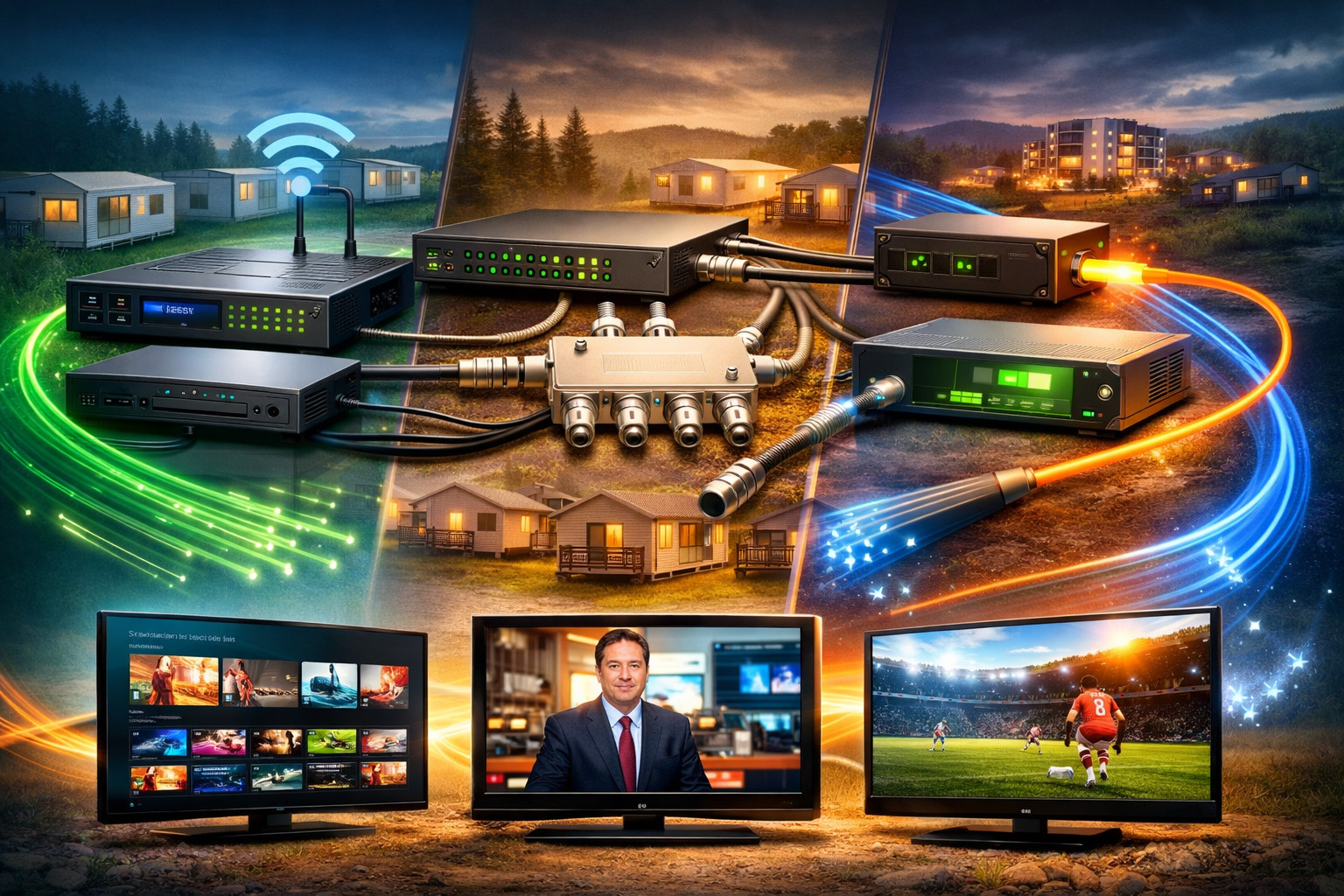
How to Distribute TV Channels in a 500-Person Camp: IPTV vs RF vs RF over Fiber

How to Distribute TV Channels in a 500-Person Camp: IPTV vs RF vs RF over Fiber

Choosing the right TV distribution system for a large camp, remote worker housing site, lodge, or hospitality property can have a major impact on cost, reliability, picture quality, and long-term maintenance. This guide compares the most practical approaches and explains why CATV RF over coax, often paired with RF over fiber, is usually the best fit.

When a project calls for 20 or more TV channels across dozens or even hundreds of rooms, the first question is usually whether to use IPTV or RF over coax . Both approaches can work, but they are not equal in every environment. A 500-man camp is a perfect example: the layout is large, infrastructure is often mixed, distances can be long, and the system must be reliable for daily use.

Table of Contents

  • Approach 1: IPTV Over Wired Copper LAN Using UDP Multicast
  • Approach 2: IPTV Over Wi-Fi Using HLS or Other Unicast Delivery
  • Approach 3: CATV RF Over Coax Using Digital QAM or ATSC Modulators
  • Approach 4: Hybrid RF Over Fiber for Long Distances
  • Cost Comparison Summary
  • What We Recommend for a 500-Man Camp
  • When IPTV Still Makes Sense
  • Final Thoughts
Short version: If the site already has coax in the rooms or trailers, the best-value solution is usually H-THUNDER-8 -based digital RF over coax. If the camp is spread out, add RF over fiber between buildings and continue with local coax distribution at each destination.

Approach 1: IPTV Over Wired Copper LAN Using UDP Multicast

In a proper wired LAN environment, IPTV is often delivered as UDP multicast . This means an encoder creates one multicast stream per channel, and the network delivers that channel only to the devices that request it. On a managed switch with IGMP support, this is an efficient way to move many TV channels without replicating traffic to every port.

How it works

  • HDMI sources feed an IPTV encoder such as the H-HDPerformux-24 .
  • The encoder generates UDP multicast streams for each channel.
  • A wired copper Ethernet network distributes the channels.
  • Each TV location uses an IP decoder or set-top box such as the H-STB-IP .
Main advantage: Multicast IPTV over wired LAN is efficient and scalable. One stream can serve many viewers without creating a separate stream for every TV.

Pros

  • Very scalable when the wired network is designed correctly.
  • Clean centralized architecture.
  • Easy to expand channels later.
  • Good for campuses, hotels, hospitals, and enterprise networks with strong IT support.

Cons

  • Requires a proper wired copper LAN with managed switches and IGMP.
  • Requires a decoder or compatible client at each TV.
  • Higher per-TV hardware cost than RF coax systems.
  • More IT involvement than a standard RF headend.

Typical budget level: For 20 channels, a 24-channel IPTV encoder such as the H-HDPerformux-24 has a MAP price of about $6,995 , and each H-STB-IP adds additional per-TV cost. For large TV counts, this cost grows quickly.

Approach 2: IPTV Over Wi-Fi Using HLS or Other Unicast Delivery

Many integrators assume that if a site already has strong Wi-Fi coverage, it makes sense to run TV over wireless. In practice, this is where many projects become more complicated than expected.

Important: Standard multicast IPTV is generally not the best fit for Wi-Fi distribution. Wireless networks do not handle multicast as efficiently or predictably as a wired LAN. For that reason, Wi-Fi TV systems typically need HLS or another unicast method .

How it works

  • The encoder still creates IPTV streams.
  • A gateway such as the H-IPTV-HD-GATEWAY converts multicast to HLS/unicast.
  • Each TV or set-top box requests its own stream individually.
  • The H-STB-IP can then display the requested channel.

Why this costs more

In a multicast design, one stream can serve many viewers. In an HLS/unicast design, the server may need to generate separate sessions for many devices. That means more processing, more traffic, and more hardware at the headend and at the edge.

Pros

  • Can work where no coax exists and only Wi-Fi is available.
  • Flexible and modern IP-based architecture.
  • Possible to isolate TV traffic on its own VLAN or SSID.

Cons

  • Higher bandwidth demand than multicast over copper LAN.
  • Requires a gateway/server in addition to encoders.
  • Requires set-top boxes at every TV.
  • More complex configuration and maintenance.
  • More dependent on RF conditions inside the Wi-Fi environment.

Typical budget level: A Wi-Fi IPTV headend using the H-HDPerformux-24 and H-IPTV-HD-GATEWAY starts around $16,990 MAP before adding set-top boxes. Then each H-STB-IP adds about $169 MAP per TV.

Approach 3: CATV RF Over Coax Using Digital QAM or ATSC Modulators

For camps, lodges, worker housing, hospitality, and other multi-room properties, digital RF over coax remains the most practical and cost-effective solution in many real-world jobs. It is especially attractive when the rooms or trailers are already wired with coax.

How it works

  • HDMI sources feed RF modulators.
  • The modulators generate digital TV channels over coax.
  • The TVs tune those channels directly, similar to a cable TV system.

For this type of deployment, a strong choice is the H-THUNDER-8 , which provides 8 channels per unit. Three units support a 20-channel system with spare capacity.

Why digital RF is different from old analog systems

Many people compare RF to the poor analog modulators they used years ago. That is not the same thing. In analog systems, picture quality gradually gets worse as noise and loss increase. In digital QAM or ATSC systems, the result is very different: you typically get a clean picture until the signal drops below threshold, at which point you see pixelation or loss of lock instead of a constantly soft, noisy image.

Pros

  • No set-top box required in many applications.
  • Lowest cost per TV when coax is already present.
  • Simple installation and maintenance.
  • Very reliable in remote environments.
  • Excellent fit for camps, trailers, dorms, hotels, and headend-style distribution.

Cons

  • Requires coax distribution.
  • Less app-like flexibility than a pure IP deployment.
  • Long coax distances may require better design or fiber transport.

Typical budget level: Three H-THUNDER-8 units provide 24 channels total and land around $11,985 MAP for the main headend, before standard splitters and amplifiers.

Recommended RF Modulator

H-THUNDER-8

8-channel HDMI to digital RF modulator for QAM/ATSC style coax distribution.

Optional RF Splitter

H-SP-1x8

Used for local coax distribution from the headend or from the receiver side of an RF over fiber system.

Optional RF Amplifier

H-RF-AMP-30

Useful where local coax distribution needs additional gain after splitting.

Approach 4: Hybrid RF Over Fiber for Long Distances

Large camps and multi-building properties often have one main equipment room but many separate destinations. That creates a problem for coax-only designs: long coax runs introduce attenuation, which can force the use of multiple amplifiers and make balancing more difficult.

This is where RF over fiber becomes the ideal companion to a digital RF headend.
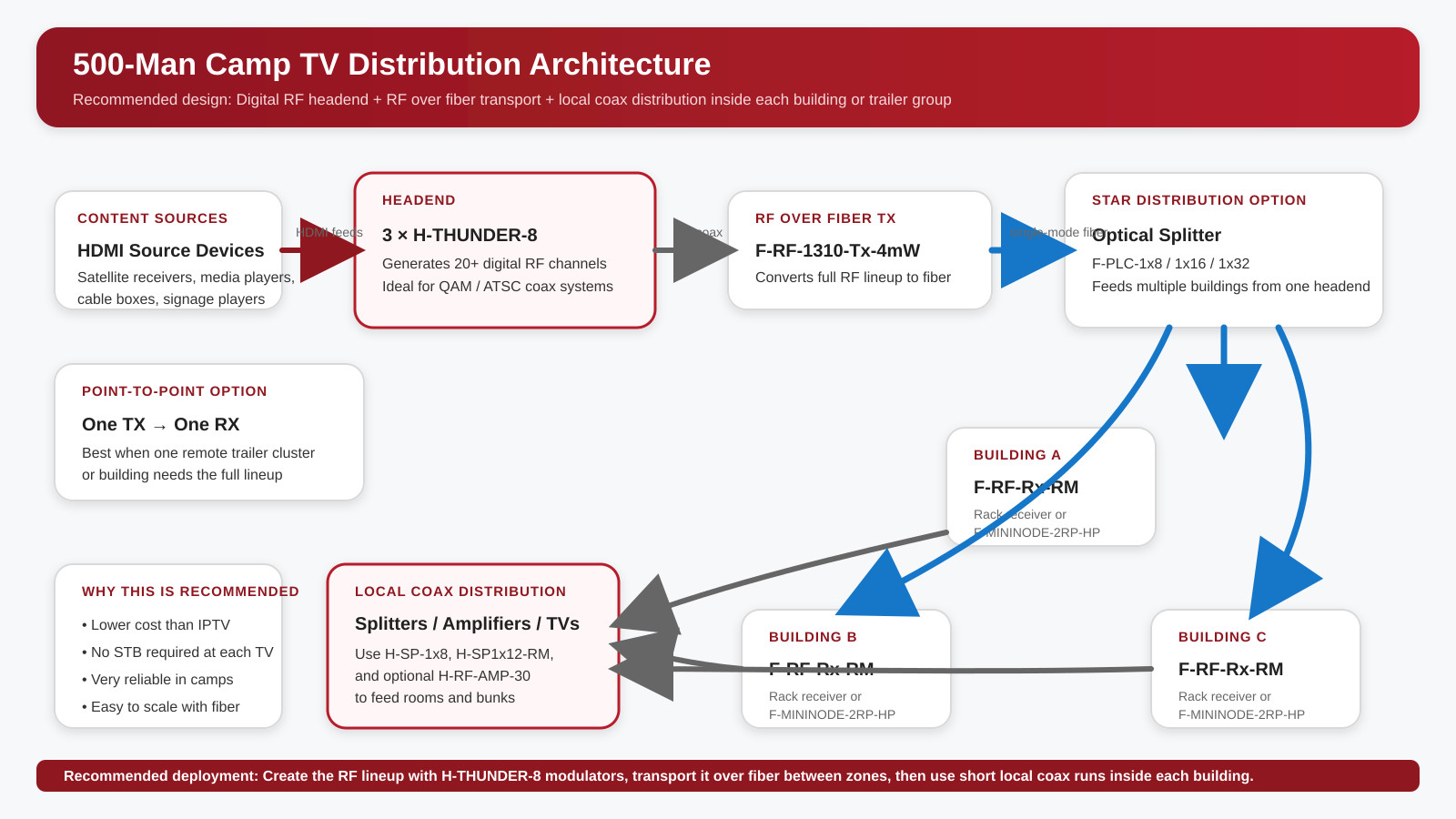
How RF over fiber works

  • The RF lineup from the modulators is combined and fed into an optical transmitter.
  • The transmitter converts the RF spectrum into an optical signal.
  • The signal travels over single-mode fiber with very low loss.
  • At the destination, an optical receiver converts it back to RF.
  • Local coax distribution starts from that receiver.

Typical architecture: headend modulators feed RF over fiber, then receivers feed local coax networks in each building or zone.

Point-to-point RF over fiber

This is the simplest version. One transmitter sends the complete RF lineup to one receiver. It is excellent when a main headend needs to feed one remote trailer cluster or building.

  • F-RF-1310-Tx-4mW for the transmit side
  • F-RF-Rx-RM for a rack-mount receive location
  • Optionally use the F-MININODE-2RP-HP where a field-style receiver is preferred

Star configuration RF over fiber

In a larger site, one transmitter can feed an optical splitter and then serve multiple destinations. This star design is ideal when one headend must serve several separate buildings, bunkhouses, or trailer groups.

  • Transmitter: F-RF-1310-Tx-4mW
  • Optical splitter: F-PLC-1x8 or larger as needed
  • Receivers at each destination: F-RF-Rx-RM or F-MININODE-2RP-HP

Pros

  • Excellent for long distances between the headend and buildings.
  • Cleaner than trying to push RF long distances on coax alone.
  • Very scalable.
  • Works perfectly with digital RF modulators.

Cons

  • Higher upfront cost than coax-only distribution.
  • Requires fiber infrastructure or new fiber installation.

Typical budget level: A basic point-to-point RF over fiber transport using the F-RF-1310-Tx-4mW and F-RF-Rx-RM starts around $3,845 MAP as an add-on to the RF system.

Cost Comparison Summary

Approach Best Fit Main Hardware Relative Cost Main Limitation
IPTV over Wired LAN Properties with structured copper Ethernet and IT support Encoder + IP decoders High Per-TV decoder cost and network requirements
IPTV over Wi-Fi using HLS Sites with no coax and strong Wi-Fi coverage Encoder + gateway + STBs Very High Higher complexity and headend load
Digital RF over Coax Camps, hotels, dorms, trailers, worker housing RF modulators Low to Medium Needs coax distribution
RF over Fiber + Coax Large camps and multi-building properties RF modulators + optical TX/RX Medium Requires fiber infrastructure

What We Recommend for a 500-Man Camp

For most remote camps, the best real-world solution is:

  1. Use digital CATV RF modulators such as the H-THUNDER-8 to create the 20-channel lineup.
  2. Where distances are short and coax is available, distribute locally over coax.
  3. Where buildings are far apart, transport the RF lineup over fiber using the F-RF-1310-Tx-4mW and F-RF-Rx-RM or F-MININODE-2RP-HP .
Why this approach wins: It avoids the complexity and per-TV hardware cost of IPTV, it does not depend on Wi-Fi performance, and it provides a clean, professional, scalable system that is easy to maintain in remote environments.

When IPTV Still Makes Sense

IPTV is still valuable. If the site already has a strong wired LAN and the customer wants a fully IP-based ecosystem, multicast IPTV can be a strong choice. If the customer specifically needs wireless delivery and accepts the added headend cost, then an HLS gateway approach using the H-IPTV-HD-GATEWAY and H-STB-IP can work. It is simply not the lowest-cost or easiest solution for most camp-style jobs.

Final Thoughts

There is no single answer for every site, but for a large camp with 20 channels and many rooms, the technical and economic case is clear. Digital RF over coax is usually the best foundation , and RF over fiber is the right upgrade when the site gets large enough that coax-only distribution becomes inefficient .

If you are planning a camp, lodge, hotel, dormitory, or remote worker housing deployment, Thor Broadcast can help design the right mix of RF, fiber, and IPTV products for your exact layout.


Need a design or quote?
Contact Thor Broadcast for a recommended BOM, channel plan, and system layout using products like H-THUNDER-8 , F-RF-1310-Tx-4mW , F-RF-Rx-RM , H-IPTV-HD-GATEWAY , and H-STB-IP .
Justin White
Justin White
Broadcast Engineer
Broadcast engineer specializing in turnkey CATV and fiber-transport solutions. Experienced in designing and deploying complete encoding/decoding workflows to move virtually any signal over IP, fiber, and RF. Focused on ultra-low-latency headend architectures and custom mux/demux builds, supporting demanding environments across telecom, sports, education, hospitality, studios, live events, and mission-critical institutions worldwide.
View author page
Contact us

Thor Broadcast Sales

Email: [email protected]
Phone: 1(800)521-THOR (8467) Ext 1
FAX: 1(800)521-6384

Customer Service/ Support

Phone: 1-800 521-THOR(8467) Ext 2
Email: [email protected]

Case Studies

- Converting Clear QAM HDTV Channels to Analog RF NTSC for Multi-Site Distribution
- Stadium IPTV - Replay System
- Hotel HDMI-to-QAM TV Distribution
- University IPTV Lecture Systems

  • CATV Modulators:
    • HDMI RF Modulators
    • HD-SDI converters
    • IP to CATV Edge Modulators
  • DVB Encoders:
    • IPTV Video Encoders
    • Hdmi RTSP RTMP RTSP Encoders
    • Transcoders, MPEG Converters, IP ASI Gateways
  • Decoders (IRD's & STB's):
    • RF input - Video /Audio Ouput
    • IP Broadcast Decoders
    • RF CATV and IPTV OTT STB's
  • Satellite Modulators:
    • DVB-S/S2 Satellite Modulators
  • Fiber Optic Transport:
    • SDI Fiber Optic Extenders, Digital Audio Extenders
    • SDI SD/HD/3G with CWDM
    • Cable TV CATV RF 45-900Mhz
    • L-Band Satellite RF 45-3000Mhz
    • Data & Ethernet over fiber
    • Analog Audio Video
    • Fiber Amplifiers - EDFA
    • DVB - ASI
    • Fiber Jumpers, Cables, Attenuators,
    • Optic Splitters Couplers CWDM Muxes
    • Optical Meters, Test Equipment, Accesories
    • Analog Baseband Video Audio, RS485/422/232 Data, Contact Closure
  • HDMI SDI Switchers, LAN Extenders, and Wireless Video Transport:
    • HD Video Switchers and Signal Format Converters for AV Pros
    • Wireless HD SD Video Data Equipment
    • Video Audio Extenders Over Ethernet LAN IP Network
  • HD 4K Cameras, SDI - HDMI - IP Streaming - PTZ - Broadcast and Security:
    • PTZ Streaming Cameras Broadcast cameras with SDI ,HDMI CVBS USB
  • DIscounted Inventory:
    • Satellite and CATV Broadcast Equipment for Sale
    • Lab Used Broadcast Equipment on sale
    • Past Generation Equipment
  • SDI Monitors:
  • Warehouse:
Thor Broadcast Logo
Email: [email protected]
Phone: 1(800) 521-8467 Ext 1
FAX: 1(800)521-6384
Information:
  • About us
  • Client Portfolio
  • Become a Reseller
  • Contact
  • Articles
  • Return Policy
  • Shipping Policy
  • International Order Policy
Popular:
  • RF Modulator
  • HDMI over COAX
  • HDMI over IP
  • COAX to HDMI
  • HDMI to SDI

Thor Broadcast
Torrance Business Park
2421 W 205th St
Torrance
CA 90501

© 2026 Thor Broadcast
Subscribe to our newsletter

Sign up here to get the latest news, updates and special offers delivered directly to your inbox.

You can unsubscribe at any time
newsletter image