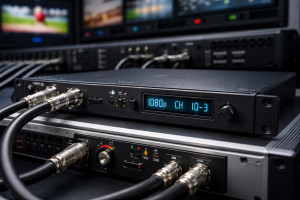
Learn how RF modulators, HDMI modulators, and HDMI RF modulators work for professional AV systems. Complete guide by Thor Broadcast.
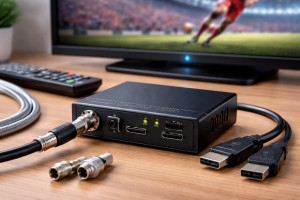
Need HDMI from coax? Learn how coax-to-HDMI converters decode RF signals, where they’re used, and how to pick the best option for your setup.
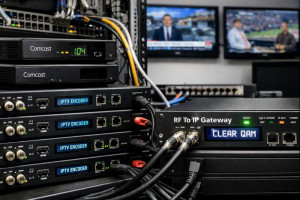
Clear vs Encrypted QAM: why Comcast often needs STBs + HDMI encoders for IPTV, and when a hybrid coax/IP headend is best.

Modern campus IPTV: Thor encodes lectures to low-latency multicast, decodes anywhere, extends via SRT/HLS.
HDMI-to-QAM headends for hotels: universal TV compatibility, no set-top boxes, low upkeep.
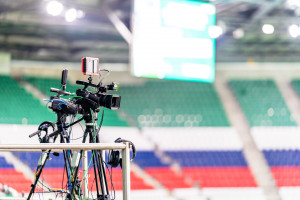
Ultra-low-latency IPTV and replay distribution for stadium-wide synchronized HD video.

This article is aimed at broadcast professionals. It explains how HDMI modulators can help get signals from cameras and video mixers to screens or other devices, especially in large venues like stadiums.
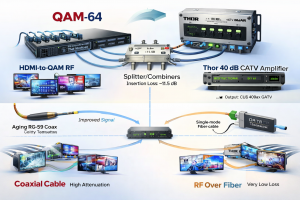
Fixing Channel Loss on Long Coax Runs (RF QAM or ATSC )| Thor Broadcast Case Study Technical Case Study • CATV/QAM over Coax • RF Level + MER Troubleshooting
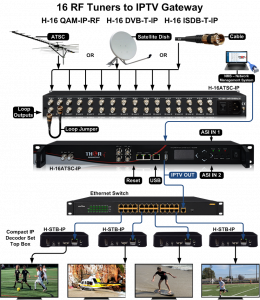
Case study: stream ATSC antenna channels over LAN with < 500ms latency using Thor Broadcast’s 16-channel ATSC to IP gateway.
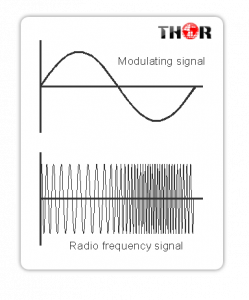
RF still matters. Learn QAM and ATSC basics, frequency planning, MER/SNR, and how HDMI/SDI modulators power modern CATV.
12G SDI over fiber is one of the most robust options for broadcasters to meet the capabilities that need to be achieved, changing with the always-evolving 4K and 8K landscape.
Technologies such as 3G SDI, HD-SDI, and 12G SDI over fiber are really very current today, considering that HD and UHD contents are one of the building blocks of most broadcasts.
Below is an explanation of just exactly what an SDI multiplexer is, how it works, and how such a device could simplify the management of video signals by combining them into one stream.
SDI fiber extenders revolutionize broadcasting by taking the ability to keep video signals far greater distances without compromising the quality.
This paper emphasizes some advantages of the 3G-SDI over fiber in live broadcasting to treat the users better in streaming.
The broadcasting industry upgrades itself now and then to support 4K and 8K video data requirements through new technologies. Some of those waves of new technologies include 12G SDI over fiber.

In the face of rapid development, high-quality video transmission stands as one of the highest requirements within the broadcasting industry.
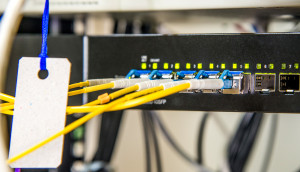
With constant changes in the world of broadcasting, the need for high-quality video transmission over large distances has become highly critical.

 ES
ES