| Availability: | In stock | Condition: | new |
|
| Shipping: | starting at $0.00 | Warranty: | 2Yrs |
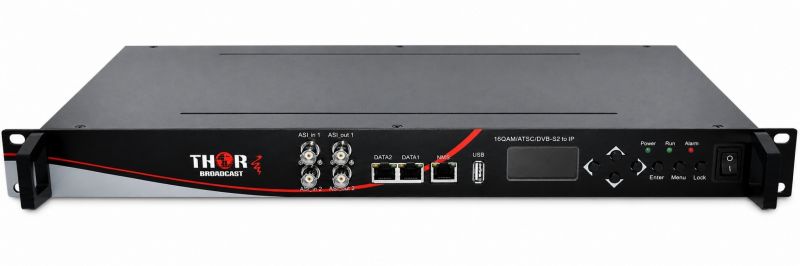
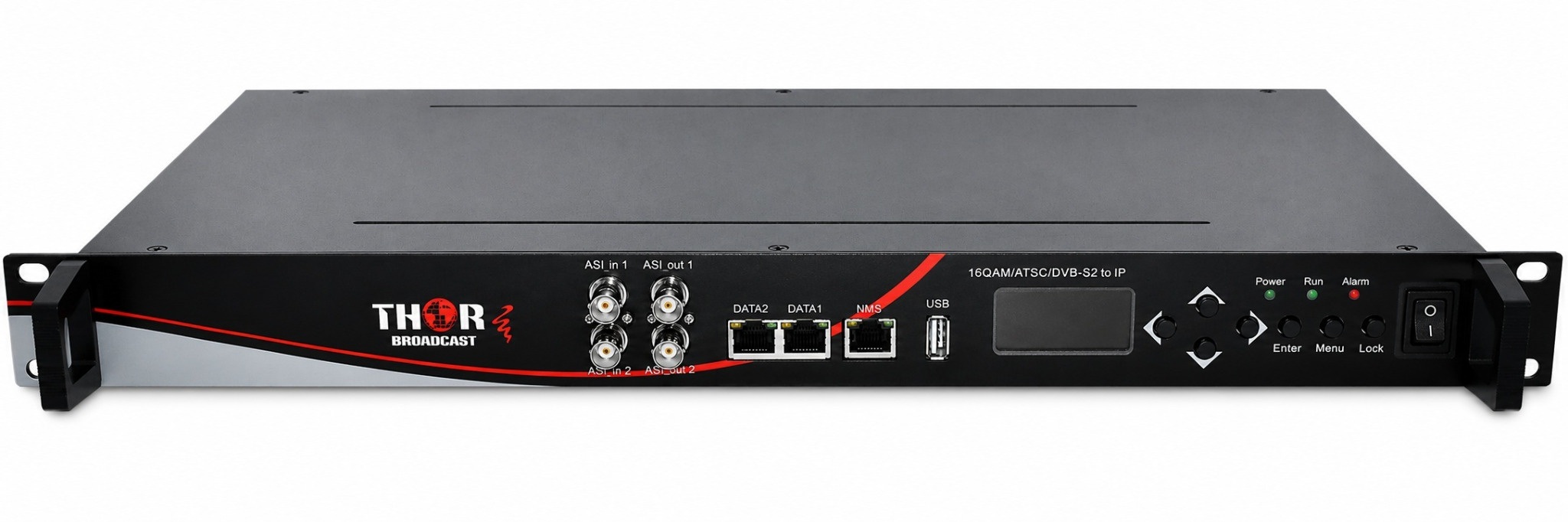
The Thor Broadcast H-8ISDB-T-IP is a professional 8 tuner ISDB-T terrestrial broadcast gateway designed to receive digital TV signals from an off-air antenna and convert the selected TV services into IPTV streams for distribution over a LAN network. This model is made for countries using ISDB-T or ISDB-T International, also known in some regions as ISDB-Tb or SBTVD.
ISDB-T stands for Integrated Services Digital Broadcasting - Terrestrial. It was originally developed in Japan for digital terrestrial television and later expanded internationally, especially across Latin America. The standard is known for its segmented transmission structure, mobile reception support, and stable performance in challenging terrain and urban environments.
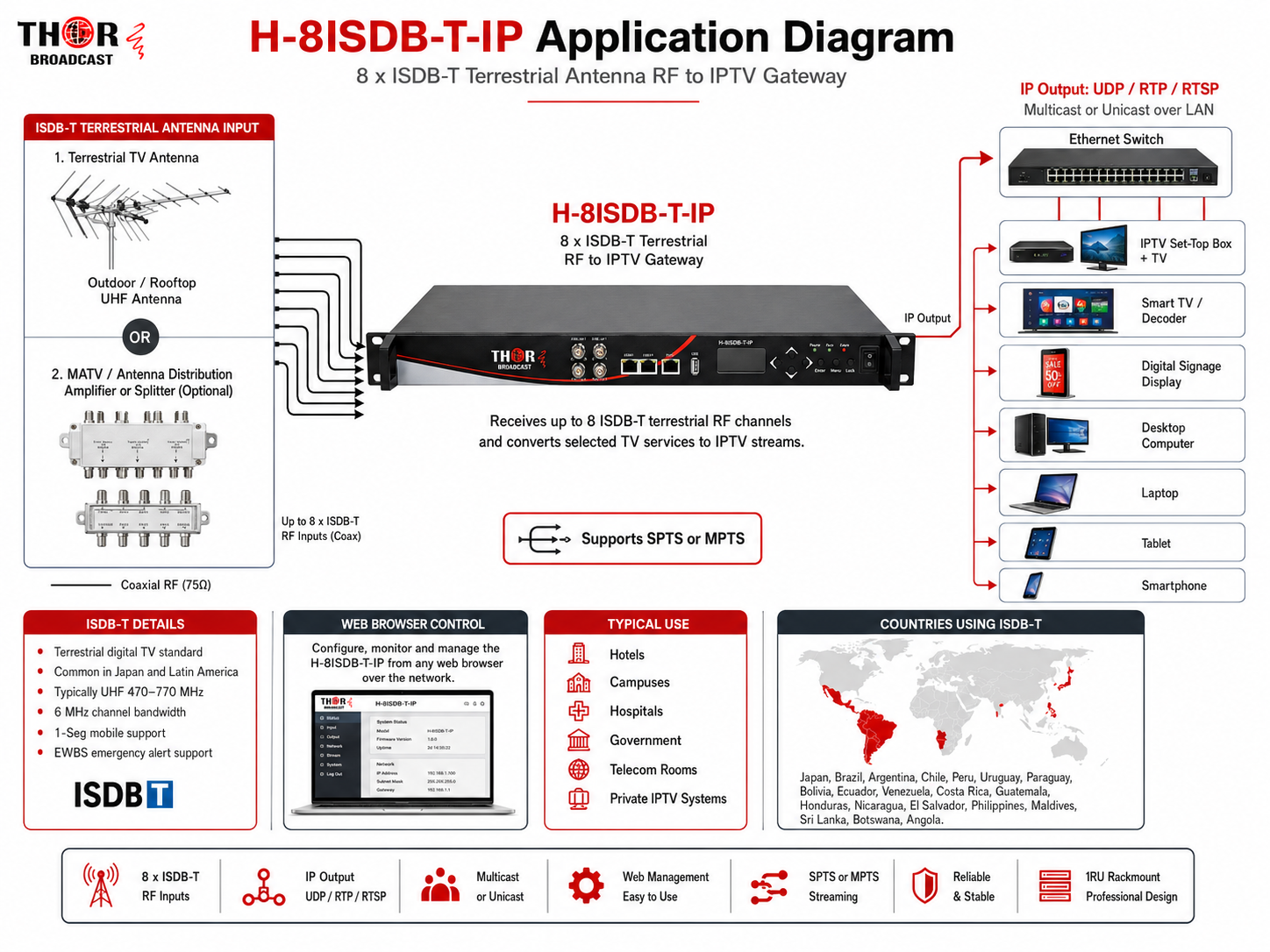
The H-8ISDB-T-IP receives ISDB-T RF channels from a rooftop antenna, MATV antenna system, or terrestrial RF distribution network. Each of the 8 tuners can be assigned to a different ISDB-T RF channel. Once the unit locks to the selected broadcast frequencies, it reads the transport stream inside each channel and makes the available TV services ready for IP output.
This allows local ISDB-T broadcast channels to be delivered to IPTV set-top boxes, smart TV decoders, monitoring computers, digital signage players, IPTV servers, or other network video devices. Instead of placing a separate ISDB-T receiver at every display, the RF reception can be centralized in the headend and distributed over Ethernet.
ISDB-T is a digital terrestrial television system used for free-to-air broadcast TV. Like ATSC, DVB-T/T2, and other terrestrial standards, ISDB-T uses antenna RF signals, but it has its own modulation structure and receiver requirements. One important feature of ISDB-T is that each 6 MHz channel is divided into 13 segments, allowing different types of services to be carried inside the same RF channel.
In many markets, ISDB-T can carry HDTV, SDTV, audio services, data broadcasting, and mobile/portable services. The mobile portion is commonly known as 1-Seg, which was designed for handheld and portable reception. ISDB-T also supports emergency warning broadcast features in countries where that function is implemented by broadcasters.
ISDB-T is strongly associated with Japan and Latin America. Japan developed the original ISDB-T standard, while Brazil developed the international version often called ISDB-Tb or SBTVD. Many Latin American countries adopted this international version for digital terrestrial television. ISDB-T has also been adopted or selected in parts of Asia and a few African markets. Always confirm the customer’s local broadcast standard before ordering, because ISDB-T receivers are not interchangeable with ATSC, DVB-T/T2, QAM, or DVB-S/S2 systems.
Some countries may be in partial deployment, regional rollout, or transition from older analog systems. For professional system design, the RF channel plan, modulation format, and local broadcaster configuration should be verified before installation.
ISDB-T terrestrial broadcasts commonly use UHF television spectrum. The exact channels depend on the country, but ISDB-T is commonly associated with 6 MHz RF channels in the UHF band.
Because spectrum rules vary by country, the actual usable RF range may be different in each market, especially where upper UHF channels have been reassigned to mobile broadband services.
An ISDB-T antenna system receives the local terrestrial TV broadcasts and sends the RF signal by coax to the H-8ISDB-T-IP. The unit tunes up to 8 ISDB-T RF channels, demodulates the transport streams, identifies the available services, and outputs the selected programs as IPTV streams through the Ethernet port.
The IP streams can be configured for multicast distribution when many endpoints need the same channel lineup, or unicast delivery for direct streaming to individual devices. In larger IPTV systems, managed network switches with proper IGMP support are recommended for reliable multicast performance.
The H-8ISDB-T-IP is for ISDB-T terrestrial antenna signals only. It is different from the H-8ATSC-IP for North American 8VSB off-air TV, the H-8DVB-T-IP for DVB-T/T2 regions, the H-8QAM-IP for clear cable QAM, and the H-8DVBS-IP for satellite DVB-S/S2. The correct model must match the actual RF broadcast standard used in the installation country.
The Thor Broadcast H-8ISDB-T-IP is an 8 tuner ISDB-T antenna RF to IPTV gateway for professional terrestrial TV distribution. It receives ISDB-T broadcast channels from an antenna system and converts the selected services into multicast or unicast IP streams for LAN delivery. With 8 RF tuners, SPTS/MPTS support, ASI connectivity, web-based management, and a compact 1RU rackmount design, the H-8ISDB-T-IP is a practical solution for ISDB-T countries that need to move local terrestrial TV into an IPTV network.
ISDB-T was developed in Japan, while Brazil’s ISDB-T International version is widely used in Latin America; common references list Japan, the Philippines, Brazil, Argentina, Chile, Peru, Uruguay, Costa Rica, and others as ISDB-T markets. ISDB-T commonly uses 6 MHz channels in the UHF band around 470 to 770 MHz, with a 13-segment transmission structure
| Model | Description | Input |
|
H-8ATSC-IP |
8 x ATSC Antenna Tuners to IPTV |
8 x ATSC Antenna |
|
H-8QAM-IP |
8 x CABLE QAM Tuners to IPTV | 8 x CABLE QAM |
|
H-DVBS2-IP |
8 x Satellite S2 Tuners to IPTV | 8 x Satellite S2 |
|
H-DVB-T-IP |
8 x DVB-T Tuners to IPTV | 8 x Satellite S2 |
|
H-ISDB-T-IP |
8 x ISDB-T Tuners to IPTV | 8 x Satellite S2 |
| H-8ATSC-IP-8ATSC H-8ATSC-IP-8QAM H-8QAM-IP-8ATSC H-8QAM-IP-8QAM H-8DVBS-IP-8ATSC H-8DVBS-IP-8QAM H-8DVBS-IP-8DVBT H-8DVBT-IP-8QAM |
8 ATSC to 8 ATSC and IP out 8 ATSC to 8 QAM and IP out 8 QAM to 8 ATSC and IP out 8 QAM to 8 QAM and IP out 8 DVBS/S2 to 8 ATSC and IP out 8 DVBS/S2 to 8 QAM and IP out 8 DVBT to 8DVB-T and IP out 8 DVBT to 8QAM and IP out |
| *All Specifications Subject to Change Without Notice | ||||
|
PN: H-8ATSC-IP PN: H-8QAM-IP PN: H-8DVBS-IP PN: H-DVB-T-IP PN: H-ISDB-T-IP |
8 x ATSC Antenna 8 x Cable QAM 8 x Satellite S2 8 x DVB-T Antenna 8 x ISDB-T Antenna |
||
|
All HD and SD | |||
|
MPEG-2 HD 1.5-19.5 Mbps H.264 HD 0.8-19.5 Mbps |
|||
|
MPEG-1 Layer II MPEG-2 AAC MPEG-4 AAC AC3 Dolby |
|||
|
48 kHz | |||
|
64 kbps, 96 kbps, 128 kbps, 192 kbps, 256 kbps, 320 kbps | |||
|
ATSC, DVB-C, DVB-S2 (model dependent) | |||
|
30-960 MHz for QAM and ATSC, 850-2100Mhz for L-band | |||
|
5-35 dBmV | |||
|
MPTS over UDP, RTP/RTPS out as mirror of ASI output (RJ45) | |||
|
100-240 VAC Auto-Switching ~ 20 W |
|||
|
19 x 9 x 3 Inches | |||
|
6 Pounds | |||
|
32-110 F | |||
This is the perfect solution for you: 8 x ATSC or Satellite Antenna Tuners to IPTV & ASI Output H-8QAM-IP H-8ATSC-IP. Or this one: 4 x Satellite or ATSC IRD Decoder to IP, ASI H-IRD-V4-ATSC H-IRD-V4-QAM. This is a link: https://thorbroadcast.com/product/4-x-satellite-or-atsc-ird-decoder-to-ip-and-8230.html
Thanks for reaching out about the H-8ATSC-IP.
This is simply a gateway, you would not be able to change any of the data rates of video protocols. However you can cherry pick your channels from 8 Major's of your choosing. We do have IP to RF Edge QAM devices, but if your Exciter only accepts ASI and TSoIP, then I would think you can use the UDP or RTP streams from the 8ATSC-IP model. However all of this would still remain in MPEG2, the original CATV channels you pull from the OTA. If you want those channel in H264 you would need to decode then encode those particular channels. There isn't an efficient or easy way to transcode at a high density, I would think that you would want to do that prior to hitting your IP radio link so you can subsequently capture more sub-channels prior to the IP conversion. There is a rather common solution, albeit not elegant; utilizing standard STB's to capture the RF ATSC programs, output via HDMI and into high density encoders which output H264. https://thorbroadcast.com/product/qam-catv-rf-and-atsc-rf-to-hdmi-decoder-stb-8230.html https://thorbroadcast.com/product/4-8-16-24-hdmi-iptv-streaming-8230.html/216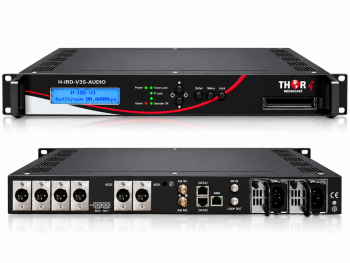 H-IRD-V3S-AUDIO - Professional Dual-Program Satellite & IP Audio Decoder
Professional dual-program audio decoder with DVB-S/S2/S2X, ASI and IP inputs, balanced XLR, AES/EBU and UDP/RTP SPTS outputs.
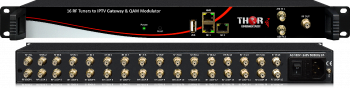 16 RF Tuners to IPTV TS & RF Transmodulator Output
The transmodulator is a multi-standard RF CATV device used for the multi-conversion of digital transmissions, supporting QAM, ATSC, and satellite DVB-S/S2, as well as DVB-T, DVB-C, and ISDB-T for both inputs and outputs. It facilitates various modulation conversions, such as ATSC to QAM, QAM to ATSC, QAM to QAM, DVB-S/S2 to QAM, DVB-S/S2 to ATSC, DVB-S/S2 to DVB-T, and DVB-S/S2 to ISDB-T.

 ES
ES