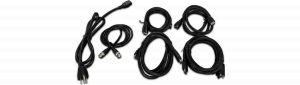
| Availability: | In stock | Condition: | new |
|
| Shipping: | starting at $0.00 | Warranty: | 2Yrs |
Low-Latency, HDCP Compliant HDMI, MPEG2 and H.264 Video Encoding, Dolby AC3 Audio Encoding
QAM, ATSC, DVB-T, ISDB-T Modulation
PN: H-4ADHD-QAM-IPLL
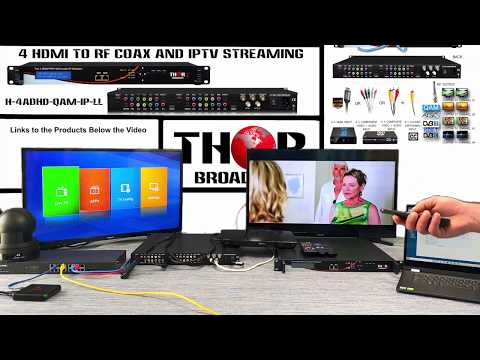
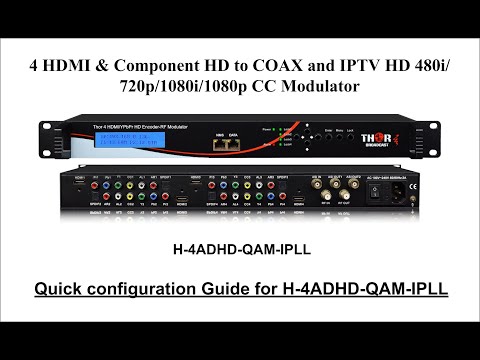
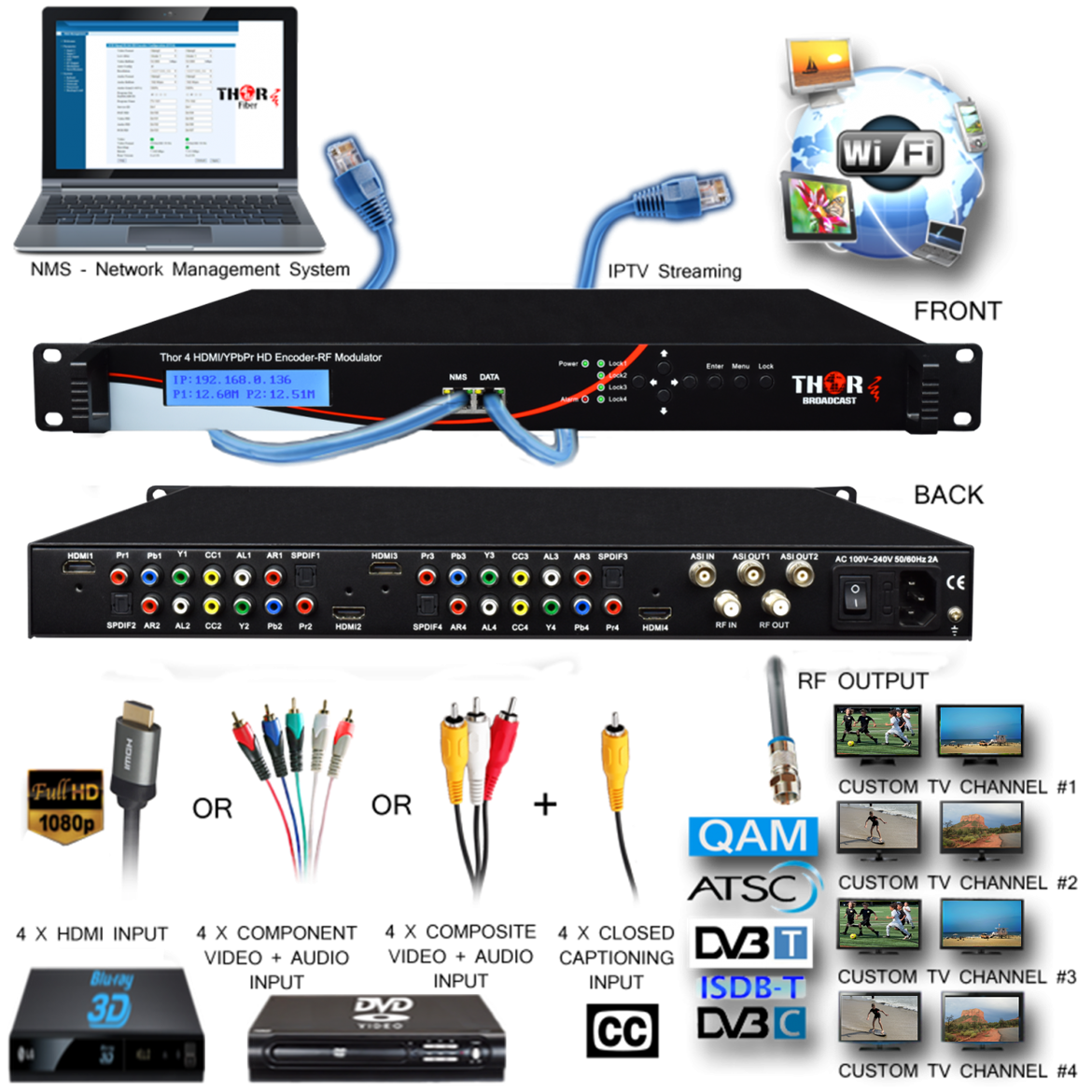
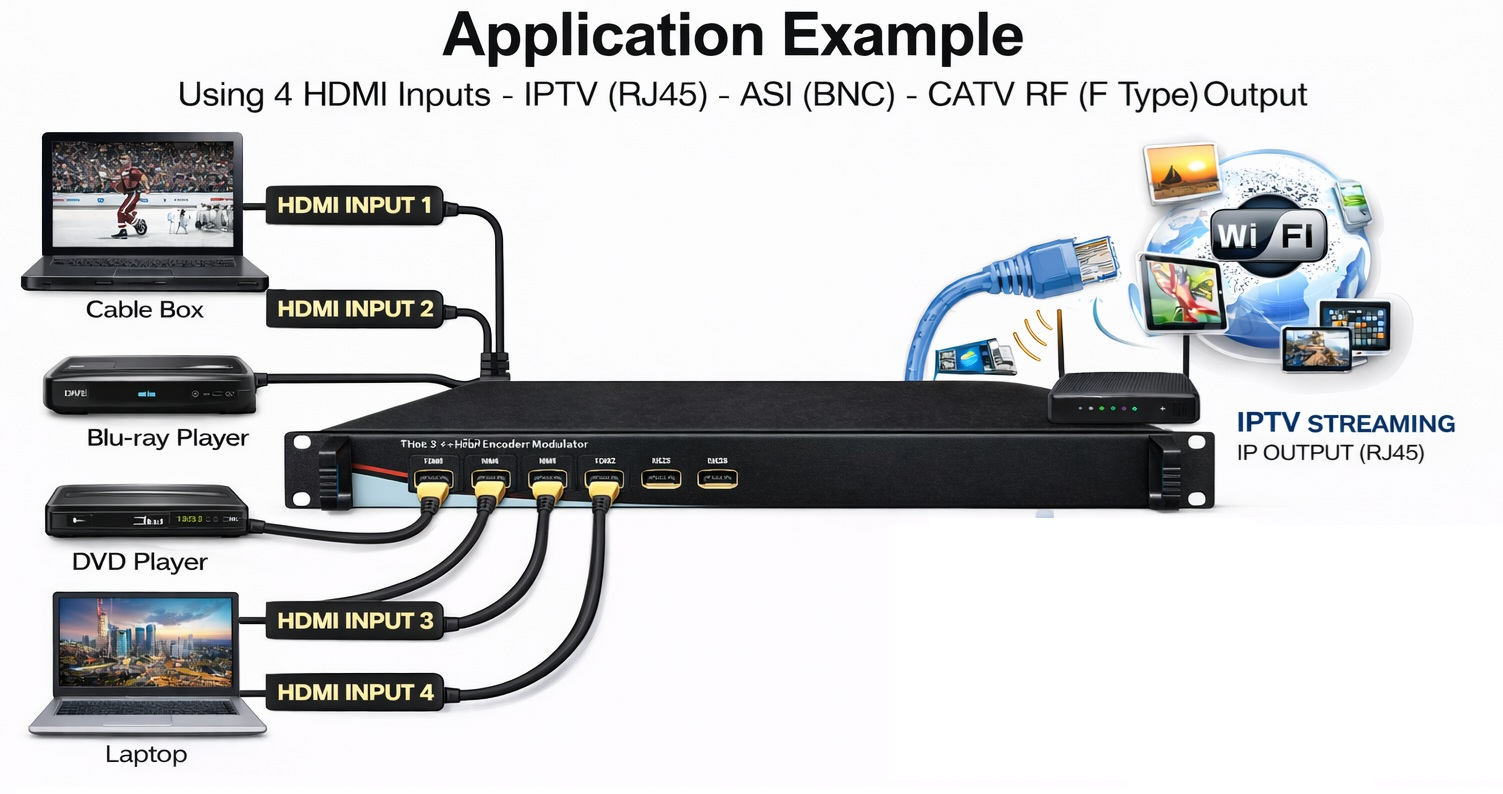
The H-4ADHD-XXX-IPLL modulator family from Thor Broadcast is designed to handle even more applications than any other 4-channel chassis system that has come before. This HDMI to COAX Modulator has all the previous award-winning features found in Thor Broadcast Modulators, as well as several new additional functions for added applications and flexibility. Our HDMI to COAX Converter provides 5 full RF carrier outputs for generating channels from content ingested through the ASI input. Encoding in either MPEG-2 or H.264 is provided for 4 crystal-clear video streams up to 1080p60 each.
Bitrate is fully adjustable from 1.5 - 19 Mbps, and a variety of audio codecs are available. Standard audio encoding in MPEG-2 AAC and MPEG-4 AAC are provided, as well as a licensed Dolby AC/3 audio codec. Audio sources can be selected from either embedded HDMI or Analog AV RCA ports. For Surround Sound, digital audio inputs can be set to "pass through" mode to preserve 5.1 and 7.1 audio that is encoded already in Dolby compatible format. Two mirrored ASI outputs are provided for broadcasters for added flexibility in distributing the content generated by the 4 encoders.
This HDMI to COAX Splitter is an ideal solution for professional stadiums and live events. It is used in more collegiate stadiums for sports and distribution than any other model.
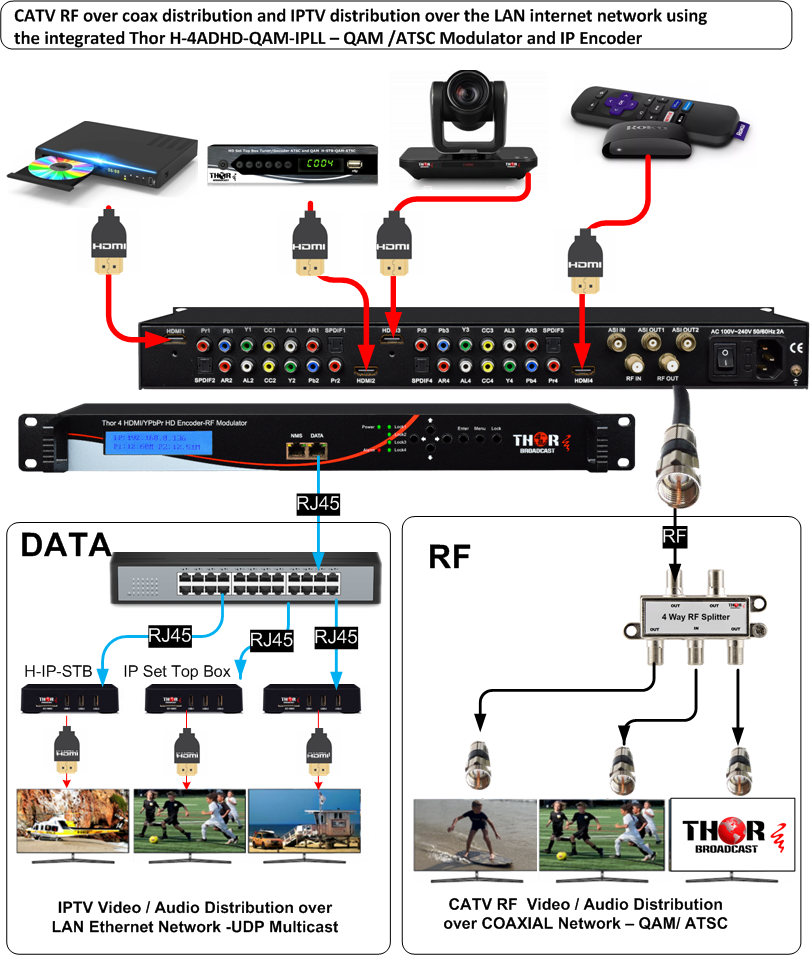
Programs input via ASI can also be multiplexed and remapped to the ASI output, adding yet another function to the unit as an ASI multiplexer. IPTV is not neglected in any way. All four encoded programs can be mapped to unique IP address outputs and ports in either UDP or RTP format. The IP output can be configured to strip null packets to reduce network bandwidth or preserve the constant bit rate (CBR) packet stuffing normally preferred by television systems. All four channels can be independently configured for either multicast or unicast outputs. Closed captioning is supported on a dedicated analog 608 CC port with RCA connector, an industry standard for line 21 captioning systems. Any 720 or 1080 line standard video signal in either HDMI or Component YPbPr format can be used for each of the four channels. This box also supports 480i for older TVs over RG6 RF coaxial cables. Just like all other professional Thor modulator chassis, this system can be configured with firmware for either QAM, DVB-C, DVB-T, or ATSC channel format output.

|
Additional Model Selection: |
We can program our modulators to any available RF modulation format: |
|---|---|
| H-4ADHD-QAM-IPLL | QAM "Cable" DVB-C RF output |
| H-4ADHD-ATSC-IPLL | ATSC " Off Air " RF output |
| H-4ADHD-DVBT-IPLL | DVB-T RF output |
|
H-4ADHD-ISDBT-IPLL |
ISDB-T RF output |
| WEIGHT: 12.7 lb BOX SIZE (IN): 22.5 x 22.5 x 5.25 in BOX SIZE (MM): 572 x 572 x 134 mm UNIT SIZE (IN): 19 x 16 x 2 in UNIT SIZE (MM): 483 x 407 x 51 mm |
|||
|
*All Specifications Subject to Change Without Notice |
|||
|
Input |
4 HDMI & 4 YPbPr up to 1080P60, 4 CVBS up to 480I |
||
|
Supported Resolutions |
1280x720P 60 / 59.94 / 50 Hz 1920x1080I 60 / 59.94 / 50 Hz 1920x1080P 60 / 59.94 / 50 Hz CVBS input supports 480I only |
||
|
Video Codecs |
MPEG-2 HD: 1.5-19.5 Mbps H.264 HD: 0.8-19.5 Mbps |
||
|
Audio Codecs |
MPEG-1 Layer II Encoding AC3 Dolby Encoding Also: Supports DD AC3 (2.0/5.1/7.1) passthrough for HDMI interface only |
||
|
Audio Sample Rate |
48 kHz |
||
|
Audio Bit Rates |
64 kbps, 96 kbps, 128 kbps, 192 kbps, 256 kbps, 320 kbps |
||
|
Modulation Standard |
QAM - J.83A, J.83B, J.83C. Firmware for ATSC or DVB-T ISDBT available |
||
|
RF Frequency Range |
30-960 MHz, 1 KHz Step |
||
|
RF Power Level |
5 - 35 dBmV Adjustable |
||
|
DVB-ASI Output |
BNC Connector: 1-60 Mbps MUXED MPTS |
||
|
DVB-ASI Input |
BNC Connector: 1-120 Mbps. Programs selected by PID. Programs muxed to all outputs |
||
|
IPTV Output |
MPEG-TS MPTS over UDP, RTP/RTSP Unicast, and Multicast supported 4 separate SPTS's 1 Muxed MPTS |
||
|
Cables Included Closed Captioning |
CC 608 via Analog Input |
||
|
Power Input |
100-240 VAC Auto Switching |
||
|
Operating Temperature |
32-110 F |
||
Our 4 ch H-4ADHD-QAM-IPLL worked on the Comcast system as an inserted channel. We have simple GUI instructions on how to set it up, we can percent it everything before the shipping, so it would be just plugged and play. We have also other similar modulators for 1,2,8 and 12channels. We have great flexible products and technical support Please check those units for your reference 2 HDMI Modulator https://thorbroadcast.com/product/2-hdmi-ypbpr-hd-digital-tv-modulator-qam-atsc-dvb-t-8230.html 8 HDMI/SDI modulator https://thorbroadcast.com/product/8-channel-hdmi-and-sdi-clear-catv-rf-modulator-qam-8230.html 12 HDMI modulator https://thorbroadcast.com/product/catv-rf-modulator-hdmi-multiplexer.html/37
That is an excellent choice, and for the RF output option you'd most likely go with QAM.
DVBT is a foreign standard, and since you mention you're in AZ, that won't work for you.
ATSC is standard 8VSB off-air antenna, so modulators can be used in this standard if you have an antenna RF infrastructure and then would like to add some custom cable channels of your own. So QAM is your best bet; my assumption is that is what your Blonder Tongue units are. Oddly enough, I researched that model and it is actually NTSC, which is the old analog variety of RF. So I'm not sure if you can purchase those in QAM or ATSC, or if they are only NTSC. The easy answer to find out is if you go to a TV on premise and do a channel scan to find channels on the coax plugged in the back, do you do Cable Scan or Off air Scan?
- Okay, so then they are QAM units. So the H-4ADHD-QAM-IPLL is the unit you'd want to select.
An IP TV UDP output from an IP encoder can be used in several ways. Some common examples include:
Overall, the specific use for the IP TV UDP output from an IP encoder will depend on the user's specific needs and requirements.
Please review the following options: 1) H-4ADHD-QAM-IPLL: 4-channel HDMI QAM modulator/IP Encoder with QAM latency around 300ms and IP latency of approximately 800ms. 2) H-4SDI-QAM-IPLL: 4-channel SDI QAM modulator/IP Encoder with QAM latency around 300ms and IP latency of approximately 800ms. https://thorbroadcast.com/product/1-4-sdi-to-qam-modulators-and-iptv-streaming-encoders.html/0 3) If latency is not a concern, I suggest the H-THUNDER-8, an 8-channel QAM modulator with latency of about 500ms. https://thorbroadcast.com/product/1-4-or-8-hdmi-digital-rf-encoder-modulator-8230.html/239 4) Here is the link for the 16 or 24-channel IP encoder with a latency of 800ms. https://thorbroadcast.com/product/4-8-16-24-hdmi-iptv-streaming-8230.html/215 https://thorbroadcast.com/product/4-8-16-24-hdmi-iptv-streaming-8230.html/216 this is link to our IPTV STB's https://thorbroadcast.com/product/compact-ip-decoder-set-top-box.html
Yes, you can connect both the gateway and the encoder to the switch; it needs to be a smart switch with the IGMP protocol enabled.
IGMP works in a way that it keeps the streams in the switch's memory and passes the individual streams to the specific port where the stream was requested by any IP receiver or decoder.
This is a more detailed explanation of how IGMP works:
IGMP (Internet Group Management Protocol) is a communication protocol used to manage the membership of Internet Protocol (IP) multicast groups. IGMP is used by IP hosts and adjacent multicast routers to establish multicast group memberships. It plays a crucial role in enabling efficient network resource usage, especially for services like multicast video streaming. Here's a simplified explanation of how IGMP works with multicast video streams and how it helps preserve bandwidth while allowing video access to anyone on the LAN network:
Multicast Video StreamingMulticast Streaming: Unlike unicast streaming, where a separate copy of the video stream is sent to each requester, multicast streaming sends only one copy of the video stream to the network, regardless of the number of requesters. This method significantly reduces bandwidth usage.
Group Membership: Devices that wish to receive a specific multicast video stream will join a multicast group. The multicast group has a specific IP address that represents all devices interested in receiving the video stream associated with that group.
Joining a Group: When a device on the LAN wants to start receiving a multicast stream, it sends an IGMP message indicating its desire to join a specific multicast group.
Multicast Router: The local router receives the IGMP join request. The router then knows that it should forward traffic for that multicast group to the network segment where the request originated.
Leaving a Group: If the device no longer wishes to receive the multicast stream, it sends an IGMP leave message. If there are no more interested receivers on the LAN, the router stops forwarding the multicast stream to that network segment.
Periodic Queries: Multicast routers periodically send IGMP queries to discover if there are still devices interested in the multicast group. If no devices respond with a desire to remain in the group, the router assumes there are no interested receivers and stops forwarding the stream to that segment.
IGMP efficiently manages network resources by ensuring that multicast traffic is only sent to network segments with interested receivers. This way, the bandwidth is not wasted on sending video streams to parts of the network where no device is interested in them.
Access by Anyone on the LANIn summary, IGMP facilitates efficient distribution of multicast video streams by managing group memberships, preserving bandwidth by directing streams only to interested receivers, and enabling open access to video content for any device on the LAN network that chooses to join a specific multicast group.
Just to clarify, the H-IPRF-QAM-32CH will accept the H.264 stream and pass it to the RF QAM. However, most TVs will not support this because MPEG4 (H.264) is not a US CATV RF standard; most TVs require MPEG2.
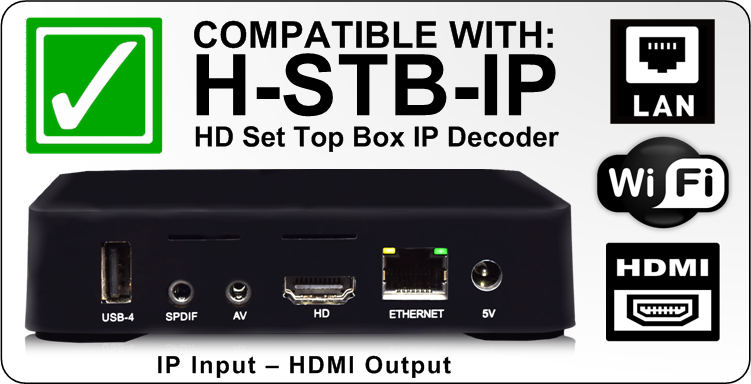
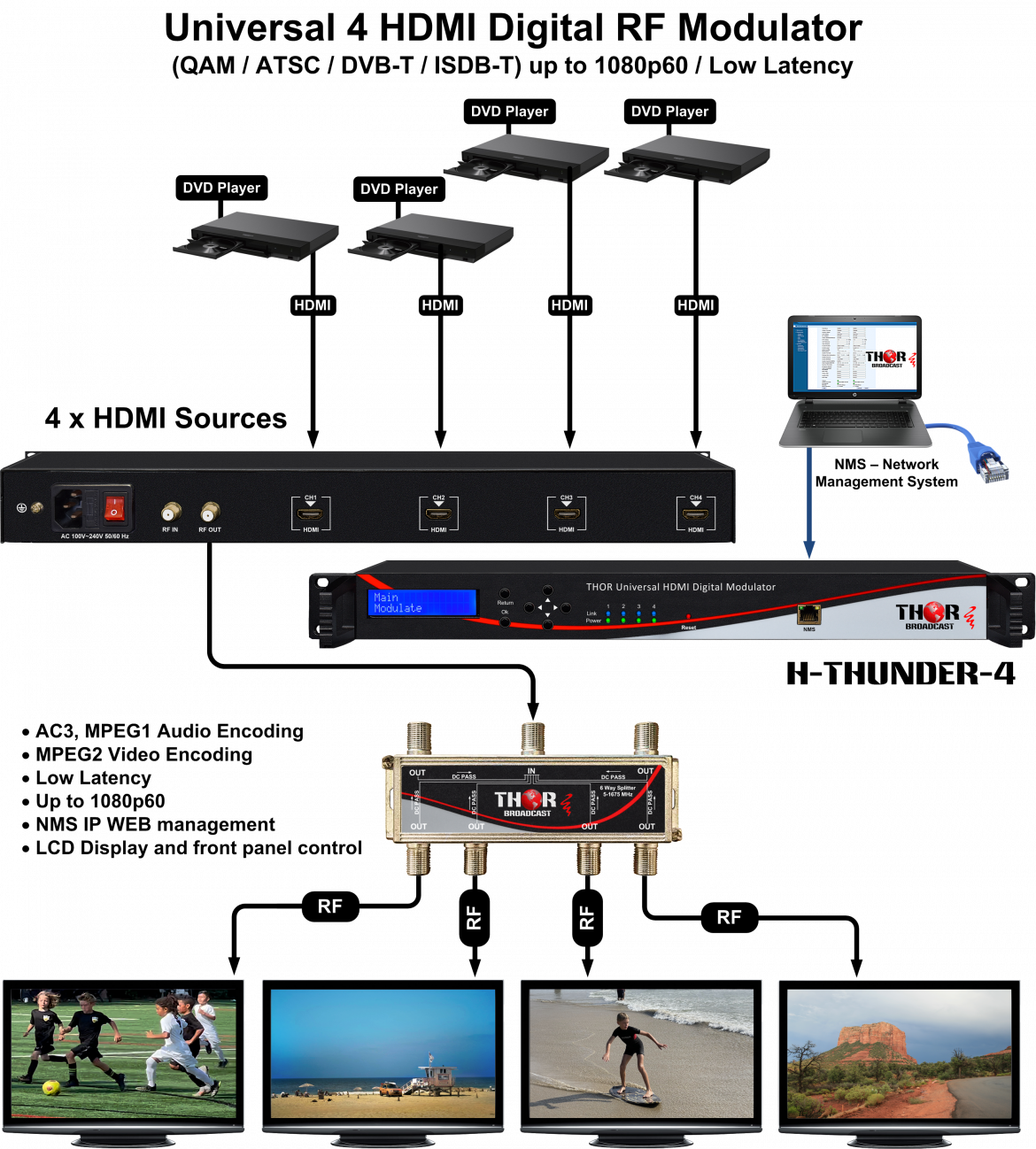
If you need to transcode just 4 streams, the easiest way would be to decode those streams to HDMI format and use a 4-channel modulator. You can decode IP using the H-STB-IP, and for the 4-channel modulator, you can use the H-THUNDER-4.
H-STB-IP
https://thorbroadcast.com/product/compact-ip-decoder-set-top-box.html
H-THUNDER-4
https://thorbroadcast.com/product/hdmi-modulator-qam-rf-coax-output-full-hd-8230.html/238
A useful troubleshooting method is to loop the ASI output directly back into the ASI input.
The procedure is:
With MPTS, the complete transport stream can contain multiple programs and the associated transport-stream information.
This is particularly useful when transporting an entire group of channels between locations.
For example:
Encoder → MPTS → IP network → decoder/modulator
The receiving equipment can then process the programs contained within that transport stream.
Thor has documented applications where multiple virtual channels are multiplexed into a single MPTS and transported over IP to remote locations.
With SPTS, the output contains a single program rather than the complete multi-program transport stream.
This can be useful when you only need to transport one channel/program independently.
For example:
HDMI/SDI source → encoder → SPTS → IP network → receiver
SPTS can simplify applications where each individual channel needs to be transported separately.
11. What are VCT and TVCT tables?VCT stands for Virtual Channel Table.
A VCT provides information about virtual television channels, including the virtual channel numbers that viewers see.
For ATSC applications, the TVCT (Terrestrial Virtual Channel Table) is used for terrestrial/ATSC virtual channel information.
For example, the physical RF channel might be different from the virtual channel displayed to the viewer:
RF channel: 29 Virtual channel: 16.1
The TV can use the VCT information to display the correct virtual channel.
MPTS means Multi-Program Transport Stream.
An MPTS can contain multiple television programs within one MPEG transport stream.
For example, a system could contain:
All four programs can be transported together as one MPTS.
SPTS means Single-Program Transport Stream.
An SPTS contains a single program/service.
Therefore:
MPTS = multiple programs in one transport stream
SPTS = one program in one transport stream
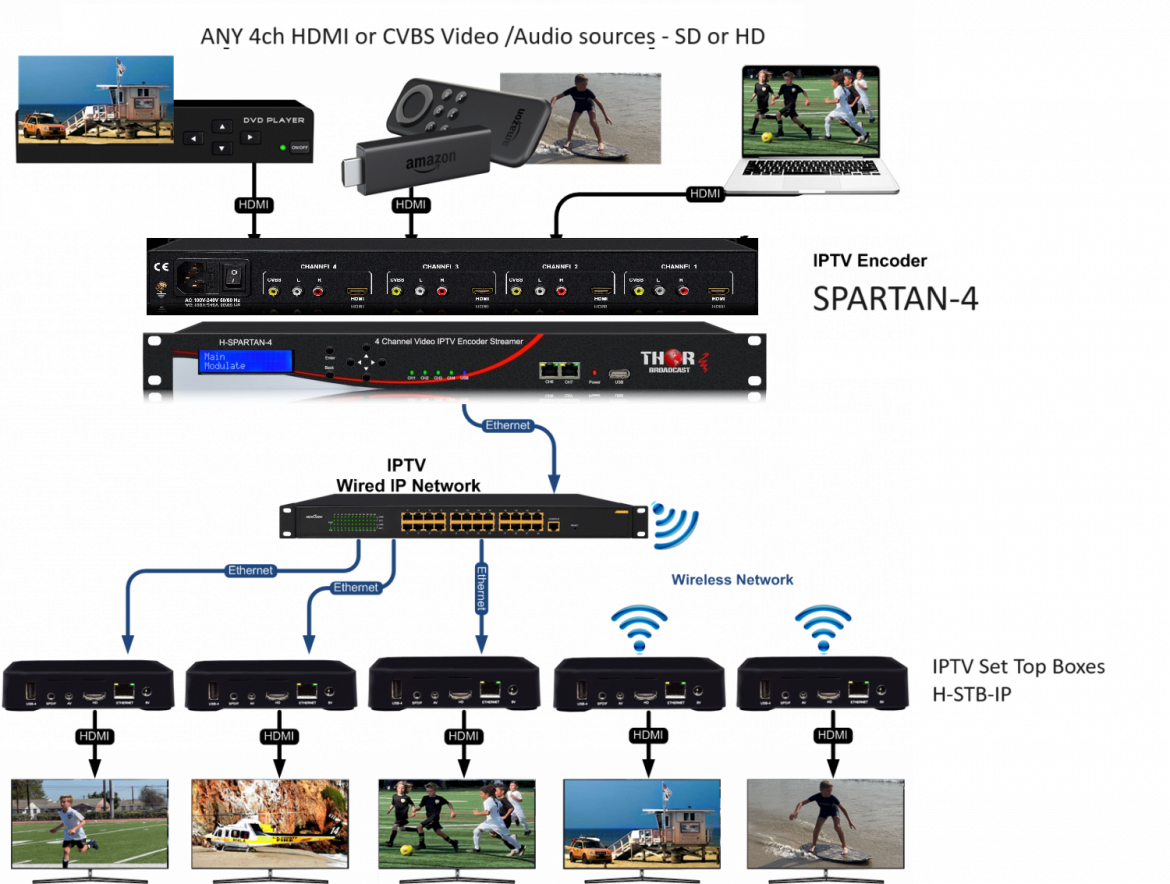
 Alternatively, you could use a 4-channel encoder like the Spartan-4 with an H-STB-IP by each TV.
https://thorbroadcast.com/product/4-channel-hdmi-cvbs-network-encoder-streamer-udp-rtp-unicast-multicast-8230-2.html
https://thorbroadcast.com/product/compact-ip-decoder-set-top-box.html
Alternatively, you could use a 4-channel encoder like the Spartan-4 with an H-STB-IP by each TV.
https://thorbroadcast.com/product/4-channel-hdmi-cvbs-network-encoder-streamer-udp-rtp-unicast-multicast-8230-2.html
https://thorbroadcast.com/product/compact-ip-decoder-set-top-box.html
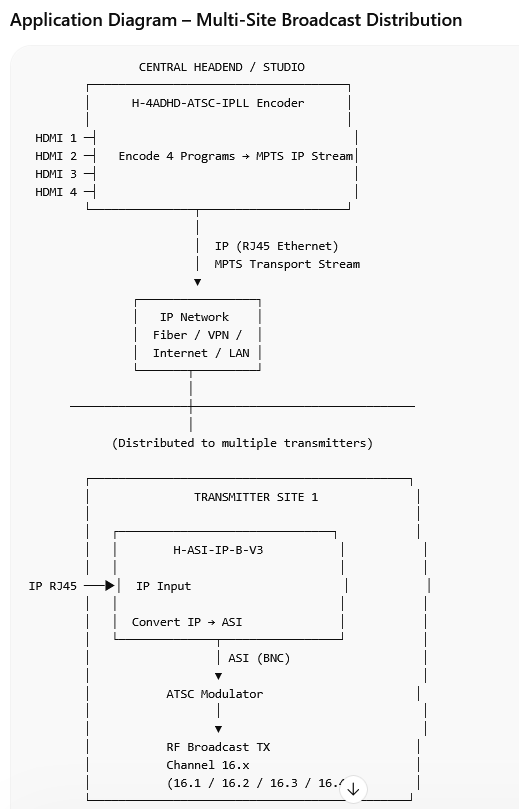
Based on your description, this is a very typical broadcast distribution architecture and there is a straightforward way to achieve it.
At the central distribution point, you can use our Thor Broadcast H-4ADHD-ATSC-IPLL encoder. - https://thorbroadcast.com/product/4-hdmi-component-hd-to-coax-and-iptv-hd-8230.html/22

This unit accepts four HDMI program sources and multiplexes them into a single MPTS (Multi-Program Transport Stream) containing your four virtual channels, for example:
16.1
16.2
16.3
16.4
The encoder then sends this MPTS over IP to each transmitter location in your network.
Since each of your remote transmitter sites has a public static IP address, the encoder can simply transmit the stream using UDP unicast to all of the transmitter sites simultaneously.
Remote Transmitter Sites
At each transmitter location you would install our:
Thor Broadcast H-IP-ASI-B-V3 - https://thorbroadcast.com/product/asi-to-ip-and-ip-to-asi-converted-with-decoding-8230.html

This unit receives the IP MPTS stream from the network and converts it back into ASI format, which can then be fed directly into the ASI input of your ATSC modulator.
The ATSC modulator then broadcasts the multiplex as RF with the four virtual channels.
System ArchitectureCentral Headend
4 Program Sources (HDMI) → H-4ADHD-ATSC-IPLL Encoder → MPTS over IP
Network Distribution
Internet / IP network UDP Unicast to multiple transmitter locations
Remote Transmitter Site
IP Stream → H-IP-ASI-B-V3 (IP → ASI Converter) → ASI Output → ATSC Modulator → RF Broadcast (Channel 16 with subchannels 16.1 – 16.4)
Advantages of this Architecture• One central encoder feeds all transmitter locations • Very efficient IP distribution over the internet • Each transmitter receives the same synchronized transport stream • Fully compatible with ASI input on your ATSC modulators
Please let me know if this would work for you.
For 7 sites, you would need:
7 pcs H-4ATSC-ATSC-IPLL
7 pcs H-ASI-IP-B-V3
1. My modulator indicates that it accepts UDP unicast. Does your 4-ADHD send UDP unicast? Yes. The H-4ADHD can output UDP unicast streams.
2. Can the 4-ADHD directly deliver 4 programs to my modulator as a one-to-one peer connection? Yes. The unit can send either:
UDP Unicast streams (one program per stream), or
UDP Multicast MPTS, which contains all four transport streams in a single multiplex.
This allows flexibility depending on how your modulator expects to receive the streams.
3. Does the 4-ADHD allow both the ASI output and the Unicast IP output to be active at the same time? Yes. Both ASI output and IP output can operate simultaneously.
4. I have a mix of ASI-only modulators that may require a unicast-to-ASI decoder.
That is correct. For modulators that only accept ASI input, you would use our IP-to-ASI converter to convert the IP stream back to ASI.
5. Pricing
Current pricing is as follows:
H-4ADHD-QAM-IPLL (4-Channel Encoder / IP Output) - $3,895
H-ASI-IP-B-V3 (ASI IP Converter / Decoder) - $2,995 - https://thorbroadcast.com/product/asi-to-ip-and-ip-to-asi-converted-with-decoding-8230.html
Your current system distributes television signals through a coaxial cable network to approximately 144 TVs throughout the vessel. The system was originally installed around 2012 and uses older analog modulators connected to DIRECTV receivers.
Over time, the system has developed issues such as:
Analog picture degradation (ghosting and noise)
Aging equipment
Limited flexibility for adding new sources such as cameras or additional channels
Moving to digital QAM distribution will significantly improve reliability and picture quality while allowing the system to expand easily.
Recommended Core SolutionWe discussed using the Thor Broadcast Thunder-8 HDMI QAM Modulator, which accepts 8 HDMI inputs and converts them into 8 digital QAM channels distributed over coax.
Product Link: https://thorbroadcast.com/product/8-channel-hdmi-rf-modulator-atsc-or-qam-8230.html
Multiple modulators can be combined to create larger channel systems such as:
16 channels (2 units)
24 channels (3 units)
32+ channels if required
Each unit operates independently and can be easily combined using standard RF combiners.
Source CompatibilityThe Thunder-8 modulator works with any HDMI source, including:
DIRECTV receivers
Satellite receivers
Media players
Computers
Digital signage players
Other HDMI devices
The system encodes video using MPEG-2 QAM, which provides maximum compatibility with televisions used in the United States, Canada, and Mexico.
Existing RF Network CompatibilitySince your vessel already has a coax distribution network with amplifiers and splitters, there is a strong possibility that the new system can be installed with minimal changes.
In many cases, the upgrade process is simply:
Remove the old analog modulators
Connect the digital QAM modulators
Rescan the TVs for digital channels
Digital QAM typically requires less RF power than analog, so existing amplifiers usually work without modification.
Older Television CompatibilitySome televisions onboard may be older analog or international models.
If a TV does not properly decode digital QAM, an external QAM set-top box may be used.
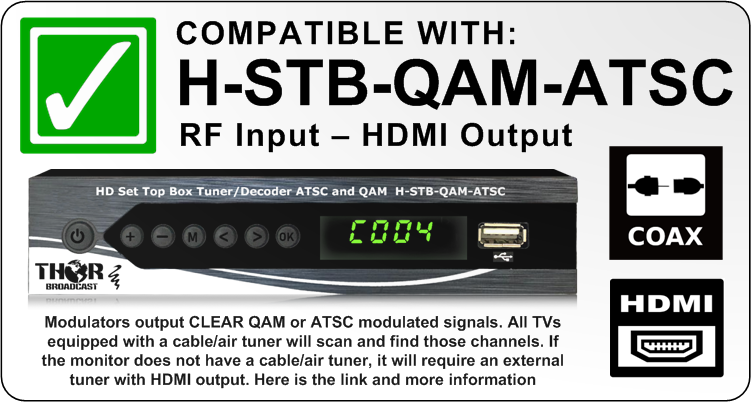
Example Decoder: https://thorbroadcast.com/product/hdmi-qam-set-top-box-decoder-8230.html
These boxes convert QAM RF channels into HDMI output, allowing older TVs to continue operating.
Camera System IntegrationYou mentioned the vessel also uses a mix of IP cameras and analog cameras that may need to appear as channels on the TV system.
IP CamerasIP camera streams (H.264) can be converted to HDMI using IP decoders.
Example IP Decoder: https://thorbroadcast.com/product/iptv-decoder-set-top-box-8230.html
These decoders output HDMI, which can then be connected to the modulator to create a camera channel.
Analog CamerasAnalog cameras can also be added using modulators that support composite video input.
Example Analog + HDMI Modulator: https://thorbroadcast.com/product/4-channel-hdmi-av-rf-modulator-8230.html
This allows legacy cameras to remain part of the system.
RF Combining and DistributionMultiple modulators can be combined together using standard RF combiners or passive splitters used in reverse.
Thor Broadcast also provides RF splitters and combiners designed for CATV systems.
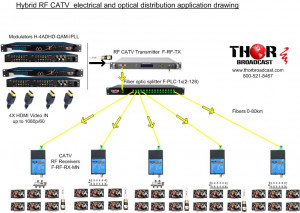
RF Splitters / Combiners: https://thorbroadcast.com/product/1-x-2-to-1-x-128-fiber-optic-couplers.html
Typical CATV RF frequency range supported:
54 MHz - 1000+ MHz, which easily accommodates digital QAM channels.
Cost AdvantageCompared to the Technicolor COM3000 system, the Thor Broadcast solution should cost a small fraction of that amount while providing:
High-definition digital channels
Flexible expansion
Integration of satellite, media players, and cameras
Compatibility with existing coax infrastructure
You are correct that the unit supports:
4 x SPTS (Single Program Transport Streams)
1 x MPTS (Multi Program Transport Stream)
SPTS = one program per IP stream MPTS = multiple programs combined into a single IP stream
2. Can SPTS be sent to different locations?Yes.
Each SPTS carries only one program, but you can send each SPTS to a different destination (IP + port).
So effectively:
Channel 1 -> Site A
Channel 2 -> Site B
Channel 3 -> Site C
Channel 4 -> Site D
If you want to send the same program to 4 different remote sites using SPTS, then:
Yes - you would need to replicate that program across multiple inputs (or use duplication upstream)
This results in 4 independent SPTS streams, each pointing to a different destination.
Alternative (better approach): If your network allows, you could also use:
Multicast distribution, or
A network-level duplication (router/server side)
This avoids duplicating inputs physically.
4. Using MPTS insteadYes - selecting MPTS is a simpler way when sending all programs to one location.
MPTS combines all 4 programs into one IP stream
That stream is then received and demultiplexed on the receiving side
Important:
Total bitrate will be ~15-20 Mbps (depending on encoding settings)
Requires sufficient and stable bandwidth between locations
If your modulator accepts:
One primary IP
One backup IP
Then typically it expects one MPTS stream, not multiple SPTS streams.
In this case, yes - the system works by combining multiple programs into a single transport stream (MPTS) and sending it to that IP.
6. IP addresses for control vs. streamingGood question.
Control IP (management GUI) -> used for configuration
Data/streaming IP -> used for video transport
7. MPTS to ASI functionality
Yes - our IP to ASI unit supports this.
You can:
Input multiple SPTS streams, or
Input one MPTS stream
And output:
A single ASI output carrying a combined MPTS
Limitation:
Total bitrate must stay within ~19.3 Mbps (ATSC standard)
Correct.
You can combine multiple programs, but total bitrate is the limiting factor.
Example:
Good quality program ? 4-5 Mbps
Total available ? 19.3 Mbps
So:
~4 programs -> good quality
6-7 programs -> lower quality
Works better for low-motion content (news, talk shows)
Resolution (SD vs. HD) matters less than bitrate per program.
9. Does your modulator behave the same way?Yes - if your modulator accepts IP input, it typically works the same:
Receives MPTS
Demultiplexes internally into channels
You are absolutely correct.
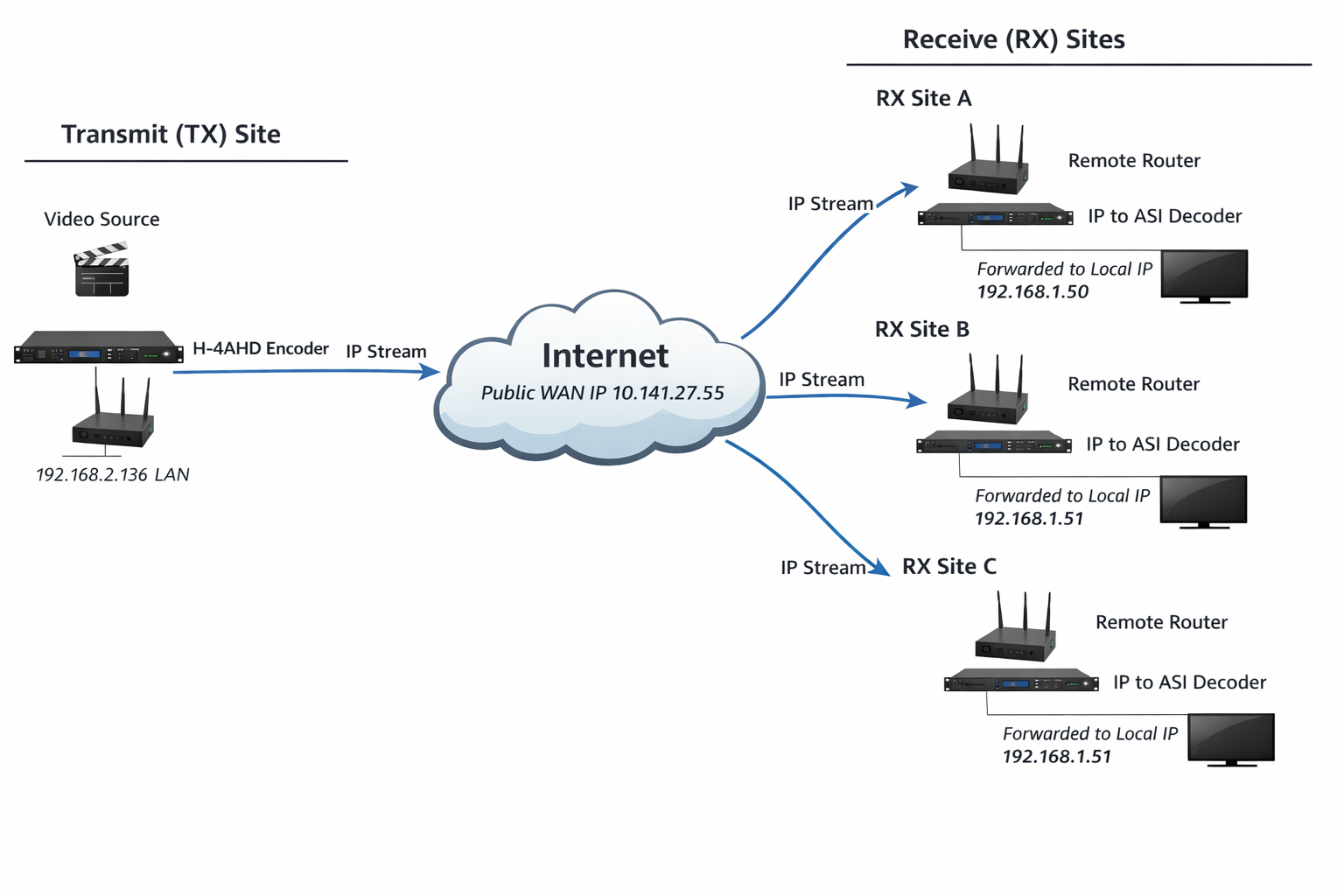
The H-4ADHD can be used as a flexible distribution appliance, not just a point-to-point encoder.
However, when distributing over public or routed networks, please note:
This requires proper network configuration
Basic concept:
Encoder (TX side) must be on the same LAN as its router
Destination IP = public/WAN IP of receiving site
Required ports must be open and forwarded
On the receiving side:
Router must port-forward the incoming stream
Forward to the IP of the decoder / IP-to-ASI unit
Example:
TX Side Encoder IP: 192.168.2.136 Router: 192.168.2.1
RX Side Public IP: 10.141.27.55 -> Port forwarded to local decoder (e.g., 192.168.1.50 port 1000)
Final NoteOnce you define:
Number of sites
Number of programs per site
Network type (private vs. public)
We can help you determine:
Exact number of units required Best architecture (SPTS vs. MPTS vs. hybrid)
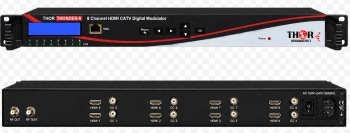 HDMI Modulator | QAM RF Coax Output - Full HD up to 1080P - 1,4,8 Channel
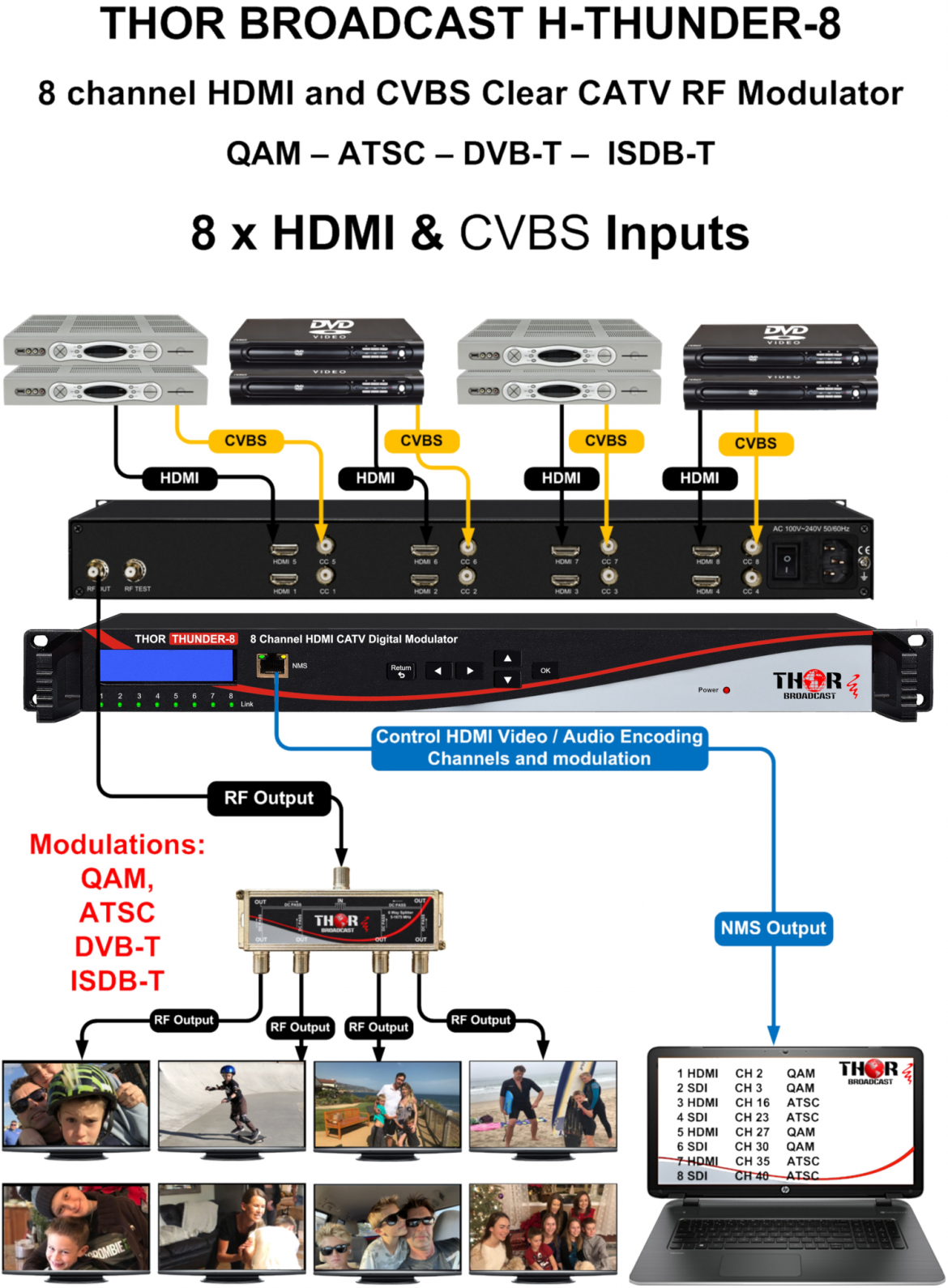
QAM, ATSC, DVB -T, ISDB -T Modulation, Thor 1, 4, or 8 x HDMI Digital RF Modulator is an all-in-one device integrating MPEG2 encoding and modulation to convert audio/video signals into ATSC / DVB-C QAM DVB-T / ISDB-T RF output. Supports Low Latency Mode for live event applications, HDCP compliant, works with any HDMI source like DVD Player or Cable Satellite STB up to 1080p/60 resolution The 8-channel model in addition to 8HDMI inputs has also 8 CVBS baseband video inputs, which can be selected, those inputs could be also used for Closed Captioning Inputs.
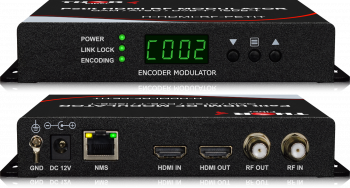 Petit HDMI RF MODULATOR
This is a smaller version of the popular H-HDMI-CC-RF unit which has HDMI Input up to full HD 1080p/60, supports QAM/ ATSC/ DVB-T/ ISDB-T modulation standards. All the Video / Audio encoding parameters and modulation channels are controlled via 10/100 Standard Ethernet and Web interface. This unit can be mounted vertically or horizontally on a rack mount cage panel for up to 12 units side by side.

 ES
ES